Ophthalmology SEO: What 54 Top-Three Eye Care Results Show About the Pages to Build
Most ophthalmology SEO advice is a checklist: claim your listing, add keywords, write blogs, get reviews. It rarely says which pages to build first, or what goes on them. This guide covers the keyword map, the page templates, on-page and schema work, technical health, local signals and measurement.
It is built on a November 2026 pull of the top three Google results for 18 eye care searches in 6 US metros. For each page we recorded its type, title, length, schema, prices, reviews and doctor credentials. It also draws on what Bryan Passanisi has seen running SEO programs for medical practices. It is written for owners and marketing leads at ophthalmology and optometry practices.
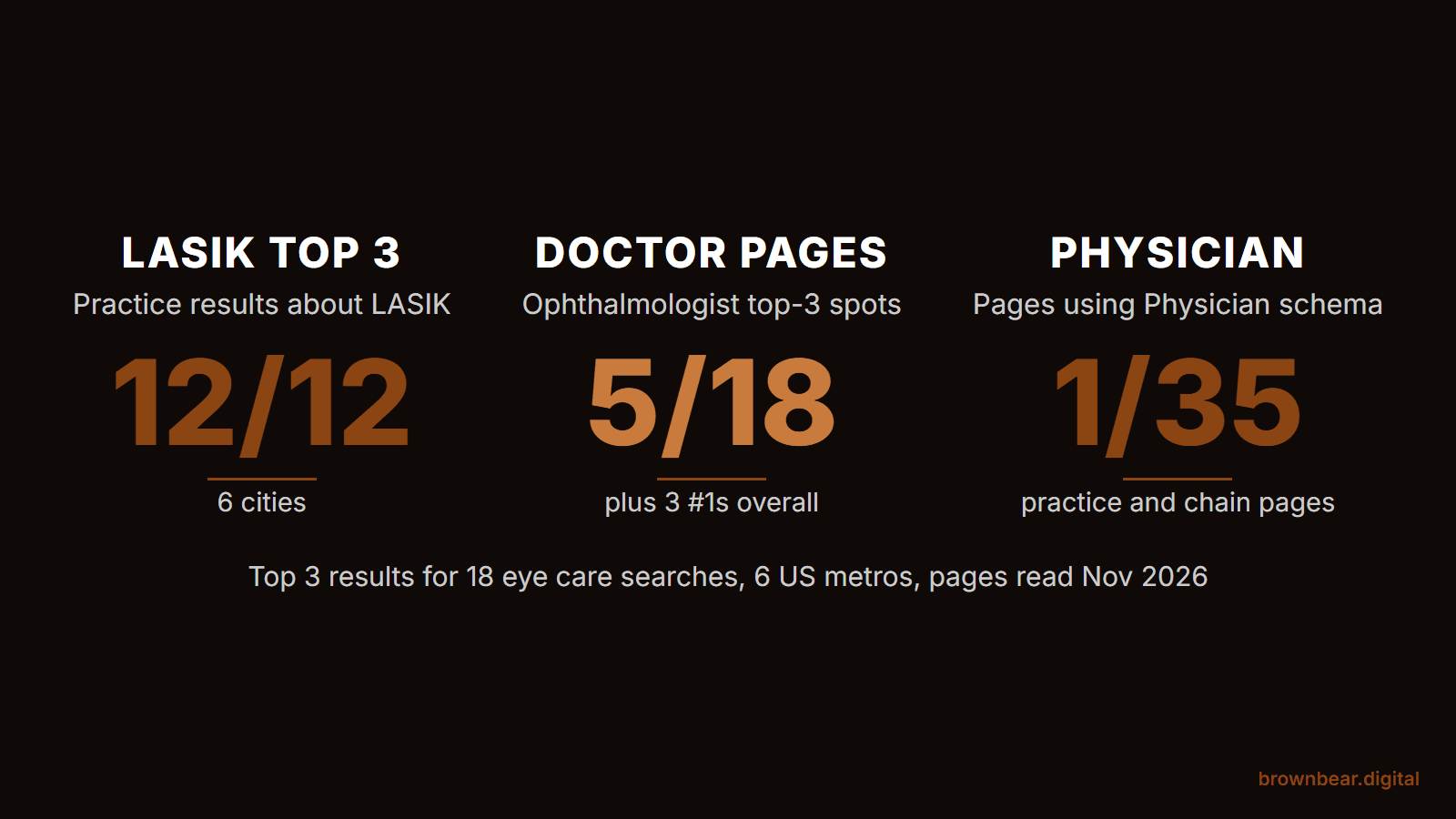
The short version: every practice in the LASIK top three had a page about LASIK, doctor pages took 5 of the 18 "ophthalmologist" top-three spots, and neither word count nor schema separated the winners. Start with what ophthalmology SEO is meant to build.
What Ophthalmology SEO Is, and What It Should Build
Ophthalmology SEO is the work of making an eye practice's website rank in Google and get cited in AI answers for the searches its patients and referring doctors run. In practice, that means one strong page for each procedure, condition, doctor and office. Those pages need a structure search engines can read, plus the local signals and links that tell Google the practice is real and trusted. The goal is booked consults and exams from organic search, not traffic for its own sake.
SEO is one part of marketing an eye practice, not all of it. Our ophthalmology marketing study covers who owns page one across these same 18 searches. It also covers the optometrist referral program, Google Ads, the federal ad rules for LASIK and eyeglasses, and what a program should cost. This guide picks up where that one stops: the pages themselves.
The Eye Care Page Anatomy: What the Top 3 Results Are Made Of
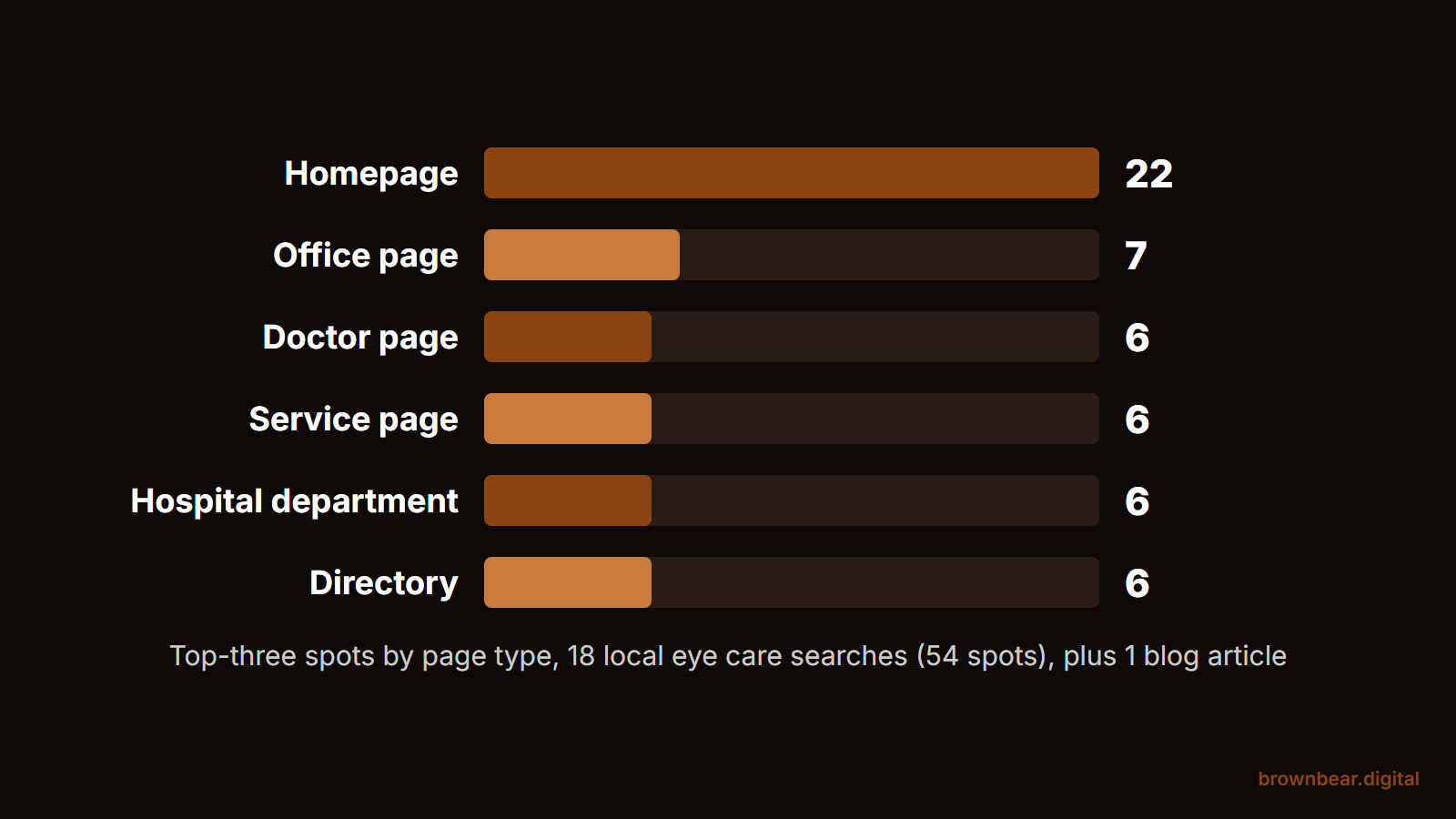
Across 54 top-three spots for 18 local eye care searches, homepages held 22 and pages dedicated to one service, doctor or office held 19. By owner, practices held 36 spots, hospitals 10, directories 6 and LASIK chains 2. The 35 practice and chain pages we could read had a median of 1,517 words. 91% put the city in the title tag, but no more than half put it in the main heading. 89% carried some schema markup, but only one used the Physician type.
Here is how we got those numbers. We started from the top 10 organic results Semrush showed on October 28, 2026 for "ophthalmologist," "lasik" and "eye doctor" plus the city, in Houston, Phoenix, Atlanta, Denver, Chicago and Charlotte. It is the same pull behind our marketing study. On November 1, 2026, we fetched every top-three page as raw HTML, the way a crawler that does not run JavaScript sees it. We recorded the page type, title, main heading, word count, schema types, any dollar figure, review content, doctor credentials, a click-to-call link and booking language. We added the top three for "lasik cost" and "cataract surgery cost." These are presence checks on the page code, not a manual read, so a credential in a footer counts the same as one in the body.
We call the result the Eye Care Page Anatomy:
| Search type | What took the top three | What the practice pages carried | What to build |
|---|---|---|---|
| Ophthalmologist plus city | 7 homepages, 5 doctor pages, 4 hospital department pages, 2 office pages. Hospitals held #1 in Denver and Chicago. | Median 951 words. Doctors and credentials up front. | A doctor page for each surgeon and a homepage that names the specialty and the city. |
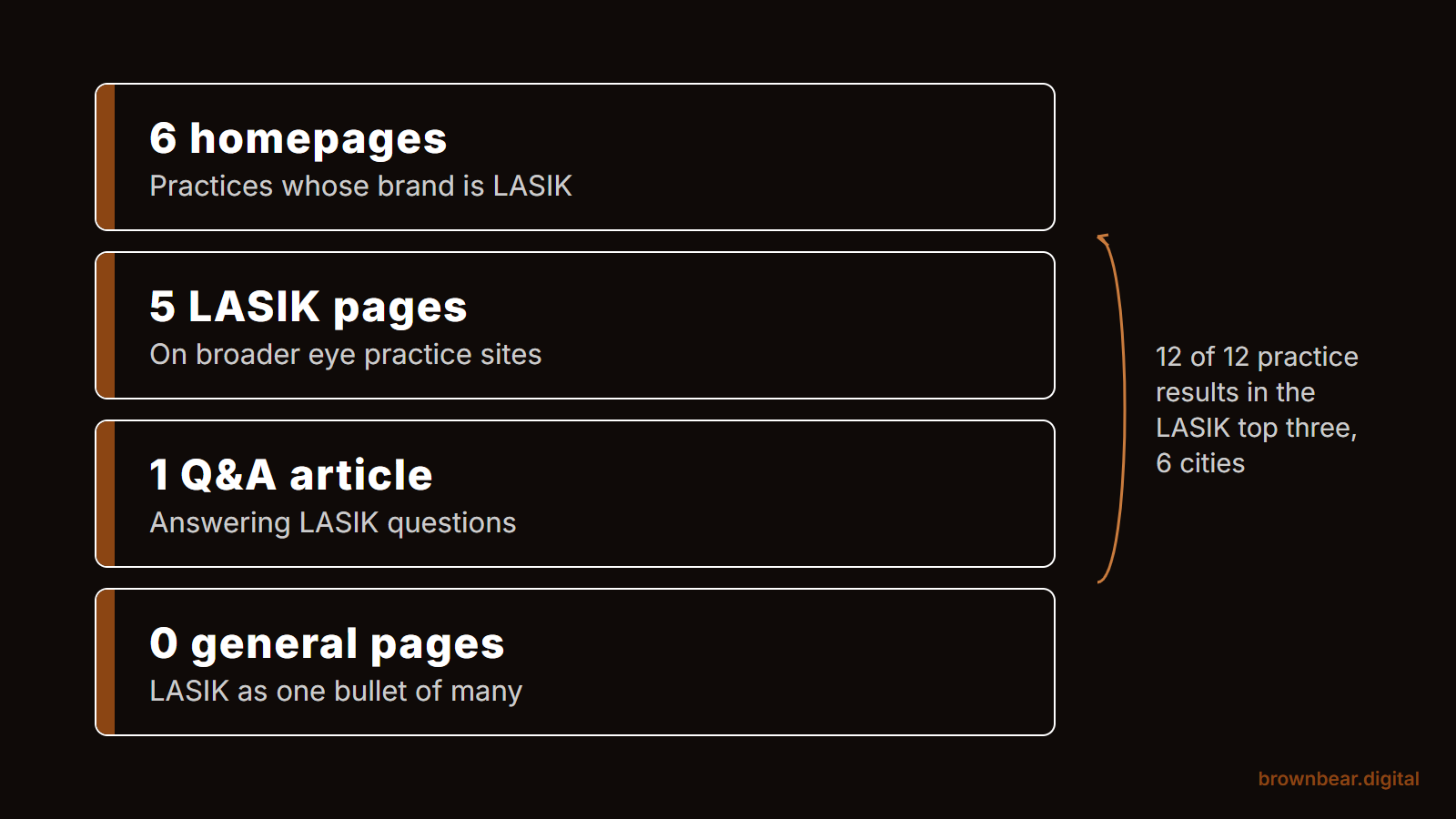
| LASIK plus city | All 12 practice results were about LASIK: 6 homepages of LASIK-led practices, 5 dedicated LASIK pages and 1 LASIK Q&A article. Plus 2 chain pages, 2 hospital pages and 2 directories. | Median 2,107 words. Half showed a dollar figure. | A LASIK page for each city you serve, with a price or range, candidacy and the surgeon. |
| Eye doctor plus city | 9 homepages, 4 directory results, 2 office pages, 2 hospital pages, 1 doctor page. VSP's doctor finder held #1 in Denver. | Median 1,325 words. Insurance named on most. | A homepage and office pages built for routine care, plus a vision plan page. |
| Cost questions | "cataract surgery cost": AllAboutVision #1, a practice cost page #3. "lasik cost": VSP, Michigan Medicine and a refractive surgery council. | Prices in plain dollars. | A cost page for cataract lenses and one for LASIK. |
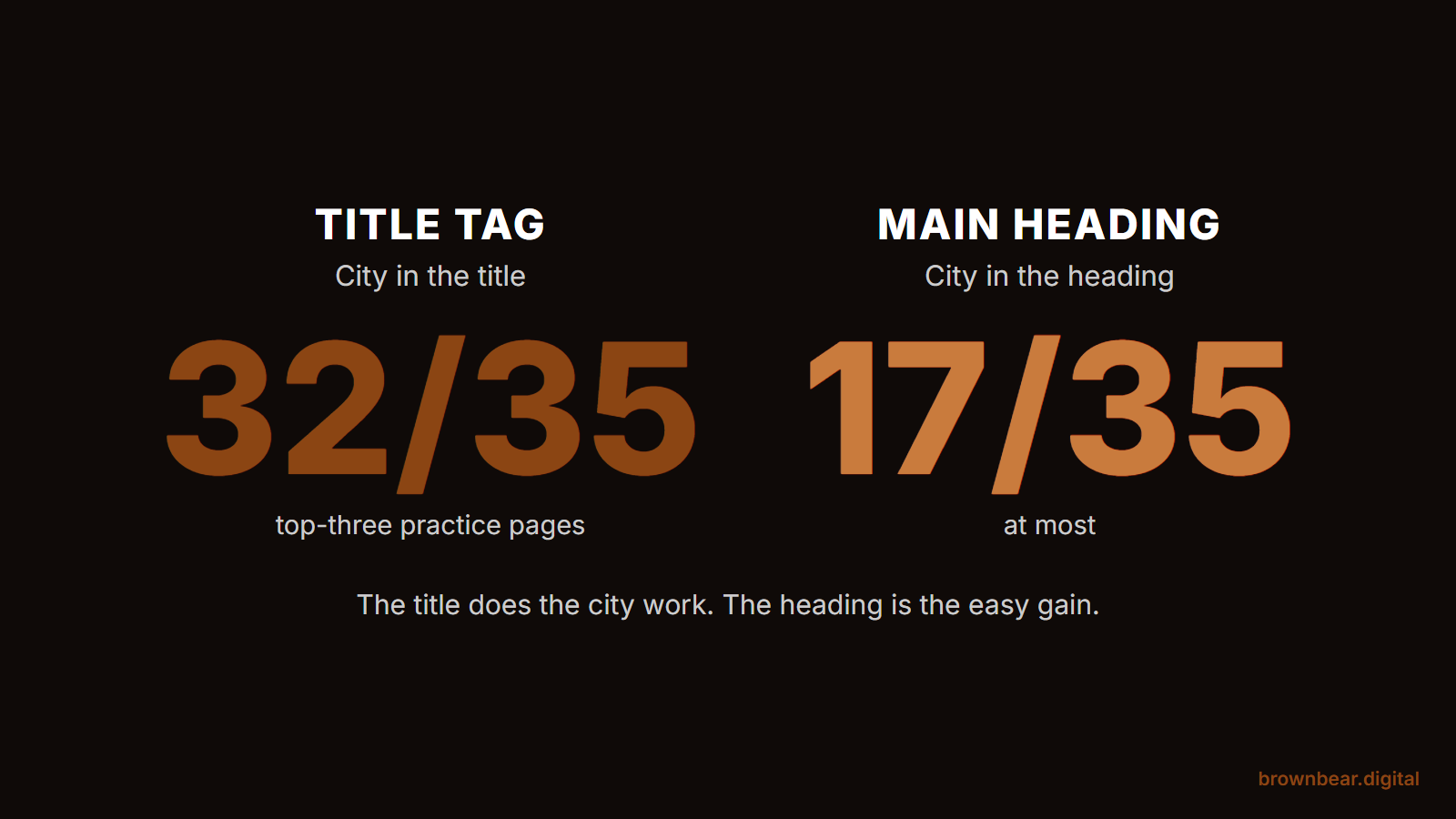
Three findings matter most. First, the winners are specific. A general eye practice homepage did not make the LASIK top three in any city. Second, the title tag does the city work and the main heading often doesn't. Headings like "Our Doctors" and "Experience Modern Eye Care" sat on pages that ranked anyway, which shows where the easy gains are. Third, the things vendors sell hardest, longer content and more schema, did not line up with rank. The #1 practice pages ran from 415 words to 6,353.
Homepages Win City Searches When They Name the Specialty and the City
A practice homepage can rank for "ophthalmologist" or "eye doctor" plus a city, and in our pull homepages took 7 of the 18 #1 spots. The ones that won said three things fast: what kind of eye care the practice provides, which city it serves, and who the doctors are. Arizona Eye Specialists held #1 for "ophthalmologist phoenix" with a title that reads "Eye Doctor Phoenix Arizona." Eye Doctors of Arizona held #1 for "eye doctor phoenix" with "Ophthalmologists in Phoenix, AZ" in its title.
Of the 35 practice and chain pages we read, 32 put the city in the title tag, and 27 put it in the first half of the title. At most 17 put the city in the main heading, and 3 had no main heading in the page code at all. That gap is cheap to close. The title gets your page into the results, and the heading and first paragraph confirm to the reader, and to Google, that the page is about their search.
Picture a three-surgeon practice in a mid-size city whose homepage heading reads "See Clearly, Live Fully" over a slider of stock photos. The title tag says only the practice name. The page ranks for the practice name and little else. The fix takes an afternoon: a title that leads with "Ophthalmologist in [City]," a heading that says the same in plain words, and a first paragraph that names the three surgeons, the procedures they do most and the neighborhoods the office serves. Nothing about the design has to change.
Every Practice in the LASIK Top Three Had a Page About LASIK
On LASIK searches, Google ranked pages about LASIK. All 12 practice results in the top three across 6 cities were LASIK-specific. Some were homepages of practices whose brand is refractive surgery, like Kraff Eye Institute in Chicago and Dishler Laser Institute in Denver. The rest were dedicated LASIK pages on broader practice sites, like Woolfson Eye Institute's Atlanta LASIK page and Desert Vista Eye's LASIK page in Phoenix. Not one was a general eye care homepage with LASIK listed among 20 services.
The LASIK pages were also the longest in our pull, with a median of 2,107 words. It was the only lane where dollar figures were common: 7 of the 14 LASIK pages we read showed one. That fits how patients shop. A LASIK patient compares consults, prices and surgeons before booking, and the page has to answer those questions or the patient goes back to the results.
Say you run a comprehensive practice that does about 30 LASIK cases a month, and LASIK appears on your site as one bullet on a "Services" page. Build a LASIK page for your main city. Cover who is and isn't a candidate and what you offer instead, such as PRK or ICL. Then add the technology, your surgeon's experience, the follow-up visits and the price or range with what it includes. If you also draw patients from a second city, build that page too, written for that city, not copied. Then point your Google Business Profile's LASIK service at it.
A LASIK page also carries rules a homepage doesn't. The FDA's 2011 letter to eye care professionals said risk information belongs in LASIK advertising, so name the main risks and who isn't a candidate on the page. The pricing rules from the FTC are covered in our marketing guide.
Doctor Pages Rank for "Ophthalmologist" Searches
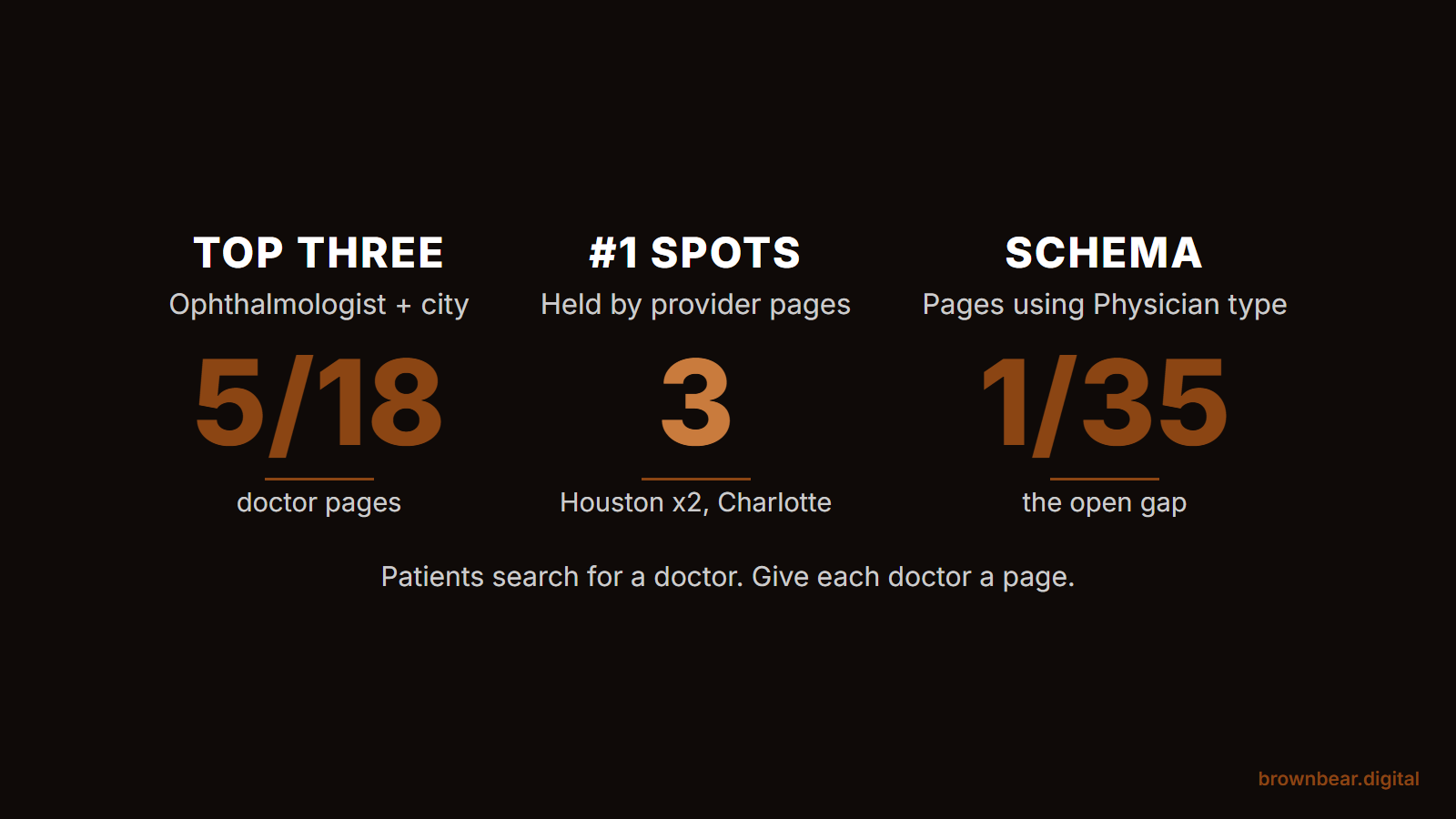
On "ophthalmologist" plus a city, doctor and provider pages took 5 of the 18 top-three spots, more than any page type except homepages. Across all three search types, a provider page held #1 three times. Houston Eye Associates' providers page won both "ophthalmologist houston" and "eye doctor houston," and CEENTA's eye care doctors page in Charlotte. In Atlanta and Denver, a single surgeon's page made the top three: Dr. Andrew Feinberg at Georgia Eye Partners and Dr. Michael Miller at The Eye Center in Denver.
That makes sense for the search. Someone typing "ophthalmologist" is looking for a doctor, and a page about one doctor answers that better than a page about a building. Yet the schema on these pages rarely says so. Only 1 of the 35 practice and chain pages used the Physician schema type. Most doctor pages leave Google to work out from the text that the page is about a physician.
A doctor page that can rank should include:
- The doctor's full name and credentials in the title and main heading, such as "[Name], M.D., Ophthalmologist in [City]"
- Board certification, fellowship training and the procedures they perform most
- The offices and days they see patients, with a booking link for each
- A photo, a short video if you have one, and reviews that name the doctor
- Physician schema that links the doctor to the practice and each office
Picture a practice with five ophthalmologists listed on one "Our Team" page: five headshots, five short bios and one booking button. Split that into five pages, one per doctor, each with the fellowship, the procedures, the offices and reviews that name them. The team page stays as a hub that links to all five. A patient searching for a glaucoma specialist now has a page that says "glaucoma specialist" next to a name and a city, and so does Google.
The Ophthalmology Keyword Map: One Search Lane, One Page
An ophthalmology keyword map assigns every search your practice can win to exactly one page on your site. Eye care searches fall into six lanes, and each lane wants a different page type. Mapping them first stops two pages from competing for one search and shows you which pages are missing.
| Search lane | Example searches | Semrush US volume | Page that should own it |
|---|---|---|---|
| Doctor plus city | ophthalmologist houston, eye doctor houston | 1,900 and 4,400 a month | Homepage, office pages and doctor pages |
| Procedure plus city | lasik denver, lasik houston | 1,300 and 1,600 a month | One procedure page per city served |
| Cost | lasik cost, cataract surgery cost | 8,100 each | One cost page per major procedure |
| Condition | glaucoma, macular degeneration, dry eye | Not pulled for this study | A short condition section on the treatment page, reviewed by a doctor |
| Insurance and plans | eye doctor that takes VSP, eye exam cost | eye exam cost 12,100 a month | A vision plan and insurance page |
| Referral | refer a patient, co-management | Small, but high value | A referring doctors page |
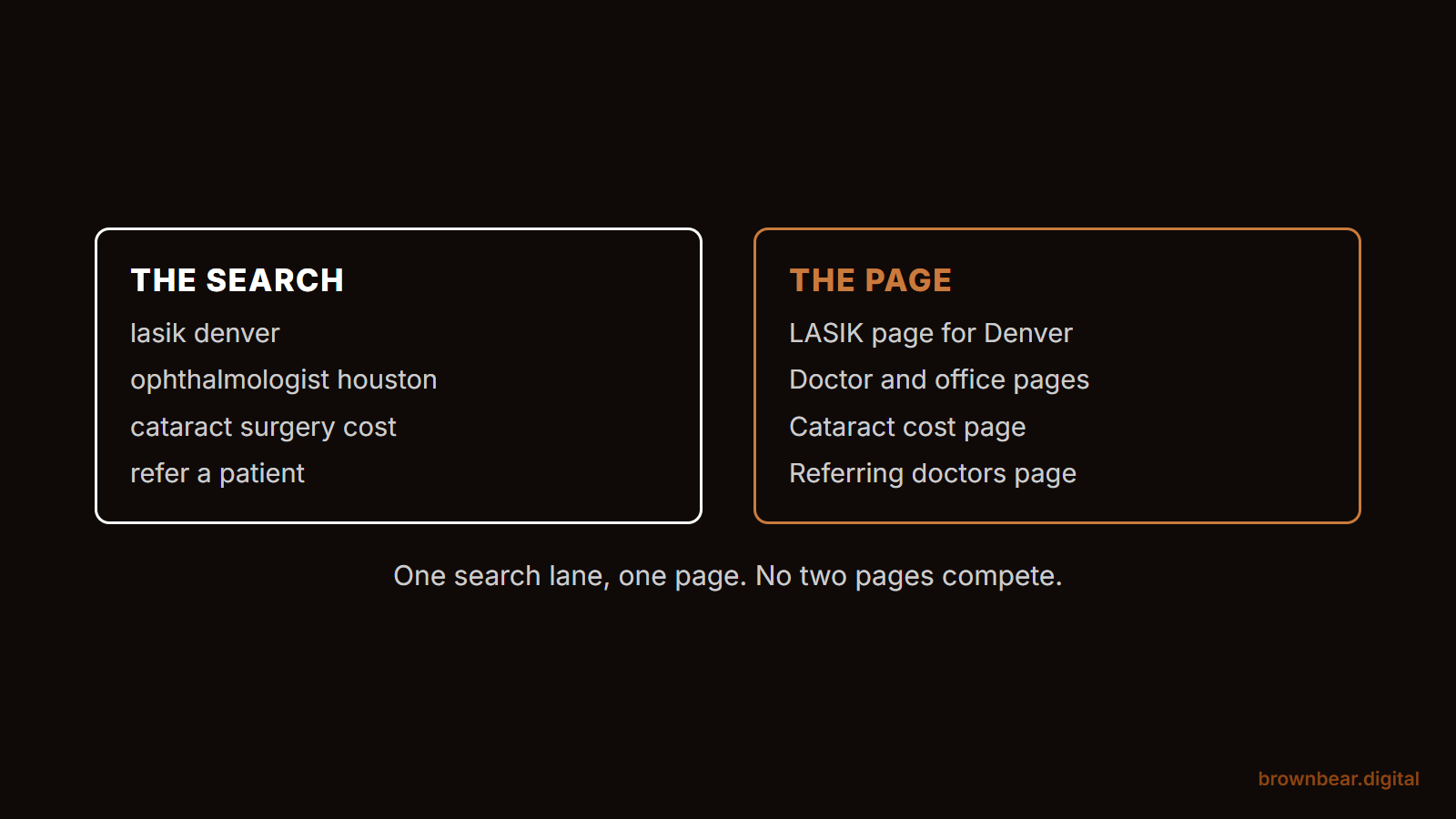
The difficulty scores tell you where to start. Semrush rated "ophthalmologist" plus our 6 cities at 23 to 51 and "lasik" plus those cities at 20 to 40. "Eye doctor" plus the city ran 22 to 50. National exam searches like "eye exam near me," at 110,000 a month and a difficulty of 53, belong to LensCrafters, VSP and Target Optical. Start where your services and the lower scores overlap, which for most surgical practices means procedure pages and doctor pages before the city's broadest term.
Use the planner below to turn your own services, doctors and offices into a page list.
Site Architecture and Page Templates for an Eye Practice
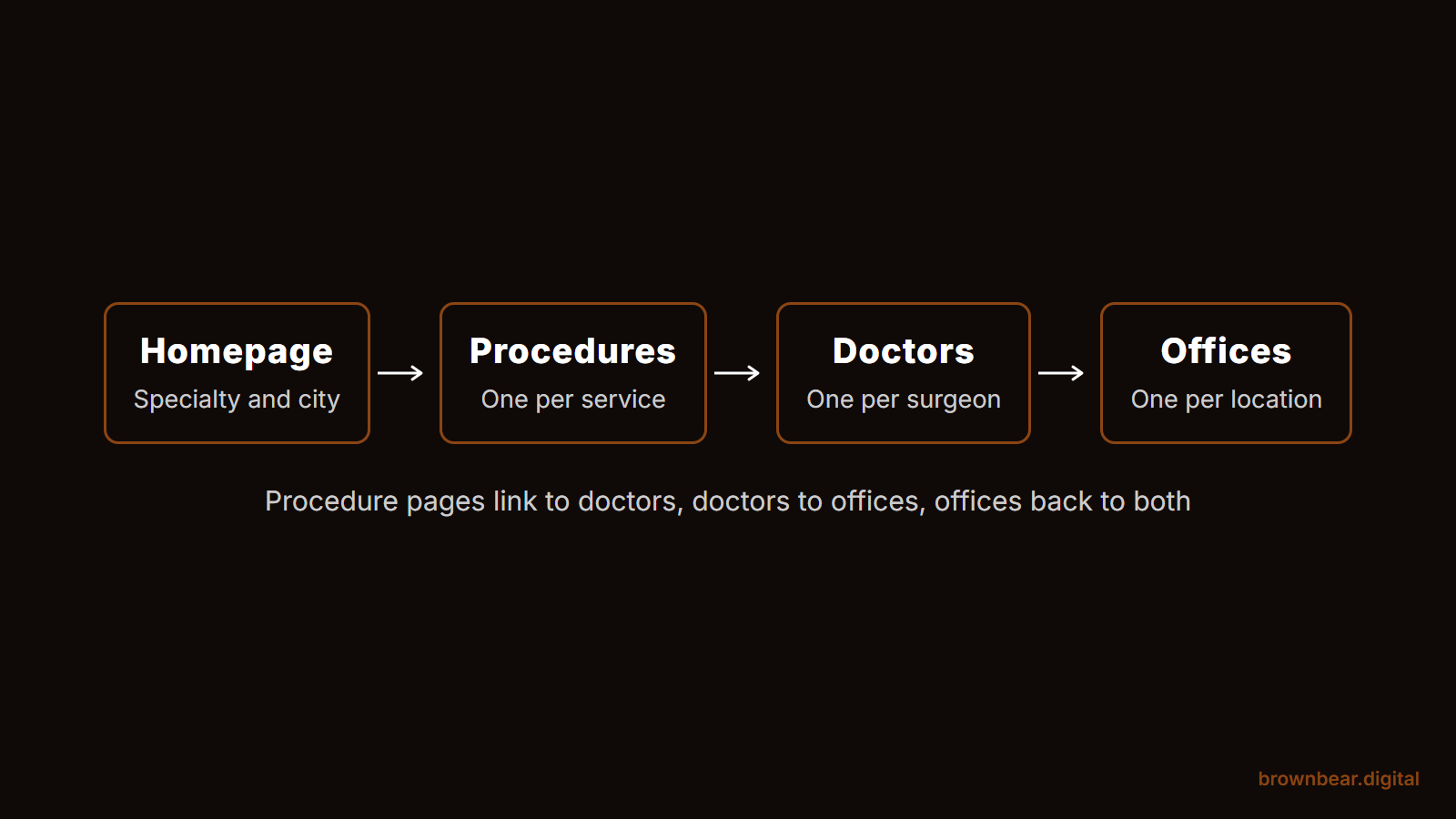
The site structure that ranks for eye care is flat and specific. It has a homepage, one page per office, one per doctor, one per procedure or service line, a cost page for each major procedure and a referring doctors page, all linked from a clear menu. Procedure pages link to the doctors who perform them, doctor pages link to the offices where they practice, and office pages link back to both. That web of links tells Google which pages matter and how they relate.
Keep URLs short and readable, such as /lasik/, /doctors/andrew-feinberg/ and /locations/buckhead/. If you serve several cities, give each procedure page a city version only where you see patients from that city, and write each one for that place. If you're rebuilding an eye care website, lock the URL map before design starts, and redirect every old URL with a 301 to its new home.
Each page type has a job, and the top results show what each one needs:
| Template | Its job | Must carry |
|---|---|---|
| Homepage | Win the practice name and the broad city search | Specialty and city in title, heading and first paragraph; doctors named; insurance; click-to-call; booking |
| Procedure page | Win the procedure plus city | Candidacy, alternatives, surgeon, technology, recovery, price or range, risks, FAQs |
| Doctor page | Win the doctor's name and specialty searches | Credentials, fellowship, procedures, offices, reviews naming the doctor, Physician schema |
| Office page | Win the neighborhood and support the Business Profile | Address, hours, parking, doctors on site, services at that office, map, phone |
| Cost page | Win cost questions and set expectations | Dollar ranges, what insurance or Medicare covers, financing, how to get a quote |
| Referring doctors page | Make it easy for optometrists to send patients | Online referral form, direct line, turnaround, co-management policy |
For a practice with several offices, the office pages carry most of the local weight. In our pull, office pages took 7 of the 54 top-three spots, from Eye Center of Texas in Houston to Georgia Eye Associates in Buckhead. Our guide for eye practices with several offices covers how to keep those pages from sounding like copies of each other.
The checker below scores any one of your pages against what the top three results in its lane carried.
On-Page SEO: Titles, Headings and the Proof Patients Look For
On-page SEO for an eye practice comes down to two jobs: telling Google exactly what the page is about, and showing the patient enough proof to book. The title tag and main heading do the first job. Doctor credentials, reviews, prices, insurance details and an easy way to call or book do the second.
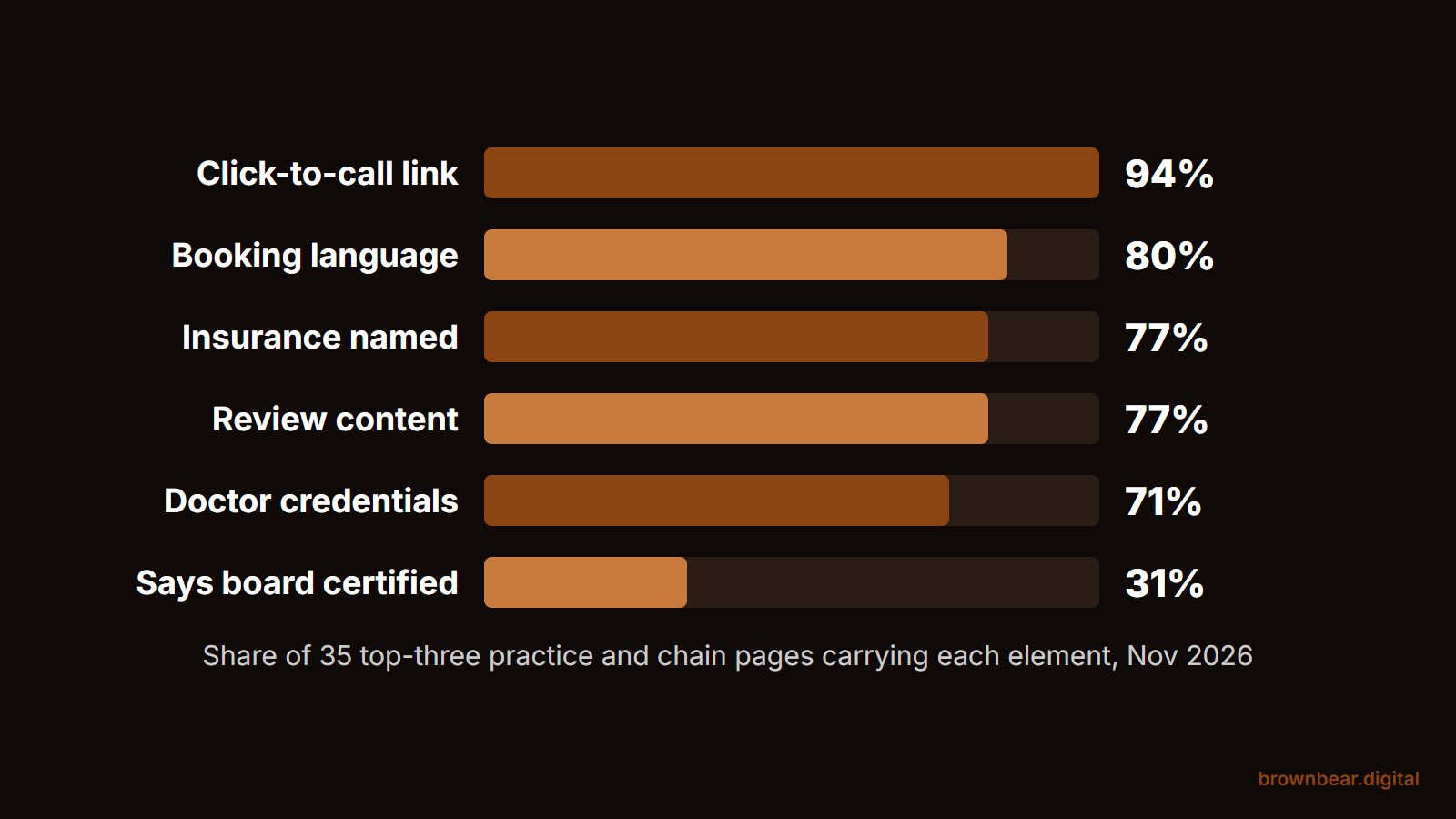
The pages in our pull were strong on the basics. Of the 35 practice and chain pages, 33 had a click-to-call link, 28 used booking language like "schedule an appointment," 27 mentioned insurance and 27 showed review content. 25 named doctor credentials, but only 11 used the words "board certified." Prices were rare outside LASIK: just 2 of the 21 ophthalmologist and eye doctor pages showed a dollar figure.
A title pattern that works, based on the pages that ranked: [Service] in [City] | [Practice Name], such as "LASIK in Denver | Practice Name" or "Ophthalmologist in Houston | Practice Name." Keep it under about 60 characters, and make the main heading say the same thing in natural words.
Eye care is a health topic, so Google holds these pages to the YMYL bar for health pages. A doctor on your team should review each clinical page before it goes live, with their name and the review date on the page. That one line does more for trust than another paragraph of copy.
The answer forks by what you sell. If most of your revenue is LASIK and premium lenses, spend your on-page effort on proof patients compare: prices, candidacy, surgeon experience and outcomes data you can support. If most of your patients arrive by referral for cataract, glaucoma or retina care, spend it on doctor pages, insurance details and the referring doctors page. Those patients usually have a name in hand and are checking you, not shopping.
Schema for Eye Care Sites: Worth Doing, Not the Lever
Schema markup helps Google read who you are, but it did not separate the winners in our pull. 31 of the 35 practice and chain pages carried some schema, yet only 18 used a medical type like MedicalClinic or MedicalOrganization. 9 ran a plugin's default page and website graph with no medical type at all. Only 5 used FAQPage, and only 1 used Physician. Pages ranked in the top three with all of those gaps.
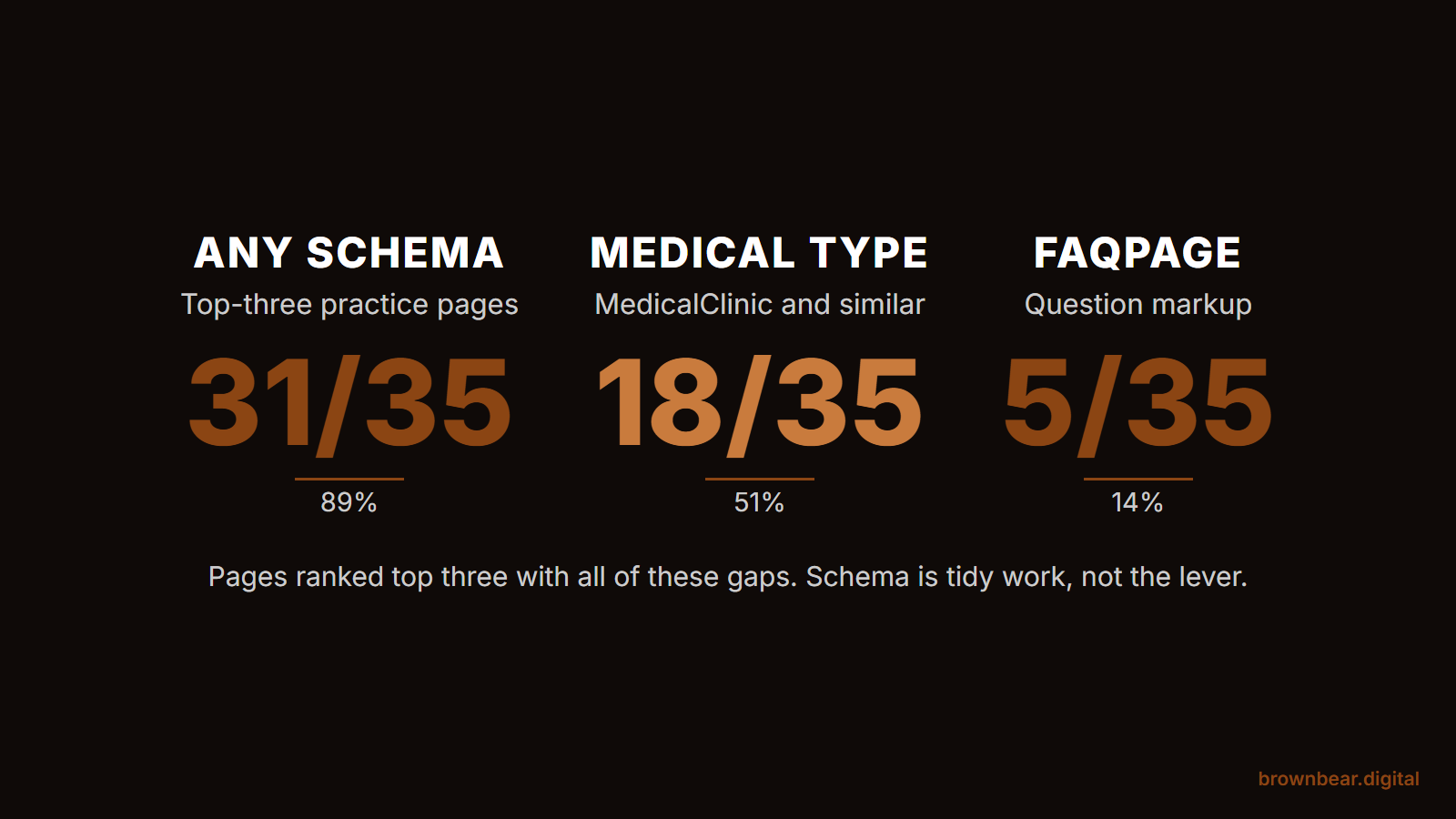
Bryan has run SEO and AI search programs for medical practices, and his view is that schema is worth keeping tidy. It is not the big lever many vendors claim, for Google or for AI tools. The bigger levers are crawlable pages and content organized so a machine can lift a clear answer from it. So add schema as part of each template, not as a project of its own:
- MedicalClinic or MedicalOrganization on the homepage and each office page, with address, phone, hours and geo coordinates
- Physician on each doctor page, linked to the practice and offices
- FAQPage only where the page shows real questions and answers
- BreadcrumbList sitewide, which most site platforms already output
Technical SEO for Eye Care Websites
A technically sound eye care site serves its main text in the page code, loads fast on a phone, gives every page one clean URL and stays up. Most practice sites pass most of that. The two failures we see most on medical sites are text that only appears after JavaScript runs and sites that break without anyone noticing.
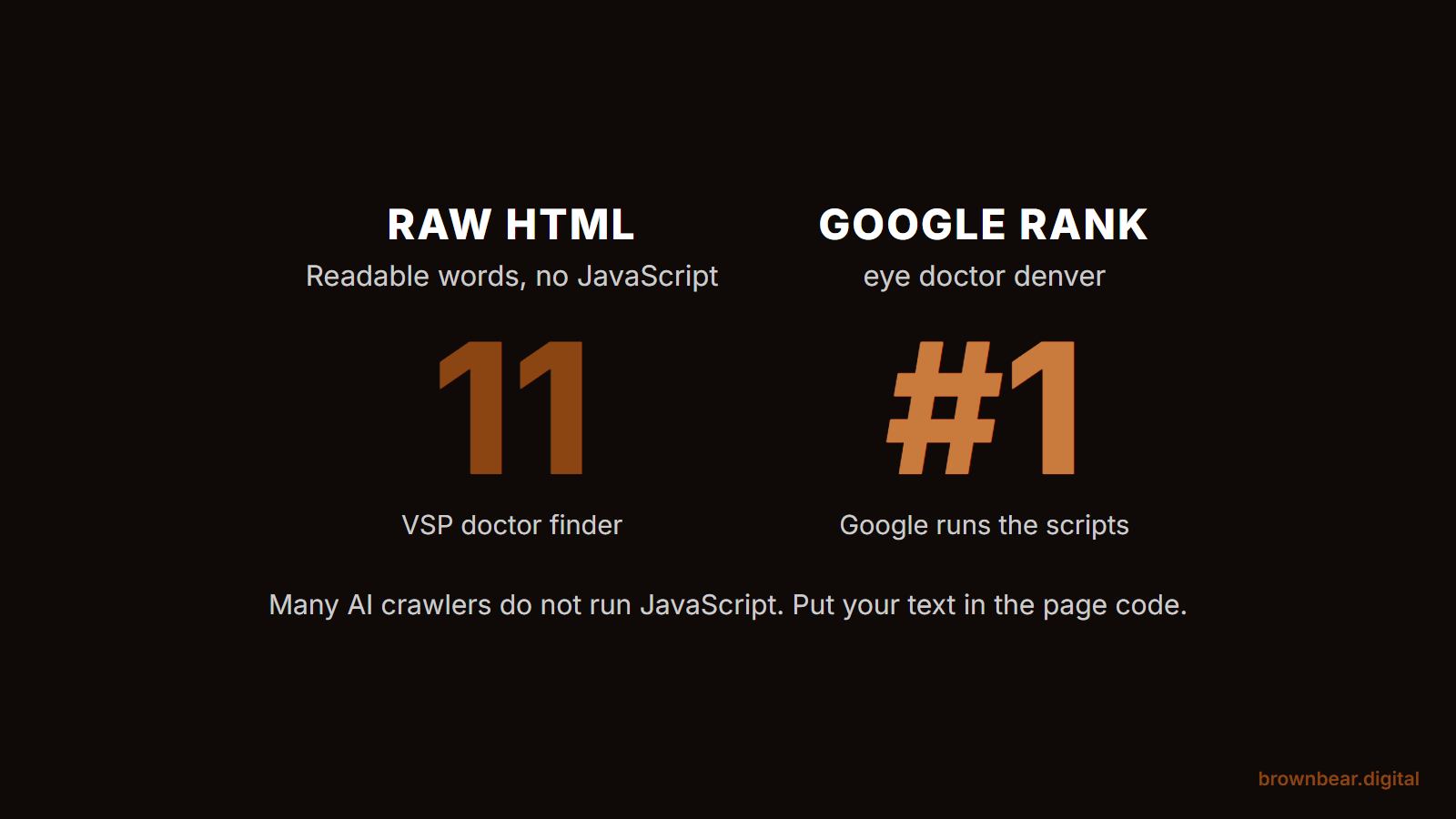
Our pull shows both. VSP's doctor finder pages returned 11 words of readable text to our fetch, because the listings load with JavaScript, and one still held #1 for "eye doctor denver." Google runs JavaScript, so it saw the listings. Many AI crawlers don't: Vercel's late 2024 analysis found that OpenAI's crawlers, ClaudeBot and PerplexityBot did not render JavaScript. A practice page built the same way would rank in Google and be close to blank to those tools. In the same October pull, one Denver practice site that showed a WordPress error message was still ranking #8 for "ophthalmologist denver" and #10 for "lasik denver," a ranking that won't last.
Run four checks every quarter:
- View the page source of your homepage, one procedure page and one doctor page. If the main heading and text aren't there, fix the JavaScript that hides page text.
- Check Search Console's page indexing report for procedure and doctor pages marked "Crawled, currently not indexed."
- Test Core Web Vitals on a phone for your top 10 pages by traffic.
- Set an uptime monitor on the homepage and booking page so a broken site gets noticed in minutes, not weeks.
Say your practice relaunched last year on a new site builder with animated sections. The pages look the same to patients, but a view of the page source shows 40 words of text and a pile of scripts. Rankings in Google may hold for a while because Google renders the scripts, but ChatGPT and Perplexity see an empty shell. Ask your developer for server-rendered text on every procedure and doctor page before you add another word of content.
Local SEO: Business Profiles, Citations and Vision Plan Directories
Local SEO is what puts an eye practice in the map pack, and it rests on your Google Business Profiles. Each office needs its own profile with the right category, hours, services and photos, and a steady stream of reviews. Our marketing guide covers profiles and review requests in detail. The SEO part is making the profiles and the site agree: each profile links to its office page, and each service listed on the profile points to the matching procedure page.
Doctors can have profiles too. Under Google's guidelines for representing your business, a practitioner who works in a public-facing role and can be contacted directly at the verified location during stated hours can have a profile of their own. Support staff should not. In a practice with several surgeons, that gives each one a listing where patients can review them by name.
Then keep your name, address and phone number identical everywhere: Google, Apple, Bing, Yelp, Healthgrades, the society directories and the vision plan directories. In Bryan's AI visibility audits, odd variations of a practice's name, address or phone number are the most common outright error he finds, and one of the easiest to fix. In our pull, VSP's doctor finder ranked for "eye doctor" in every city, so if you're in network, check that your VSP and EyeMed listings are complete and correct. It is a page-one placement you already qualify for.
Content and Links: What to Publish After the Core Pages
Once the core pages exist, the content that earns its keep is cost pages, condition sections tied to treatment pages, and pages that answer what your patients ask at the front desk. "Cataract surgery cost" draws about 8,100 searches a month, and 4 of the top 10 results in our October pull were eye practices' own cost pages, including Lakeland Eye Clinic at #3. A practice that explains what Medicare covers and what each lens upgrade costs out of pocket is competing with AllAboutVision and GoodRx, not with a hospital.
Broad condition searches are a different story. In the medical practices Bryan works with, big health authorities tend to own definition questions like "what is glaucoma," in both the results and the AI answers. Local and cost questions still open the door for a practice. So keep condition content short, put it on the treatment page, and have a doctor review it.
Links come from the relationships an eye practice already has. Referring optometrists can link to your referral page. Local news covers new technology and community eye screenings. Society directories, such as the Phoenix Ophthalmological Society's, ranked in our pull, and a listing there is a citation and a link. Chase those before any paid link offer, which in a health topic is more risk than reward.
Optometry SEO: How the Build Changes for an Optometry Practice
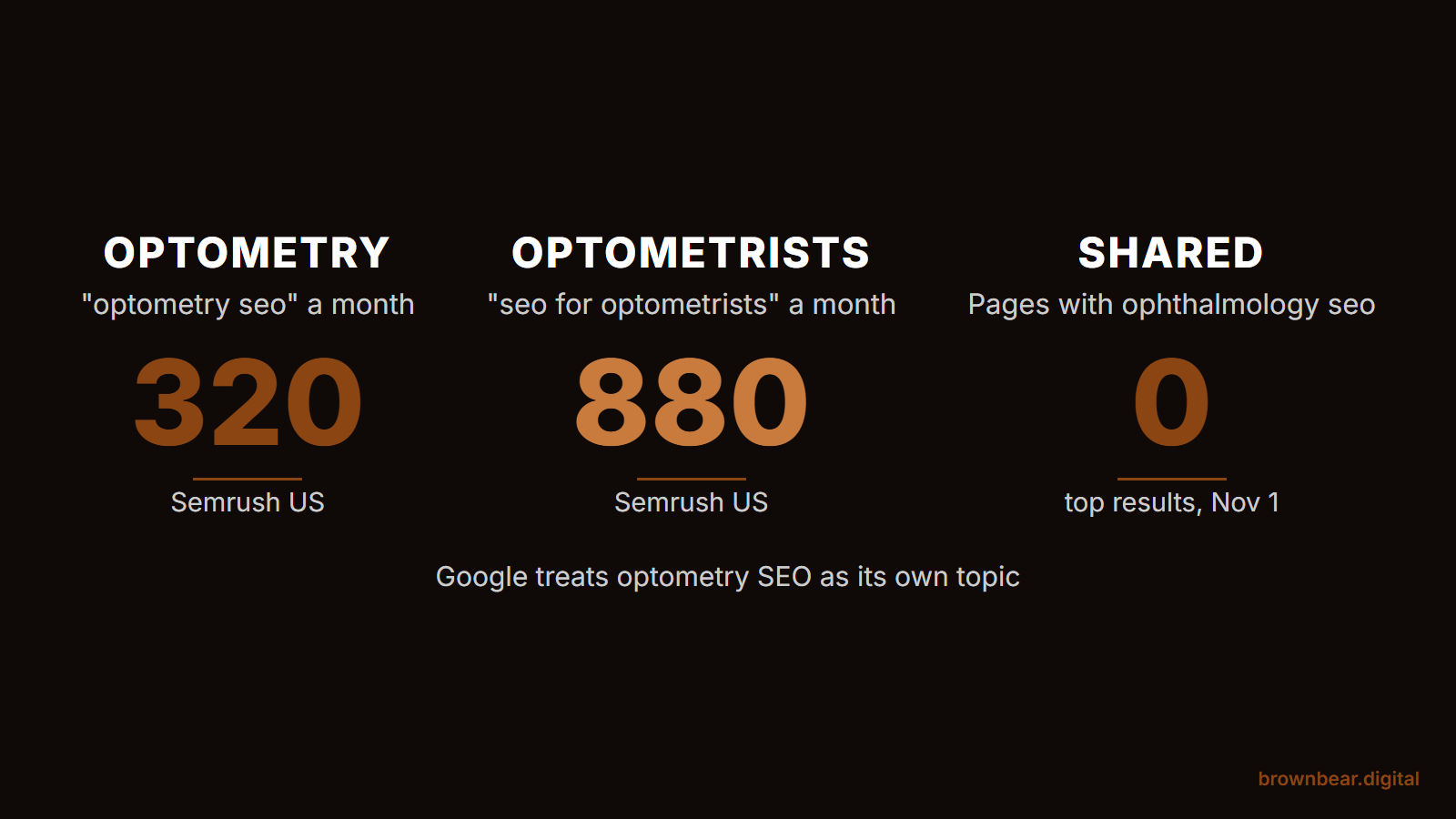
Optometry SEO uses the same building blocks, but an optometry practice competes for different searches and against different sites. "Optometry seo" draws about 320 searches a month and "seo for optometrists" about 880. When we checked on November 1, 2026, the top results for "optometry seo" shared no pages with the top results for "ophthalmology seo." Google treats them as separate topics, and so should your plan.
For an optometry practice, the money searches are "eye doctor" plus the city, "eye exam" plus the city, contact lens and eyewear searches, and specialty care like dry eye and myopia control. The competition includes VSP's doctor finder, which ranked for "eye doctor" in all 6 of our cities, and on national exam searches, retail optical brands. Build for that:
- A vision plan page that lists every plan you accept by name, because that's the first question many exam patients ask
- Exam pages for adults, children and contact lens fittings, with what each includes and costs
- A page for each specialty clinic, such as dry eye or myopia control, with the doctor who runs it
- An optical page that shows the frame brands you carry, which a chain counter can't match
If you co-manage surgical patients with an ophthalmology practice, link to each other's relevant pages. It helps patients, and it is one of the few links in eye care that both sites earn.
Picture a two-doctor optometry practice that started a dry eye clinic last year. The site has one line about it on the services page, so the clinic gets no organic patients. A dry eye page that names the doctor, the treatments offered, what a first visit looks like and what insurance usually covers gives the practice a search it can win. Dry eye treatment plus the city is far less crowded than "eye doctor."
Ophthalmology SEO for LASIK Practices and Cataract Practices
Ophthalmology SEO is for any eye practice that wants patients to find it by what it treats. Before you pick where to start, look at where your cases come from: self-pay patients who shop, or insured patients who arrive with a referral.
For LASIK practices competing with chains and each other
In our pull, every practice result in the LASIK top three was a LASIK page or a LASIK-led practice's homepage. Those pages ran a median of 2,107 words, the longest of any lane. Woolfson Eye Institute's Atlanta LASIK page, #1 for "lasik atlanta," was the longest page we read at 6,353 words, while Desert Vista Eye's #1 page in Phoenix was 415. Length was not the common thread; being about LASIK was. If you run a refractive practice, build a LASIK page for each city you draw from, add PRK, SMILE and ICL pages for the patients who don't qualify, and publish a LASIK cost page with a real price or range.
For cataract practices that live on referrals and lens upgrades
Cataract patients usually arrive with a referral, so they check the surgeon rather than shop. In our pull, doctor pages took 5 of the 18 "ophthalmologist" top-three spots. Lakeland Eye Clinic's cataract cost page ranked #3 nationally for "cataract surgery cost," which draws about 8,100 searches a month. If you do cataract surgery, build a page for each surgeon, a cataract page that explains standard and premium lenses, and a cost page that separates what Medicare covers from each upgrade. Send the cost page to referring optometrists so patients see it before the consult.
Ophthalmology SEO in AI Search
AI tools now answer many of the questions patients used to search, and they decide which practices to name from the same pages and listings Google reads. When Bryan runs an AI visibility audit for a medical practice, the information is rarely wrong. More often, the services the practice most wants to be known for are buried, so the AI describes a generalist. Owners are usually most surprised by how much review sites, directories and press shape what the AI says.
For an eye practice, the work in this guide is the AI work: specific procedure and doctor pages, text in the page code, consistent listings and mentions on sites the AI reads. If you want to see what ChatGPT and Google's AI already say about your practice, that is where AI search visibility for eye practices starts.
How to Measure Ophthalmology SEO, and How Long It Takes
Measure ophthalmology SEO by page type and by booked visits, not by total traffic. Group your pages in Search Console by folder, such as procedure pages, doctor pages and office pages, and watch clicks and average position for each group. Track calls and form fills from organic search to the page they started on, and ask your front desk to record "how did you hear about us" on every new patient. A program that grows LASIK page clicks but books no consults has a page problem, not a ranking problem.
Timelines depend on the lane. Procedure and doctor pages in lanes with lower difficulty scores can move within a quarter of going live. The broad "ophthalmologist" plus a big city search, where hospitals held #1 in Denver and Chicago, is a long project, and anyone who promises it in 90 days is guessing. For what a program should cost against the value of a surgical case, use the calculator in our marketing guide.
Grow Your Eye Care Practice With Brown Bear
Ophthalmology SEO pays off when every procedure, doctor and office has a page built to win its own search, and the site underneath is fast, crawlable and consistent. Brown Bear maps your searches to pages first, then builds and fixes the pages, schema and listings that follow from the map. If you want to see which pages your practice is missing, start with our SEO for eye care practices.
Written By
Founder, Brown Bear Digital
Bryan has 15 years of experience across SEO, paid search, and AI search strategy. He founded Brown Bear to give businesses direct access to senior-level search expertise without the agency overhead.
Learn More About BryanGet Found on Google.
Get Cited by AI.
Tell us about your site. We'll send back a proposal for SEO and AI search.