ChatGPT Ads: What a Plastic Surgery Practice Should Test First
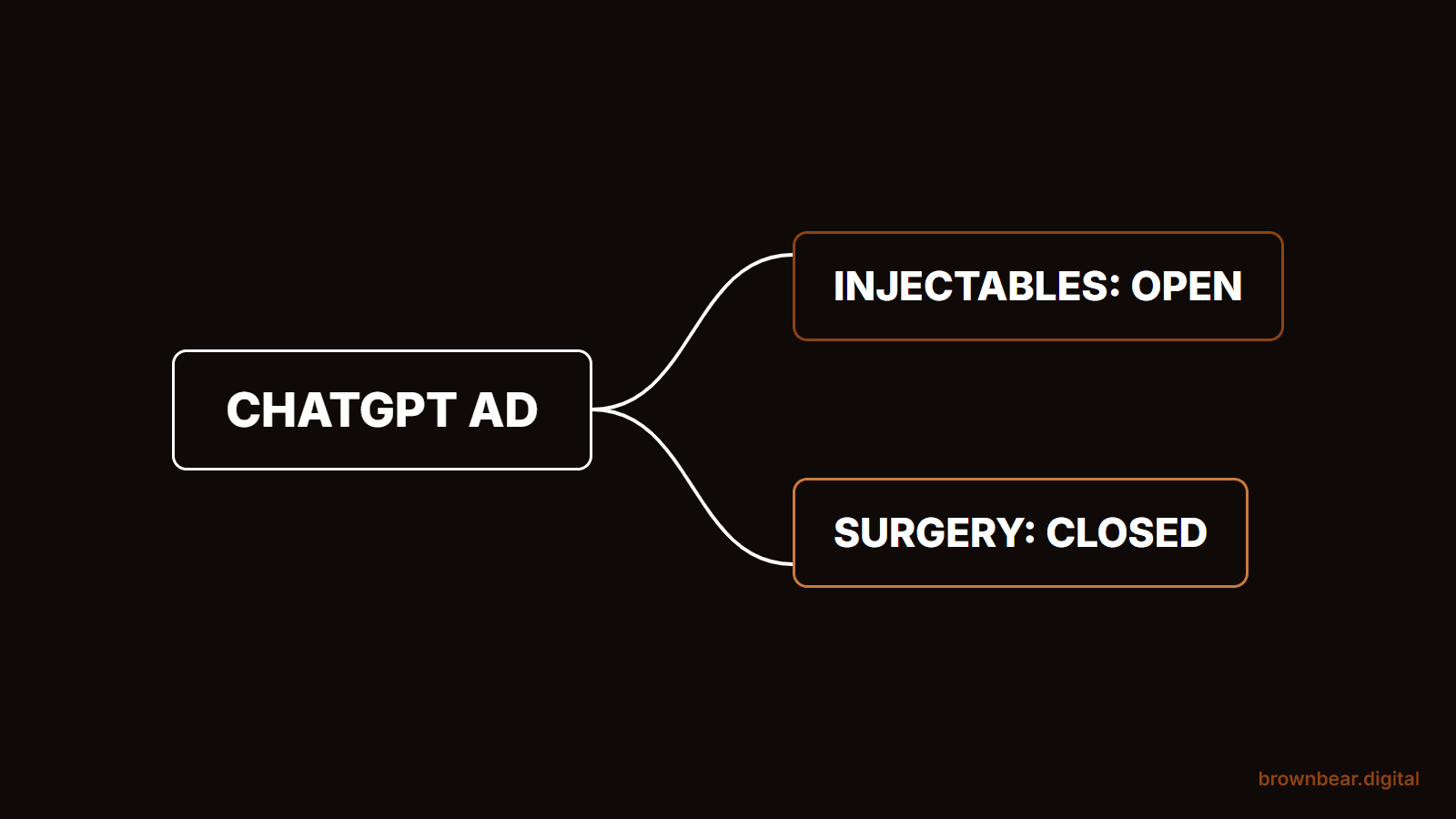
ChatGPT now sells ads to a platform OpenAI says reaches 1.2 billion people a week, and practice owners keep asking the same question: can I buy the spot under "best rhinoplasty surgeon near me"? For surgery, the answer today is no. For the non-surgical side of a practice, it may be yes. This is Brown Bear's guide to ChatGPT ads for plastic surgery practices: what OpenAI allows, what it blocks, and how to run a first test that you can judge against the Google Ads account you already have.
It draws on what Bryan Passanisi, founder of Brown Bear Digital, sees running paid search and AI visibility programs for plastic surgery practices, read against OpenAI's own ad policies and help center as of October 2026.
We cover both ad surfaces inside AI answers: ChatGPT, where OpenAI decides who may advertise, and Google's AI Mode, where a small healthcare ads test is already running. A surgery-only practice and a practice with a busy injectables room will reach different answers, and we'll say where they split.
If you own a practice, you want to know whether this is a real channel or a distraction. If you run marketing for a group with a med spa, you are probably being asked to put a number on a test. And if you manage the Google Ads account, you want to know how much of your playbook carries over and how much does not.
By the end, you'll know which of your services are likely eligible, what a test should cost against your Google numbers, what the landing page has to look like, and when waiting is the smarter call. The longer payoff is a paid plan that follows patients into AI answers without risking your ad accounts or your reputation.
We've grouped it into four parts: how ChatGPT ads work, what the policy means for a practice, how to size and build the test, and when to wait. Start with the mechanics, because they are not the same as Google's.
How ChatGPT Ads Work in Late 2026
ChatGPT ads are sponsored units that appear below a ChatGPT response, labeled as sponsored and kept separate from the answer itself. Advertisers buy them in OpenAI's self-serve Ads Manager, and an auction picks which ad fits the conversation. OpenAI says the ads do not change what ChatGPT recommends.
The basics, per OpenAI's help center for advertisers:
- Who sees them. Logged-in users on the Free and Go plans. OpenAI does not show ads on Plus, Pro, or any Business plan, or to accounts identified as belonging to users under 18.
- What an ad contains. The advertiser name, a favicon, a headline, a short description, an image, and a landing page.
- How ads are matched. By the context and intent of the conversation, the ad's own copy and landing page, and "context hints" the advertiser writes at the ad group level. OpenAI is explicit that context hints are not exact-match keywords and do not guarantee delivery.
- How you pay. By impressions or by valid clicks, in a relevance-weighted second-price auction. For click campaigns, OpenAI recommends starting with a maximum bid of $3 to $5.
- What you can measure. Impressions, clicks, spend, click-through rate, average cost per click and per thousand impressions, and conversions, once you install OpenAI's conversion tracking.
The program has moved fast. OpenAI announced the test in January 2026, turned on the first ads in February, opened a self-serve Ads Manager in May, and by late September had reached more than 60 countries, by trade trackers' count. On October 5, 2026, it announced a visual ad format that will appear during image generation, starting with a US test later in October.
| Google Search ads | ChatGPT ads | |
|---|---|---|
| What triggers the ad | Keywords and match types | The conversation, plus context hints you write |
| Where it shows | Above and below results, sometimes in AI answers | Below the response, labeled sponsored |
| Who sees it | Nearly every searcher | Free and Go users only, adults |
| Plastic surgery eligibility | Allowed, with health policy limits | Surgery likely prohibited; minimally invasive procedures case by case |
| Audience data you can use | Limited for cosmetic surgery by Google's health policy | No access to chats; aggregate reporting only |
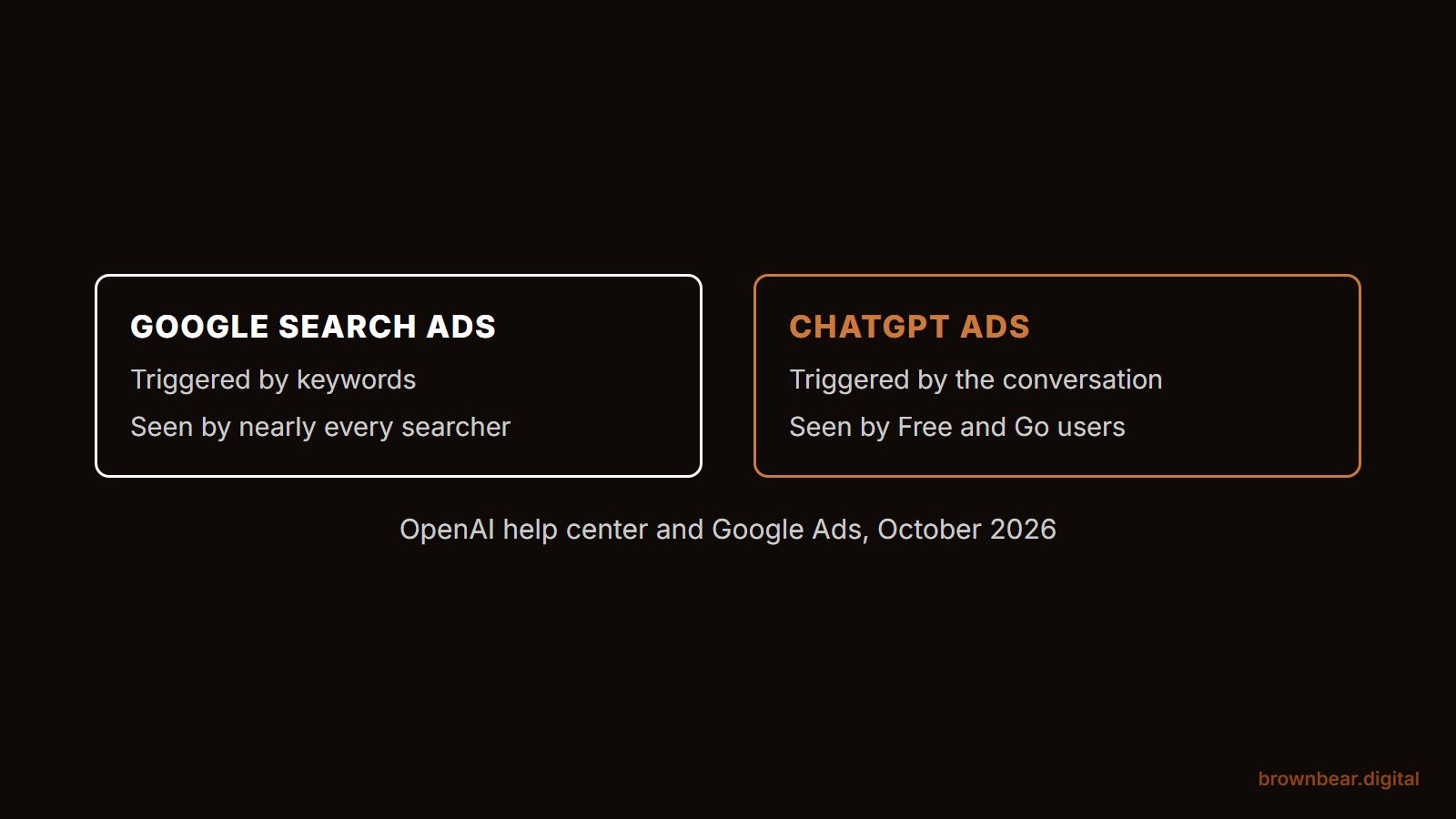
The row that matters most for a practice is the fourth one. Everything else in this guide follows from it.
What OpenAI's Ad Policy Means for a Plastic Surgery Practice
OpenAI treats health services as a restricted category. Under its Ad Policies, updated September 10, 2026, ads for health services outside the US are generally prohibited. In the US, OpenAI "may allow ads from approved advertisers on a case-by-case basis" for a short list that includes dental services, hospitals and urgent care, vision products, and "minimally invasive cosmetic procedures."
The same section closes the door on surgery. OpenAI does not allow ads for "invasive or high-risk medical procedures," unsupported treatment claims, or "health-related products that exploit body-image concerns, distress, or other vulnerabilities." Advertisers may also be asked for proof of licensure.
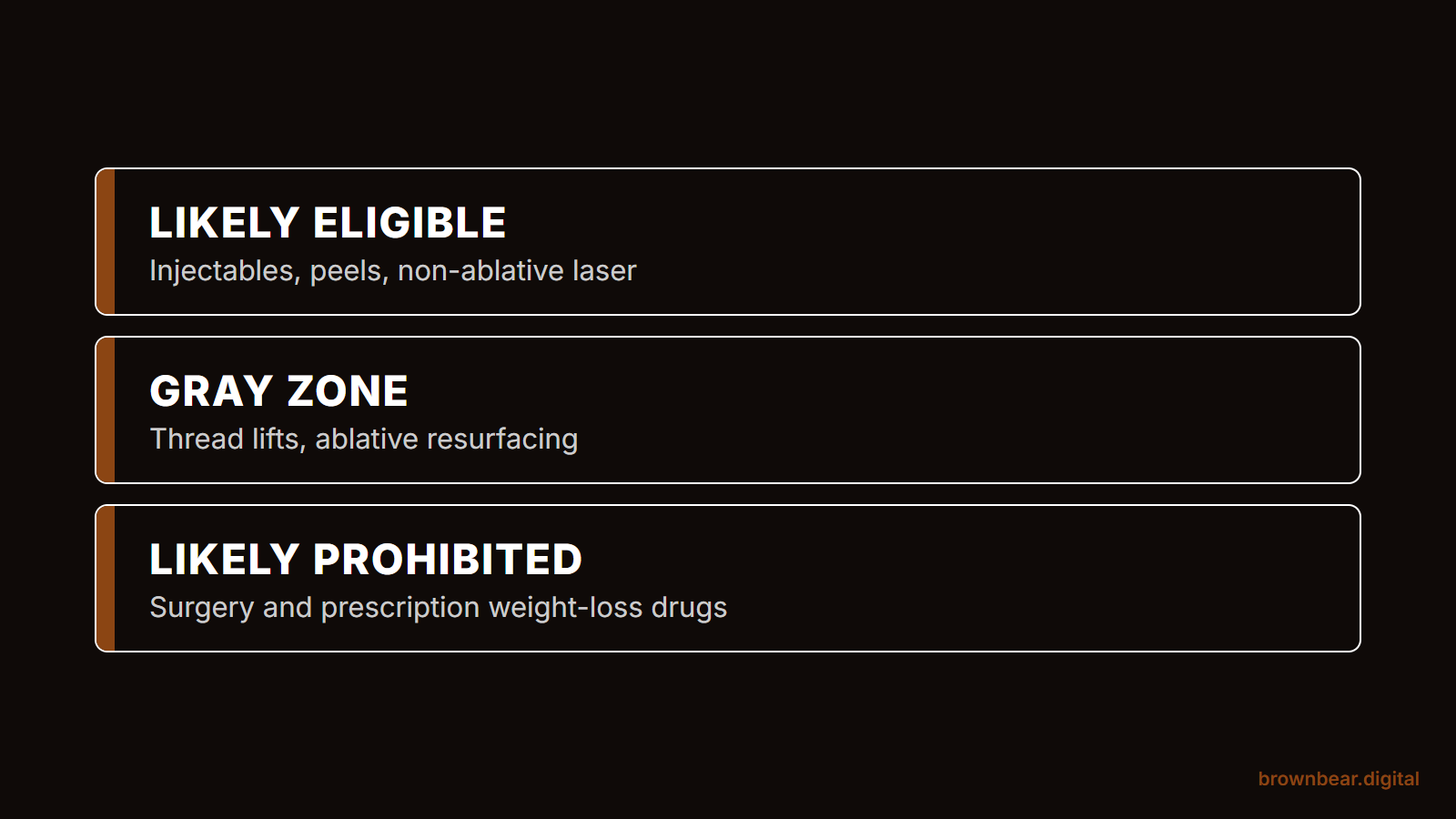
OpenAI never names plastic surgery in the policy, so the mapping below is our reading, not OpenAI's list:
| Service line | Likely status | Why |
|---|---|---|
| Neurotoxin, fillers, peels, microneedling, non-ablative laser, non-surgical fat reduction | Likely eligible, case by case | Fits "minimally invasive cosmetic procedures" |
| Ablative laser resurfacing, thread lifts | Gray zone | Downtime and risk may push review toward "invasive or high-risk" |
| Breast surgery, rhinoplasty, tummy tuck, facelift, liposuction, BBL | Likely prohibited | "Invasive or high-risk medical procedures" |
| Prescription weight-loss medication | Likely prohibited | Prescription drugs are not on the eligible health list |
Two more rules shape a practice's test. First, OpenAI reviews the advertiser, the ad, and the landing page together, and an approved ad "may not link to destinations that introduce disallowed content." Second, eligibility is only half of it. OpenAI's placement rules keep all ads out of "mental and personal health conversations," "emotionally reliant contexts," and "sensitive user journeys." An approved injectables ad can still be held back from a chat about the patient's own health.
Google draws the line in a different place, which is worth knowing before you copy assumptions across. Google's health policy for personalized advertising lists "cosmetic surgery, surgical procedures, or injections" as invasive medical procedures, which limits audience targeting for all three. OpenAI's policy puts injectables on the eligible side. The two platforms do not share a definition of invasive, so check each one on its own terms.
Where your practice lands depends on your menu. If you are a surgery-only practice, ChatGPT ads are effectively closed to you today; your AI ad budget belongs in the Google AI Mode test covered below, and your AI effort belongs in organic visibility. If your practice runs an injectables room or a med spa, you have a testable product, and the work starts with applying as a licensed practice and building a page for the eligible service alone.
Run your own menu through the sorter below. Tap the services you offer, and it files each one as likely eligible, gray zone, or likely prohibited, with the landing page rule that applies to your mix.
Where Google Stands: AI Overviews and the AI Mode Healthcare Test
Google is the other place ads now appear inside AI answers, and its rules for healthcare are also in motion. Google's help page on ads in AI Overviews says Google does not show ads in AI Overviews for sensitive verticals, healthcare included, and that Google Ads offers no separate reporting for ads that do appear there. Ads can still show above or below an AI Overview in the normal slots.
AI Mode is the exception. Around Google Marketing Live in May 2026, Google Ads Liaison Ginny Marvin confirmed "a small test of ads in AI Mode for the healthcare vertical," in the US, for English queries. Performance Max, AI Max with search terms matching, Shopping, and broad match are eligible. The first phase leaves out ads that use pinning or text disclaimers. Search Engine Roundtable reported the test on June 1, 2026.
That matters for a surgical practice in a way ChatGPT does not. Cosmetic surgery is not on Google's prohibited or certification-required healthcare lists, so a surgical practice can advertise on Google within the personalized-advertising limits above. If your account already runs AI Max or broad match, some of your ads may already be eligible for the test without any change on your side. Our guide to AI Max and broad match for plastic surgery PPC covers how to keep that reach from bleeding into the wrong searches.
Picture two practices in the same city. One is a breast and body surgery practice with no injectables. Its AI ad test this quarter is a Google question: is AI Max on, are search terms clean, and are consult requests counted correctly. The other has a med spa that books 300 injectable appointments a month. It has the same Google question plus a real ChatGPT test to run. Same city, same channel, two different plans.
Which ChatGPT Conversations Are Worth Paying For
Because context hints describe conversations rather than keywords, the first planning job is choosing which conversations you want to sit under. For a practice, those conversations fall into three tiers, and only the first two belong in a test.
The Conversation Ladder
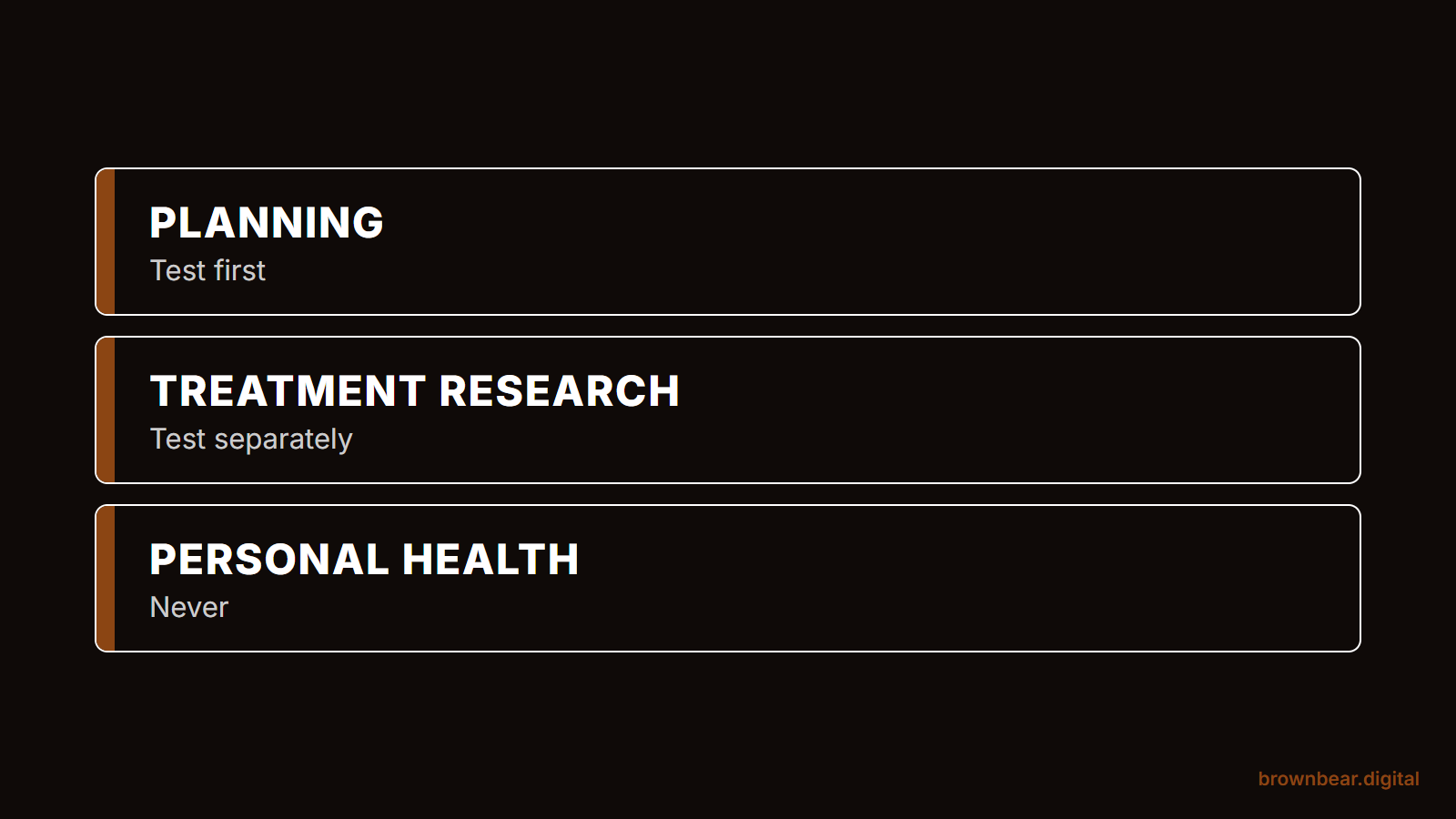
- Planning conversations. A patient is planning around a date or a life event: a wedding, a reunion, a new job, a vacation. "What should I do for my skin before my wedding in June" is a planning question, not a health complaint. This is where a test should start.
- Treatment research conversations. A patient is comparing services as a consumer: neurotoxin versus filler for forehead lines, what a laser facial involves, how often to book maintenance. Whether ChatGPT treats these as ad-eligible or as personal health is what your first weeks of data will show. Write a separate ad group for them so you can read the difference.
- Personal health and body-image conversations. A patient describing a symptom, a complication, or distress about how they look. OpenAI's placement rules keep ads out of these, and its content rules ban creative that exploits body-image concerns. Never write context hints aimed here.
Specific hints beat broad ones. In an r/PPC write-up from September 2026, an advertiser running ChatGPT campaigns in Europe called context hints "the whole game" and argued for being "uncomfortably specific." For a practice, "injectables" is the broad version. "Planning neurotoxin and skin treatments in the 8 weeks before a wedding" is the specific one.
Write the next answer, not a search ad
The same thread made the point that most advertisers will miss: by the time your ad shows, the user already has an answer. A search-style headline like "Best Botox in Dallas" restates what ChatGPT just said. The ad that earns the click answers the next question the patient is about to ask.
Say a 34-year-old asks ChatGPT how to look rested for her wedding in eight weeks, and the answer covers sleep, skincare, and the idea that some treatments need lead time. The next question in her head is when. An ad headed "When to Book Each Treatment" with a description like "Our pre-wedding timeline for injectables and peels, week by week" answers it. "20% Off Botox" does not, and a line like "Look years younger by your big day" risks the body-image rule and a misleading outcome claim at the same time.
Keep the copy short. In the same thread, advertisers reported a 50-character headline and a 100-character description, with some placements truncating sooner, so they wrote to roughly half of each. Check the limits in your own Ads Manager before you build.
How to Size a Test Against Your Google Ads Baseline
Size a ChatGPT test from the Google numbers you already trust, not from the hype. Your Google account tells you what a qualified consult request costs today. The test only has to answer one question: can ChatGPT deliver consult requests for an eligible service at a cost you would accept?
Three reference points help set expectations:
- Google, plastic surgery. LocaliQ's healthcare search benchmarks put plastic and cosmetic surgery at a $5.75 average cost per click and a $102.51 cost per lead, from campaigns run between October 2024 and September 2025.
- ChatGPT, bids. OpenAI's suggested starting maximum is $3 to $5 per click. Published healthcare results do not exist yet.
- ChatGPT, outcomes. The evidence is thin and mixed. OpenAI's October 5 announcement cited WeightWatchers' attributed cost per acquisition on ChatGPT ads at 15.3% below its blended paid-search benchmark, as reported by OpenAI's measurement partner DV Rockerbox. In the r/PPC thread, other advertisers reported the opposite: one said clicks cost about 2.5 times their Google price with no conversions, and another said they had burned through about 2,000 in spend with zero response.
Before any of that, look at the Google account itself. When Bryan's team opens accounts that "didn't work," the same two problems show up almost every time: budget leaking through campaign and keyword setups never tuned for lead quality, and clicks sent to pages not built to convert. A practice with those problems on Google will carry them straight into ChatGPT, where the reporting is thinner and the benchmarks do not exist.
That gives you a fork. If your Google account is clean, with qualified consult requests as the primary conversion and a cost per request you can quote, a small ChatGPT test is a reasonable next step. If you cannot quote that number, fix Google first; the test would have nothing to be judged against.
Where the money comes from matters too. Bryan's view is that paid search should capture demand where organic is not visible yet, then hand off as SEO takes over. Pulling an SEO budget to fund a ChatGPT experiment trades a compounding asset for an unproven channel. Fund the test from paid, at the margin, the same way you would think about splitting budget between SEO and paid search.
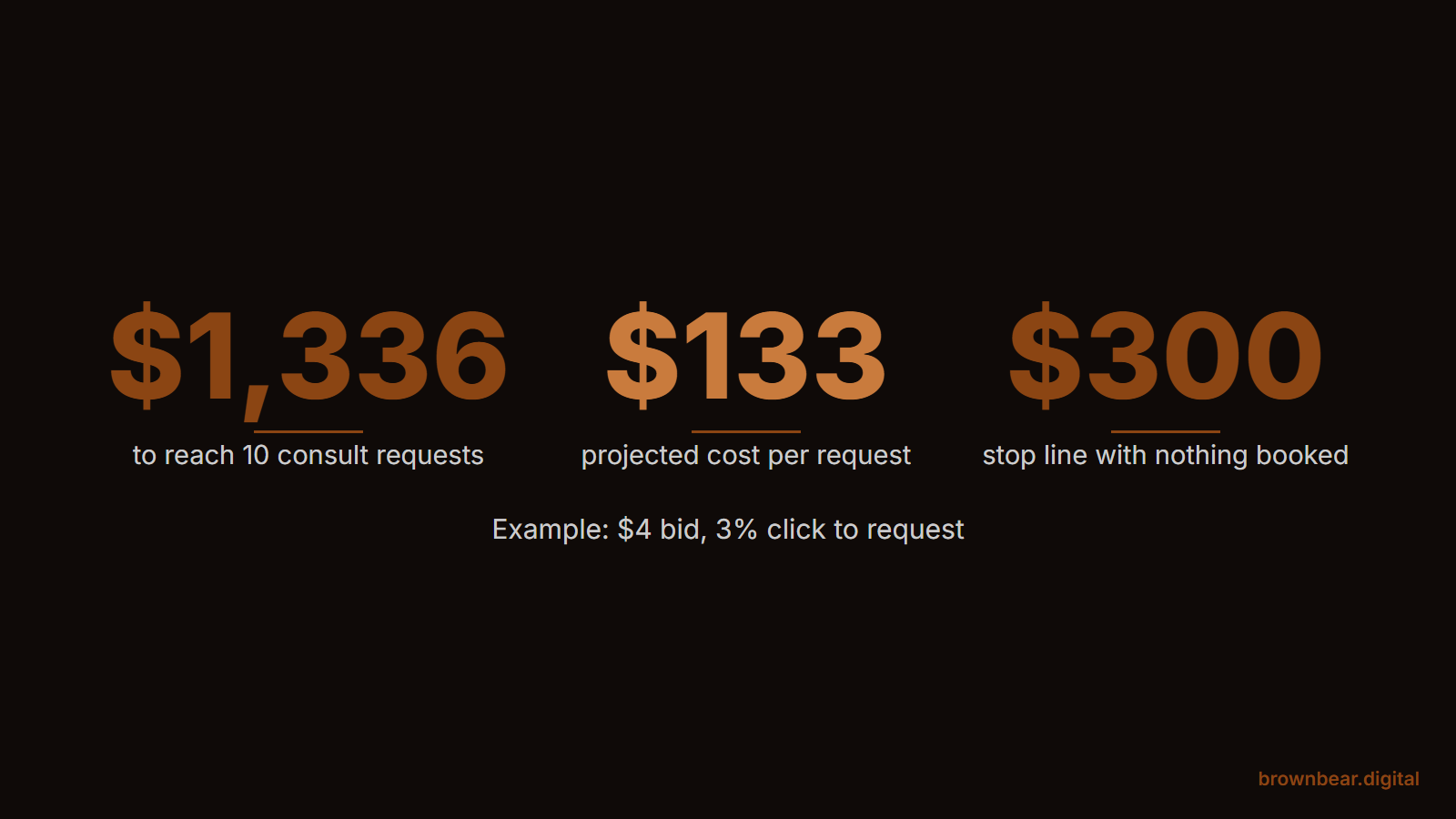
Picture a practice spending $15,000 a month on Google with a $150 cost per consult request. It caps the ChatGPT test at 10% of that, $1,500 for the first month. At a $4 bid and a 3% click-to-request rate, 10 requests take about 334 clicks, roughly $1,336. The test fits, the projected cost per request is $133, and the stop line is $300 with nothing booked. Change any of those inputs and the answer moves, which is why the sizer below asks for yours.
Build the Landing Page for a Patient Arriving From a Conversation
The landing page is part of the ad in OpenAI's review, so build it for the eligible service alone. A neurotoxin ad that lands on a page with a tummy tuck banner, a surgical gallery, or an "ask about breast augmentation" pop-up introduces content the policy disallows. Keep the page to the service, the provider's credentials, pricing or a price range, and one way to request a consult.
The visitor arrives mid-thought. They have already read an answer and clicked an ad that promised the next one, so the page should open by delivering it: the pre-wedding timeline, the maintenance schedule, the comparison. Then make booking easy. Most of what our guide on why practice pages fail to turn visits into consult requests covers applies here with more force, because this visitor came from a conversation that never showed them your site.
Say a practice's ad promises a week-by-week pre-wedding plan and the click lands on the generic homepage. The visitor has to hunt for the plan, finds a surgery slider instead, and leaves. The same click on a page that opens with the plan, lists three treatments with lead times, and offers a 15-minute consult call has a reason to stay. One page answered the question the ad asked; the other made the patient start over.
Track it without leaking patient data. OpenAI offers a measurement pixel and a server-side Conversions API. A pixel firing on booking or intake pages can pick up health information, so send neutral events, such as "consult request submitted," from the server, and check the setup with whoever handles your HIPAA compliance. Add your own UTM tags to the final URL too; OpenAI says static tracking parameters persist on ad clicks. Then judge the test the way you judge Google, by cost per consult and the KPIs behind it, not by click-through rate.
When a Practice Should Wait
Waiting is the right call for many practices this year. ChatGPT ads are new, healthcare approvals are manual, and there are no published results for practices yet. Wait if any of these is true:
- Your menu is surgical only.
- Your Google account cannot tell you a cost per qualified consult request.
- You cannot build a landing page that shows only the eligible service.
- You serve patients outside the US, where OpenAI generally prohibits health service ads.
- Your test budget cannot buy enough clicks to produce about 10 consult requests.
If none of those apply, here is the order we would run it in:
- Run your menu through the sorter and pick the one eligible service that already converts best on Google.
- Apply in Ads Manager as a licensed practice, with licensure documents ready, before you write a word of creative.
- Build the single-service landing page and server-side conversion tracking, then test both.
- Launch two ad groups, planning conversations and treatment research conversations, sized with the budget sizer, and read them at the halfway mark and at the stop line.
Ads Don't Buy the Recommendation
OpenAI's rule that ads do not influence answers cuts both ways. You cannot buy your way into the answer, so the practice ChatGPT names when a patient asks "who's best near me" is still decided by your site, your reviews, and what third parties say about you.
That is where most of the opportunity still sits. Bryan's observation from client work is that AI-assisted patients compress the journey: "what type of breast augmentation is right for me" becomes "who's best near me" inside one session, without visiting a dozen sites. And when his team runs AI visibility audits, owners are most surprised by how much third-party sites, reviews, directories, and press shape what the AI says about them. An ad can sit under that answer. It cannot replace being in it. Our breakdown of how AI assistants shortlist and book surgeons covers that side.
The immediate payoff of a careful test is a clear answer on one service, at a cost you set in advance. The long-term payoff is a practice that shows up in AI answers on its own merits and buys placement only where the numbers justify it.
Plan Your ChatGPT Ads Test With Brown Bear
ChatGPT ads reward practices that already run disciplined paid search: clean conversion tracking, pages built for one job, and a cost per consult they can quote. Brown Bear manages Google Ads for plastic surgery practices and measures it by booked consults, and we will tell you plainly whether a ChatGPT test makes sense for your menu or whether the money works harder on Google. Start with our paid media management for aesthetic practices.
Written By
Founder, Brown Bear Digital
Bryan has 15 years of experience across SEO, paid search, and AI search strategy. He founded Brown Bear to give businesses direct access to senior-level search expertise without the agency overhead.
Learn More About BryanGet Found on Google.
Get Cited by AI.
Tell us about your site. We'll send back a proposal for SEO and AI search.