How AI Agents Are Changing the Way a Patient Finds Their Plastic Surgeon
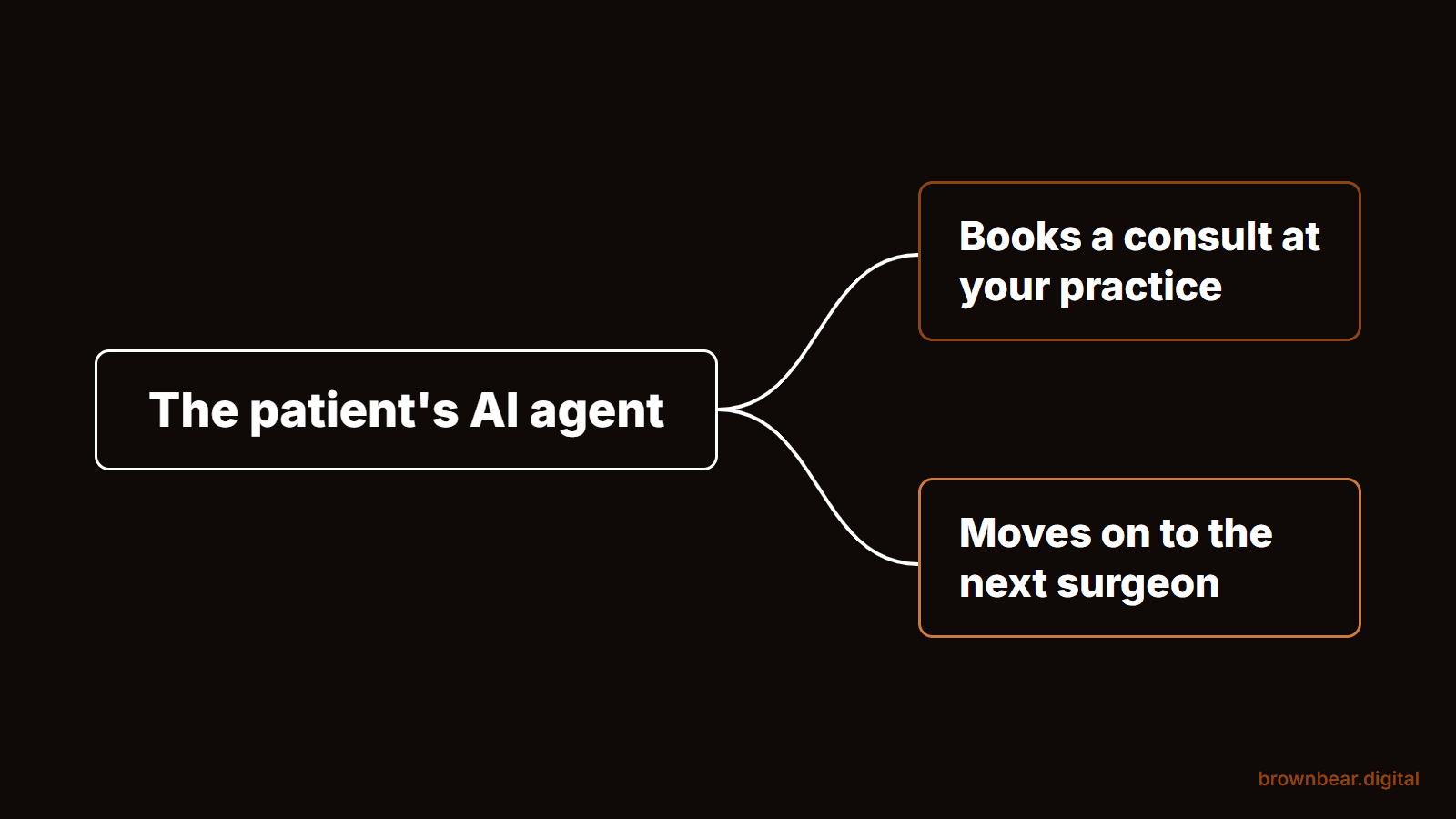
A patient used to research a surgeon and then pick up the phone. In 2026 she can tell an assistant to do the whole errand: find three board-certified rhinoplasty surgeons within 20 miles, compare what each one publishes about price and recovery, and request a consultation with the one that has a Tuesday opening. The assistant opens the sites, reads them, fills in the form, and comes back to her for the final yes.
This is Brown Bear's guide to that shift, written for the practices on the other end of the errand. It draws on primary announcements from OpenAI, Google, Meta, Microsoft, Anthropic, Perplexity and xAI, and on national survey data from Pew, KFF and Rock Health. It also draws on what we see in the AI visibility work we do for aesthetic practices, including our own study of the #1 breast augmentation result in 101 US cities.
When we say AI agents, we mean both the assistants that research and recommend on a patient's behalf and the newer ones that act: browse, compare, fill in forms, call businesses and book. If you own a practice and keep hearing that "AI is changing everything," you want to know what has actually shipped and what is still a pitch deck. If you run marketing and a consult request arrived that nobody can trace to a channel, you are probably already meeting these patients. And if you run several locations or a med spa alongside a surgical practice, every inconsistency between your listings now gets read by a machine that does not forgive them.
By the end you will know which assistants can already do which errands, how fast patients are adopting them, and what we expect by 2028. You will also have the handful of changes that decide whether an agent completes the errand at your practice or moves on to the next name. We cover it in four parts: what agents are and who makes them, the adoption data, our forecast, and what to do about it.
So start with the difference that matters most: what an agent does that a chatbot never did.
Key Takeaways
Patient assistants now act, not just answer
Meta's Muse, ChatGPT's cloud browser, Claude in Chrome and Perplexity's Comet can operate a browser, and the Gemini app books medical appointments through Zocdoc. Most still pause for the patient's approval before anything hard to undo.
Patients are delegating faster in health than in general use
The share of US adults who have used ChatGPT went from 18% in 2023 to 44% in February 2026, and health use of AI chatbots doubled in a single year in Rock Health's survey.
An agent can only compare what you publish as text
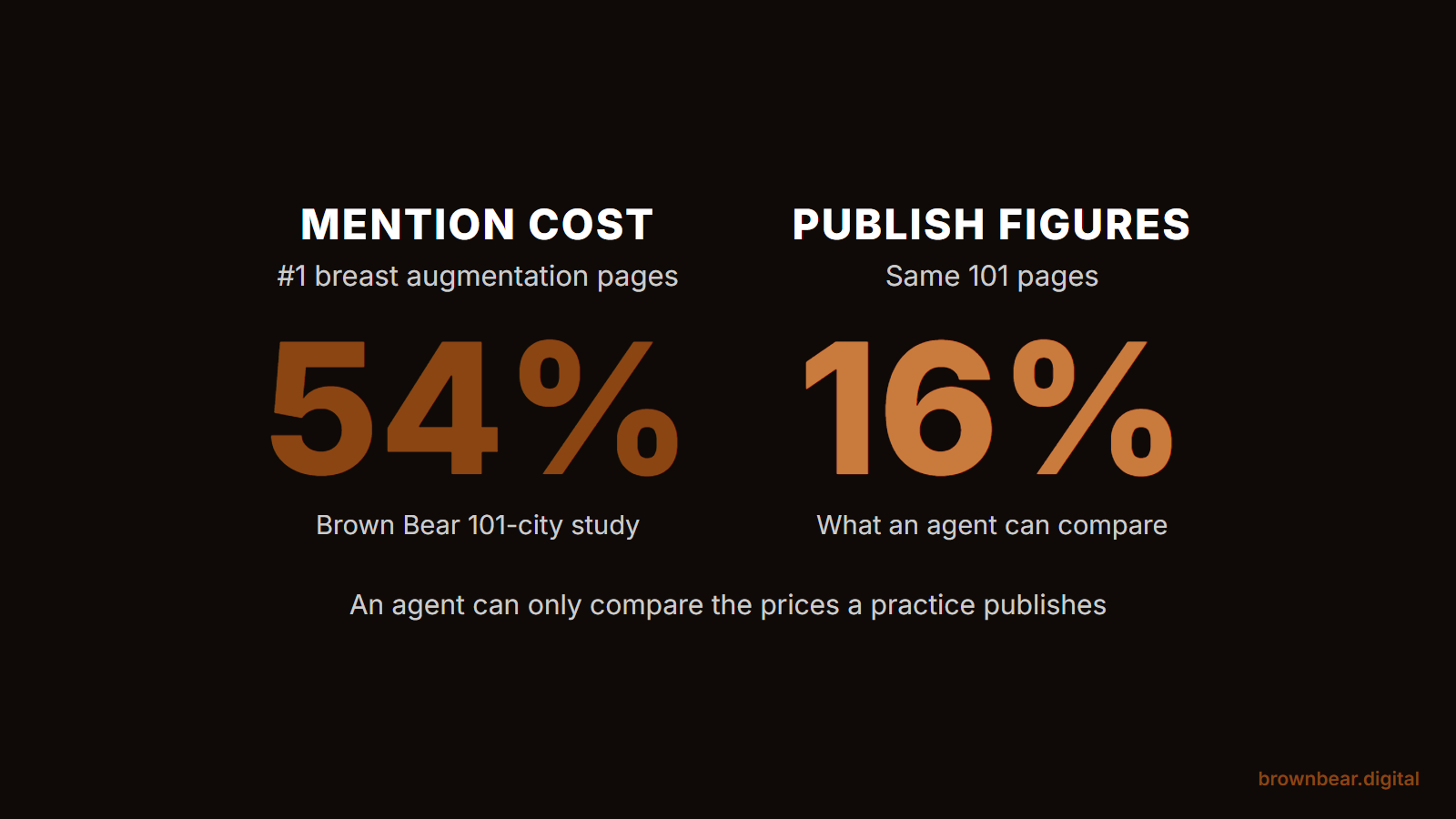
In our 101-city study, 54% of #1 breast augmentation pages mentioned cost but only 16% published actual figures. A price in a PDF, an image or a script does not exist for the compare step.
Your security settings may be turning patients' agents away
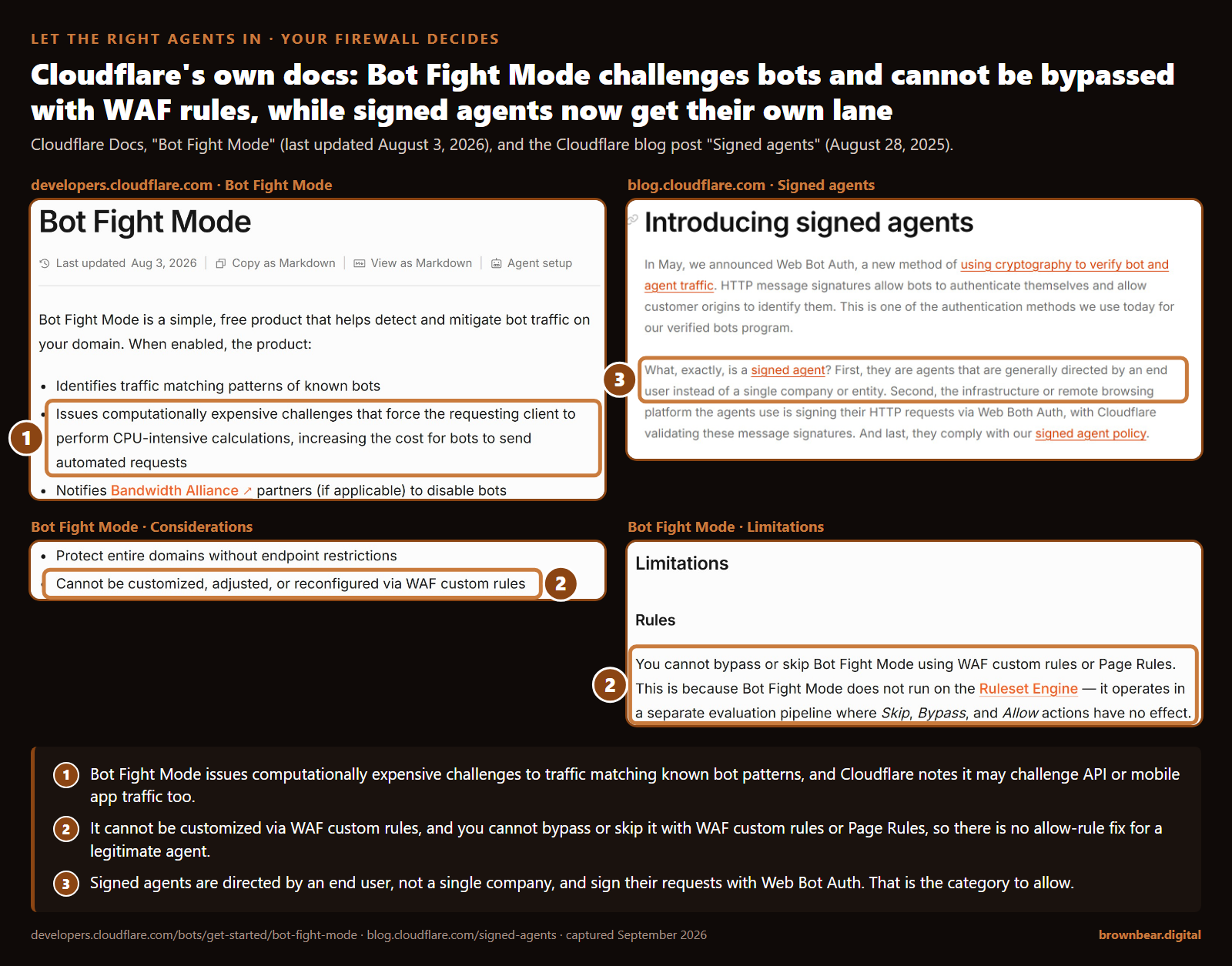
Cloudflare says Bot Fight Mode cannot be bypassed with WAF custom rules. Check that your CDN or firewall allows signed agents and keeps challenges off first-contact forms.
Expect fewer visits and more complete inquiries
The software does the browsing, so page views fall while inquiries arrive with the comparison already done. Judge the work by consultations, and re-run the same assistant tests in 90 days.
What Changes When the Assistant Can Act, Not Just Answer
An AI agent is an assistant that completes tasks on a person's behalf instead of only answering questions. For a plastic surgery patient, that means the assistant can visit practice websites, read and compare them, and fill in a consultation form or book a slot. It returns to her only when it needs a decision or approval.
That is a different job from the one AI search has been doing. A chatbot or an AI Overview answers "what is a deep plane facelift" and names a few surgeons. An agent takes the next steps too. The practical difference for a practice is where the patient's attention goes. With AI search she still visits your site to check what the answer said. With an agent, the software visits for her, and it reads your site the way it reads everything: literally, quickly, and without patience for anything it cannot parse.
| Layer | What the patient asks for | What the software does | What it needs from your practice |
|---|---|---|---|
| Answer | "What does a revision rhinoplasty involve?" | Summarizes sources into one reply | Clear, crawlable explanations it can quote |
| Recommend | "Who is good at revision rhinoplasty near me?" | Builds a short list of two or three names | A consistent entity across your site, reviews and directories |
| Act | "Book me a consult with one of them next week" | Visits sites, compares, fills in forms, books, asks her to confirm | Published facts, a completable booking path, and a site that lets it in |
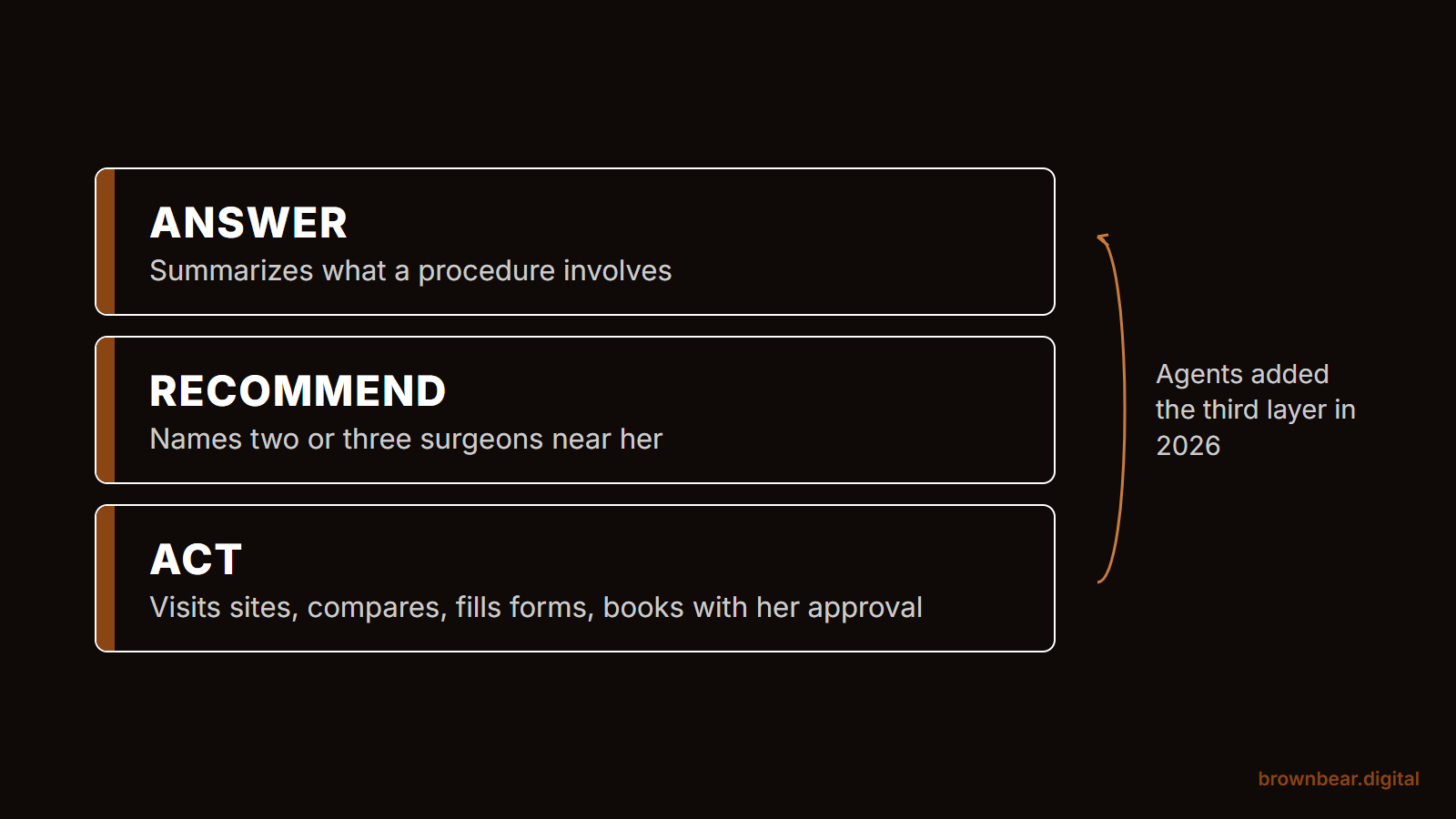
Our companion piece on how AI search shapes which surgeon a patient calls covers the first two layers in depth. This guide is about the third one, because it is the one that arrived in 2026.
Which Assistants Can Already Research, Compare and Book
As of September 30, 2026, every major assistant can research and compare practices. Several can now act on websites too: Meta's Muse, Grok Bot from xAI, ChatGPT's cloud browser, Claude in Chrome and Perplexity's Comet can operate a browser, and Google's Gemini app can book medical appointments through Zocdoc. Most of them pause for the patient's approval before anything that is hard to undo.
The table below lists what each vendor itself says its product does, with the date of the announcement. Capabilities change monthly, so treat it as a dated snapshot rather than a permanent map.
| Assistant | What it can do today, per the vendor | Health or booking detail | Source date |
|---|---|---|---|
| ChatGPT, OpenAI | ChatGPT Work's cloud browser, on paid plans other than Free and Go, reads web pages, clicks buttons and enters information into forms on supported public and signed-in sites | Asks for confirmation before actions that are hard to reverse, such as confirming a booking. Health in ChatGPT launched in the US in July 2026 | Help center, updated 2026; Health launch July 23, 2026 |
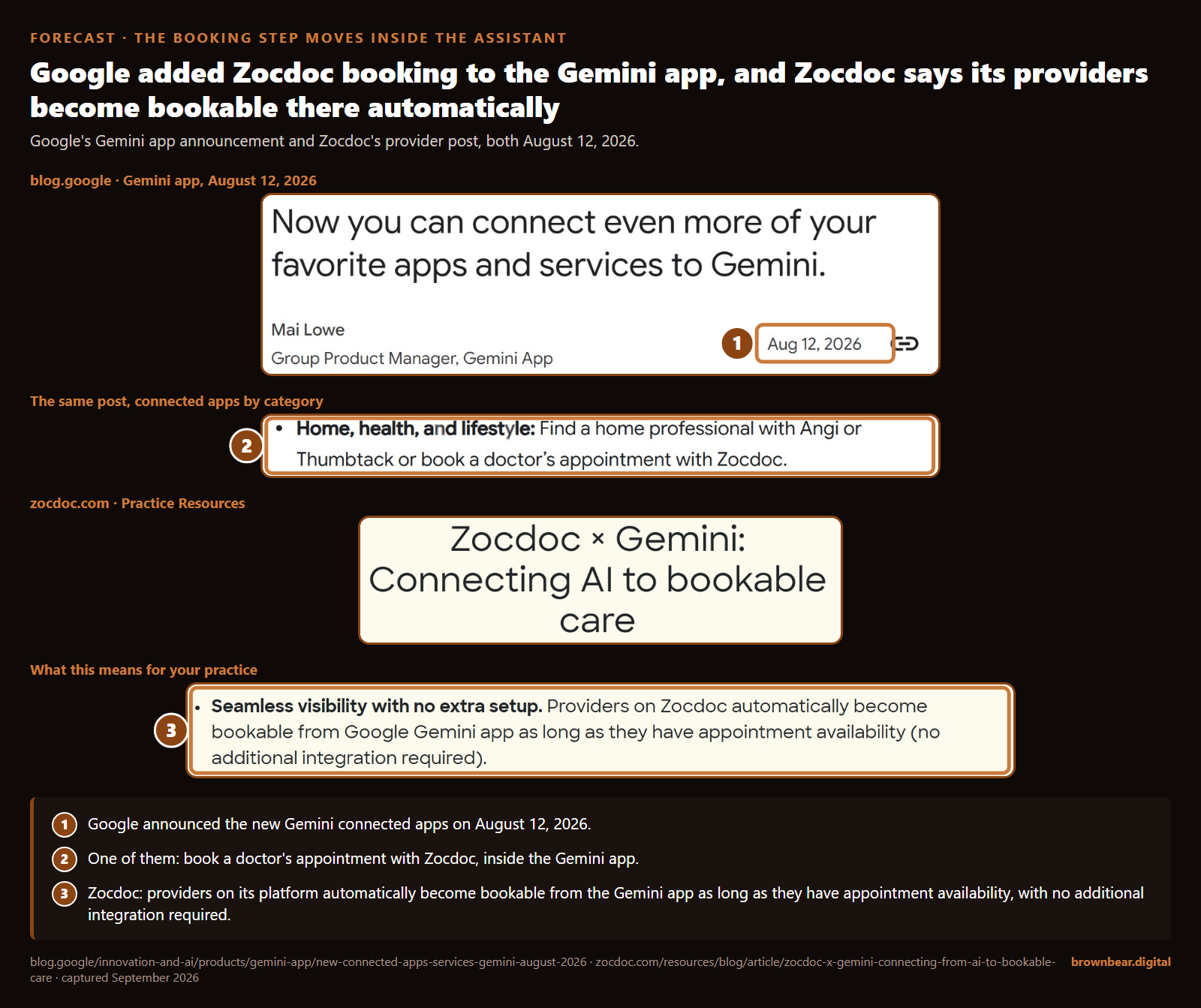
| Gemini, Google | Connected apps let the assistant act inside partner services | Patients can book a doctor's appointment with Zocdoc from the Gemini app | August 12, 2026 |
| Google Search AI Mode | Agentic booking through partner platforms, plus AI that calls businesses to check pricing and availability | Local appointments for US Labs users through partners that include Booksy, Fresha and Vagaro. Calling extended to beauty businesses | November 17, 2025; May 19, 2026 |
| Muse, Meta | A personal agent that can open a browser, fill out forms and negotiate on a person's behalf, and keeps working after the app closes | Launch post mentions booking travel and checkout, and does not mention health or doctor booking | September 8, 2026 |
| Grok Bot, xAI | Always-on agents with their own computer that sign in to tools and websites and work across apps | Positioned for work tasks. No health or booking use case stated | August 11, 2026 |
| Claude, Anthropic | Claude in Chrome reads the page, then clicks, types and fills forms while the user decides what happens next | No health booking use case stated | Available on all paid plans, checked September 30, 2026 |
| Perplexity | Comet browser with an assistant that can book meetings and send email | No medical booking found | Comet made free October 2, 2025 |
| Copilot, Microsoft | Copilot Health searches real-time US provider directories | Find clinicians by specialty, location, languages spoken and insurance. The announcement describes search, not booking | March 12, 2026 |
Muse and Grok, the assistants most practices have not thought about
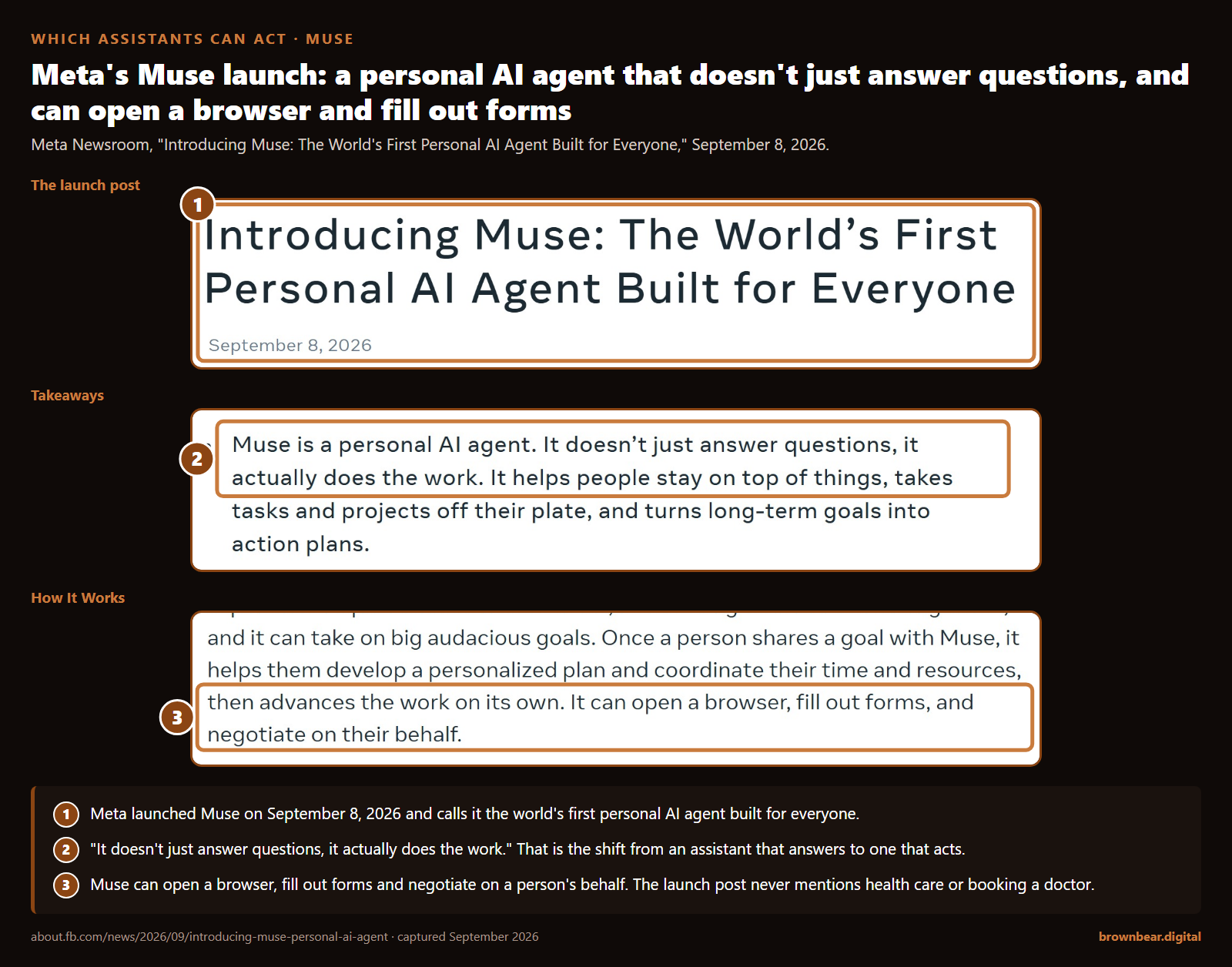
Muse is the one to watch. Meta launched it on September 8, 2026 as "a personal AI agent" that "doesn't just answer questions, it actually does the work." Meta says Muse can open a browser, fill out forms and negotiate. It is rolling out in the US on iOS, Android and muse.ai, and it is free for most uses. A separate Sentinel agent has to approve anything Muse sends to the internet. It runs on Muse Spark, the first in the Muse family of models from Meta Superintelligence Labs, and people can reach it in the Muse app or directly in WhatsApp. Nothing in the launch post mentions health care, so booking a consultation through Muse is a capability we would describe as possible in principle and unannounced in practice.
Grok matters for a different reason. xAI's Grok Bot, launched August 11, 2026 in beta for SuperGrok subscribers, runs always-on agents that "sign into the tools you already use and work across apps." It is pitched at work, not patients. But the mechanics are the same as a patient-side errand, and it means the population of software that can operate a website is growing faster than the population of patients using any one product.
The pattern across all of them is the same. Discovery, comparison and form filling are live now. Fully autonomous booking of a surgical consultation is not yet a mainstream product anywhere except through connected scheduling platforms like Zocdoc, and every vendor keeps a human confirmation step in the loop.
How Fast Patients Are Moving From Asking to Delegating
Fast, and faster in health than in general use. The share of US adults who have used ChatGPT went from 18% in 2023 to 44% in February 2026, according to Pew Research Center's 2026 survey of 5,119 US adults. Health use doubled in a single year in Rock Health's survey, and one national survey now finds AI tools cited more often than Google search as an influence on choosing a doctor.
| Measure | Earlier | Latest | Source |
|---|---|---|---|
| US adults who have used ChatGPT | 18% in 2023, 23% in 2024, 34% in 2025 | 44%, February 2026 | Pew Research Center, June 2026 |
| US adults who have ever used AI chatbots for health information | 16%, a year earlier | 32%, December 2025 | Rock Health, 8,000 adults, March 2026 |
| US adults who turned to AI chatbots for health information in the past year | n/a | 32%, February to March 2026 | KFF Tracking Poll, 1,343 adults |
| Patients who searched for a doctor and cited AI tools like ChatGPT and Claude as an influence | 17% for conversational AI assistants the prior year | 36%, ahead of Google search at 34% | rater8 2026 Patient Choice Report, vendor survey of nearly 1,000 patients |
| People asking ChatGPT health questions each week | 230 million globally, January 2026 | More than 300 million, July 2026 | OpenAI |
| Monthly users of Google's AI Mode | 100 million in the US and India, July 2025 | More than 1 billion, July 2026 | Alphabet earnings remarks |
| Consumers comfortable with AI agents scheduling appointments for them | n/a | 39%, April 2025 | Salesforce consumer research |
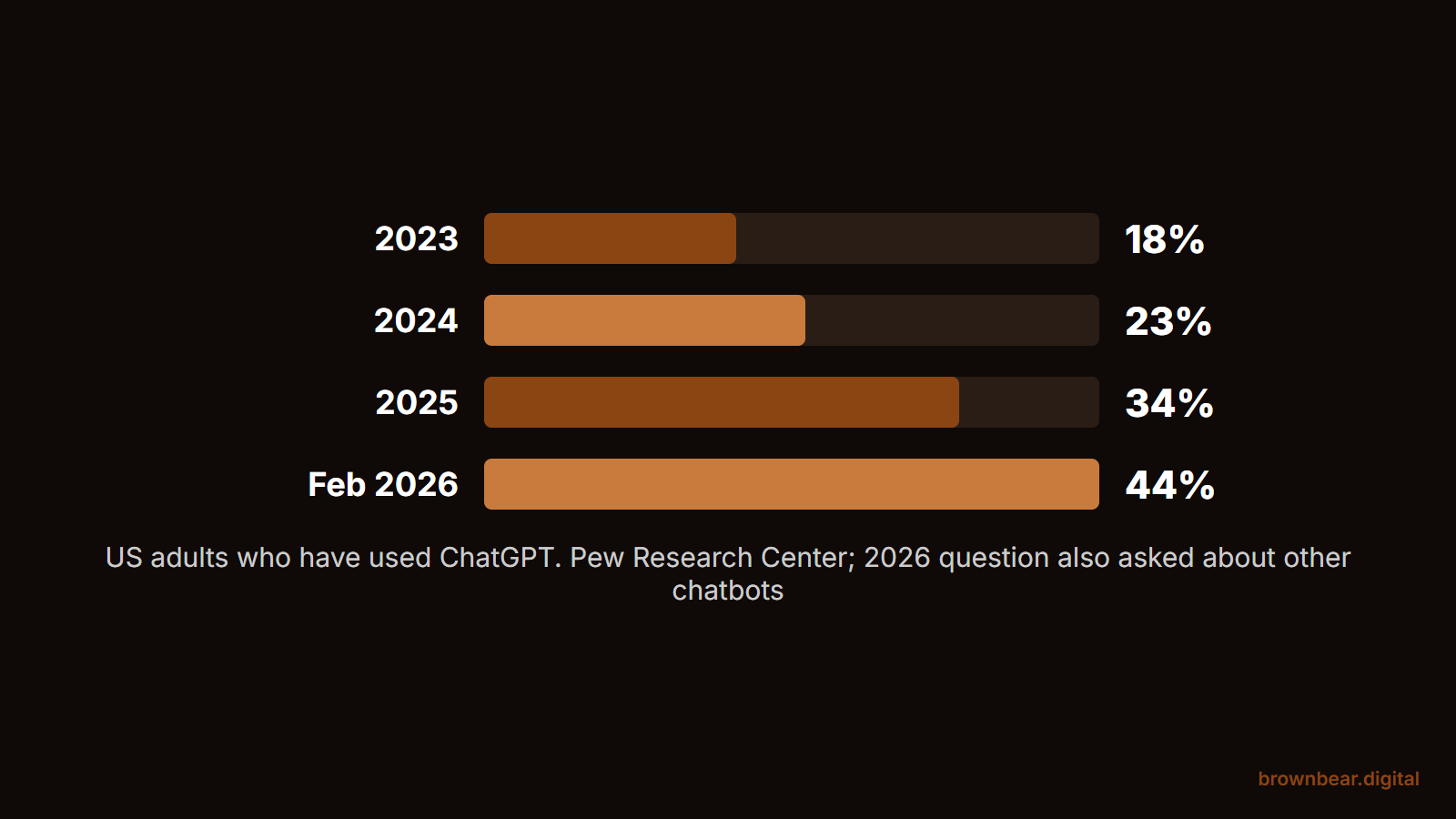
Three cautions keep these numbers true to their sources. Pew changed its question in 2026 to ask about other chatbots too, so the 44% is not a perfectly matched point on the earlier line. Pew itself still calls it more than double the 2023 share. KFF's 2024 poll measured monthly use and its 2026 poll measured past-year use, so the two do not form a trend line, and we have not drawn one. And the rater8 figure comes from a company that sells patient-review software, which is why we name it as a vendor survey. Even so, the direction is consistent across every source that measured it. The same rater8 report found that 66% of patients had encountered incorrect provider information from an AI tool while 60% still trusted the summary without checking it. The machine's version of your practice is increasingly the version patients act on.
There is one gap worth stating plainly. We could not find a primary US survey that measures how many aesthetic surgery patients specifically use an assistant to research a surgeon. The health-wide numbers above are the closest available evidence, and the rest of this piece does not pretend otherwise.
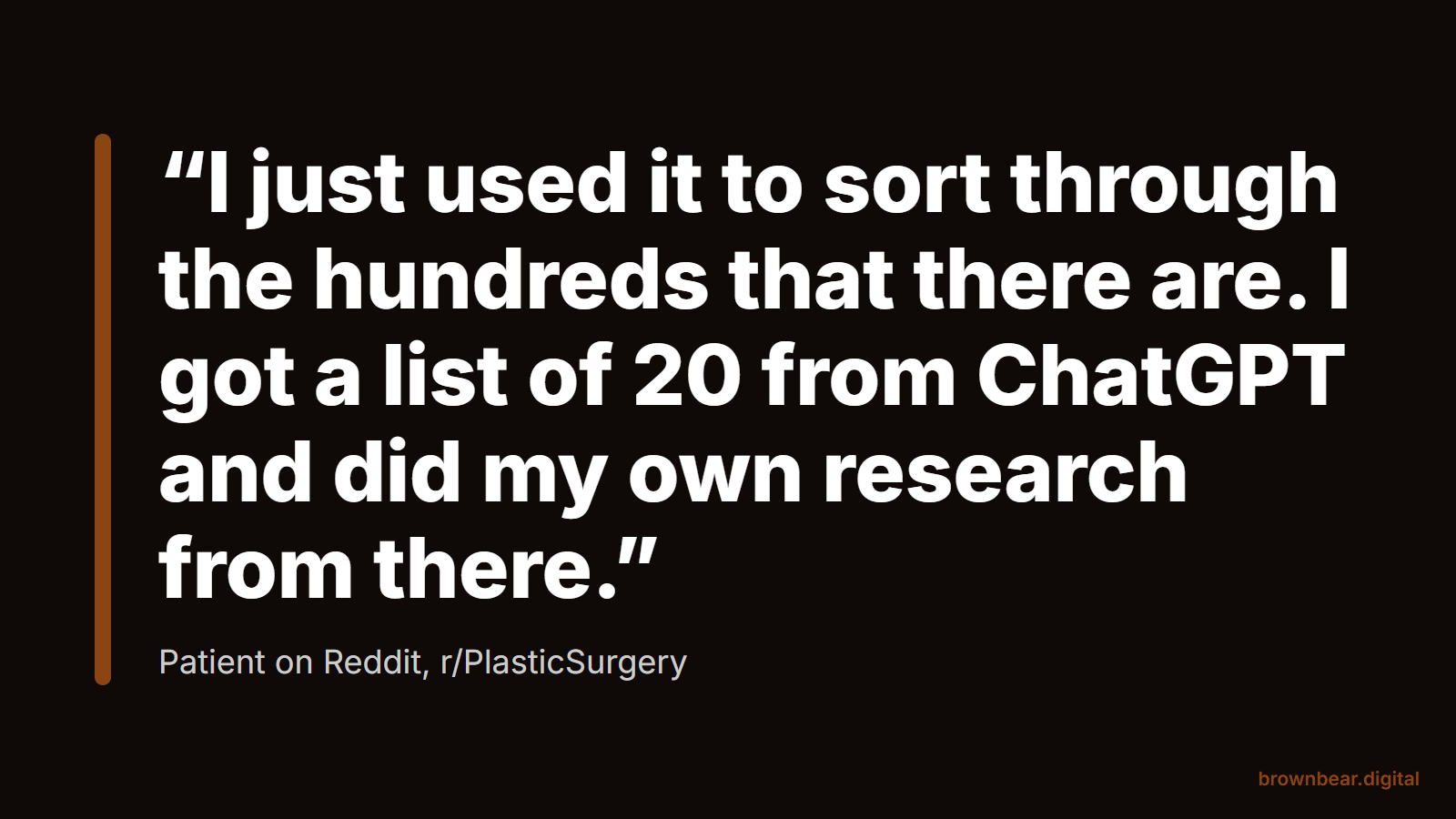
What we see in the practices we work with fits the direction of the data. Referral traffic from LLMs is still a small share of visits, but it converts to consultations and form fills at a higher rate than other channels, because the patient has already done her comparing inside one conversation before she arrives.
What a Patient's Errand Looks Like When an Agent Runs It
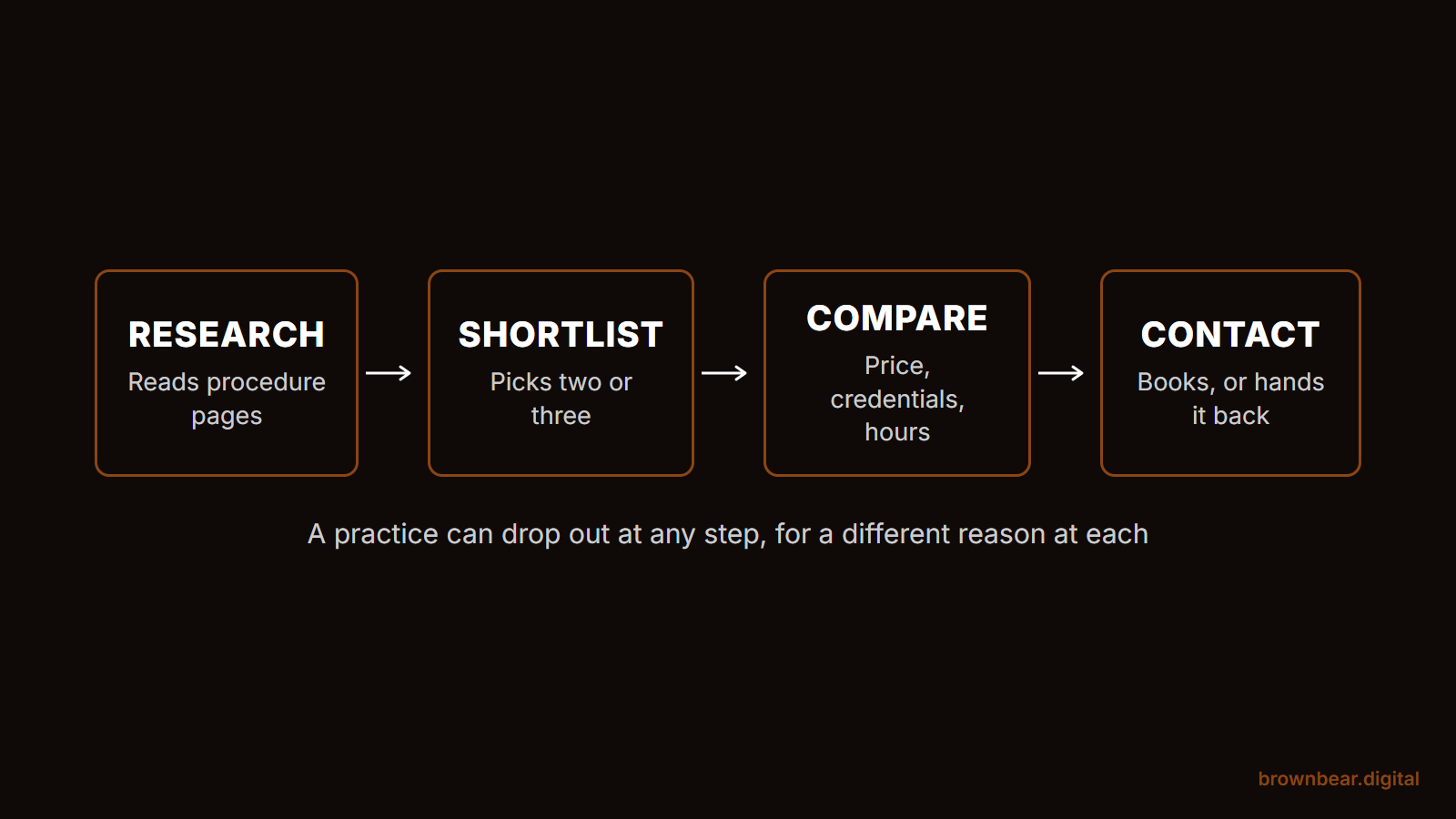
An agent working for a prospective patient runs the same five errands she would have run herself. In order, it researches the procedure, builds a shortlist, compares the candidates on published facts, makes contact, and books or hands the booking back to her. Your practice can drop out at any one of the five, and at each step the thing that decides it is different.
- Research. The agent reads procedure explanations, recovery timelines and candidacy notes from sources it trusts. Large authority sites win the generic questions. Your procedure pages win when they answer the local, specific version.
- Shortlist. It assembles two or three names from directory listings, board and society records, reviews that name the procedure, and third-party mentions. A surgeon who is inconsistent across those sources is easy to leave off.
- Compare. It opens each shortlisted site and looks for the facts the patient asked about: price range, credentials, the procedure itself, location, availability. A fact that is not on the page, or only lives in an image or a script, does not exist for this step.
- Contact. It tries to reach you through the path your site offers. A labeled form, a booking link or a phone number it can surface all work. A form hidden behind a challenge it was never meant to solve does not.
- Book or hand back. On a connected scheduling platform it can finish the booking after the patient confirms. Everywhere else it prepares the request and hands it back to her, which is the moment a second practice can still win.
Picture a 44-year-old in Scottsdale planning an upper blepharoplasty around a work trip. She asks her assistant for board-certified surgeons within 25 miles who publish a price range and have a consultation available in the next two weeks. The agent finds five names, but two sites show no price at all and one hides its form behind a puzzle. It returns with two options, one of them already booked for her approval. The practice she never hears about was not rejected. It was simply unreadable.
Bryan Passanisi, founder of Brown Bear, describes the same compression from the human side. In his words, the patient's search journey now collapses into a sequence of prompts inside one session and one source, from "what type of breast augmentation" to "who's best near me," without bouncing across sites. An agent takes that compression one step further: the sequence of prompts becomes one instruction.
Brown Bear's Forecast for 2027 and 2028
This section is our read, not a measurement. It is reasoned from the dated trends above and from the products vendors have actually shipped, and it contains no invented percentages. We will revisit it as the evidence changes.
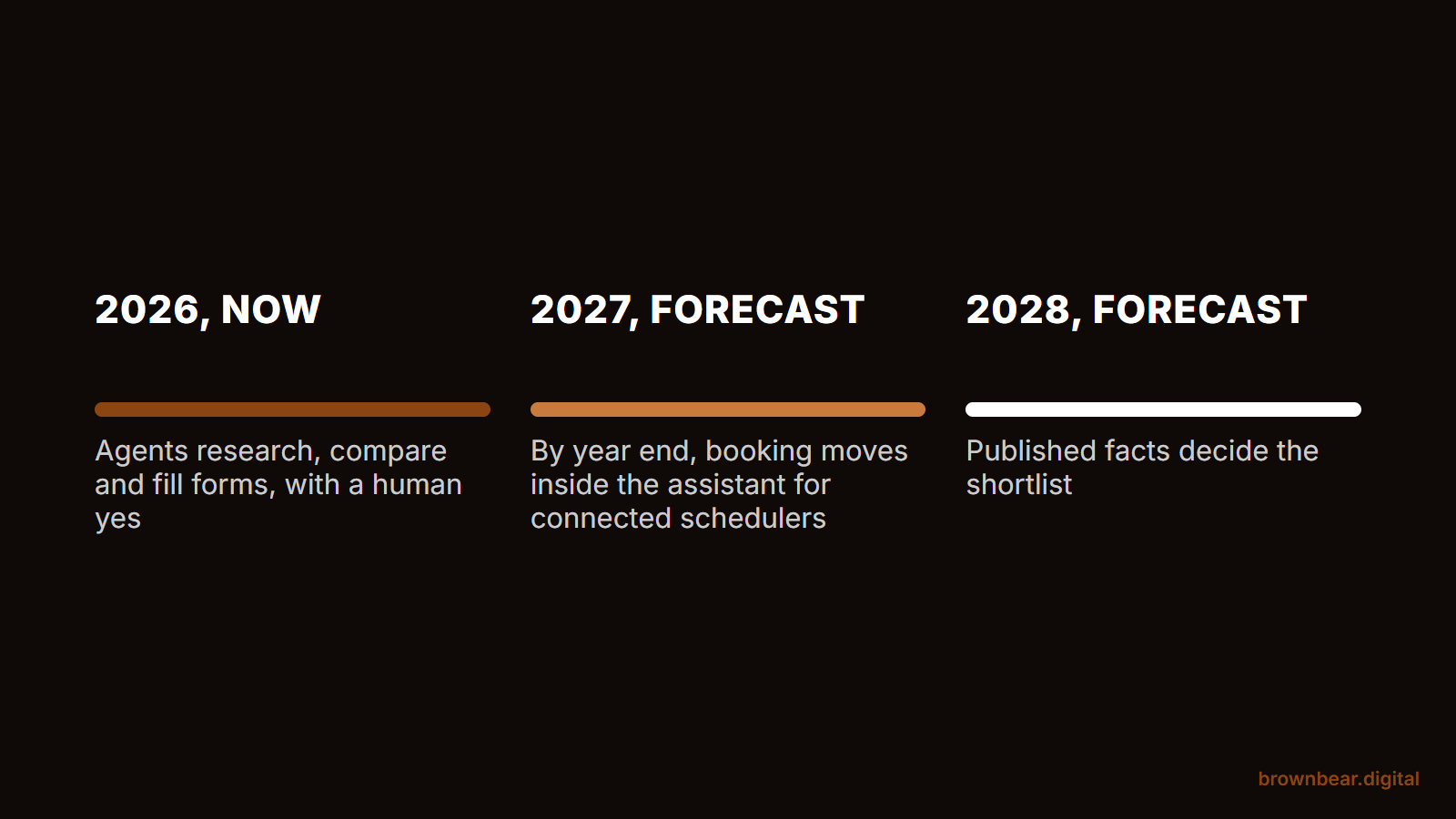
1. By the end of 2027, the booking step moves inside the assistant for practices on connected schedulers
The pieces already exist. Zocdoc says providers on its platform "automatically become bookable from Google Gemini app as long as they have appointment availability," with no extra integration. Google's AI Mode already books local appointments for US Labs users through beauty and wellness schedulers. We expect the same pattern to reach aesthetic consultations through whichever scheduling platforms plug into the big assistants first. Practices on those platforms will become bookable inside the conversation by default. Practices that are not will receive a prepared request and a handoff.
2. By 2028, published facts decide the shortlist
An agent asked to compare surgeons can only compare what they publish. In our 101-city study, 54% of the pages ranking #1 for breast augmentation mentioned cost but only 16% published actual figures. Google Search already calls businesses in some categories to ask about pricing and availability on a searcher's behalf. We expect agents to favor practices that state a price range, board certification, procedures offered, locations and hours in plain text, and to describe everyone else from third-party sources or skip them.
3. Fewer visits, more complete inquiries
Pew found that Google users clicked a traditional result on 8% of visits when an AI summary appeared, against 15% when one did not. Agents push further in the same direction: the software does the browsing, so the practice sees fewer page views and more inquiries that arrive with the comparison already done. We expect practices that judge marketing by sessions to conclude, wrongly, that it is failing, while consultation volume from the same channels holds or grows.
4. Agents get identities, and security settings become a marketing decision
OpenAI's cloud browser already signs its requests with an open standard called Web Bot Auth. Google documents a Google-Agent user agent for "agents hosted on Google infrastructure," and Cloudflare now lists signed agents as their own category. We expect the practices that treat bot protection as a pure IT setting to block legitimate patient agents without knowing it, and the practices that review those settings to be the ones that get booked.
5. The consultation stays human
Agents will shortlist and schedule. They will not decide who operates on a patient's face. In Salesforce's 2026 research with 3,200 adults across eight countries, 89% said a clear option to escalate to a human is essential for trusting AI administrative support. We expect the decision to stay in the consult, and the reputation that earns the consult to keep being decided off your site, in reviews and profiles an agent reads before it ever reaches you.
What would change this forecast.
Predictions in this space have a mixed record. Gartner forecast in 2024 that traditional search engine volume would drop 25% by 2026, while Google reports that AI features are increasing total Search queries. A serious trust failure involving an agent and a medical booking, new regulation of AI in health scheduling, or platforms choosing to gate health bookings behind partners only would each slow the timeline. None of them would reverse the direction.
Where Agents Drop a Plastic Surgery Practice Today
Agents fail on practice websites for a short list of predictable reasons. The facts they need are missing or locked in formats they cannot read, the site's security blocks them, or the next step cannot be completed without a human. Most of these are invisible from inside the practice, because a human visitor never hits them.
- Facts in the wrong format. Prices in a PDF, credentials in a badge image, hours in a widget that only loads with JavaScript. The 2024 Vercel and MERJ analysis found that none of the major AI crawlers it measured rendered JavaScript, while Google's Gemini, which runs on Googlebot's infrastructure, could.
- Security that cannot tell a patient's agent from a scraper. Cloudflare's own documentation says its Bot Fight Mode cannot be bypassed with WAF custom rules, so a practice that turns it on has no allow-rule fix for a legitimate agent.
- A booking path built for patience. Multi-step widgets with custom date pickers, a challenge on the first inquiry form, or booking by phone only. OpenAI's own help pages note that some websites use security measures that restrict automated browser agents, and that the agent asks the user to take over when it gets stuck.
- An entity that does not match itself. In the AI visibility audits we run, the information about a practice is rarely wrong outright. The most common error is a small variation in name, address or phone number across listings, and the procedures a surgeon most wants to be known for are buried, so AI describes a generalist.
The Agent Errand Test
A patient tells her assistant: "Find a board-certified surgeon near me for my procedure, compare prices, and request a consult." Answer ten questions about your site and watch where the agent completes the errand, hands it back to her, or moves on to the next name.
0 of 10 answered
For informational purposes only. This is a self-assessment built on the article's five-errand model, not a live test of your site or a guarantee of how any assistant behaves, and it is not legal or medical advice. Your answers stay in this browser tab. Nothing is stored or sent.
The Six Agent-Readiness Moves That Matter Most
Six changes decide most of whether an agent can complete a patient's errand at your practice: let the right agents in, publish your core facts as text, make the next step completable, keep your entity identical everywhere, hold schema in proportion, and handle agent-sent inquiries under your HIPAA obligations. This is the summary. Our page-by-page guide to what an AI-ready website looks like for plastic surgeons covers each page type in detail.
1. Let the right agents in, on purpose
Each AI company runs separate bots for separate jobs, and a robots.txt rule only controls the one it names. OpenAI's OAI-SearchBot surfaces sites in ChatGPT search, GPTBot collects training data, and ChatGPT-User visits pages when a person asks. OpenAI says each setting "is independent of the others." Blocking GPTBot therefore keeps you out of training, not out of ChatGPT's answers. Google-Extended controls Gemini training and grounding and, in Google's words, "does not impact a site's inclusion in Google Search nor is it used as a ranking signal." PerplexityBot powers Perplexity's search results, while Claude-User and Claude-SearchBot do the equivalent jobs for Anthropic.
The user-triggered fetchers are the ones that matter for agents, and robots.txt may not stop them: OpenAI says rules "may not apply" to ChatGPT-User, and Perplexity and Google say their user-triggered fetchers generally ignore robots.txt. The setting that actually decides whether a patient's agent gets through is usually your CDN or firewall. Check that it allows signed agents and is not running a blanket bot challenge on your procedure and contact pages. The full crawler-access walkthrough lives in our guide to site-level AI search optimization.
2. Publish the facts an agent compares, as text
Put the facts a patient's agent is sent to find on the page, in server-rendered HTML: the procedures you perform, a price range or starting price for each, the surgeon's board certification and training, every location with its address, and your hours and consultation fee. A range is enough. "Breast augmentation from $6,500 to $9,000, including surgeon, anesthesia and facility fees" gives an agent something to compare. "Pricing varies, call for a quote" gives it a reason to move on.
Most practices already know these facts. They are just scattered across a PDF, a popup and the front desk's memory. The builder below turns them into one plain block you can place on your site.
Practice Fact Card Builder
Fill in the facts a patient's agent is sent to compare. You get a plain HTML block to place on your site, in text an agent can read without running any scripts. Leave a field empty and the card tells you what is missing.
Practice and surgeon
Procedures and price ranges
Locations, hours and booking
For informational purposes only; not legal, medical or pricing advice. Publish only figures your practice has approved, and have your team review price language against your state's advertising rules. Your entries stay in this browser: a draft is saved to this device's local storage so you can come back to it, and nothing is transmitted. Use Clear to remove it.
3. Make the next step completable by software
Give every procedure page at least one path an agent can finish: a short native HTML form with labeled fields, a direct online-booking link, or a click-to-call number in text. OpenAI says its Atlas browser uses ARIA labels, "the same labels and roles that support screen readers," to interpret forms and buttons, so the accessibility work you owe patients anyway is also the agent work. Keep challenges off the first inquiry and use quieter spam defenses such as a hidden honeypot field and rate limits. If you schedule consultations through a platform, confirm whether it connects to the major assistants, because that connection is what turns a handoff into a booking.
4. Keep your entity identical everywhere an agent looks
An agent checks your practice against your Google Business Profile, RealSelf, board and society directories, and review sites before it trusts your own website. Make the name, address, phone, surgeon names and procedure list match exactly across all of them, and make your featured procedures prominent on each. Google's own guidance on AI features tells site owners to keep Business Profile information up to date. Our guide to RealSelf profile optimization for AI answers covers the directory most aesthetic patients' agents will read.
5. Keep schema tidy, and keep it in proportion
Structured data is worth maintaining, and it is not what gets a practice chosen. Google states there is "no special schema.org structured data" needed to appear in AI Overviews or AI Mode. In our 101-city study, six of the pages ranking #1 carried no structured data at all. Bryan's view, from the sites Brown Bear rebuilds, is that schema is overhyped for AI search: the bigger levers are crawlability and plainly structured content, and we routinely strip large amounts of JavaScript off client sites for that reason. The same logic applies to llms.txt: Google's John Mueller said in June 2025 that "no AI system currently uses llms.txt," and Google's guidance says no new machine-readable files are needed. Do not spend an agent-readiness budget on either before the facts and the booking path are fixed.
6. Treat agent-sent inquiries exactly like patient-sent ones under HIPAA
An inquiry typed by a patient's agent carries the same information as one typed by the patient, and HHS guidance does not treat it differently, so plan on the same obligations. What changes is volume and completeness: agents fill in every field, including the reason for the visit. The HHS Office for Civil Rights guidance on online tracking technologies says that when tracking on a page that lets people schedule appointments collects details such as an email address or a reason for seeking care, the HIPAA Rules apply. A tracking vendor on a booking page is a business associate that needs a BAA. A 2024 court ruling vacated only the part of that guidance about unauthenticated pages that connect an IP address to a visit. Keep ad pixels off consultation and booking pages, and have a BAA with your form and scheduling vendors. Then ask counsel whether your practice is a covered entity at all, since a cash-only aesthetic practice that conducts no electronic standard transactions may not be. Our guide to HIPAA rules for patient inquiry forms and medical SEO goes further.
Where to Start, Based on How Patients Book With You Now
The right first move depends on how a patient reaches your calendar today.
If you already take consultations through a connected scheduling platform
, your booking step may be agent-ready before your website is. Start with the facts: publish price ranges and credentials as text, and make sure the platform profile matches your site exactly, because the agent reads both before it offers your slot.
If consultations are booked by phone or through a custom form
, the booking path is your bottleneck. Start there. Use a short labeled form without a challenge on first contact, and put the phone number in text on every procedure page. Then test with an assistant to see whether it reaches the submit step.
If you run several locations or several surgeons
, the entity layer is where agents will trip. Say you run three offices and one surgeon's directory listing still shows her former practice. An agent asked for "a female surgeon for breast revision near me" may never connect her to your group. Fix each surgeon's listings one at a time before you touch the site.
Whatever your starting point, this quarter looks like this:
- Run the agent errand test above against your own site, and ask two assistants to find and contact your practice for your top procedure.
- Publish a price range, credentials, locations and hours as plain text on each core procedure page.
- Remove challenges from first-contact forms and check that your firewall is not blocking signed agents.
- Re-run the same two assistant tests in 90 days and compare where each one stopped.
Measure the result the way the traffic will actually behave. Early movement is realistic. In our facelift AI citation case study, the practice's pages went from 16 AI Overview citations before a six-page content hub launched in April 2025 to 108 by July 2025 and 168 by July 2026. The practices that start now will be the ones the agents already know when the booking step moves inside the assistant.
References
-
Pew Research Center. (2026, June 17). Americans and AI 2026: Chatbots, smart devices and views on impact. https://www.pewresearch.org/internet/2026/06/17/americans-and-ai-2026-chatbots-smart-devices-and-views-on-impact/
-
Pew Research Center. (2025, July 22). Google users are less likely to click on links when an AI summary appears in the results. https://www.pewresearch.org/short-reads/2025/07/22/google-users-are-less-likely-to-click-on-links-when-an-ai-summary-appears-in-the-results/
-
Rock Health. (2026, March 23). The tortoise and the hare of care: Health AI insights from Rock Health's 2025 Consumer Adoption Survey. https://rockhealth.com/insights/the-tortoise-and-the-hare-of-care-health-ai-insights-from-rock-healths-2025-consumer-adoption-survey/
-
KFF. (2026, March 25). Poll: 1 in 3 adults are turning to AI chatbots for health information. https://www.kff.org/health-information-trust/poll-1-in-3-adults-are-turning-to-ai-chatbots-for-health-information-equaling-the-share-who-use-social-media-for-health/
-
rater8. (2026, June 3). 2026 Patient Choice Report. https://rater8.com/blog/2026-patient-choice-report/
-
OpenAI. (2026, January 7). Introducing ChatGPT Health. https://openai.com/index/introducing-chatgpt-health/
-
OpenAI. (2026, July 23). Launching Health in ChatGPT. https://openai.com/index/health-in-chatgpt/
-
OpenAI. Using cloud browser in ChatGPT. OpenAI Help Center. https://help.openai.com/en/articles/20001280-using-cloud-browser-in-chatgpt
-
OpenAI. ChatGPT Work's cloud browser allowlisting. OpenAI Help Center. https://help.openai.com/en/articles/11845367-chatgpt-works-cloud-browser-allowlisting
-
OpenAI. Overview of OpenAI crawlers. https://developers.openai.com/api/docs/bots
-
OpenAI. Publishers and developers FAQ. OpenAI Help Center. https://help.openai.com/en/articles/12627856-publishers-and-developers-faq
-
Alphabet. (2026, July 22). Q2 2026 earnings remarks. https://blog.google/company-news/inside-google/message-ceo/alphabet-earnings-q2-2026/
-
Google. (2026, August 12). Now you can connect even more of your favorite apps and services to Gemini. https://blog.google/innovation-and-ai/products/gemini-app/new-connected-apps-services-gemini-august-2026/
-
Google. (2025, November 17). Agentic plans, booking and travel in AI Mode. https://blog.google/products-and-platforms/products/search/agentic-plans-booking-travel-canvas-ai-mode/
-
Google. (2026, May 19). Search at I/O 2026. https://blog.google/products-and-platforms/products/search/search-io-2026/
-
Google Search Central. AI features and your website. https://developers.google.com/search/docs/appearance/ai-features
-
Google Search Central. Google's common crawlers. https://developers.google.com/crawling/docs/crawlers-fetchers/google-common-crawlers
-
Google Search Central. Google-Agent. https://developers.google.com/crawling/docs/crawlers-fetchers/google-agent
-
Zocdoc. (2026, August 12). Zocdoc x Gemini: Connecting from AI to bookable care. https://www.zocdoc.com/resources/blog/article/zocdoc-x-gemini-connecting-from-ai-to-bookable-care/
-
Meta. (2026, September 8). Introducing Muse: The world's first personal AI agent built for everyone. https://about.fb.com/news/2026/09/introducing-muse-personal-ai-agent/
-
xAI. (2026, August 11). Introducing Grok Bot. https://x.ai/news/introducing-grok-bot
-
Anthropic. Claude in Chrome. https://claude.com/chrome
-
Perplexity. (2025, October 2). Comet is now available to everyone worldwide. https://www.perplexity.ai/hub/blog/comet-is-now-available-to-everyone-worldwide
-
Microsoft AI. (2026, March 12). Introducing Copilot Health. https://microsoft.ai/news/introducing-copilot-health/
-
Salesforce. (2025, April 14). Consumers are ready for AI agents. Are businesses? https://www.salesforce.com/news/stories/consumers-ready-for-ai-agents-research/
-
Salesforce. (2026, June 24). Patients trust doctors' agents over public AI. https://www.salesforce.com/news/stories/patients-trust-doctors-agents-over-public-ai/
-
Gartner. (2024, February 19). Gartner predicts search engine volume will drop 25% by 2026. https://www.gartner.com/en/newsroom/press-releases/2024-02-19-gartner-predicts-search-engine-volume-will-drop-25-percent-by-2026-due-to-ai-chatbots-and-other-virtual-agents
-
Vercel. (2024, December 17). The rise of the AI crawler. https://vercel.com/blog/the-rise-of-the-ai-crawler
-
Cloudflare. Bot Fight Mode. https://developers.cloudflare.com/bots/get-started/bot-fight-mode/
-
Cloudflare. (2025, August 28). Signed agents. https://blog.cloudflare.com/signed-agents/
-
HHS Office for Civil Rights. Use of online tracking technologies by HIPAA covered entities and business associates. https://www.hhs.gov/hipaa/for-professionals/privacy/guidance/hipaa-online-tracking/index.html
-
Search Engine Roundtable. (2025, June). Google: No AI system currently uses llms.txt. https://www.seroundtable.com/google-ai-llms-txt-39607.html
Get Your Practice Ready for AI Agents With Brown Bear
Agents reward the same things good patients always did: clear facts, a consistent reputation and an easy way to say yes. Brown Bear works with plastic surgery and aesthetic practices, and with other businesses that depend on being chosen, to make those things legible to the software patients now send ahead of them. If you want to know where an assistant stops on your site today and what to fix first, start with our AI search and agent readiness program.
Written By
Founder, Brown Bear Digital
Bryan has 15 years of experience across SEO, paid search, and AI search strategy. He founded Brown Bear to give businesses direct access to senior-level search expertise without the agency overhead.
Learn More About BryanGet Found on Google.
Get Cited by AI.
Tell us about your site. We'll send back a proposal for SEO and AI search.