Google AI Mode for Medical Practices: What Changes When Search Becomes a Conversation
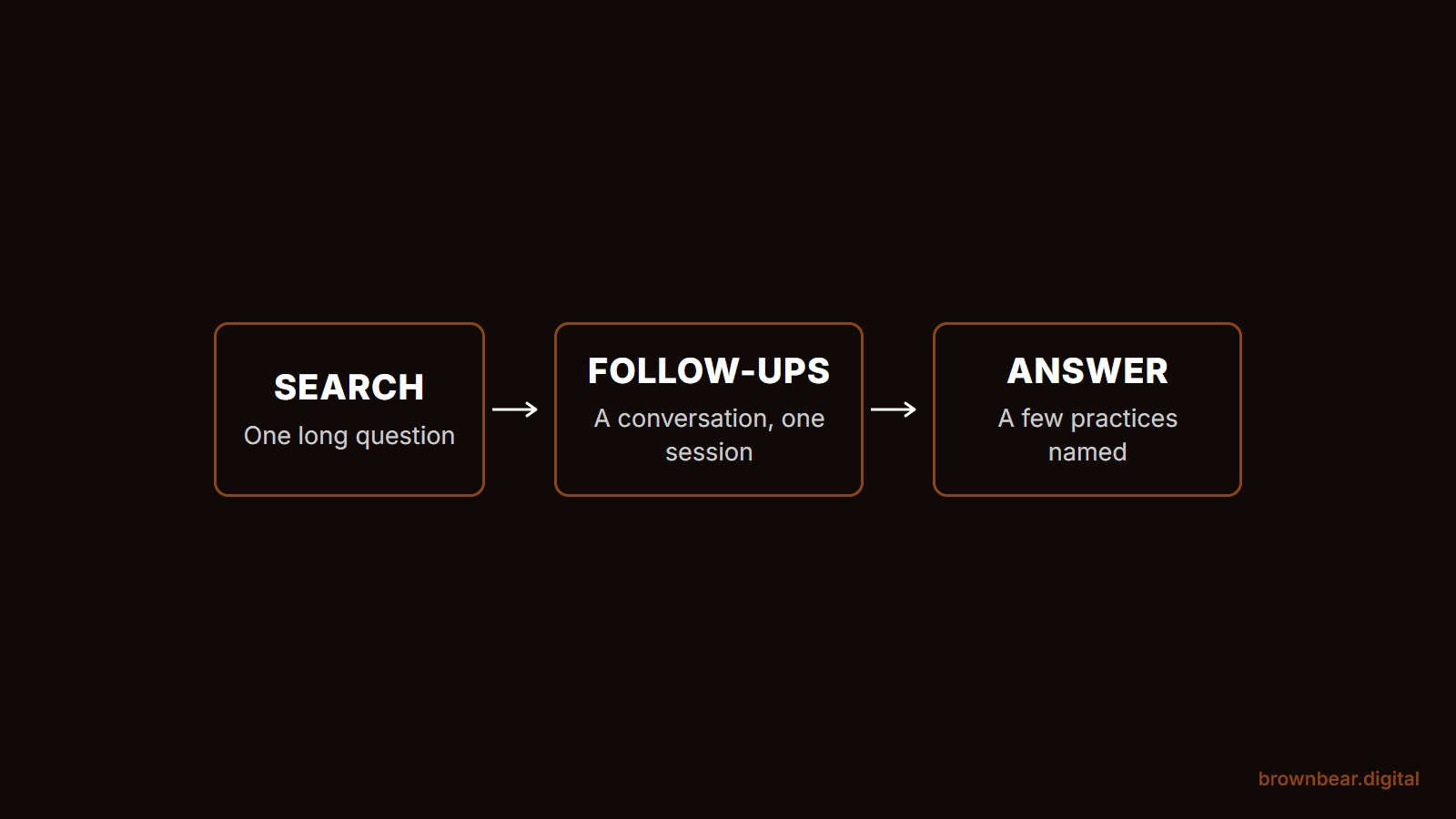
Patients have started asking Google the questions they used to save for the consultation. In AI Mode, a patient can type "is a mini tummy tuck enough after two kids, and how soon can I lift my toddler again," get a written answer, and keep asking follow-ups without ever scrolling a list of links. This is Brown Bear's guide to Google AI Mode for medical practices: what it reads, how to measure it, and what Google's new healthcare ads test means for your budget.
It draws on what Bryan Passanisi, founder of Brown Bear Digital, sees in AI visibility work for plastic surgery practices, alongside Google's own documentation and the 2026 announcements that changed how often patients end up in AI Mode without choosing it.
When we say AI Mode SEO, we mean both sides of the screen: the organic side, where your practice gets cited or named inside the answer, and the paid side, where Google is now testing healthcare ads in the same conversation. A solo surgeon and a ten-location group share most of the work, and we'll say where they split.
If you own a practice, you may have noticed patients arriving with sharper questions and fewer website visits behind them. If you run marketing for a group, you are probably being asked whether AI Mode needs its own budget line. And if you manage the Google Ads account, you want to know whether the healthcare test should change how your campaigns are built.
By the end, you'll know which patient questions AI Mode is likely to answer, what it reads before it mentions a practice, what you can and cannot measure today, and what to fix in the next 30 days. The longer payoff is a practice that shows up the same way, accurately, whether a patient searches, scrolls, or asks.
We've grouped it into four parts: what AI Mode is and why it is growing, what it pulls from, the ads test, and how to track and prepare. So start with the basic question: what is AI Mode, exactly?
What Google AI Mode Is, and How It Differs From an AI Overview
Google AI Mode is a conversational search experience inside Google Search, powered by Gemini, that answers long or multi-part questions in written form, cites a small set of sources, and lets the searcher keep asking follow-ups. An AI Overview is a summary placed at the top of a normal results page. AI Mode replaces the results page with the conversation itself.
Google rolled AI Mode out to all US users in May 2025. Under the hood, both features work the same way: according to Google's documentation on AI features and your website, AI Overviews and AI Mode may use "query fan-out," issuing multiple related searches across subtopics and data sources to build a response. The same page explains the eligibility rule. To appear as a supporting link, a page must be indexed and eligible to show in Search with a snippet. There are no extra requirements and no special markup.
| AI Overview | AI Mode | |
|---|---|---|
| Where it appears | Top of a normal results page | Its own conversational view |
| Typical question | Short, single question | Long, layered question with follow-ups |
| How sources are found | Query fan-out over Google's index | Query fan-out over Google's index, often more sub-searches |
| What sits below it | Organic results, ads, map pack | The conversation; organic results are a click away |
| Eligibility for your pages | Indexed and snippet-eligible. No special files or schema required. | Indexed and snippet-eligible. No special files or schema required. |
If you want the mechanics of the summary box itself, our breakdown of how Google builds an AI Overview covers it layer by layer. For AI Mode, the practical takeaway is simpler. There is no separate AI Mode index to submit to. If Google can crawl, index, and quote your pages, they are in the pool.
Why AI Mode Is Getting Harder for Practices to Ignore
AI Mode stopped being a side tab in 2026. At Google I/O in May 2026, Google said AI Mode had passed one billion monthly users within a year of launch. Then two changes started moving patients into it without a deliberate click.
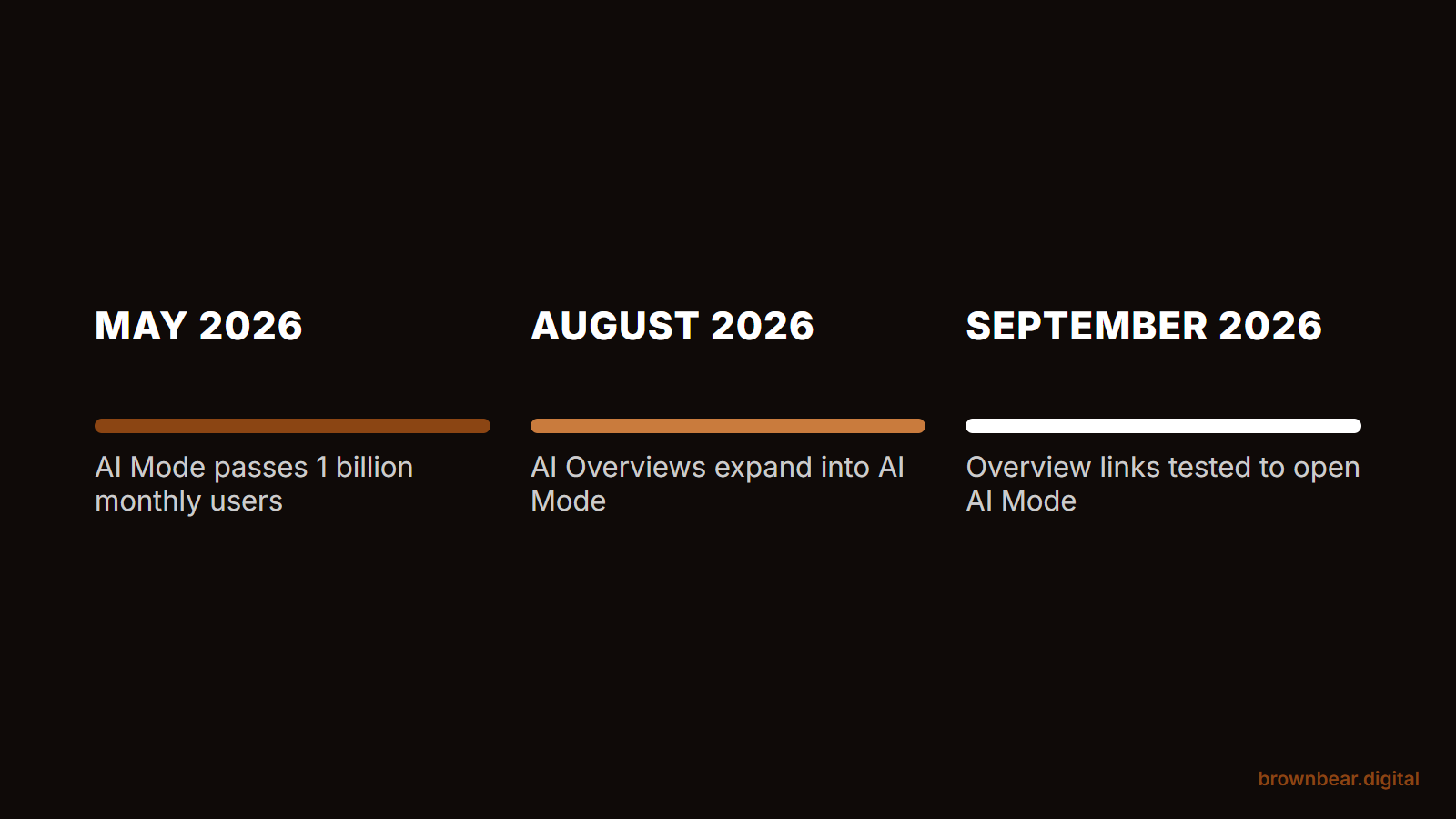
- AI Overviews that expand into AI Mode. In late August 2026, Google confirmed that for some queries, AI Overviews "may dynamically expand" into a fuller response with the follow-up box already open. Search Engine Roundtable reported the change on August 28, 2026.
- Links inside AI Overviews that open AI Mode. In September 2026, Search Engine Roundtable reported a test, spotted by Gagan Ghotra, where linked phrases inside an AI Overview answer opened AI Mode instead of a web page.
Put together, the line between an AI Overview and AI Mode is getting thin. A patient can start with a normal search and finish in a conversation.
Clicks fall when that happens. In a preregistered field experiment with 1,100 participants, posted as a preprint in August 2026, researchers from the University of Pennsylvania and Northeastern found that routing people's searches into AI Mode cut click-through to outside websites by 18.8 percentage points compared with normal Google Search. Semrush's early clickstream study put the zero-click rate for AI Mode sessions at 92 to 94 percent, though that was measured on US desktop sessions from May to July 2025, in AI Mode's first months.
Fewer clicks is not the whole story for a practice. Bryan's observation from client work is that AI-assisted patients compress the research journey: "what type of breast augmentation is right for me" turns into "who's best near me" inside one session, without bouncing across a dozen sites. The visits that do arrive tend to come later in the decision and with more intent.
Picture a 38-year-old mother of two researching a tummy tuck. Her first question is whether a mini tummy tuck is enough. Her second asks about recovery with small children at home. Her third asks for surgeons near her with strong reviews. Three questions, one session, and the practices named in that last answer are the only ones she visits. That is the shift: fewer chances to be seen, but each one sits closer to a booked consult.
Which Patient Questions Land in AI Mode, and Which Still Go to the Map
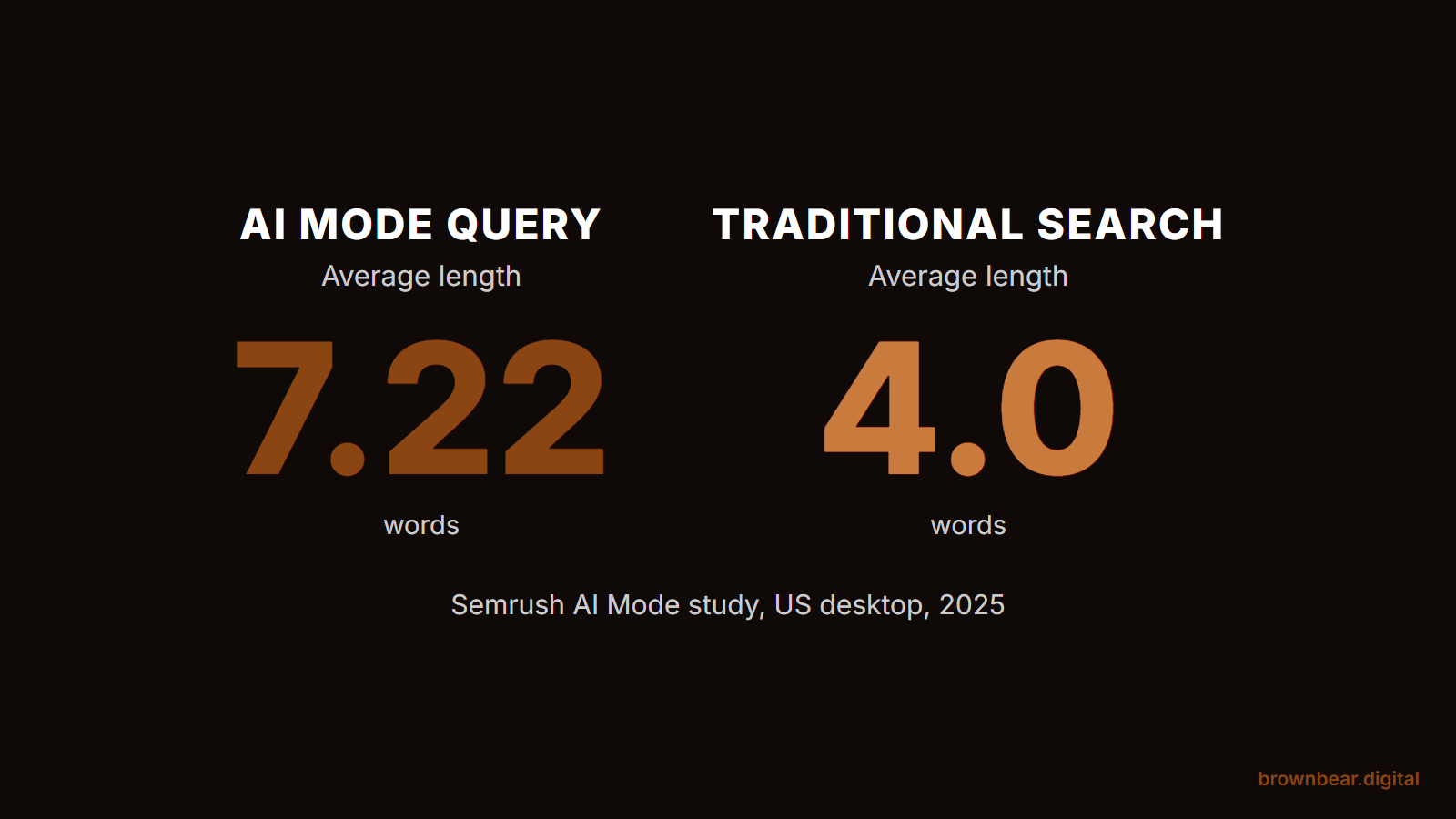
Long, layered research questions are AI Mode territory. Short local searches and searches for a named practice still lean on the map pack and your Google Business Profile. The same Semrush study found the average AI Mode query ran 7.22 words against 4.0 for a traditional search, which matches what patients do when they finally get to ask the real question.
| Patient question type | Example | Where it tends to land | What earns you a place |
|---|---|---|---|
| Definition | "What is a deep plane facelift" | AI Overview or AI Mode, usually citing large health publishers and societies | Hard for a practice to win; not where to start |
| Comparison and candidacy | "Mini vs full tummy tuck after two c-sections" | AI Mode, often with follow-ups | Procedure pages that answer the specific variant, by name |
| Recovery and logistics | "How long off work after rhinoplasty, desk job" | AI Mode | A recovery section with real timelines, written by the practice |
| Cost | "Breast augmentation cost in Denver with financing" | AI Mode or AI Overview, with local intent | A cost page with ranges and what changes the price |
| Provider choice | "Best rhinoplasty surgeon near me for revisions" | Map pack, AI Mode follow-ups | Business Profile, reviews, third-party profiles, consistent details |
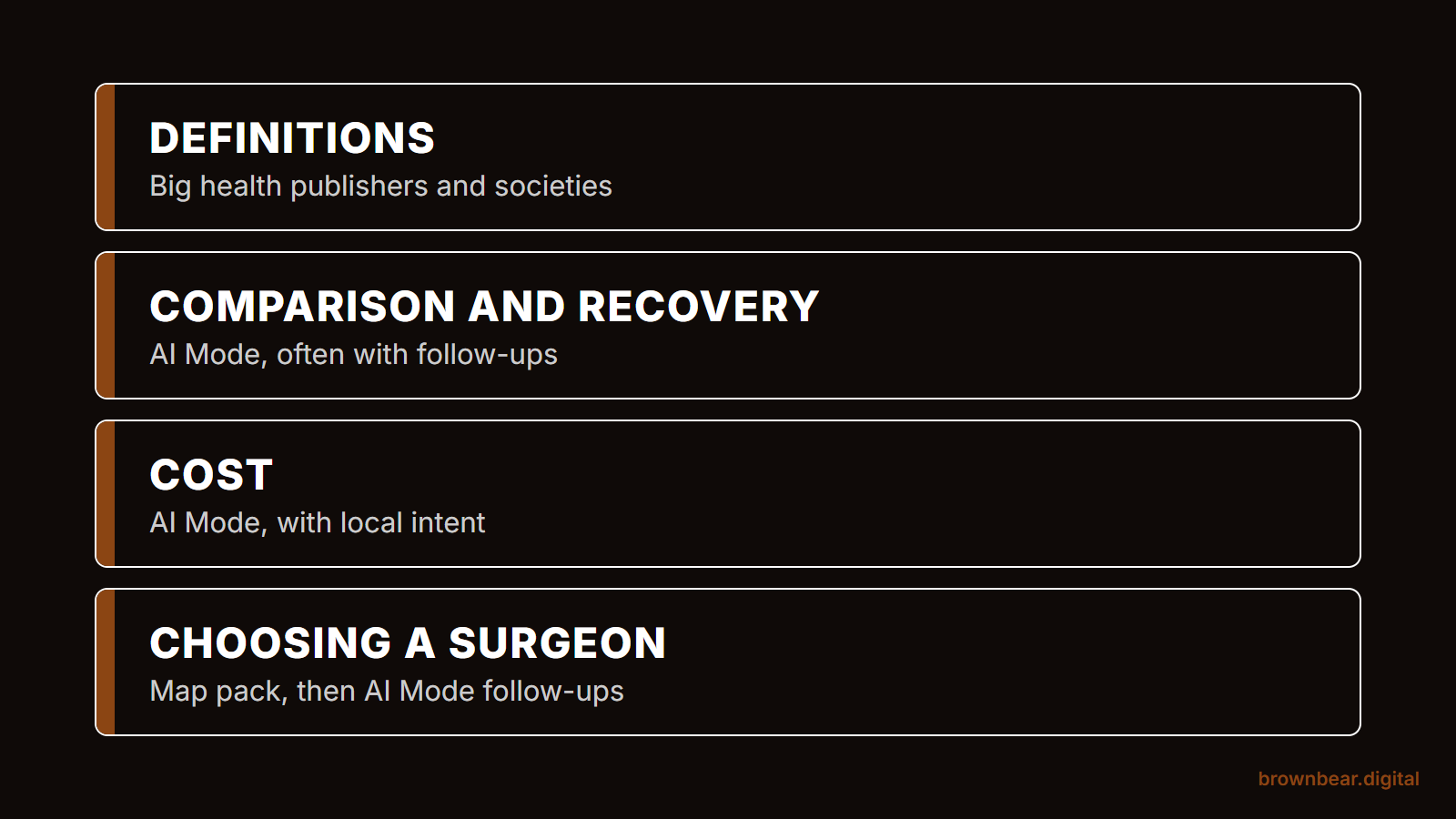
That table follows a split Bryan sees across client accounts. Large authority sites such as Mayo Clinic and the American Society of Plastic Surgeons are taking over AI answers for head terms like "what is breast augmentation." Local and focused questions, cost above all, still open the door for practices, because Google and the language models infer local intent and pull in surgeons from the area.
Where you should focus depends on your footprint. If you are a single-location practice, put your effort into cost, recovery, and comparison questions for the three or four procedures that drive revenue, plus a flawless Business Profile. Definitions are not worth the fight. If you run a multi-location group, the bigger risk is inconsistency: one location listed with an old phone number or a retired surgeon is enough for an AI answer to repeat it. Fix the location data before writing anything new.
What AI Mode Reads Before It Mentions Your Practice
AI Mode builds its answer from Google's index and Google's other data. When Google introduced AI Mode, it said the feature could tap "fresh, real-time sources like the Knowledge Graph, info about the real world, and shopping data" on top of web content. For a medical practice, that comes down to four sources you can see and influence:
- Your own site. Procedure, cost, recovery, and surgeon pages that are crawlable and say specific things.
- Your Google Business Profile and reviews. Hours, categories, services, photos, and what patients write about you.
- Third-party pages about you. Hospital rosters, specialty board profiles, directories, review sites, and press.
- Consistency across all three. When the details disagree, the answer can pick the wrong one.
The first source surprises most owners in one direction. In Brown Bear's 101-city study of top-ranking breast augmentation pages, 52% of the number one results were the practice's homepage, not a procedure page, and 6 winners carried no structured data at all. Google is ranking the practice, not just the page, and AI Mode reads from that same index.
Bryan's view follows from that. Schema is still worth keeping tidy, but it is overhyped as an AI search lever. The bigger on-site levers are crawlability and plainly structured content. Language models crawl JavaScript poorly, and Brown Bear strips large amounts of script off client sites so the words on the page can actually be read.
The third source surprises owners in the other direction. When Bryan's team runs AI visibility audits, owners are most surprised by how little they show up compared with competitors, and by how much third-party sites shape that visibility. Our research on the third-party sources AI reads about a practice shows how heavily rosters and board profiles weigh. The information is rarely wrong outright. More often the procedures a surgeon wants to be known for are buried, so the AI sees a generalist. The most common true error is small: odd variations of the practice's name, address, or phone number.
The Fan-Out Map: one patient question, six hidden searches
Because AI Mode fans a question out into sub-searches, the useful way to plan content is to work backwards from one real patient question to the searches it probably triggers, then check which page on your site answers each one. Google does not publish the sub-queries, so treat the list below as an illustration built from the question itself, not a leak of Google's internals.
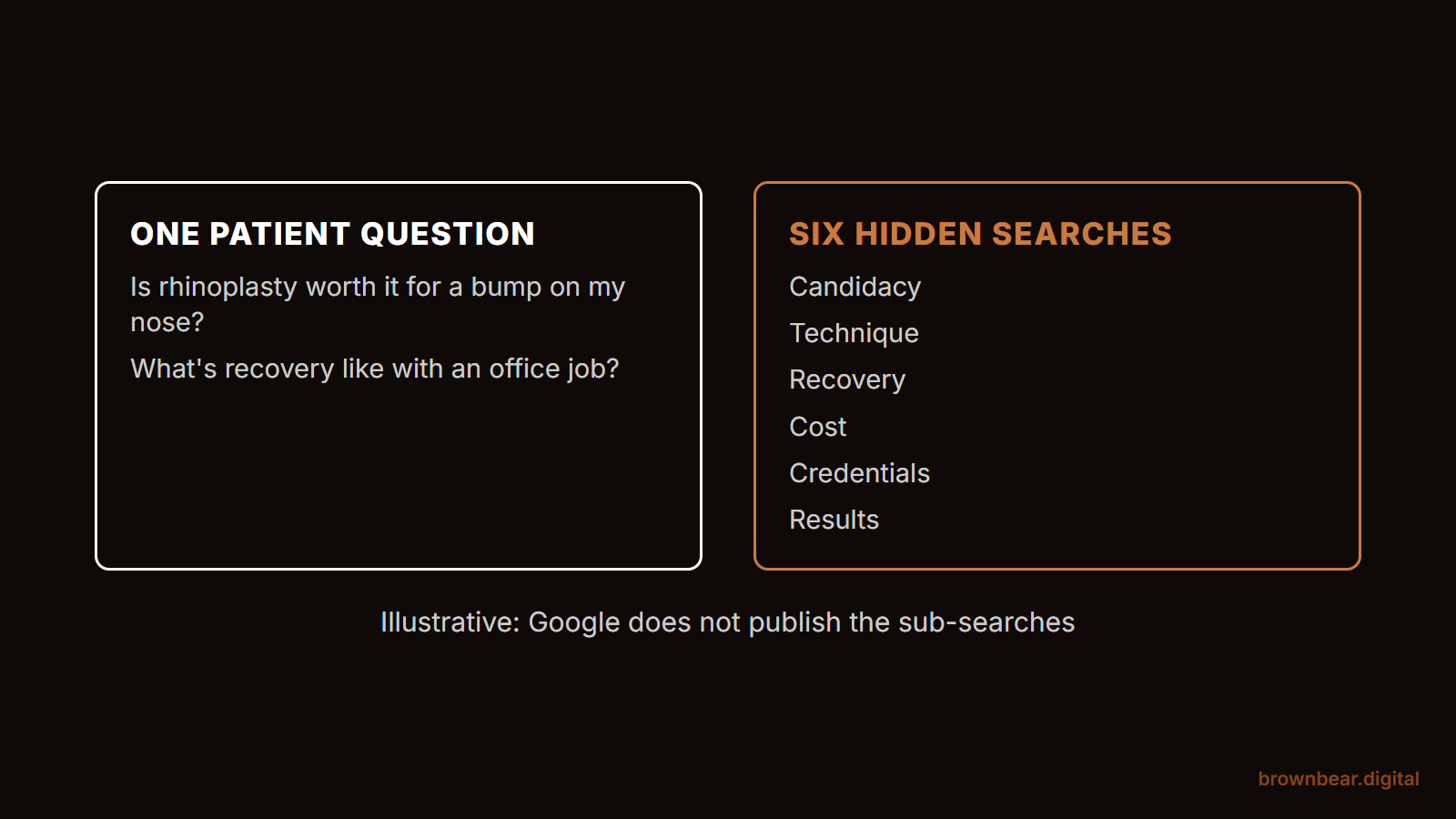
| Patient asks: "I have a bump on my nose. Is rhinoplasty worth it, and what's recovery like if I work in an office?" | The page or asset that should answer it |
|---|---|
| Dorsal hump reduction results and who is a good candidate | Rhinoplasty page, a section on hump reduction specifically |
| Open vs closed rhinoplasty for a hump | Rhinoplasty page, technique section in plain language |
| Rhinoplasty recovery week by week, return to desk work | Recovery section or page with a dated timeline |
| Rhinoplasty cost in your city | Cost page with a range and what moves it |
| Surgeon credentials for rhinoplasty | Surgeon bio, board profile, hospital roster, all saying the same thing |
| Real results for similar noses | Gallery cases tagged by concern, plus reviews that mention the procedure |
Say a practice has one rhinoplasty page that opens with "Rhinoplasty can enhance facial harmony" and never mentions a hump, an office job, or a price. Of the six sub-searches above, it answers maybe one. A competitor with a hump reduction section, a recovery timeline, and a cost range answers four. The second practice did not out-write the first. It simply had a page for more of the questions the patient's single prompt turned into.
Run your own version below. Pick a procedure and a patient question type, and the Fan-Out Mapper lists the sub-questions to cover and turns the ones you can't answer yet into a content gap list.
Healthcare Ads in AI Mode: What Google's Test Means for Your Budget
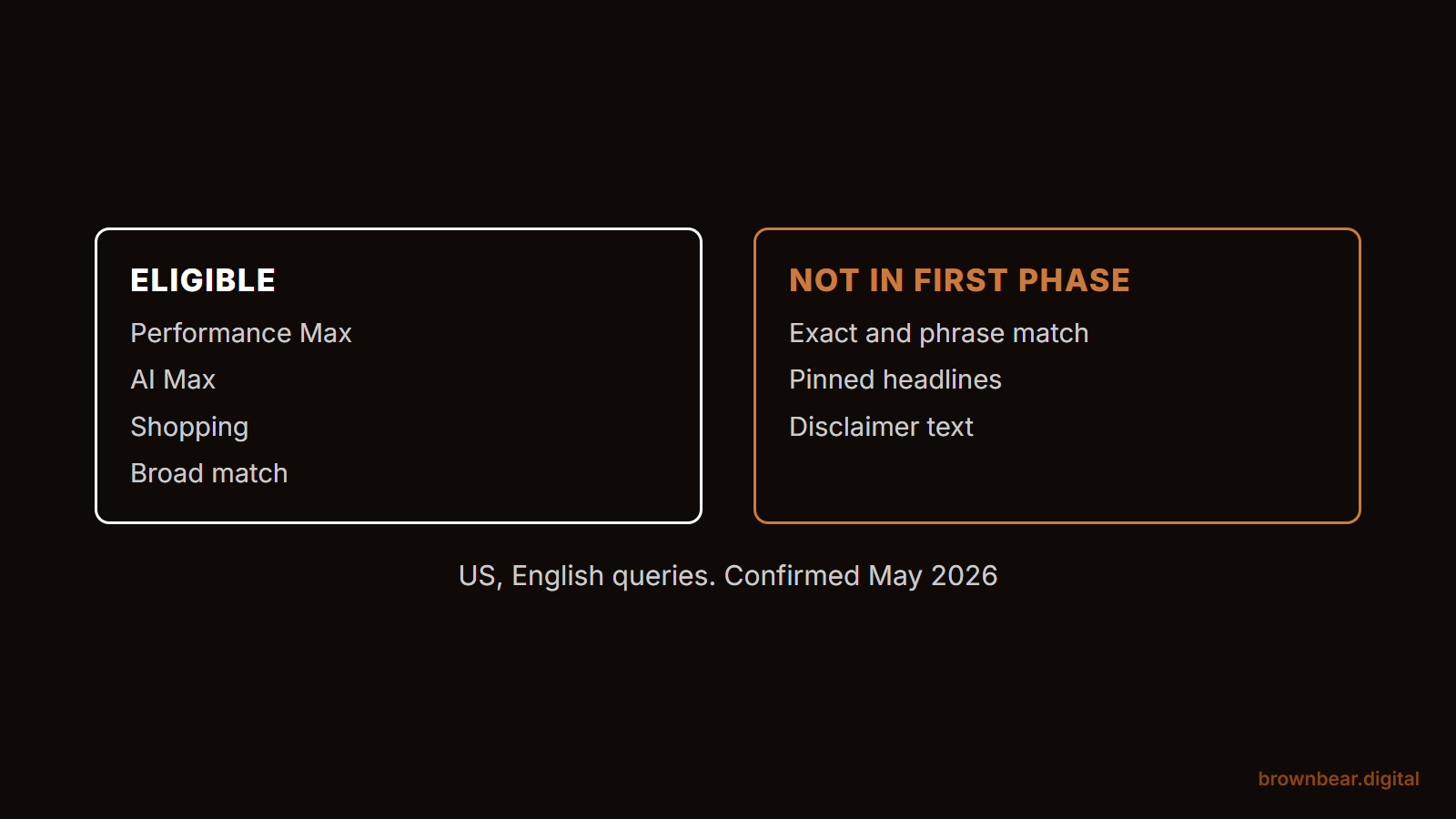
Google is running a small test of healthcare ads in AI Mode, limited to the US and English-language queries. On May 20, 2026, around Google Marketing Live, Google's Ads Liaison, Ginny Marvin, confirmed the test and named the eligible campaign types: Performance Max, AI Max with search terms matching, Shopping, and broad match. She also said the first iteration is limited to creatives that don't use pinning or text disclaimers, and that eligible ads can serve in AI Mode and AI Overviews. Search Engine Roundtable reported the confirmation on June 1, 2026.
Why it matters: until this test, healthcare had been kept out of ad placements inside AI Overviews and AI Mode, as PPC Land reported, though healthcare ads could still show above or below an AI Overview. That door is now open a crack, and the rules about who gets through are already visible:
- Exact match and phrase match keyword campaigns are not on the list. The test favors Google's automated targeting.
- Pinned headlines and disclaimer text keep an ad out of the first phase.
- Google Ads does not offer a separate reporting segment for ads in AI Overviews, and we found none for AI Mode as of early October 2026, so expect to judge results through overall campaign numbers.
That last point is where most practices will get hurt. When Bryan's team opens a Google Ads account a practice says "didn't work," the same two problems almost always show up: efficiency leaking out through campaign and keyword setup that was never tuned for lead quality, and clicks sent to pages not built to convert. Broad match and Performance Max widen the net. If your conversion tracking counts every form fill as a win, an AI placement will happily buy more of the wrong ones.
Picture a med spa running Performance Max with "contact form submitted" as its only conversion. The test expands where its ads can appear, cost per conversion looks great, and the front desk spends the month calling back people asking about jobs and gift card balances. Nothing in the dashboard says AI Mode caused it, because nothing in the dashboard separates AI Mode out.
What to do depends on how your account is built today. If you run exact and phrase match Search campaigns only, do not restructure to chase a small test; keep the keyword control you have and watch for a wider rollout. If you already run Performance Max or AI Max, you may be in the test without knowing it, so tighten what you count:
- Change the primary conversion from form fills to qualified consult requests, and import booked consults as offline conversions.
- Add brand and job-seeker negatives, and exclude careers, gift card, and login pages from final URL expansion.
- Send traffic to procedure pages built to convert, not the homepage.
- Note the test's start in your reporting so a shift in lead quality has a date to line up against.
If your ads rely on pinned headlines or required disclaimer text, you are outside the first phase by definition, and that is fine. For accounts that need a second pair of eyes before a rollout, our paid search management for medical practices starts with exactly this conversion audit.
How to Track AI Mode in Search Console and GA4
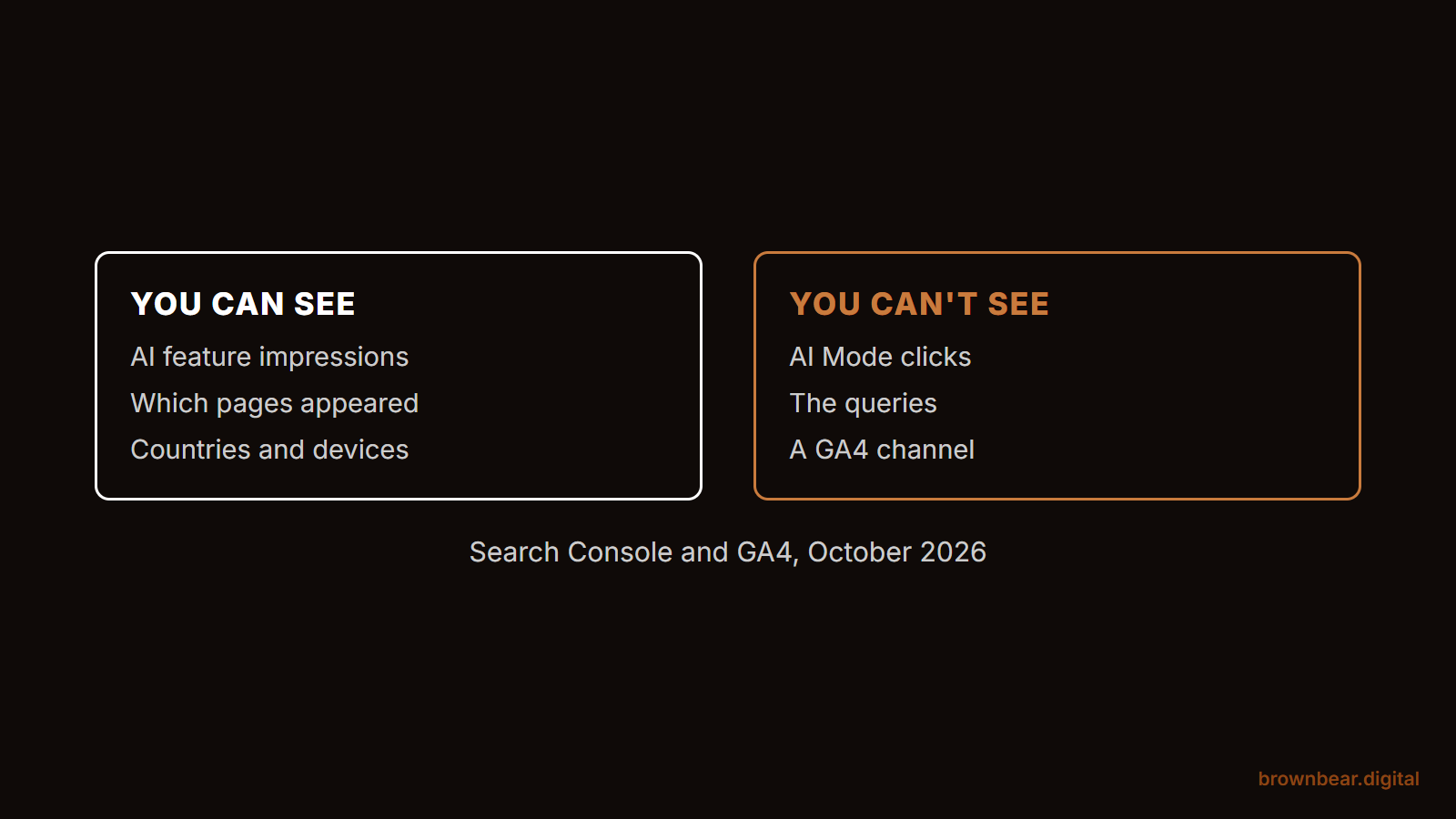
You cannot isolate AI Mode clicks today. Google's documentation says traffic from AI features is included in the Search Console Performance report under the "Web" search type, mixed in with everything else. Google Analytics 4 treats an AI Mode visit as normal Google organic traffic. In May 2025, AI Mode links briefly carried a "noreferrer" setting that made those visits look like direct traffic; Google's John Mueller called it a bug, and the fix followed within days.
What you can see is impressions. On June 3, 2026, Google introduced Search Generative AI performance reports in Search Console, and as of August 31, 2026, they are available to all sites. The reports show impressions, pages, countries, devices, and dates for appearances in generative AI features such as AI Overviews and AI Mode. They do not show clicks or queries yet. Our guide to reading the generative AI report in Search Console covers the impression trap in detail.
One false start worth knowing about: on October 2, 2026, an SEO spotted an "st_source=ai_overview" parameter on links in AI Overviews, and it briefly looked like Google was adding attribution. It turned out to be a Chrome extension rewriting the links. Don't build a report around it.
Bryan's measurement rule for clients is to stop chasing impressions and watch what converts. LLM referral traffic, from ChatGPT, Perplexity, and similar tools, converts to consultations and form fills at a higher rate than other channels and is more engaged. AI Mode will not show up in that report because it lives inside Google, so you need a few proxies alongside it:
- Check the generative AI report monthly and compare its page list against your procedure, cost, and recovery pages. Pages that never appear are the first content gaps.
- Track referrals from ChatGPT, Perplexity, Gemini, and Copilot as their own channel group in GA4. Our AI referral and mention tracking setup walks through it.
- Add "AI assistant, such as ChatGPT or Google AI Mode" as an option on your intake form's "how did you hear about us" question.
- Once a month, ask AI Mode your top five patient questions for each priority procedure and record whether your practice is named and described correctly.
Say a practice manager sees organic clicks flat for the quarter while more new patients tell the front desk "I found you on Google." Nothing is broken. That is what AI Mode looks like in a dashboard: the conversation happened on Google, the click never came, and the patient called anyway. The intake question and the monthly check are the only way to see it.
A 30-Day AI Mode Readiness Plan for Your Practice
Most of AI Mode readiness is work a good practice website should already be doing, done in the right order. Here is the order we'd use:
- Week 1: make your details agree everywhere. Name, address, phone, hours, and surgeon list on your site, Business Profile, specialty board profiles, hospital rosters, and the top directories.
- Week 2: answer the fan-out questions. For your top three procedures, add the missing comparison, recovery, cost, and credential sections, written by the practice in plain language.
- Week 3: make sure Google can read it. Confirm those pages are indexed in Search Console, and that key content isn't hidden behind sliders, tabs, or scripts that load late.
- Week 4: set your baseline. Turn on the reporting above, add the intake question, record your first monthly AI Mode check, and make the ads decision for your account.
The order shifts with the kind of practice you run. If you are a solo surgeon, weeks 1 and 2 are the whole game, and your surgeon bio and board profile should carry the specialty you want to be known for. If you run a multi-location group, stretch week 1 to two weeks and audit every location separately, because one stale listing gets repeated. If you run a med spa, put cost and membership pages first, since treatment pricing is the question patients ask most and the one spa sites most often leave out.
The AI Mode Readiness Check below turns the plan into a scored list, so you can see where you stand before week 1.
The immediate payoff is a short list of fixes you can start this week instead of a vague worry about AI. The long-term payoff is a practice that every version of Google search describes the same way, accurately, with the procedures you want to be known for front and center. For the wider strategy around it, see our AI search optimization guide for plastic surgery practices.
Get Your Practice Ready for AI Mode With Brown Bear
AI Mode rewards the practices whose sites, profiles, and third-party listings all tell the same specific story. Brown Bear builds the on-site SEO and the off-site foundations together, because AI visibility depends on both, and we measure it by consults rather than impressions. If you want to know how your practice shows up when a patient asks Google instead of searching it, start with our SEO for medical practices in AI search.
Written By
Founder, Brown Bear Digital
Bryan has 15 years of experience across SEO, paid search, and AI search strategy. He founded Brown Bear to give businesses direct access to senior-level search expertise without the agency overhead.
Learn More About BryanGet Found on Google.
Get Cited by AI.
Tell us about your site. We'll send back a proposal for SEO and AI search.