How to Choose a Plastic Surgery SEO and AI Search Agency in Dallas
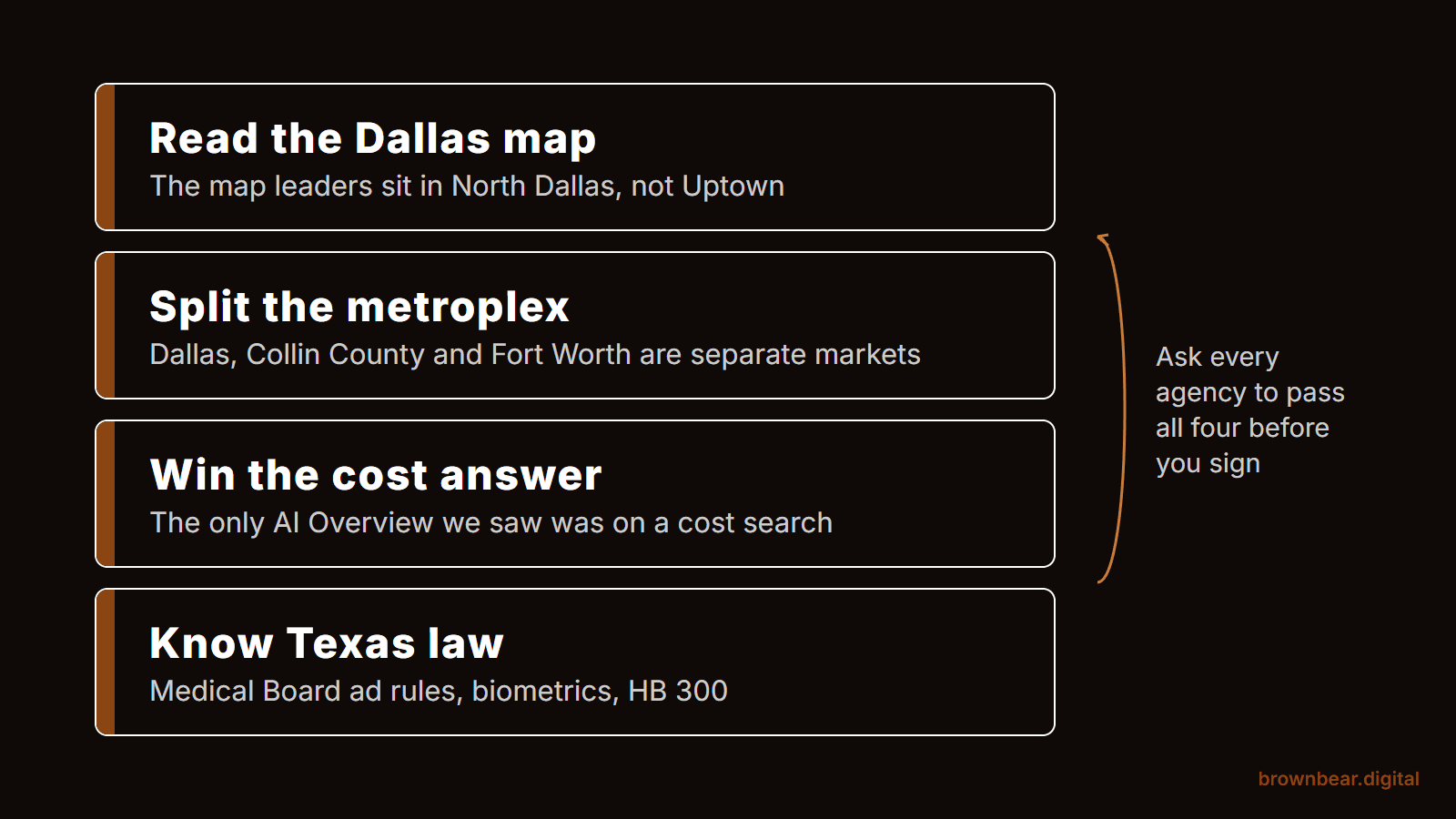
Every agency that pitches a Dallas plastic surgery practice says it knows the North Texas market. Few of them show up having searched it. The quickest way to sort them is to look at what Dallas patients see on Google and in AI answers, then ask each agency to explain those results back to you. An agency that can read your map results, your first page and the AI answers for your procedures deserves a second meeting. One that can't is pitching a template.
This is a buyer's guide built from the market itself. On October 28, 2026 we ran six live Google searches across Dallas, Plano and Fort Worth, recorded who held the map, the first page and the AI Overview, and turned each finding into an interview question with what a good answer sounds like. We also read the Texas statutes and Medical Board rules an agency runs into when it writes your ads, adds a face simulation tool, or touches your consultation leads.
When we say an SEO and AI search agency, we mean the firm responsible for both your Google results, meaning the map, the regular listings and AI Overviews, and the answers assistants like ChatGPT and Perplexity give when a patient asks who to see.
If you're a solo surgeon in Uptown or the Park Cities, you're competing for the most crowded searches in the metro. If you run offices in Dallas and Plano or Frisco, you're really running two or three practices in search. And if your practice is in Fort Worth or Southlake, the first question is whether you're in the Dallas market at all. By the end you'll have the questions to ask, the answers that should satisfy you, and a list of the Texas rules a careless agency can put you on the wrong side of.
One disclosure up front. Brown Bear is an SEO and AI search agency, so we're one of the firms you might interview. We're based in the San Francisco Bay Area and would serve a Dallas practice remotely. We apply every test in this guide to ourselves near the end, including the ones where not being in Dallas counts against us.
The guide runs in four parts: what DFW results show, how the metro splits into separate markets, how to test AI search claims, and the Texas rules and contract terms to settle before you sign. Let's start with what a patient actually sees.
What This Guide Adds to the General Hiring Advice
The hiring advice that applies to any SEO agency lives in our national guide: reading their own rankings, red flags like guaranteed results, what a fair contract looks like. Our plastic surgery agency evaluation guide adds the questions agencies dread, reference checks and a scorecard you can use in every pitch. Read one of those first if you have never hired an agency. Everything below is what changes when the market is Dallas and Fort Worth and the law is Texas law.
What Dallas Search Results Show Before Any Agency Pitches You
We searched six terms on October 28, 2026: "plastic surgeon dallas", "breast augmentation dallas", "mommy makeover dallas", "plastic surgeon plano", "plastic surgeon fort worth" and "tummy tuck cost dallas". The searches ran from outside Texas with the city in the query, so a patient in Preston Hollow may see a slightly different map. The patterns are what matter, and they are clear enough to build an interview around.
| Search | Map results | First page | AI Overview |
|---|---|---|---|
| plastic surgeon dallas | 3 practices on LBJ Freeway, Preston Road and Forest Lane | Practice sites, the ASPS Find a Surgeon directory and UT Southwestern | None |
| breast augmentation dallas | 3 practices, two of them also in the plastic surgeon map | 8 results, mostly practice procedure pages, plus UT Southwestern | None |
| mommy makeover dallas | 3 listings, two of them belonging to one practice | 9 practice sites, including UT Southwestern | None |
| plastic surgeon plano | 3 Plano practices | Plano practice sites and Yelp | None |
| plastic surgeon fort worth | 3 Fort Worth practices, none from the Dallas maps | Fort Worth practice sites and two Texas Health Resources pages | None |
| tummy tuck cost dallas | None | Practice cost pages | Yes, citing practice sites and a surgeon's YouTube video |
Five findings come out of that table. Each one is a test for the agencies on your list.
1. The Dallas map sits in North Dallas, not Uptown
All three map results for "plastic surgeon dallas" had addresses on LBJ Freeway, Preston Road and Forest Lane, the North Dallas corridor around Preston Center and the Medical City campus. None was in Uptown. Two practices appeared in the map for all three Dallas procedure searches.
Ask:
"Where is our office relative to the practices that hold the Dallas map, and what does that mean for how we compete?"
A good answer sounds like:
the agency already knows where the map leaders are, tells you whether your address can realistically win the citywide map, and if it can't, shifts the plan to procedure pages, reviews and neighborhood searches. It brings a benchmark, not a hunch. Our 101 city breast augmentation study found that winning procedure pages in competitive metros ran 2,000 to 2,500 words with a gallery on nearly every one, and that is the kind of evidence a good agency should put on the table.
2. One practice can hold two of the three map spots
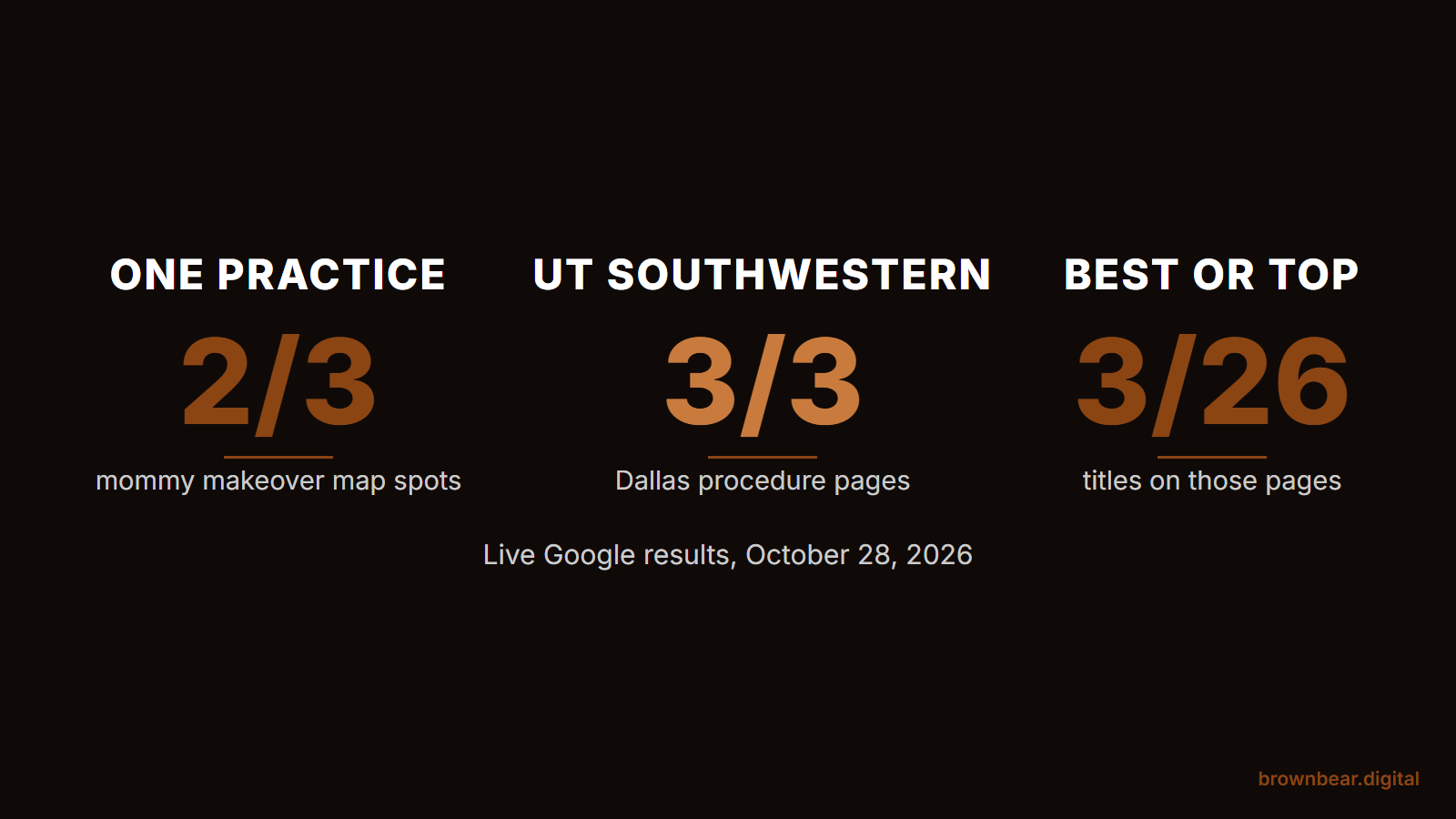
For "mommy makeover dallas", one practice held two of the three map listings: its Preston Road office and its Plano office. Its page title names both cities. In Dallas, a practice with more than one well-reviewed location can take most of the map for a procedure, and the review count behind each listing is part of why.
Ask:
"Could our offices hold more than one map spot for our main procedure, and what would each location need?"
A good answer sounds like:
the agency treats every office as its own listing with its own reviews, photos and location page, and it can show you which competitor is already doing this. If you have one office, a good answer explains how to compete against a practice that shows up twice.
3. UT Southwestern is on every Dallas procedure page
UT Southwestern Medical Center appeared on the first page for all three Dallas procedure searches. The American Society of Plastic Surgeons directory took one seat for the broad search. Practice sites held almost everything else, and several titles carried superlatives: 3 of the 26 titles on those three first pages used "best" or "top".
Ask:
"Which institutional and directory pages show up for our procedures, and where do we have room to beat them?"
A good answer sounds like:
the agency is realistic. You won't outrank an academic medical center on its own name, but its procedure pages are often thinner than a dedicated practice page, and that's where you can win. On the superlatives, a good agency doesn't copy them. Texas has specific rules on comparison claims, covered later in this guide.
4. The only AI Overview showed up on a cost search, and it cited a surgeon in Honolulu
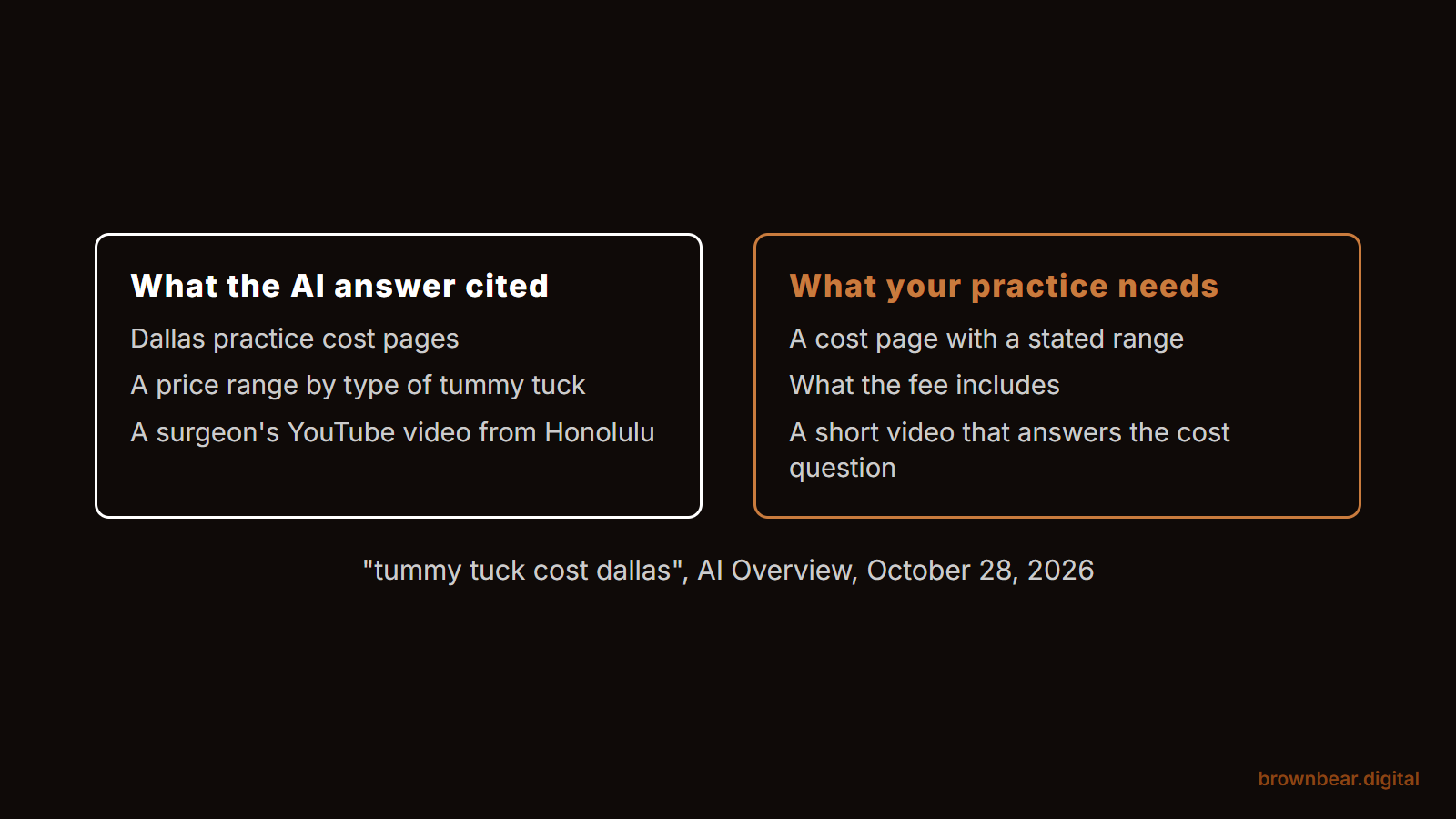
None of the five procedure and city searches showed an AI Overview. "tummy tuck cost dallas" did. It gave a Dallas range of $9,000 to over $20,000, broke the price down by type of tummy tuck, listed what the fee usually includes, and cited Dallas practice sites as its sources. It also cited a YouTube video from a plastic surgeon whose practice is in Honolulu. Nearly every organic result on that page was a practice cost page or price article.
Picture a mother in Frisco pricing a tummy tuck late at night. She types a cost question, reads the AI answer, and the names she sees are the practices whose cost pages and videos the answer pulled from. A practice without a clear cost page isn't in that answer at all, and a video from a surgeon in Hawaii is. In our work, cost and local procedure searches are where practices still get cited in AI answers, while broad head terms tend to go to large authority sites. Across a subset of our plastic surgery clients, videos that held an AI Overview placement drew at least 70% more impressions than the rest, though we can't say the videos caused the consultation increases we saw over the same period.
Ask:
"Which of our pages or videos could an AI answer cite for a Dallas cost question today, and what would you build first?"
A good answer sounds like:
the agency has already run the cost search for your procedures, shows you who is cited, and proposes a cost page with a stated range, what's included, and financing details, plus a short video that answers the same question.
5. Fort Worth is a different market
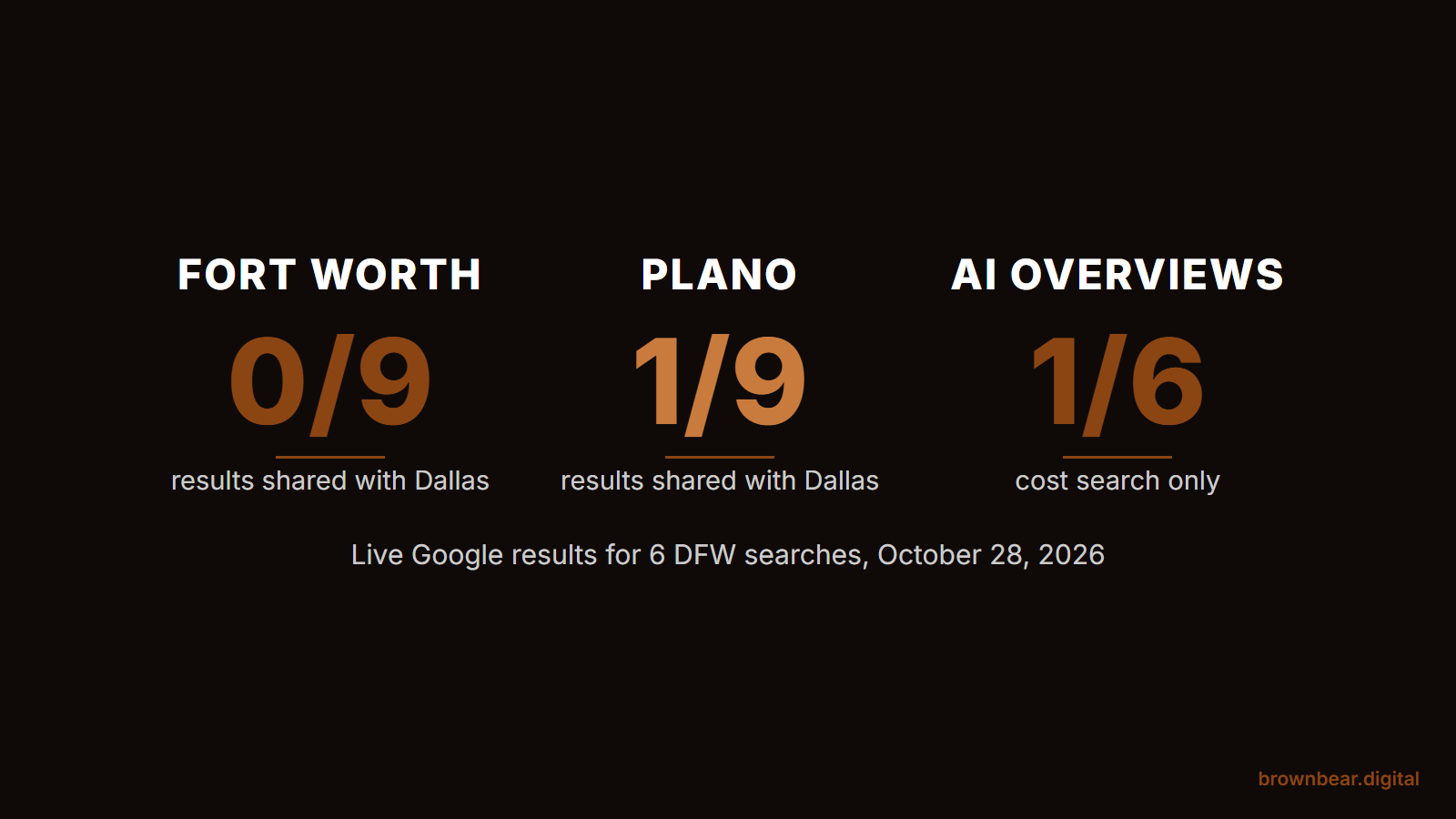
The Fort Worth search shared nothing with Dallas. None of the nine first page results for "plastic surgeon fort worth" appeared on any Dallas first page we captured, and none of its three map results appeared in a Dallas map. Texas Health Resources took two seats. One Fort Worth practice puts "Fort Worth Dallas" in its page title, and it still appeared only on the Fort Worth page.
Ask:
"If we want patients from both sides of the metroplex, what will you build for each one?"
A good answer sounds like:
the agency treats Fort Worth as its own market with its own competitors, and doesn't claim a "DFW" page or title will rank in both. The next section is about why that matters for how your practice is built.
Choosing an Agency for Multi-Office, Suburban and Fort Worth Practices
The same agency can be right for a single Uptown office and wrong for a practice with three locations, because the DFW metroplex behaves like several search markets, not one. Before you compare pitches, decide which of these describes you, since each one changes what you should ask.
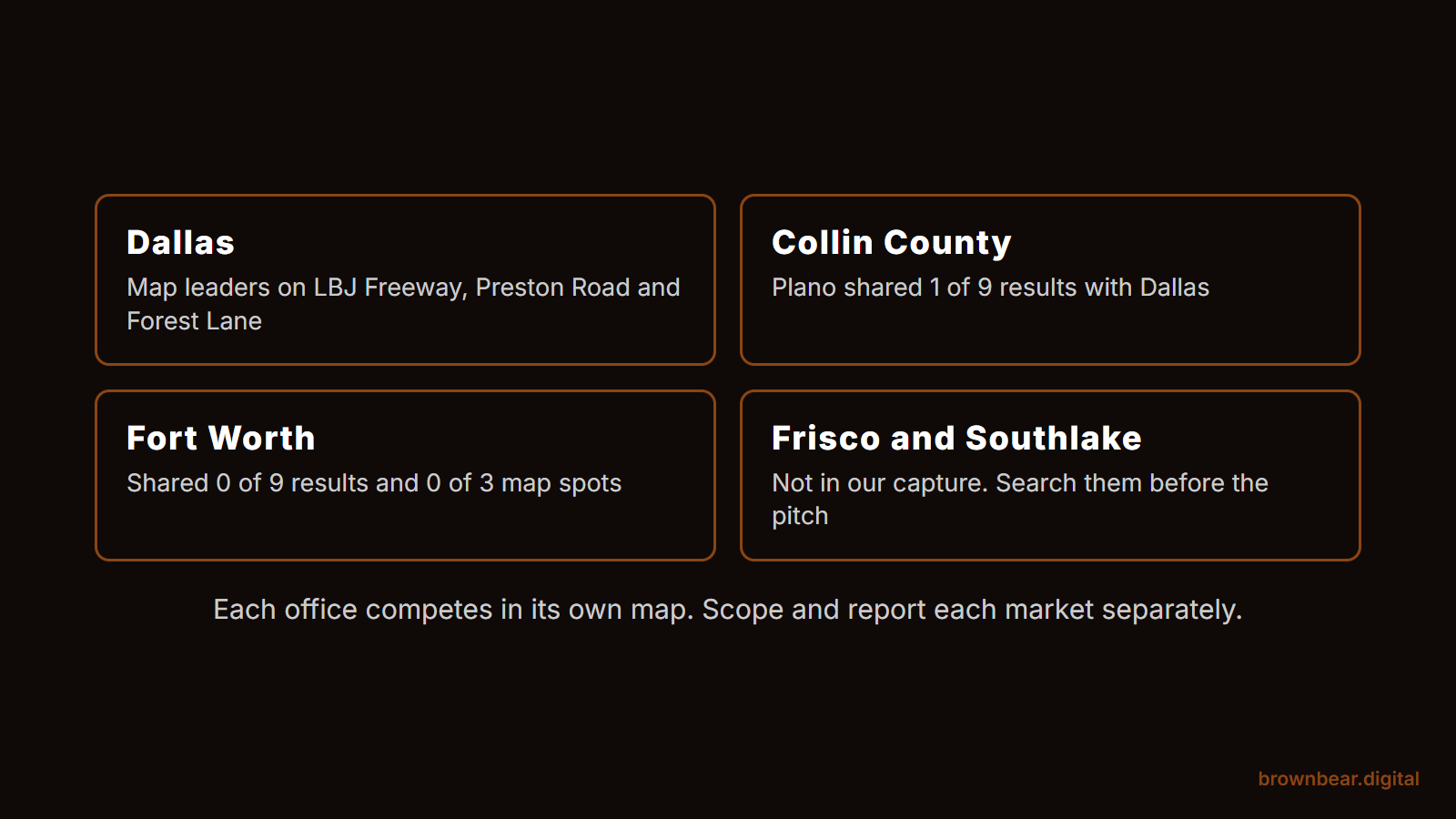
For Fort Worth practices
Fort Worth patients see Fort Worth practices: in our capture, the Fort Worth first page and map had no overlap with Dallas, and a hospital system took two organic seats. Searches for "plastic surgeon fort worth" run about 590 a month, against about 1,000 for Dallas, so this is a large market in its own right. A Fort Worth practice should hire for Fort Worth and ignore pitches built around Dallas head terms. Ask each agency to show you the Fort Worth results for your procedures, and treat any plan that leads with "Dallas" keywords as a sign it hasn't looked.
For multi-office practices
The practice that held two of three map spots for "mommy makeover dallas" did it with a Dallas listing and a Plano listing, each with hundreds of reviews. That is the model for a multi-office group: each office competes in its own map, with its own reviews and its own page. Ask how the agency will build a page and a profile for every office, how it keeps two offices from competing for the same searches, and how it reports each location separately.
For suburban practices in Plano and Frisco
Only 1 of the 9 first page results for "plastic surgeon plano" also ranked for "plastic surgeon dallas", and the Plano map was led by the Plano office of a Dallas practice. One Plano practice ranks with "dallas" in its domain name, which tells you the domain matters less than the location signals behind it. A suburban practice usually doesn't need to beat Uptown at all. Ask the agency to scope around the suburbs your patients drive from, and to bring live results for Frisco or any suburb we didn't search, since we haven't verified those.
Use the check below to see how many separate markets your offices sit in, along with the searches and questions to bring to each pitch.
Local or Remote: What a Dallas Office Actually Buys You
A Dallas office isn't proof that an agency knows Dallas search, and a remote agency isn't automatically blind to it. What matters is which parts of the work need someone in the building.
| Being in DFW helps with | Being in DFW matters little for |
|---|---|
| Photo and video shoots at your office for procedure pages, your Google Business Profile and YouTube | Technical SEO, site speed and how AI crawlers read your site |
| Training front desk staff on how search calls are answered and booked | Procedure and cost pages, galleries and on-page work |
| Dallas and Fort Worth press, events and podcasts that earn links and mentions | Map and AI answer tracking, which can be set to any ZIP code |
| Knowing which suburbs your patients actually drive from | Reporting, Search Console and analytics |
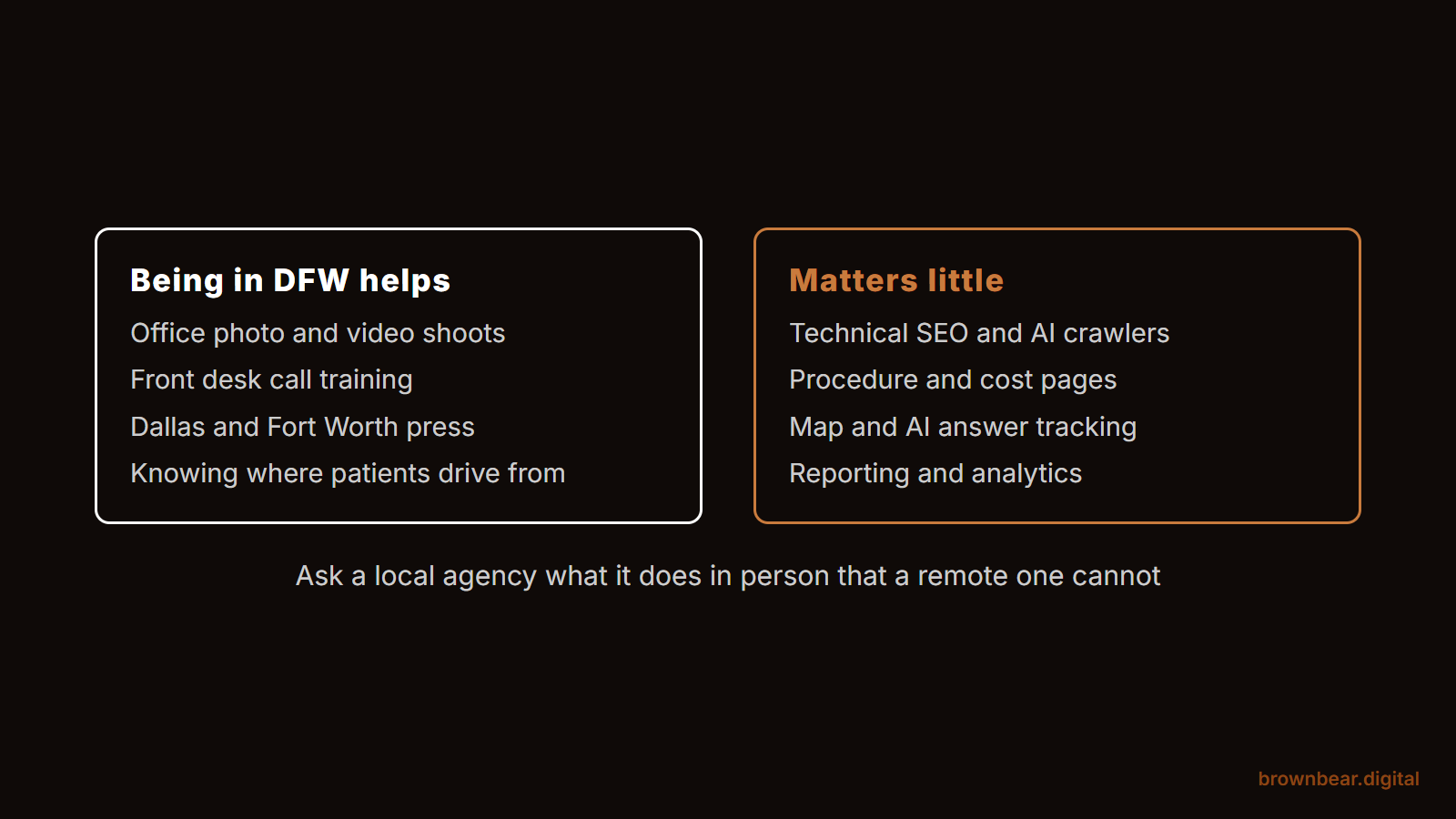
Say an agency with an Uptown office pitches you and leans on being local. Ask what it does in person that a remote agency can't. If the answer is "we know the area" and nothing specific, the office is decoration. If the answer is quarterly shoots, staff call training and introductions to local press, it's worth paying for.
Ask a remote agency:
"How do you see what a patient in Plano or Fort Worth sees?" A good answer describes rank and AI tracking set to each office's area, plus a plan for on-site work, such as hiring a DFW photographer.
How to Test an Agency's AI Search Claims in Dallas
Most agencies now promise AI search visibility. You can check whether they understand it in about 15 minutes. Run these prompts in ChatGPT, Perplexity and Google AI Mode, each in a fresh session, then ask the agency to run them live in the meeting and explain what comes back.
- "Who are the most experienced plastic surgeons in Dallas for a mommy makeover?"
- "I live in Plano. Who should I see for a breast augmentation consultation?"
- "What does a tummy tuck cost in Dallas, and what's included in the price?"
- "Which plastic surgeons in Fort Worth have the best reviews for liposuction?"
- "I'm in Southlake. Is it worth driving to Dallas for a facelift?"
Score each answer with four checks, one point each:
- Named. Your practice or surgeon appears.
- Correct. Your name, address, phone number and procedures are right.
- Sourced from you. The answer cites your site, your video or a profile you control.
- Right market. You show up for the prompts that match your offices, not just the Dallas ones.
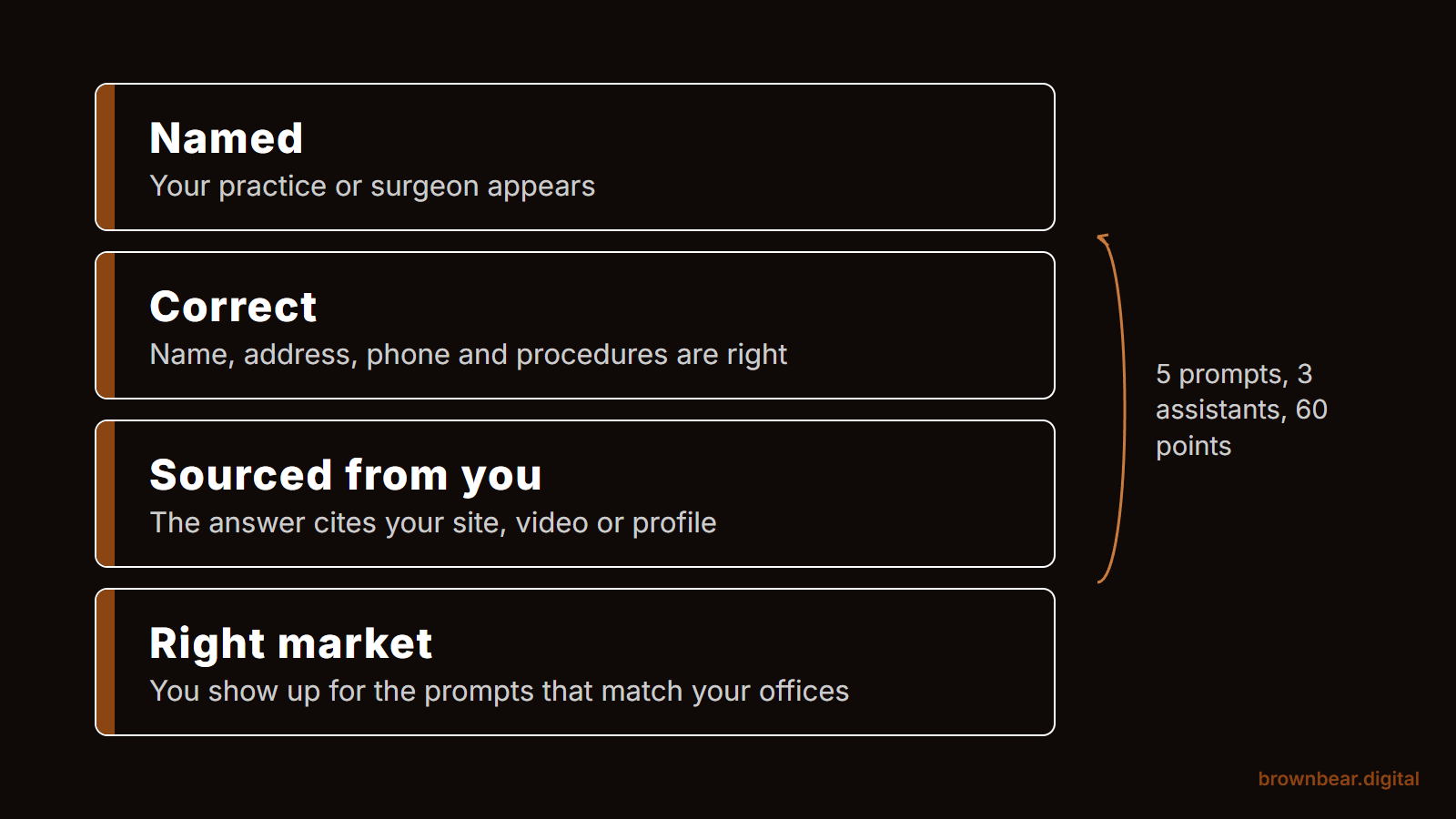
Five prompts across three assistants is 60 possible points. The total matters less than the pattern. A good agency looks at your weakest prompts and tells you why each named competitor was chosen: which reviews, cost pages, videos and directories the answer drew from. An agency that can't explain why a competitor was named can't change it. AI answers also shift from session to session, so judge patterns, not one result, and walk away from anyone who guarantees a mention in ChatGPT.
Texas Rules an Agency Touches When It Markets Your Practice
An agency that writes your ads, adds tools to your site or handles your leads is working inside Texas law, whether it knows it or not. None of this is legal advice, and your healthcare attorney has the final word. What you're testing is whether the agency knows these rules exist and asks before it acts.
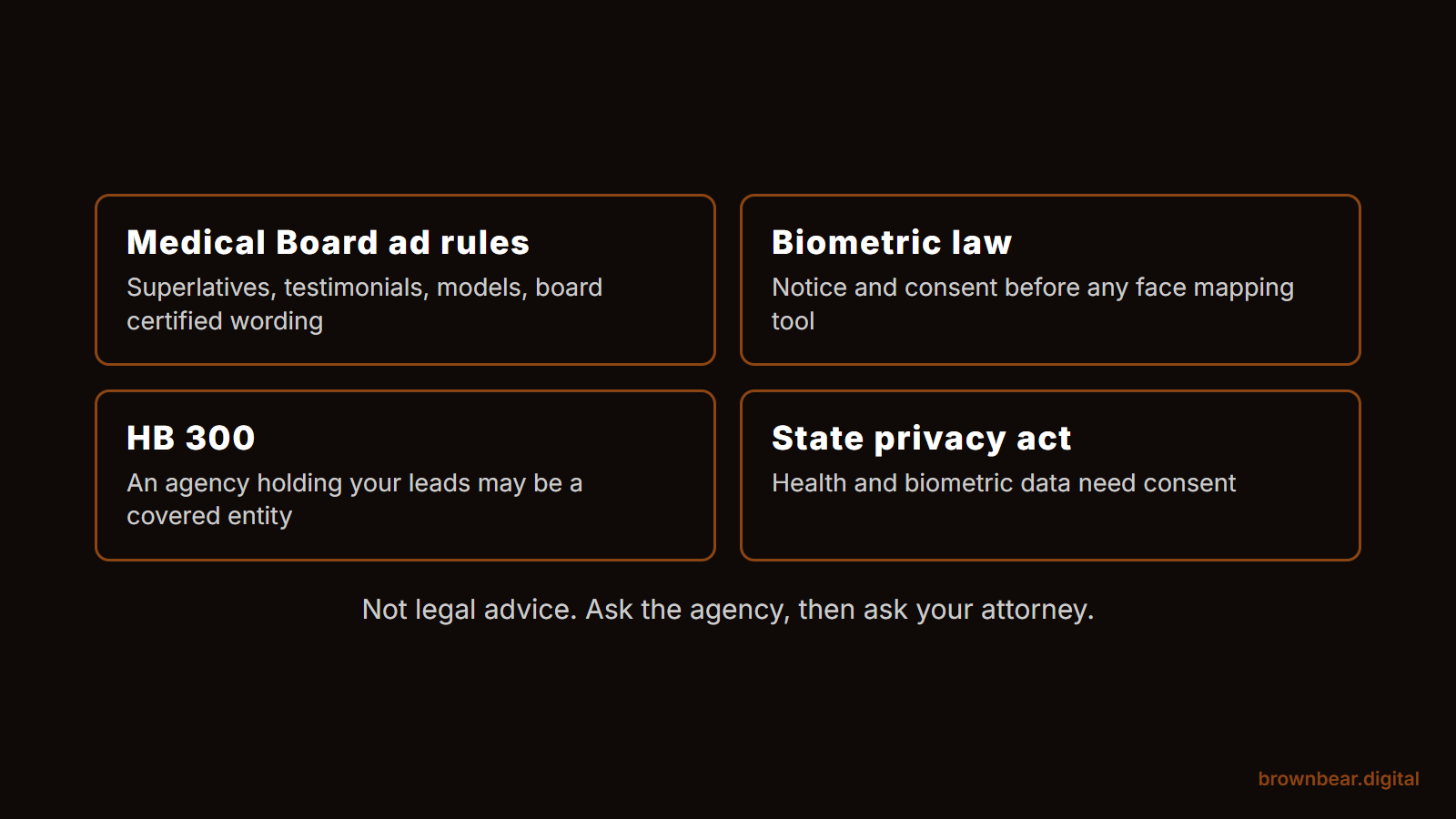
Medical Board advertising rules
The Texas Occupations Code's advertising section treats advertising as false or misleading when it creates an unjustified expectation about results, compares one provider's services with another's without factual substantiation, contains a testimonial, or confuses patients about a provider's credentials. The Texas Medical Board's advertising rules, in Chapter 164 of Title 22 of the Texas Administrative Code, add more. A testimonial needs a disclaimer about the speaker's credentials and disclosure of any compensation. Models and actors have to be identified as such. A paid article or placement has to say it was paid for. A claim of unique or exclusive skill needs substantiation. And "board certified" is limited to current certification by an ABMS member board, the AOA's osteopathic board, the American Board of Oral and Maxillofacial Surgery, or a board the Medical Board has approved.
This is where the Dallas titles matter. When 3 of 26 titles on the Dallas procedure pages use "best" or "top", an agency will be tempted to match them. Whether a given phrase crosses the line is your attorney's call. The point is that your agency writes those titles, ads and review replies, so it needs to have thought about it.
Ask:
"How do you handle superlatives, testimonials, before and after images and board certification wording under the Texas Medical Board's rules?"
A good answer sounds like:
the agency knows the rules, won't write "best" or "#1" without substantiation your counsel has approved, labels models and paid placements, names the certifying board, and sends anything borderline to you before it goes live.
Texas's biometric law and AI face tools
Texas has its own biometric privacy law. Under the Capture or Use of Biometric Identifier Act, a record of face geometry is a biometric identifier, and a business can't capture one for a commercial purpose without telling the person first and getting consent. It can't sell or share the data except in narrow cases, and it has to destroy the data within a reasonable time, no later than a year after the purpose expires. The attorney general can seek up to $25,000 per violation. A 2025 amendment, effective January 1, 2026, adds that an image posted online doesn't count as consent unless the person posted it. This is not a dormant law: the attorney general's first case under it ended in a $1.4 billion settlement with Meta in July 2024.
The Texas Data Privacy and Security Act adds a second layer for businesses large enough to fall under it. It treats biometric data used to identify someone and information about a physical health diagnosis as sensitive data that needs the consumer's consent. Protected health information under HIPAA is exempt, and businesses that count as small under the SBA's definition are mostly outside the act, though even they need consent to sell sensitive data. The act's definition of biometric data excludes photographs. The biometric identifier law has no photo exclusion written into it, which is why tools that measure or map faces are the ones to put in front of your attorney.
Imagine an agency pitches a virtual try-on tool for your rhinoplasty page: a visitor uploads a selfie and sees a predicted result. It may well lift consultation requests. It also captures face geometry from people who aren't your patients yet, which puts it squarely in the questions above.
Ask:
"Will any tool you install capture face geometry? Who gives the notice and collects consent, where is the data stored, and when is it destroyed?"
A good answer sounds like:
the agency knows which vendors map faces, won't install one without your attorney's sign-off, and has the notice, consent and deletion schedule in place before launch.
HB 300 and why your agency may count as a covered entity
Texas's medical privacy law, expanded by House Bill 300 in 2011 and in force since September 2012, defines a covered entity far more broadly than HIPAA. It includes anyone who comes into possession of protected health information, anyone who maintains a website in the business of collecting it, and their contractors. If your agency receives consultation form leads, call recordings or access to your patient CRM, it may be a covered entity under Texas law even where it isn't one under HIPAA. Covered entities must train employees on state and federal privacy law within 90 days of hire.
The law also requires notice when health information may be disclosed electronically, and a separate authorization for each electronic disclosure outside the exceptions it lists. Using health information for marketing needs clear permission in written or electronic form. Whether a form submission passed to an ad platform counts as an electronic disclosure is a question for your attorney, so get the answer before any tag fires. The attorney general can seek penalties of up to $5,000 per negligent violation, up to $25,000 per knowing one and up to $250,000 when information is used for financial gain, with up to $1.5 million a year for a pattern of violations. Our guide to the federal HIPAA side of website tracking covers the rest.
Ask:
"If you handle our leads, do you consider yourselves a covered entity under Texas law? Which tags fire on our forms and thank you pages, what do they send, and where is each patient's marketing permission recorded?"
A good answer sounds like:
the agency answers the covered entity question directly, audits every tag before adding new ones, keeps form contents out of ad platforms unless your counsel approves, and can show how its staff are trained.
Tick what an agency has proposed to see which Texas rules each item touches and the question to ask before you sign.
Contracts and Pricing for a DFW Practice
Prices follow the same bands as anywhere for the work involved. What changes in DFW is which band you land in, because many practices run more than one office and Dallas, Collin County and Fort Worth each need their own work.
| DFW practice | Typical monthly range |
|---|---|
| One office, focused local program: Google Business Profile and a few medically reviewed pages a month | $1,500 to $3,000 |
| Solo surgeon, full program, often Uptown or North Dallas | $3,000 to $6,500 |
| Multi-surgeon practice, one office | $5,000 to $10,000 |
| Offices in more than one DFW market | $8,000 to $20,000 or more |
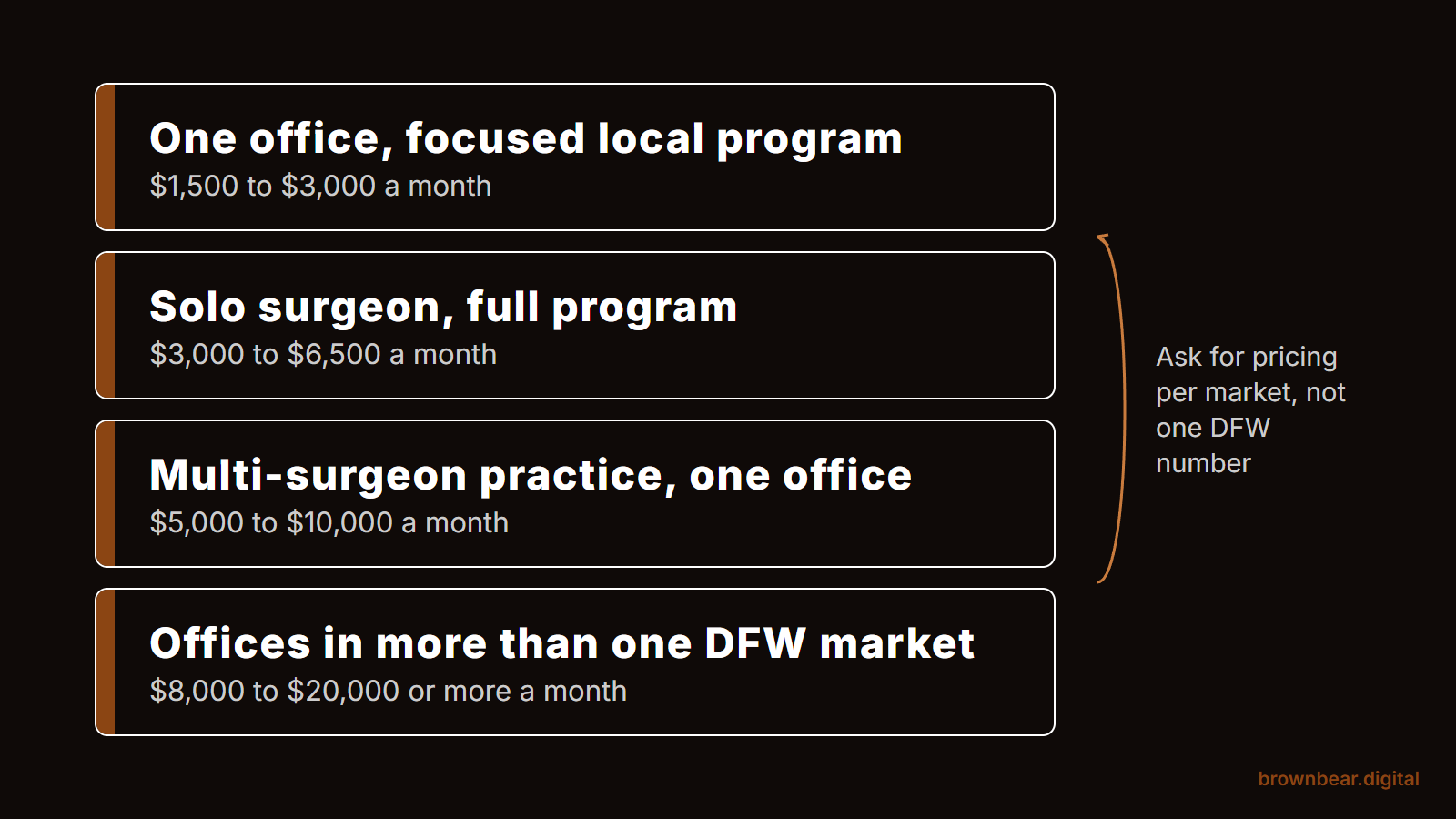
Our national guide shows how these plastic surgery SEO bands break down into hours and pages.
Say you run a Southlake office and a North Dallas office. One quote covers "DFW". Ask what each office gets, because those may be two different markets with two different maps, and a single plan can quietly serve one of them while the other gets a location page and little else.
Three contract questions matter more here than in a one-office city:
- Is pricing per market? Ask what Dallas, Collin County and Fort Worth each add, and what is shared.
- Who owns the accounts? Your Google Business Profiles, Search Console, analytics, videos and every page written for you should be in your name, for every office.
- What happens at 90 days? A 12-month agreement is reasonable for SEO, which typically takes 9 to 12 months to produce patients, as long as there is a review point on the specific procedure and market searches you agreed on.
Measure the agency on consultations booked from search, not rankings alone. Google itself says no one can guarantee a top ranking, so a contract that promises one is a reason to walk.
Applying These Tests to Brown Bear
We said we'd hold ourselves to the same tests, so here is how we answer them.
- Local or remote. We're in the Bay Area with no DFW office. Shoots and staff training would mean hiring a local photographer or a travel day, and you should weigh that.
- Seeing each market. We track maps and AI answers for each office's area, not just for "dallas".
- Reading the results. The capture in this guide is the kind of first page review we'd bring to a first meeting for your procedures, and you can ask us to run it live.
- Texas rules. We're not attorneys. We flag superlatives, testimonials, face tools and form tracking for your counsel, won't install a tool that maps faces without a notice and consent flow your attorney has approved, and will tell you in writing whether our setup puts patient information in our hands.
- Pricing. Our quotes fall inside the bands above, and we scope each market separately.
If we can't answer one of these questions to your satisfaction, hire someone who can. You can read more about our SEO and AI search for plastic surgery practices.
Questions Dallas Practice Owners Ask About Hiring an Agency
Do I need an agency based in Dallas?
No, but you need one that can show you what patients see in your part of the metroplex. Being local helps with shoots, staff training and press. It doesn't help with technical work, content or AI search on its own.
Can one agency handle both Dallas and Fort Worth?
Yes, if it treats them as separate markets. In our capture the two shared no first page or map results, so one plan with one set of keywords won't cover both.
Can my practice use patient testimonials in Texas?
Texas lists testimonials among its examples of misleading health care advertising, and the Medical Board's rule sets conditions: a disclaimer about the speaker's credentials and disclosure of any compensation. Have your attorney approve how testimonials and review quotes appear before an agency publishes them.
Does Texas's biometric law cover before and after photos?
The state privacy act excludes photographs from its definition of biometric data. The biometric identifier law names a record of face geometry and has no photo exclusion, so tools that measure or map faces are the ones to clear with your attorney.
How long before a new agency shows results in Dallas?
Expect 9 to 12 months for SEO to produce patients. Cost pages, suburb searches and map visibility for a second office tend to move sooner than citywide head terms, where the North Dallas map leaders have years of reviews.
Talk to Brown Bear About Search in Dallas
Before you sign with anyone, run the six searches and five AI prompts in this guide for your own procedures and offices, and bring the results to every pitch. If you'd like us to go through them with you, our page on Brown Bear as an SEO and AI search agency in Dallas explains how we would serve practices across the metroplex, and we'll walk through your map, first page and AI answers in the first meeting.
Written By
Founder, Brown Bear Digital
Bryan has 15 years of experience across SEO, paid search, and AI search strategy. He founded Brown Bear to give businesses direct access to senior-level search expertise without the agency overhead.
Learn More About BryanGet Found on Google.
Get Cited by AI.
Tell us about your site. We'll send back a proposal for SEO and AI search.