How to Choose an SEO and AI Search Agency Without Paying for Hype
Almost every SEO agency pitch now includes a slide about AI search. Some of those agencies have changed how they work. Others have changed the name of a service they already sold. From the outside the two pitches look identical, and the difference only shows up six months into a contract.
This guide is a buyer's method for telling them apart. It is written by Brown Bear Digital, and we are an SEO and AI search agency, so read it knowing we have a stake in how you choose. That is also why every test below is one you can run on us. Most of what we know about this comes from our work with plastic surgery and medical practices, where search mistakes are expensive and AI answers already shape who patients call. The method works for any business.
When we say an SEO and AI search agency, we mean both the classic work of ranking in Google and the newer work of getting your business named and cited when someone asks ChatGPT, Gemini, Perplexity or Google's AI features for a recommendation. People call that second part GEO, AEO or AI SEO. The labels matter less than what gets delivered.
If you are hiring your first agency, you probably want a way to compare proposals that use completely different words. If you have been burned before, you want to spot the red flags earlier this time. And if your current agency just added an AI search line item to your invoice, you want to know whether it is worth the money.
By the end you will have a 15-minute test for any agency's AI search claims, the reporting and contract terms to require, a short list of interview questions, and a clear view of what a sensible budget buys. We cover it in five parts: what you are actually buying, how to vet AI search claims, what it costs, the terms and questions that protect you, and whether the agency needs to be in your city. So let's start with the fastest version of the answer.
How to Choose an SEO and AI Search Agency: The Short Answer
Choose the agency that can show you, in writing, what it will deliver each month, how it will measure AI visibility, and that you will own every account and dataset it builds. Six checks do most of the work:
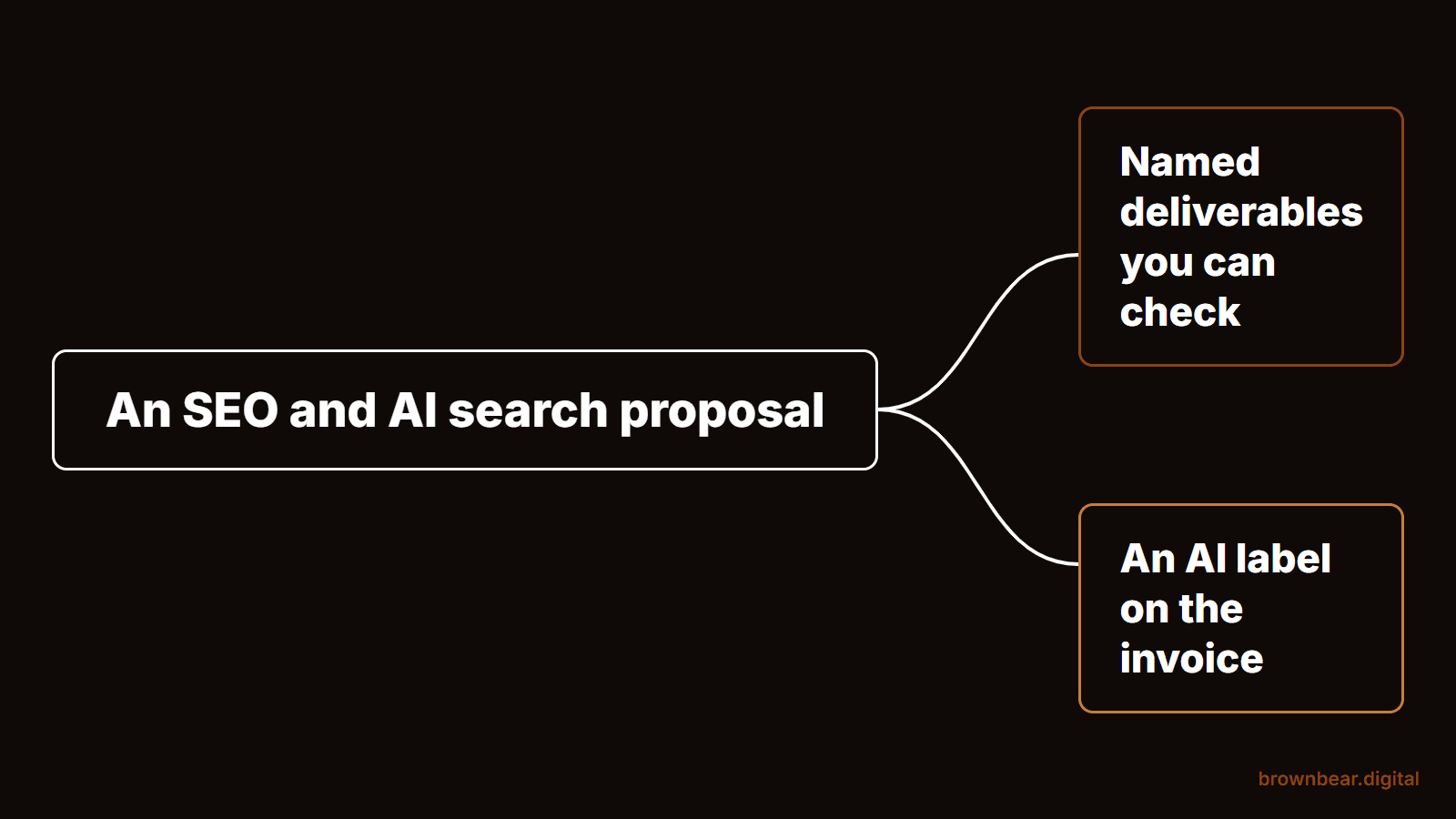
- Ask for named deliverables, not outcomes. A good proposal lists the pages, fixes, placements and reports you will get. A weak one lists rankings and traffic it hopes you will get.
- Make them separate SEO from AI search. Each line item should say which one it serves and why.
- Run the mirror test. Ask the AI assistants about the agency itself. An agency selling AI visibility should be able to explain what you find.
- Ask to see an AI visibility report. It should show a fixed set of prompts, results by assistant, and the raw answers.
- Walk away from guarantees. Nobody can guarantee a Google ranking or a ChatGPT mention.
- Own everything. Domain, analytics, Search Console, Business Profile, ad accounts, content and the AI tracking data all belong to you.
The rest of this guide shows how to run each check.
Decide What You Are Buying: SEO, AI Search, or Both
SEO and AI search overlap more than agencies admit, but a proposal should still separate them. The overlap is real: AI assistants and Google's AI features lean on pages that are crawlable, clearly written and trusted elsewhere on the web, which is what good SEO already builds. The difference is in where the work happens and how it is measured.
| SEO | AI search, also called GEO or AEO | |
|---|---|---|
| Goal | Rank and earn clicks in Google's results and map pack | Get your business named, described accurately and cited in AI answers |
| Main work | Technical fixes, page content, local listings, links | Crawler access, answer-ready pages, entity consistency, the third-party sources assistants rely on |
| Where the work happens | Mostly on your site and Google Business Profile | Your site plus reviews, directories, press and profiles you do not control |
| How it is measured | Rankings, organic clicks, calls and form fills from search | Mentions and citations across a fixed set of prompts, plus referral visits from AI assistants |
| Shared foundation | Crawlability, fast pages, clear content, consistent business details | Same |
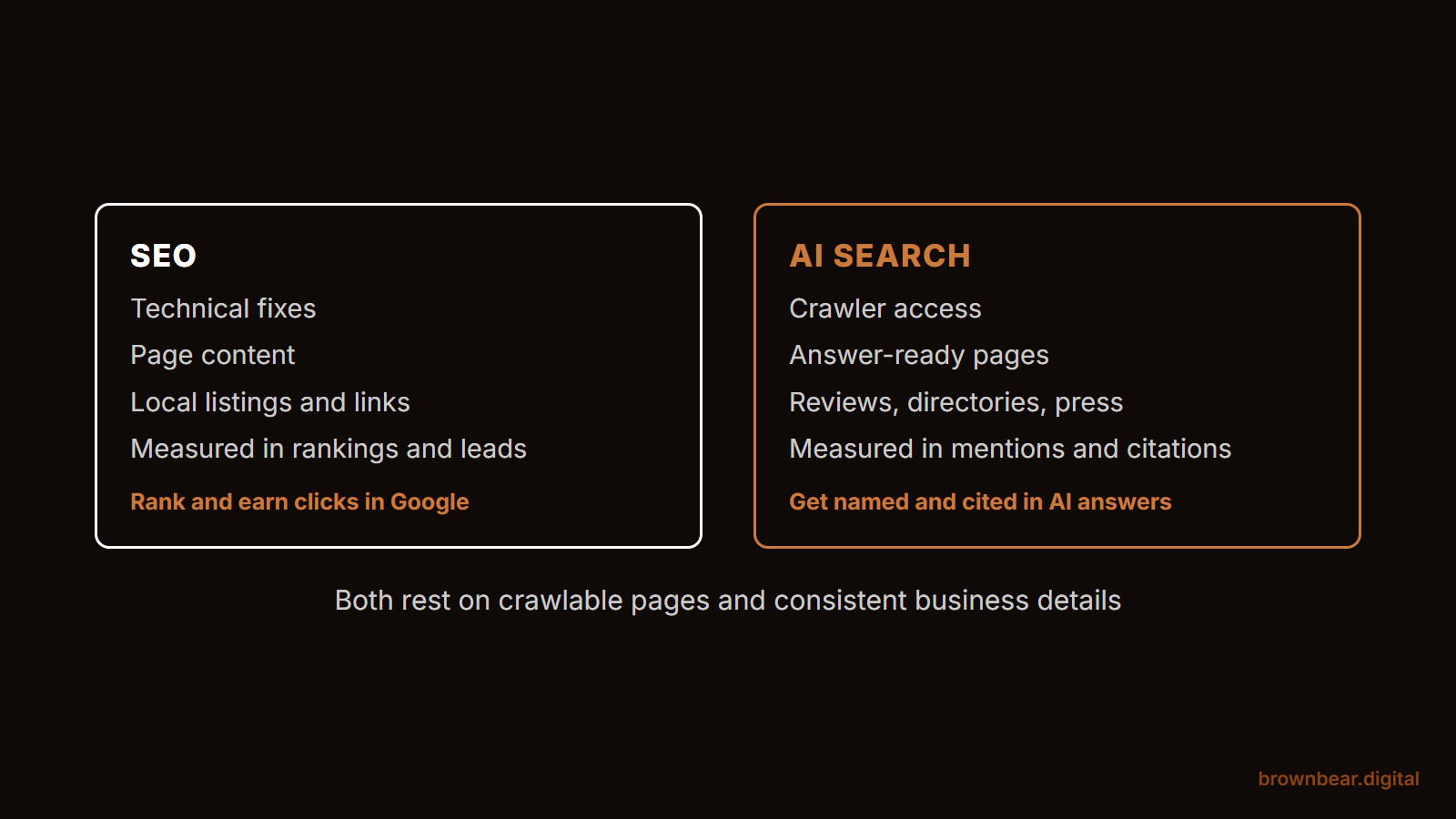
The deciding factor is where you stand today. If you barely show up in Google for your core services, put most of the budget into SEO first, because the assistants draw heavily on the same signals and you will not be cited for a service Google does not associate with you. That is also why our technical and on-page SEO work comes before anything else on a site Google barely knows. If you already rank well but the assistants leave you out or describe you as something you are not, the AI search work is where the gap is, and it should be a named part of the proposal rather than a vague add-on.
In the AI visibility audits we run for practices, the information the assistants give is rarely flat wrong. The problem is emphasis: the services a business most wants to be known for are buried, so the assistants describe a generalist. The most common outright error is small variations in the business's name, address or phone number across the web, which are cheap to fix. What surprises owners most is how much of their AI visibility is decided by third-party sites rather than their own.
That is why an AI search proposal that only touches your website is incomplete.
How to Vet an Agency's AI Search Claims
A real GEO or AEO deliverable is something you can see, check and keep. If a line item cannot be described that way, it is a promise, not a deliverable.
These are the deliverables worth paying for:
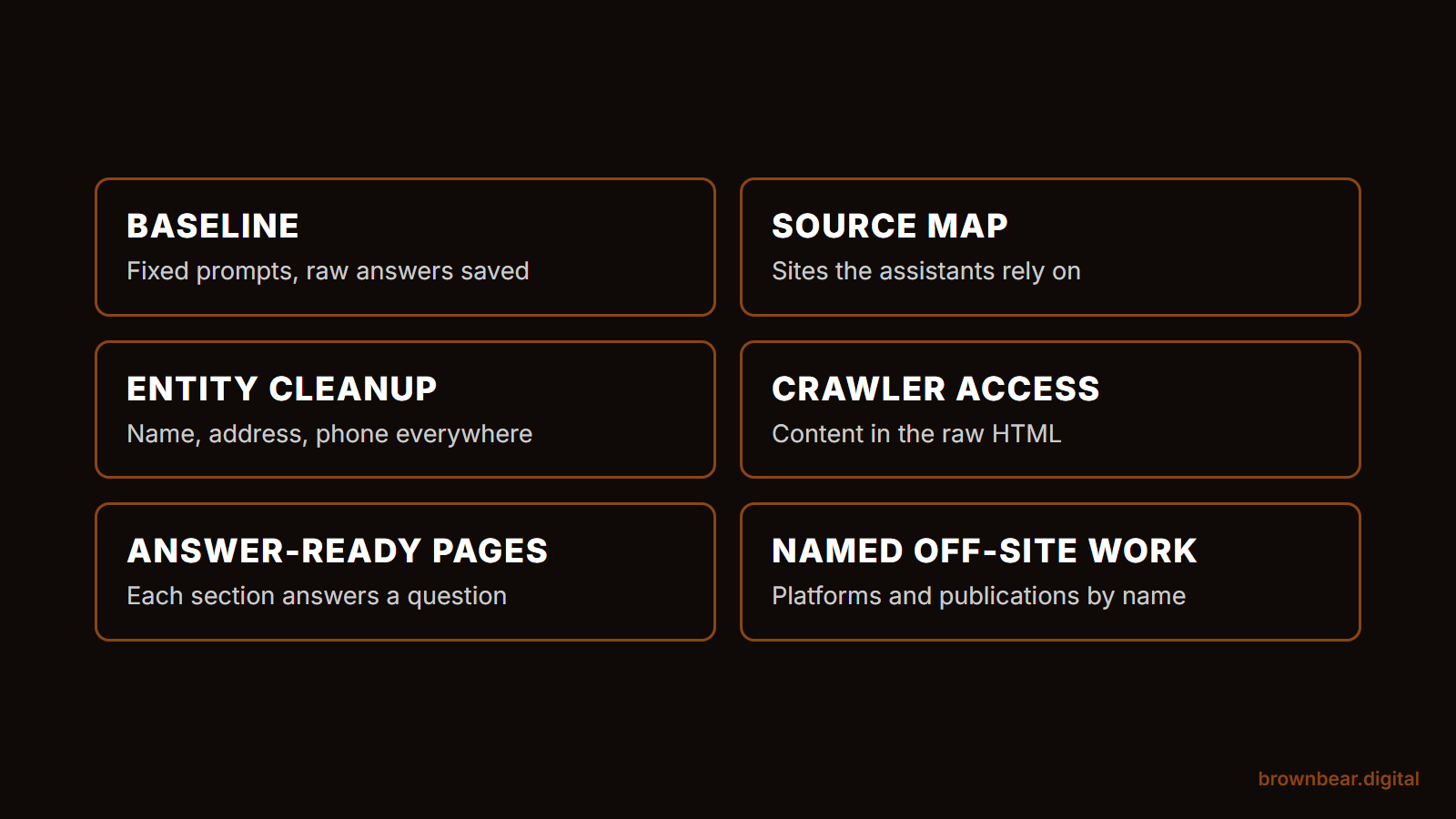
- A baseline. A fixed set of prompts your customers would actually type, run across the main assistants before any work starts, with the raw answers saved. Without a baseline, nobody can show you anything changed.
- A source map. The specific sites the assistants lean on when they describe you or your competitors: review profiles, directories, industry lists, press. This tells you where the off-site work needs to go.
- Entity cleanup. Your name, address, phone, services and credentials made consistent everywhere they appear.
- Crawler access and readable pages. Confirmation that AI crawlers are allowed in and that your important content exists in the page's raw HTML, not only after JavaScript runs.
- Answer-ready content. Service and FAQ pages rewritten so each section answers a real question directly, with the evidence nearby.
- Off-site work with names attached. Which review platforms, directories or publications will be updated or pitched, listed by name.
Crawler access sounds like a formality, and it often is not. When we ran our AI crawler test on 136 Bay Area plastic surgery homepages in October 2026, about 1 in 7 turned an AI crawler away at the server while serving a normal browser without trouble, and none of the sites we checked blocked OpenAI's crawlers in robots.txt. An agency that only reads robots.txt would have missed those blocks entirely.
Watch how much weight a proposal puts on schema markup. Schema is still a best practice worth keeping clean, but in our experience it is not the lever agencies sell it as for AI search. The bigger levers are crawlability and clearly structured content, and on many client sites that means stripping out a large amount of JavaScript the crawlers cannot read.
Picture a roofing company owner comparing two proposals. The first is $2,500 a month for SEO. The second is $3,700: the same SEO scope plus a $1,200 "AI optimization" line made up of an llms.txt file, "AI-ready schema" and a monthly AI visibility score. Run that second line through the list above and there is no baseline, no source map, no named off-site work, and a score with no prompts behind it. The extra $1,200 buys the label. A version worth paying for would name the prompts, the sources and the fixes.
Interactive
The AI Search Claim Checker
Tick every claim that appears in an agency proposal or pitch you are weighing. You get each one sorted into a real deliverable, a claim that needs proof, or a red flag, plus the deliverables the proposal is missing.
Sorting reflects Brown Bear's assessment of common AI search proposal language, drawn from the guide above and Google's published guidance on generative AI features. It is for informational purposes only, is not legal, financial or professional advice, and is not a guarantee of any agency's results. Your selections stay in your browser; nothing is stored or transmitted.
The Mirror Test: Check an Agency's Own AI Visibility in 15 Minutes
The fastest way to judge an agency's AI search claims is to ask the assistants about the agency. An agency that sells AI visibility has every incentive to have its own. It is not a perfect test, and the point is less whether the agency appears than whether it can explain what you found.
Run these six prompts in ChatGPT, Gemini, Perplexity and Google's AI Mode. Use a private browser window where you can, and paste the agency's real name and city in place of the brackets.
| # | Prompt | What it tells you |
|---|---|---|
| 1 | What is [Agency name] and what does it specialize in? | Whether the assistants know the agency at all, and whether they describe it the way it describes itself |
| 2 | Is [Agency name] good at SEO and AI search? What do clients say? | Which review and third-party sources the assistants lean on for it |
| 3 | Best agencies for AI search optimization in [their city] | Whether it shows up for the category it sells, without its name in the prompt |
| 4 | Best SEO agency for [your industry] | Whether its claimed specialty is visible to the assistants |
| 5 | What does [Agency name] charge for SEO? | Whether its public information is accurate, or whether the assistants guess |
| 6 | Who founded [Agency name] and what is their background? | Whether the people behind it have a footprint outside the agency's own site |
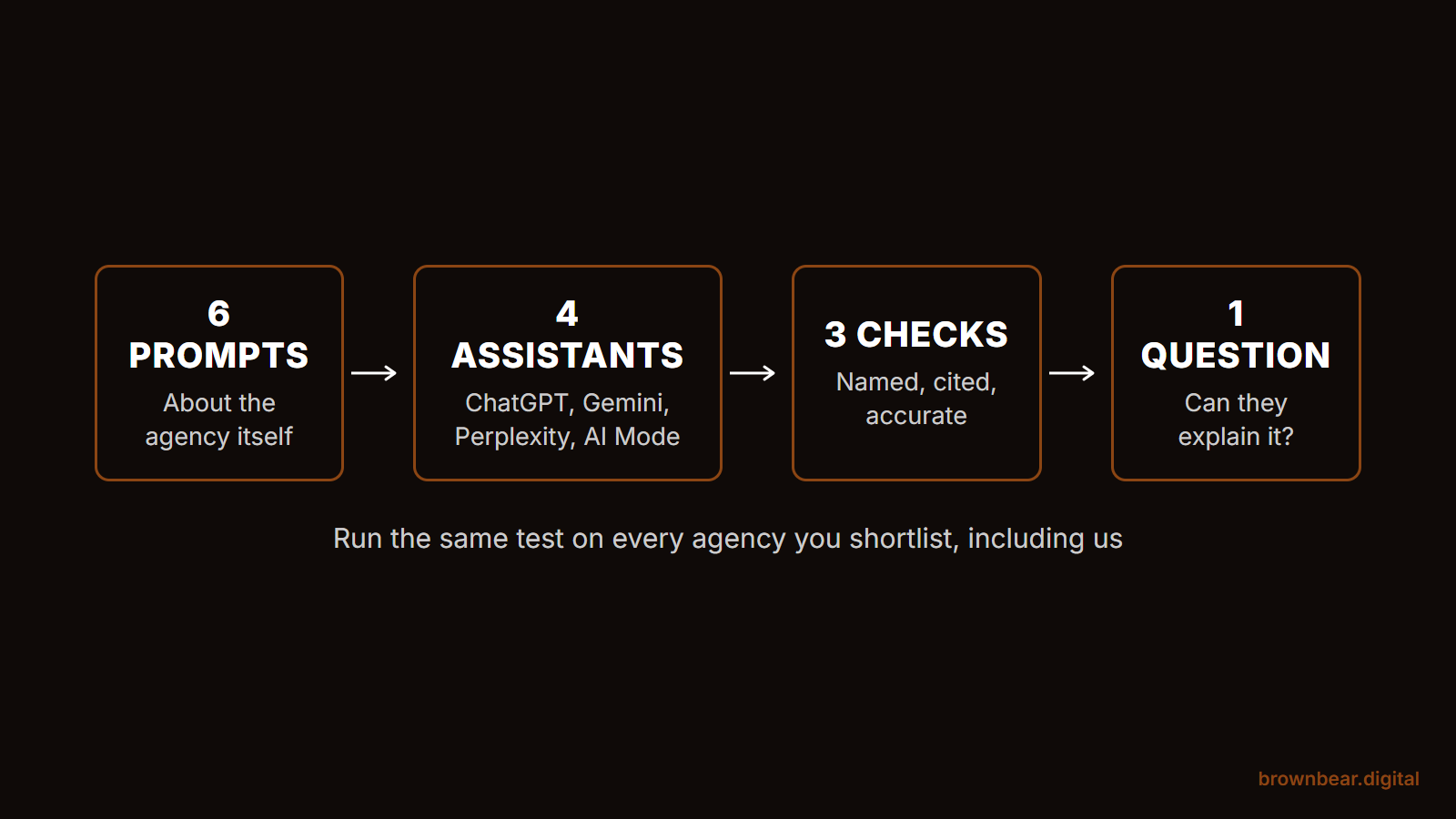
For each assistant and prompt, record three things: was the agency named, was its own site cited as a source, and was the description accurate. Then bring the results to the sales call.
How to read it:
- Named and accurate on most prompts. The agency practices what it sells. Ask how it got there and how long it took.
- Known by name but missing from category prompts. This is normal for smaller and niche agencies, including good ones. The question is whether they can tell you why and what they would do about it.
- Described wrongly or not known at all. Not disqualifying by itself, but an agency selling AI visibility should already know this and have a reason. If the results surprise them, that tells you how closely they watch the channel.
Answers vary between runs and between people, so treat one pass as a snapshot, not a verdict. Run the same test on us, and judge Brown Bear by the same rules.
Say an agency's website calls it a team of generative engine optimization specialists, and three of the four assistants describe it as a web design studio. That is useful information. A strong agency will already know about the gap, name the sources causing it, and walk you through the fix, which is exactly the work you would be paying it to do for you. A weak one will tell you the assistants are wrong.
What AI Visibility Reporting Should Show You
A good AI visibility report tracks the same prompts every month, separates being mentioned from being cited, shows results by assistant, and connects the visibility to visits and leads. Anything less is a number you cannot check.
Ask any agency to show you a sample report, with client names hidden, that includes:
- A fixed prompt set. The same prompts every period, chosen with you, mostly without your brand name in them. Prompts that include your name only prove the assistants can spell it.
- Mentions and citations as separate measures. A mention means the assistant named you. A citation means it linked your site as a source. They move independently and need different work.
- Results by assistant. ChatGPT, Gemini, Perplexity and Google's AI features draw on different sources and change at different speeds. One blended score hides that.
- The raw answers. Screenshots or exports of what each assistant actually said, so you can check the summary yourself.
- Referral visits and leads from AI assistants. Visits from chatgpt.com, perplexity.ai and similar sources in your analytics, and the calls or forms they produced. For Google's own AI features, Google points site owners to a generative AI performance report in Search Console.
- What changed and why. The fixes made that month, tied to the prompts they were meant to move.
The last two items are the ones that matter to a business owner. Across our own client work, visitors referred by AI assistants have converted to consultations and form fills at a higher rate than other channels and engaged more once they arrive, which is why it is the main AI search number we report. A proprietary "AI visibility score" with no prompts, sources or visits behind it is a number the agency controls, not a measure of your business. For the full method, see our guide to tracking brand mentions in AI search.
Red Flags in an SEO and AI Search Pitch
Some claims should end the conversation, or at least change it. Most of them are versions of one problem: the agency is selling certainty about systems nobody controls.
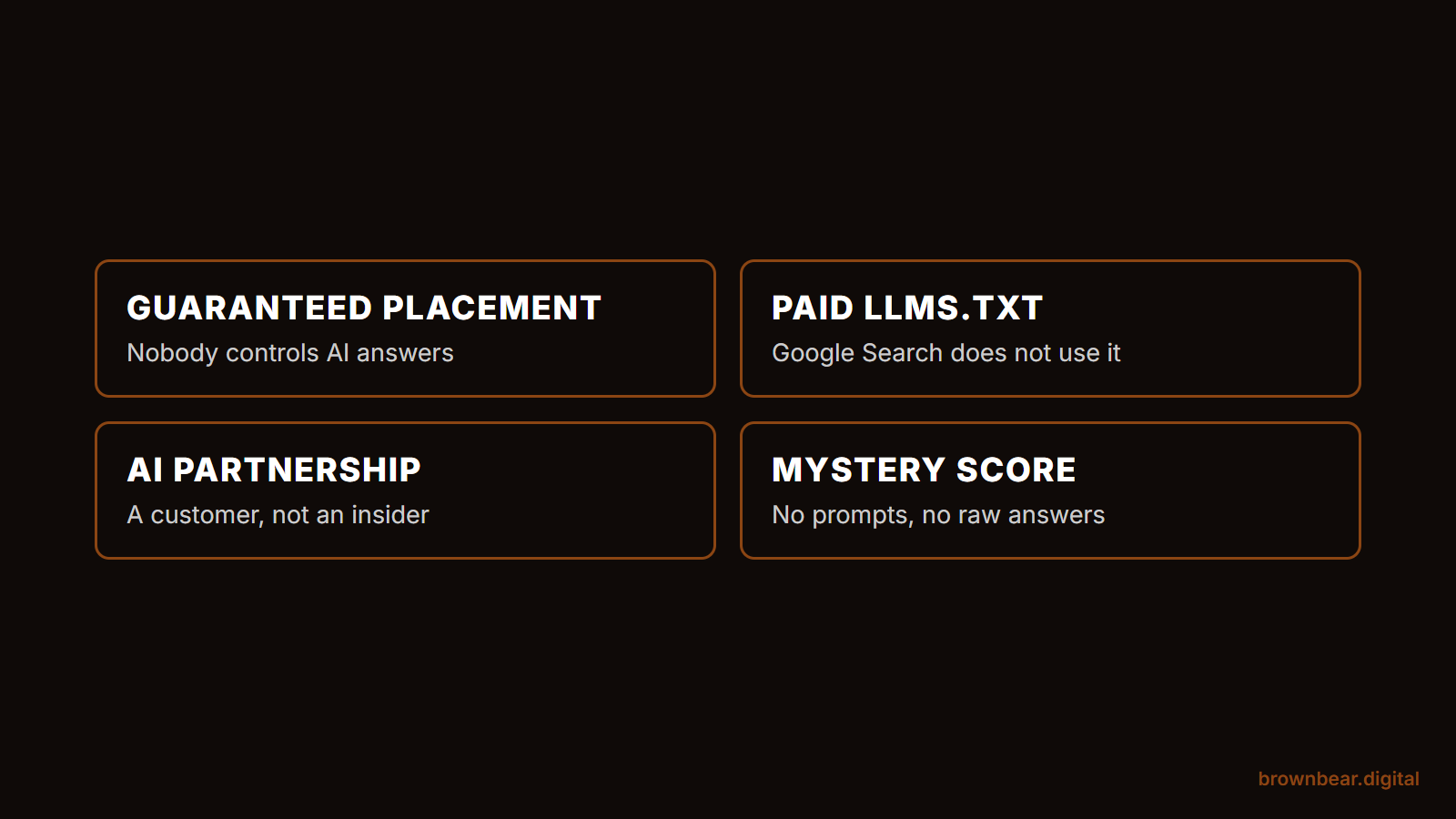
- Guaranteed rankings or guaranteed ChatGPT placement. Google's own guidance on hiring an SEO says no one can guarantee a number one ranking, and warns against anyone who claims a special relationship with Google. The same logic applies to the assistants, which change their answers between runs and between users.
- llms.txt sold as a product. Google's guidance on its generative AI features says sites do not need llms.txt or other special AI files to appear in Google Search, because Google Search does not use them. Creating one is cheap and harmless. Paying a monthly fee for it is not.
- A "partnership" with OpenAI, Google or another AI company. Being a customer of an AI tool is not a partnership with the model that ranks you.
- AI-written content at volume. Dozens of generic posts a month is the fastest way to look like every competitor, and assistants have no reason to cite a page that says what a thousand others say.
- "Chunking" or special AI writing styles as the centerpiece. Google's same guidance lists chunking content for AI among the tactics site owners can ignore for Google Search. Clear structure helps readers and machines, but it is a writing standard, not a separate service.
- A proprietary score with no prompts disclosed. If you cannot see the prompts, you cannot check the score.
- Reluctance to give you read access. Google suggests granting an SEO only read access to Search Console when it is doing an audit. An agency that needs full control of your accounts before you have hired it is asking for the wrong thing.
None of these red flags is specific to AI search vendors. The classic SEO ones still apply too: one package for every industry, no named contact, and reporting that never connects to calls or sales.
What an SEO and AI Search Agency Costs
For a full program, expect to pay a few thousand dollars a month, and treat AI search as part of the same scope rather than a separate fee. The useful way to compare proposals is by the hours a fee buys, not the label on it.
The numbers we can stand behind come from the medical space we work in. In our breakdown of what plastic surgery SEO costs, most practices pay $1,500 to $10,000 a month, a full program for a single-surgeon practice typically runs $3,000 to $6,500, and the price guides we reviewed put programs that add AI search, digital PR and conversion work at $8,000 to $20,000 or more. Below about $1,000 a month you are buying a handful of hours, not a program. At the most common hourly rate in Ahrefs' survey of SEO providers, $75 to $100, $1,500 a month buys roughly 15 to 20 hours, which is enough for a focused scope and not much more.
Three rules for reading a price:
- Divide the fee by the hours. Ask how many hours the fee covers and who does them. A low price with senior hours is rare; a low price with junior hours is common.
- Look for AI search inside the scope. The baseline, source map, entity cleanup and off-site work should be line items with hours attached, not a flat "AI add-on."
- Price the market, not the agency. A business in a crowded metro needs more hours to compete than the same business in a small town.
That last rule is why we broke the numbers down city by city for plastic surgery practices: what SEO runs in San Francisco, Miami's budget picture, a worked Chicago budget, and the Manhattan budget breakdown. The method in each carries over to other industries.
Contract and Ownership Terms to Get in Writing
The contract matters as much as the agency. Get these terms in writing before you sign, whichever agency you choose:
- You own every account. The domain, website, Google Analytics, Search Console, Google Business Profile and ad accounts are created in your business's name, with the agency added as a user. On the Business Profile, you hold the primary owner role.
- You own the work. Content, images, reports and any tools built for you transfer to you, including when the contract ends.
- You own the AI tracking data. The prompt set, the raw answers and the history are yours. This is the term most new AI search contracts leave out, and it is the one that lets the next agency pick up where the last one stopped instead of starting a new baseline from zero.
- Monthly deliverables are named. The contract lists what you get each month, not just a fee.
- There is a review point and a way out. A 90-day review against agreed milestones, then month-to-month or a short notice period. Twelve months with no exit protects the agency, not you.
- Reporting connects to leads. The contract says what the monthly report will include, including calls, forms or sales from search and AI referrals.
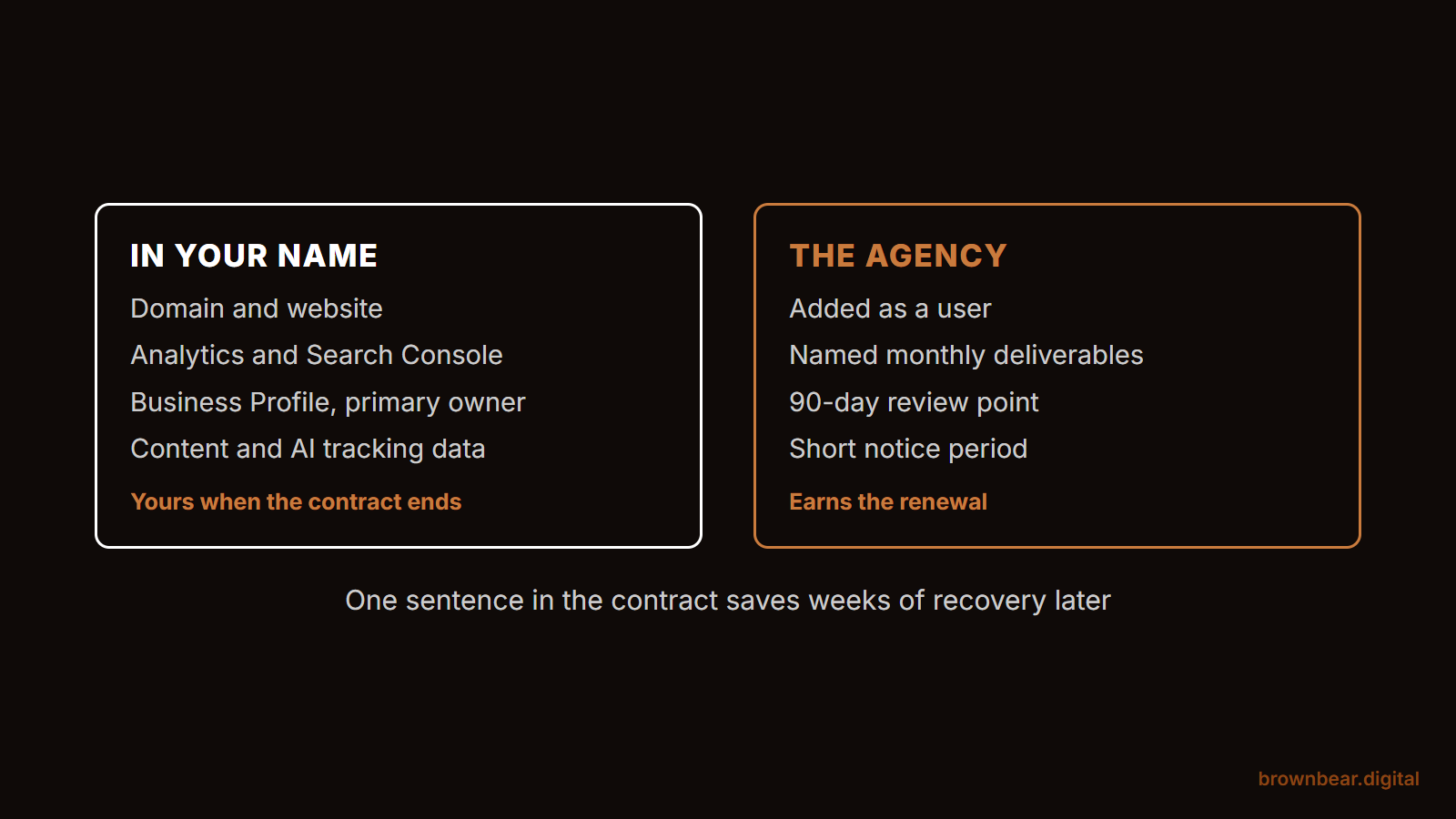
Picture a three-office dental group that decides to switch agencies, only to find its Google Business Profiles were created under the outgoing agency's account manager's personal login. Recovering ownership means weeks of verification while reviews go unanswered and hours stay wrong. One sentence in the original contract would have prevented it.
If you run a medical practice, there are extra terms to check, including how a fee tied to consultations or revenue sits with your state's fee-splitting rules. The plastic surgery agency guide linked in the medical section below walks through those.
12 Questions to Ask in the Agency Interview
Bring these to every call. The answers matter less than whether the agency can give a specific one.
- What will you deliver in the first 90 days, by name?
- Which parts of your proposal are SEO, which are AI search, and which serve both?
- What prompts would you track for us, and can we choose them together?
- Which assistants do you report on, and do we get the raw answers?
- How do you separate mentions from citations in your reporting?
- Which third-party sites do you think the assistants rely on in our industry, and how do you know?
- What did you find when you ran your own agency through the assistants?
- How will you check that AI crawlers can actually read our site?
- Who does the work each month, and how many hours does our fee cover?
- Show me a report for a client like us with the name hidden. What did it lead to?
- What happens to our accounts, content and tracking data if we leave?
- What would make you tell us this is not working?
Question 7 tends to be the most revealing. An agency that has run the mirror test on itself will answer in detail. One that has not will change the subject.
Local or Remote: Does Your Agency Need to Be in Your City?
For most businesses, no. SEO and AI search work is done remotely, and the best fit for your industry may be in another state. What matters is whether the agency understands your local market, and you can test that from anywhere.
A local agency earns its place when:
- You depend on local search. If most customers find you through the map pack or "near me" searches, an agency that already knows the neighborhoods, competitors and local directories saves months.
- You need people on site. Photo and video shoots, office visits and in-person training are easier with someone nearby.
- Local press and relationships matter. Regional publications, associations and sponsorships are easier to earn with local contacts.
If none of those apply, choose on expertise and fit, not geography. Either way, ask the agency to describe your local search results before the pitch: who ranks in the map pack, which directories appear, what the AI assistants say when someone asks for the best option in your city. An out-of-town agency that has done that homework beats a local one that has not.
Local intent is also where AI search is still most open. In our work with plastic surgery practices, big authority sites increasingly take the AI answers for broad questions, while searches with local intent or about cost still surface individual practices. That is the ground a local strategy fights for, wherever the agency sits. You can see where Brown Bear works on our locations page.
Choosing an Agency in Your City
We wrote city-specific buyer's guides for plastic surgery practices, built from each market's live search results. The questions and tests carry over to any business in those cities:
- San Francisco: what to look for in a San Francisco agency, for practices competing across a dense Bay Area market.
- Miami: the Miami agency guide, including Spanish-language search, travel patients and Florida's advertising rules.
- Chicago: what to check in Chicago, from the city versus suburbs split to the Illinois rules an agency should know.
- New York: vetting a New York agency, with interview questions built from Manhattan's search results and the state compliance questions to ask.
If You Run a Medical or Plastic Surgery Practice
Healthcare raises the bar on everything above. Google holds medical content to a higher standard, patient privacy rules limit what tracking an agency can install, and for broad medical questions the AI answers lean heavily on large authority sites. An agency that is good for a restaurant can still be the wrong one for a surgeon.
Two of our guides cover the parts this one does not:
- Plastic surgery practices: our guide to evaluating a plastic surgery agency's pitch covers the questions about the long research cycle and consultation conversion, the portfolio deep dive, reference checks, and a scorecard for every pitch.
- Other medical practices: our guide to medical practice SEO hiring covers YMYL content standards, HIPAA and web tracking, and how to judge a retainer by what a new patient is worth.
Use this guide to check the AI search claims and the contract, and those two for the medical specifics.
Choose Your SEO and AI Search Agency With Brown Bear in the Running
Choosing well comes down to three things: deliverables you can name, AI visibility you can measure, and accounts and data you own. Brown Bear works mostly with plastic surgery and medical practices, where both Google and the AI assistants hold businesses to a higher standard, and we would rather be chosen on those terms than on a pitch. If you want an agency that will run the mirror test with you and show its work, start with our AI search and SEO services.
Written By
Founder, Brown Bear Digital
Bryan has 15 years of experience across SEO, paid search, and AI search strategy. He founded Brown Bear to give businesses direct access to senior-level search expertise without the agency overhead.
Learn More About BryanGet Found on Google.
Get Cited by AI.
Tell us about your site. We'll send back a proposal for SEO and AI search.