How to Choose a Plastic Surgery SEO and AI Search Agency in San Francisco
Every agency that pitches a San Francisco plastic surgery practice promises the same three things: better rankings, more AI visibility and more consultations. The pitches sound alike because most of them were written for any city. This guide is written for this one. It takes what Google and the AI assistants actually show Bay Area patients right now and turns it into the questions that separate an agency that knows this market from one reading a national script.
It comes from Brown Bear Digital, a search agency based in the Bay Area that specializes in SEO and AI search for plastic surgeons, and from founder Bryan Passanisi's work on practice websites and AI visibility. That also makes us one of the agencies you might be weighing. So every test in this guide applies to us too, and we run ourselves through it near the end.
When we say an SEO and AI search agency, we mean both the classic work of ranking your website and Google Business Profile and the newer work of getting ChatGPT, Perplexity and Google's AI answers to name your practice. The national version of this decision, including the questions agencies dread and the contract terms that protect you anywhere, lives in our national agency evaluation guide and in our broader guide for medical practices hiring SEO help. This one covers what changes when the practice sits in San Francisco or anywhere around the bay, and the general guide to choosing an SEO and AI search agency covers the decision for any business.
If you are a solo surgeon in the city hiring your first agency, you need to know which promises this market can actually support. If you run a multi-surgeon group on the Peninsula or in the East Bay, you need an agency that understands a Union Square map pack and a Walnut Creek map pack are different races. And if you are the practice manager with three proposals on your desk and a recommendation due, you need questions you can ask in a 30 minute call and judge without being an SEO.
By the end you will have five interview questions drawn from the live San Francisco results, a way to decide whether an in-market agency matters for your location, a 15 minute test of any agency's AI claims, the California compliance questions every proposal should survive, and the price and contract terms that are normal here. We cover it in five parts: the local search results, the interview questions they produce, local versus remote agencies, AI search and California compliance, then pricing and the final decision.
Before you take a single pitch meeting, look at what the agency would actually be competing for.
What San Francisco Patients See When They Search for a Plastic Surgeon
In San Francisco, independent practices own the search results for plastic surgery, academic medical centers take a few organic slots on procedure searches, and AI Overviews show up on some procedure searches and not others. An agency that wins here has to outrank other well-funded surgeons, not directory listings.
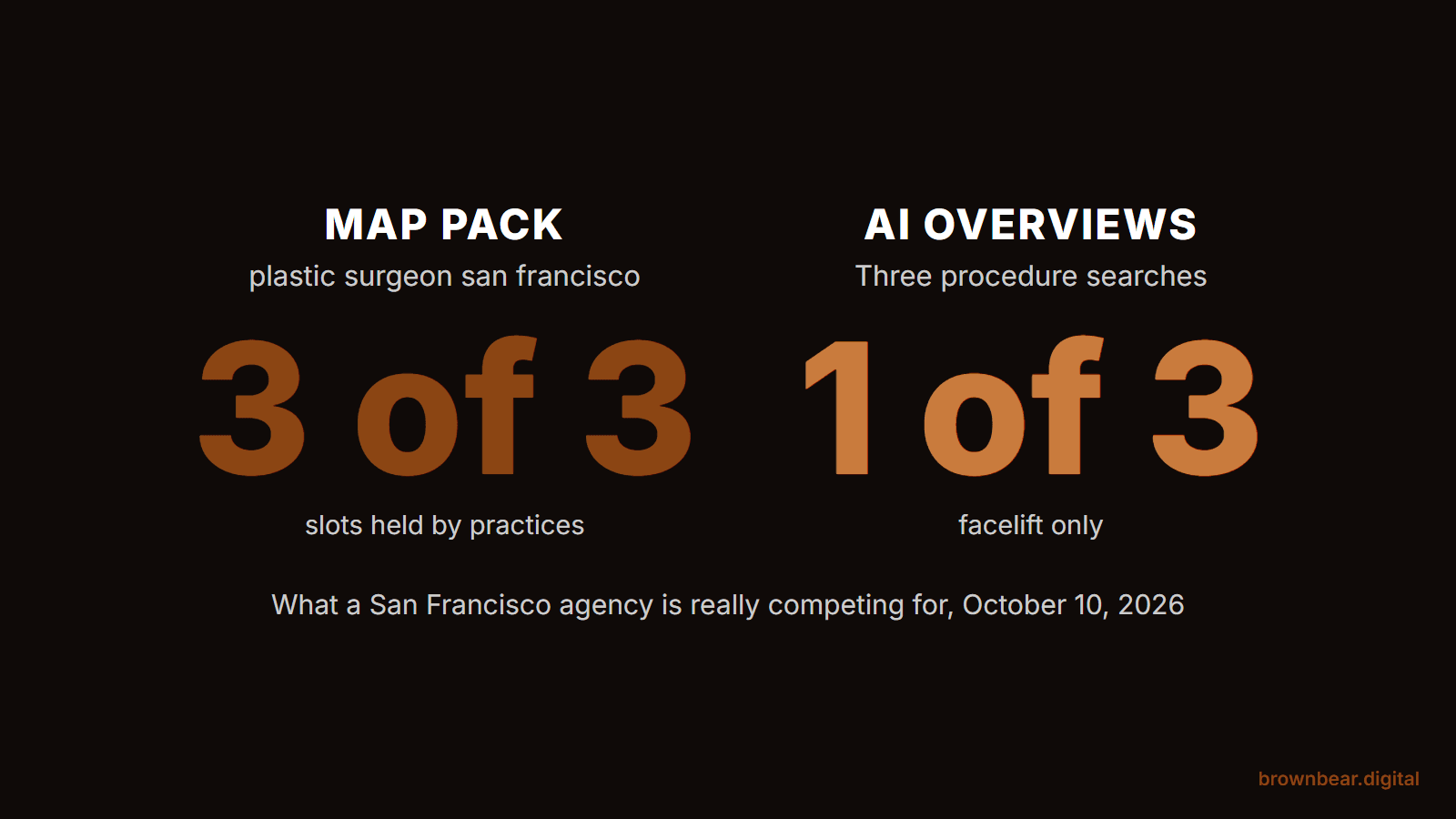
We ran three searches from San Francisco on October 10, 2026, plastic surgeon san francisco, breast augmentation san francisco and facelift san francisco, and read the results as a patient would see them. Five findings matter when you choose an agency.
| Finding | What we saw | Why it matters for your agency |
|---|---|---|
| Practices own the head term | On plastic surgeon san francisco, all 3 map pack slots and 8 of the 9 organic results were independent practice websites. The ninth was a Sutter Health surgeon profile. No RealSelf, Yelp or Healthgrades page appeared in the organic results. | Your competition is other surgeons' websites and profiles, so the agency has to out-build them, not just claim directory listings. |
| One practice sits in every map pack | The same practice, with 396 Google reviews, held a map pack slot on all three searches. | Prominence compounds. A credible agency explains how it builds yours over a year; it does not promise to displace the leader in 90 days. |
| A downtown address does not set you apart | Five of the surgeons and practices we saw across the map packs and the AI Overview list the same building, 450 Sutter Street. | Proximity cannot separate practices that share an address. Categories, procedure pages and reviews have to. |
| Academic centers take procedure slots | A UCSF breast augmentation page ranked fourth, and a UCSF head and neck surgery facelift page ranked second. | Some page one positions belong to institutions you will not outrank on general information, so the plan has to win on what only a practice can show. |
| The facelift AI Overview names facial plastic surgeons and quotes a price | Only the facelift search showed an AI Overview. It named five San Francisco surgeons and practices, at least three of them facial plastic surgery practices by name, and repeated one practice's published starting price of $39,500. | For some procedures your real AI competitors are a different specialty, and the AI answer reuses what practices publish about price. |
Treat these as one day's snapshot, not a ranking report. Local results shift with where the searcher stands, and AI Overviews come and go between sessions, so a facelift search tomorrow may show none, and a procedure search that showed none today may show one next week. That volatility is itself a test: an agency that tells you what "the" San Francisco results look like from a single search is guessing.
Five Interview Questions Built From the San Francisco Results
The fastest way to tell whether an agency knows this market is to ask it about the results above. Each question below comes from one finding, with what a strong answer sounds like and what should worry you.
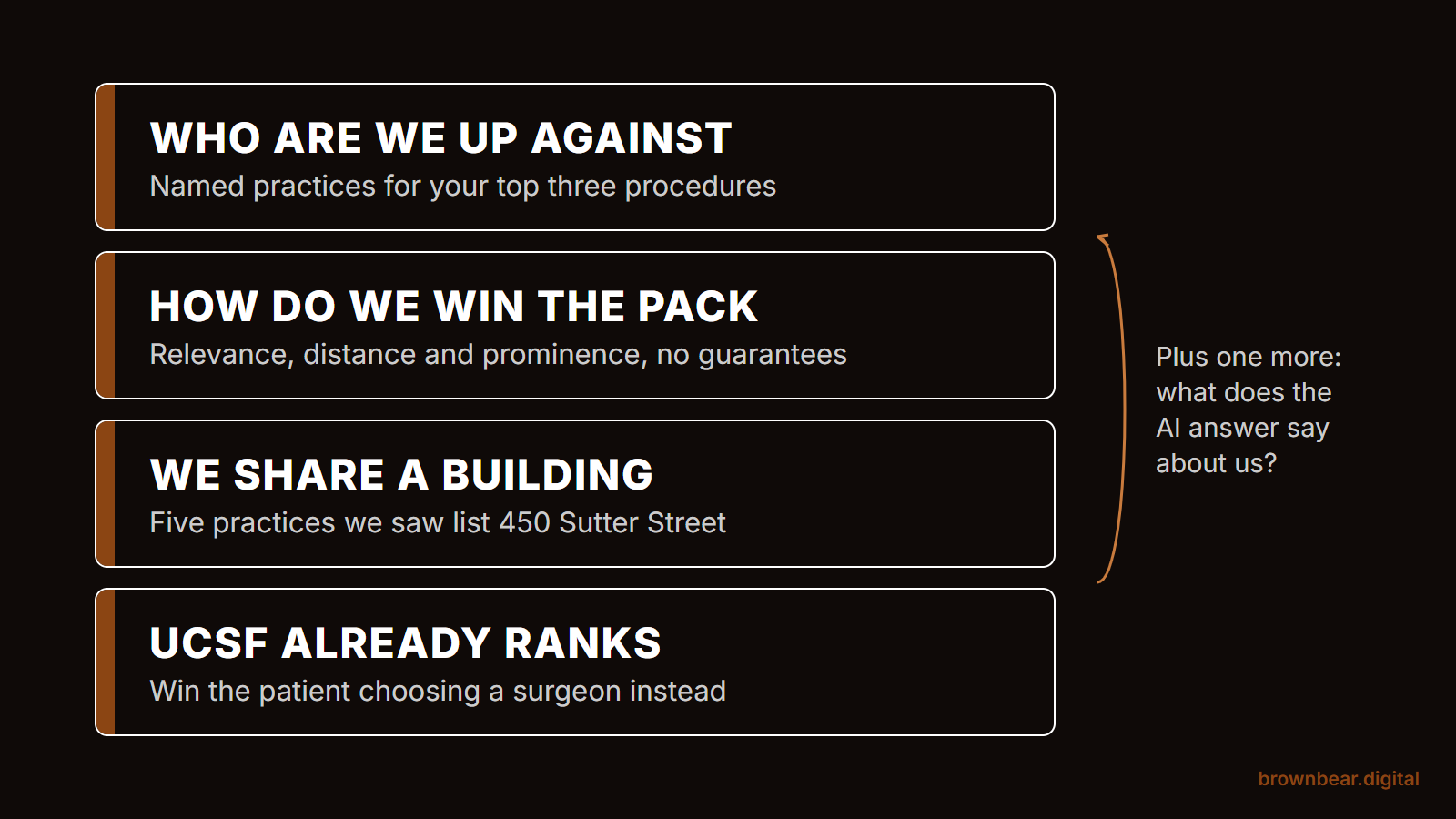
1. Who are we actually up against for our top three procedures?
A strong answer names the practices in the map pack and top results for your signature procedures, from searches run near your office, and points out where a UCSF, Stanford or Sutter page holds a slot. It sounds like: "For facelift, you are competing with facial plastic surgery practices and a UCSF department page, not with the body contouring practices you think of as rivals." A weak answer says "San Francisco is very competitive" and stops there, or lists national brands that never appear in your results.
Picture a two-surgeon practice in Pacific Heights where facelifts drive most revenue. One proposal promises page one for plastic surgeon san francisco within 90 days. Another shows the facelift results, names the facial plastic surgeons in the AI answer, and builds the plan around beating them. Only the second proposal is aimed at the patients who pay the bills.
2. How do you win a map pack slot when the leader has hundreds of reviews?
Google says local results are mainly based on relevance, distance and popularity, a factor it also calls prominence, and that there is no way to pay for a better local ranking. A strong answer works through all three: matching your categories and procedure pages to what patients search, accepting that distance favors whoever is closest to the searcher, and building reviews at a steady pace rather than racing a 396 review total. A weak answer guarantees a top three position or proposes review tactics that sound like buying them.
3. We share a building with other surgeons. How will you separate us?
With five of the practices we saw at one downtown address, this is a live problem. A strong answer covers a correctly named profile with its suite number, a primary category that matches your focus, procedure pages that make the difference obvious, and a name, address and phone number that read identically everywhere. Two of the three head term pack winners use the "practice name: surgeon name" format that Google's profile guidelines describe for a surgeon who shares a profile with a branded practice; a strong agency will know when that format fits you. Walk away from anyone who suggests profiles at addresses where you do not see patients. Google's guidelines rule out virtual offices and rented mailing addresses a business does not operate from, and a profile that breaks them risks suspension.
In Brown Bear's AI visibility audits, the most common error is not wrong medical information but odd variations of a practice's name, address or phone number across the web, which is cheap to fix and easy to overlook. Our Business Profile guide covers profile naming and categories in detail.
4. What is your plan for procedure searches where UCSF already ranks?
A strong answer does not promise to outrank a university department on general information. It targets the practice side of the search instead: surgeon credentials, a before-and-after gallery, a consultation process and price ranges, the material an academic page does not carry. It sounds like: "UCSF will keep that slot for patients researching the procedure. We will build the page that wins the patient who is choosing a surgeon." A weak answer is "we will write more content than UCSF."
5. What would the AI answer for our signature procedure say about us?
A strong agency has already looked before the first call. It can tell you which practices the AI names for your procedure, which sources it cites, and why. On the facelift answer we captured, that meant noticing the AI repeated a practice's published starting price, which is a reason to discuss whether you publish price ranges. A weak answer claims AI Overviews do not matter for local searches, or promises a guaranteed spot in them. No one can guarantee that.
Local or Remote: When a Bay Area Agency Is Worth It
An in-market agency matters most for map pack work across the Bay Area's sub-markets and for anything that needs a person in your office. It matters least for technical SEO, content and AI visibility, which a remote specialist can do just as well.
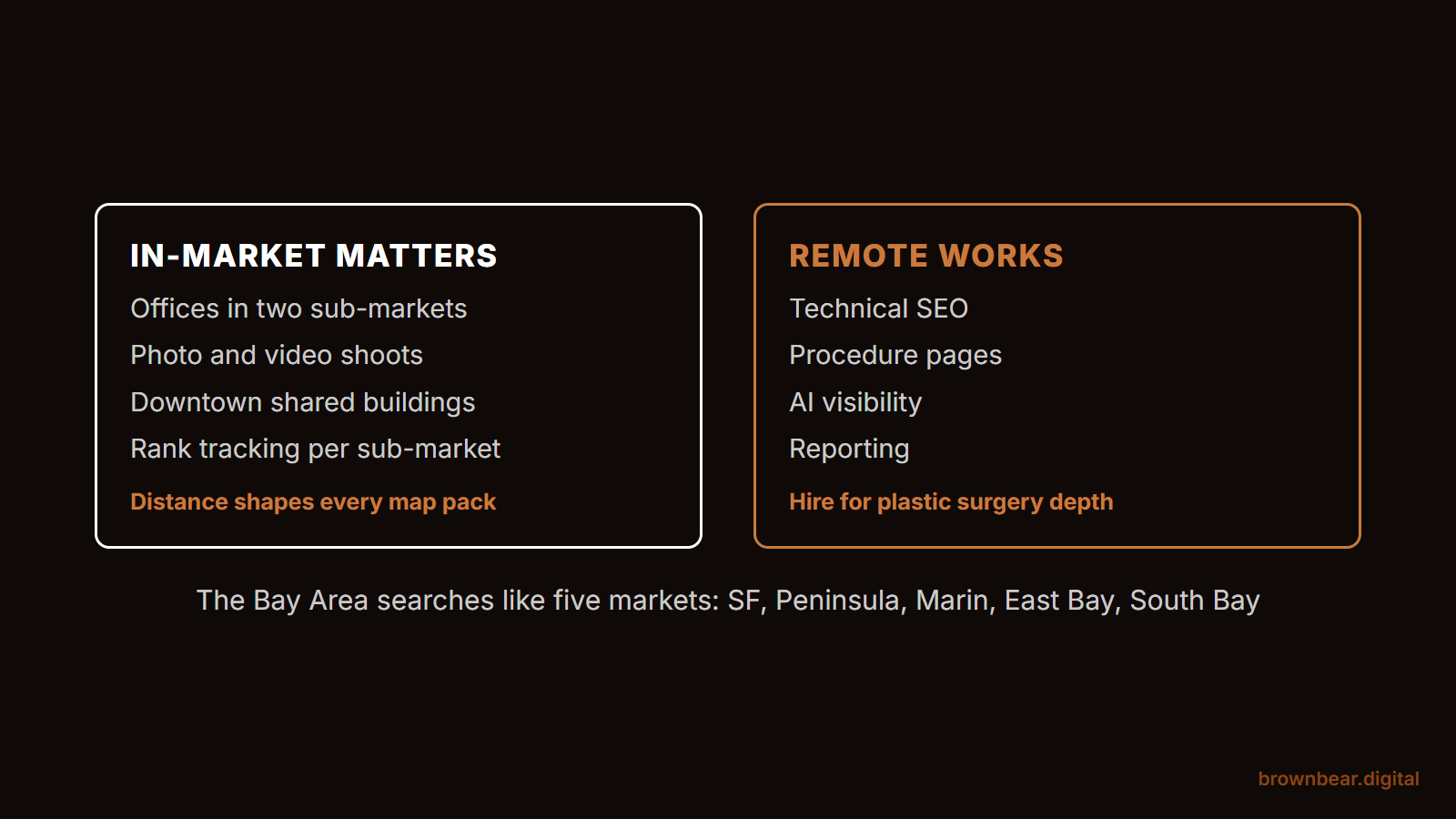
The reason is distance. Google defines it as how far each business is from the person searching, so a patient in Palo Alto, Walnut Creek or Mill Valley sees a different map pack from one in SoMa, even for the same words. For local search, the Bay Area behaves like five markets, and an agency should be able to tell you which ones you are really in.
| Sub-market | What a good agency should already know | Question to ask it |
|---|---|---|
| San Francisco | Dense downtown clusters, several surgeons per building, neighborhood searches like Pacific Heights or the Marina | How do you separate us from practices at our own address? |
| Peninsula | Patients searching by town from San Mateo to Palo Alto, with Stanford in the results | Which Peninsula towns can our office realistically rank in? |
| Marin | A smaller pool of practices, and patients who may also search the city | Should we target Marin searches, city searches, or both, and what in our consult data says so? |
| East Bay | Separate packs for Oakland, Berkeley and Walnut Creek searches | Would an East Bay office need its own profile and pages? |
| South Bay | San Jose and Silicon Valley results that rarely show city practices | Is the South Bay worth chasing without a location there? |
Where your answer lands depends on your footprint:
- If you have one office in the city and most patients live nearby, local presence is a convenience, not a requirement. Hire for plastic surgery depth first.
- If you run offices in two or more sub-markets, favor an agency that tracks rankings separately in each and can visit each office to shoot photos and video for profiles and galleries.
- If you want patients from a sub-market where you have no office, be wary of any agency proposing a stack of town pages for it. Pages that exist only to rank in towns you do not serve read as doorway pages. Content, reviews that mention the trip, and AI visibility are the better routes. A second location page is legitimate when there is a real, staffed office behind it.
Say a surgeon in Walnut Creek gets two proposals. A downtown San Francisco agency leads with plastic surgeon san francisco, a race the practice cannot win from across the bay. A remote specialist leads with the Walnut Creek and Lafayette map packs and a plan for the procedures East Bay patients search. The second agency is the local expert here, even though it has never had an office in the Bay Area.
How to Test an Agency's AI Search Claims for San Francisco
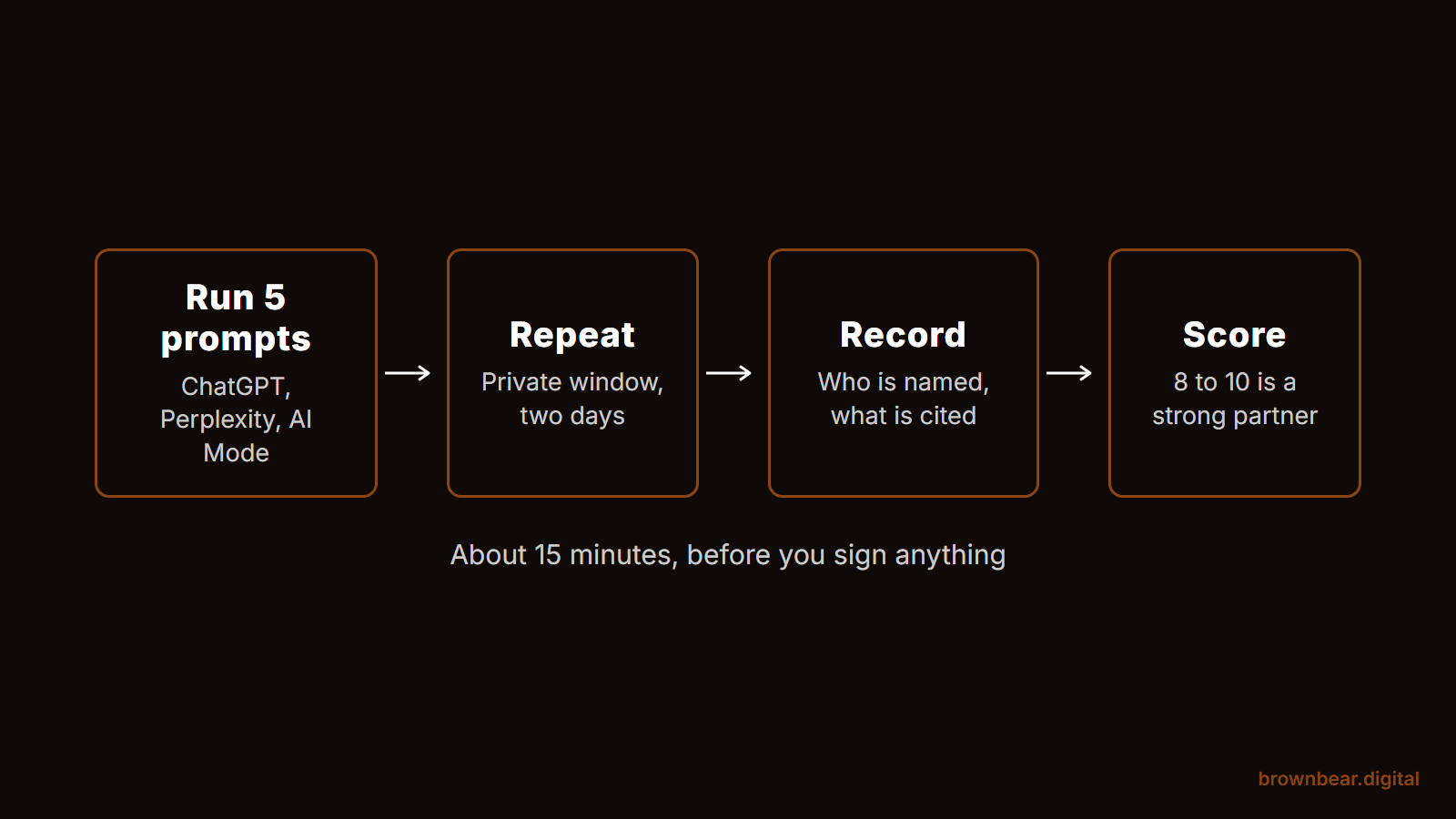
Run the same patient prompts the agency says it can influence, in ChatGPT, Perplexity and Google's AI Mode, write down who gets named and which sources get cited, then ask the agency to explain what you found. It takes about 15 minutes and works before you sign anything.
Use prompts your patients would type, with your procedure and town filled in:
- Who are the best plastic surgeons in San Francisco for a facelift?
- Best breast augmentation surgeon near Palo Alto
- How much does a tummy tuck cost in San Francisco?
- Is Dr. [your name] a good choice for rhinoplasty?
- Compare [your practice] and [the practice you lose consults to]
Run each prompt in a logged-out or private window, on two different days, and screenshot the answers. AI answers vary from run to run, so one result proves little and a pattern across runs proves a lot. Then score each agency on how it handles what you found.
| What the agency does | Points |
|---|---|
| Shows you its own run of these prompts for your practice, before or during the first call | 2 |
| Explains why each named competitor appears, pointing to the reviews, directories, press or pages behind it | 2 |
| Checks whether AI crawlers can read your website at all | 2 |
| Separates what it can influence from what it cannot, with no guarantee that you will be named | 2 |
| Proposes measurement: AI referral traffic in analytics plus a monthly rerun of the same prompts | 1 |
| Runs its own agency name through the same tools and shows you the result | 1 |
A score of 8 to 10 is a strong AI search partner. 5 to 7 means ask for more evidence before you sign. Under 5, the agency is selling AI search as a label on ordinary SEO.
The crawler check matters more in this market than most practices expect. In our AI crawler study of 136 Bay Area and Northern California practice homepages, 48 of the 130 sites that responded had at least one crawler-facing problem, and about 1 in 7 refused at least one AI crawler at the server while serving a browser normally. An agency that pitches AI visibility without checking yours first is planning content for a site the machines may not be able to read.
Picture a practice manager in Burlingame who runs the five prompts on a Monday and finds that ChatGPT names three competitors and describes her surgeon as a general plastic surgeon, not the breast specialist he is. In three pitch calls that week, one agency had already seen the same thing and traced it to thin procedure pages. That agency gets the follow-up meeting. After you hire, rerun the same five prompts every month and keep the screenshots side by side.
California Compliance Questions Your Agency Should Answer Without Looking Them Up
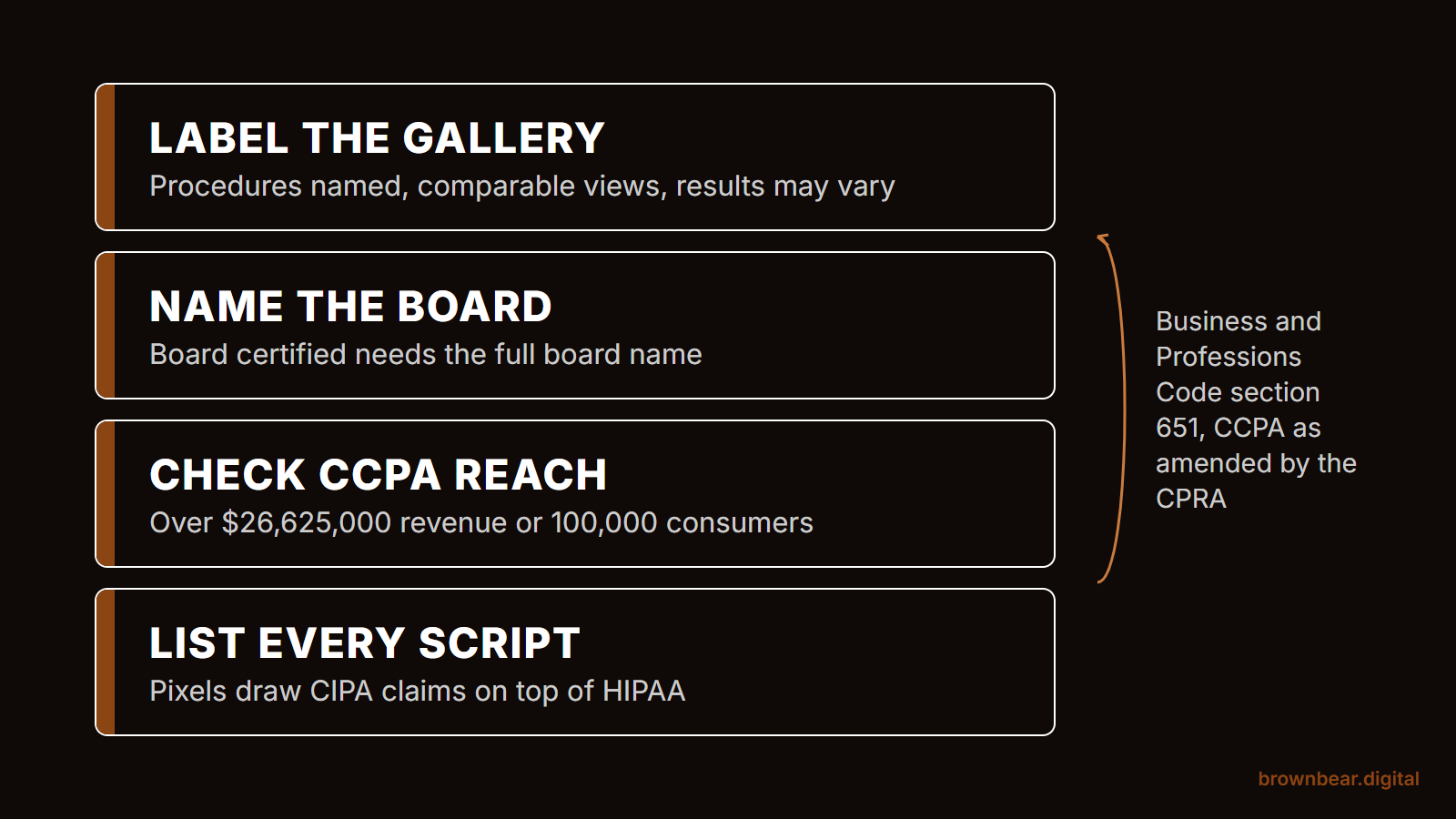
An agency writing for a California plastic surgery practice should know Business and Professions Code section 651 well, should ask about your revenue and traffic before telling you whether the state's privacy law applies, and should treat tracking pixels as a California lawsuit risk on top of HIPAA. These questions are not legal advice, and your healthcare counsel has the final word, but an agency that cannot discuss them is not ready to write for you.
Before-and-after photos and testimonials
Under California Business and Professions Code section 651, a before-and-after photo of an actual patient must state, in a prominent location and readable type, which procedures were performed. The before and after views must be comparable in presentation so poses and lighting do not distort the result, and they must carry a statement that the same results may not occur for all patients. Images of models must be labeled as models, altered images are treated as misleading, and testimonials that mislead by leaving out material facts fall under the same section. A licensee who violates it is guilty of a misdemeanor.
Ask: "Show me how you would label a before-and-after set in our gallery, in a Google Business Profile post and in an Instagram carousel." A strong agency answers with the three required elements without prompting. Our gallery guide shows what a compliant gallery looks like on the page.
The words "board certified" in titles and snippets
Section 651 also says a physician licensed by the Medical Board of California may not use the term "board certified" unless the full name of the certifying board appears with comparable prominence. At least two of the meta descriptions in the San Francisco results we read used "board-certified plastic surgeon" with no board named. Title tags and meta descriptions are short, so ask the agency how it writes them under this rule. A good answer names the board in full or leaves the phrase out of the snippet entirely.
CCPA and CPRA for tracking and ads
The California Consumer Privacy Act, as amended by the CPRA, applies to a for-profit business doing business in California that meets any one of three tests: annual gross revenue above $26,625,000 after the January 1, 2025 adjustment, buying, selling or sharing the personal information of 100,000 or more California residents or households, or earning half or more of its revenue from selling or sharing it. "Sharing" includes the cross-context behavioral advertising that ad pixels do.
If you run a solo practice well under that revenue line, the act may not reach you at all, and a good agency says so instead of selling you a privacy package. If you run a large multi-location group, it may, and the agency should plan for a "Do Not Sell or Share" link and for honoring browser opt-out signals like Global Privacy Control. Either way, the right first move is a question about your revenue and traffic, not a template.
Tracking pixels, HIPAA and California's wiretap law
HIPAA still governs any patient information your website collects through forms, chat and portals, and every vendor that touches it needs a business associate agreement. In 2024 a federal court vacated the part of HHS's tracking technology guidance that treated certain data from public, unauthenticated web pages as protected health information, and HHS dropped its appeal, so some agencies now treat pixels as settled. In California they are not. Sutter Health, the Northern California system, agreed to a $21.5 million settlement of class action claims, brought under the California Invasion of Privacy Act, that tracking tools on its website and patient portal sent data to Meta, Google and other third parties. It admitted no wrongdoing.
Ask: "Which third-party scripts will you add to our site, what does each one send, and which vendors will sign a business associate agreement?" A strong agency answers with a list. A weak one says "we install the standard pixels." Our guide to HIPAA and website tracking covers the federal side in depth.
What Agency Pricing and Contracts Look Like in San Francisco
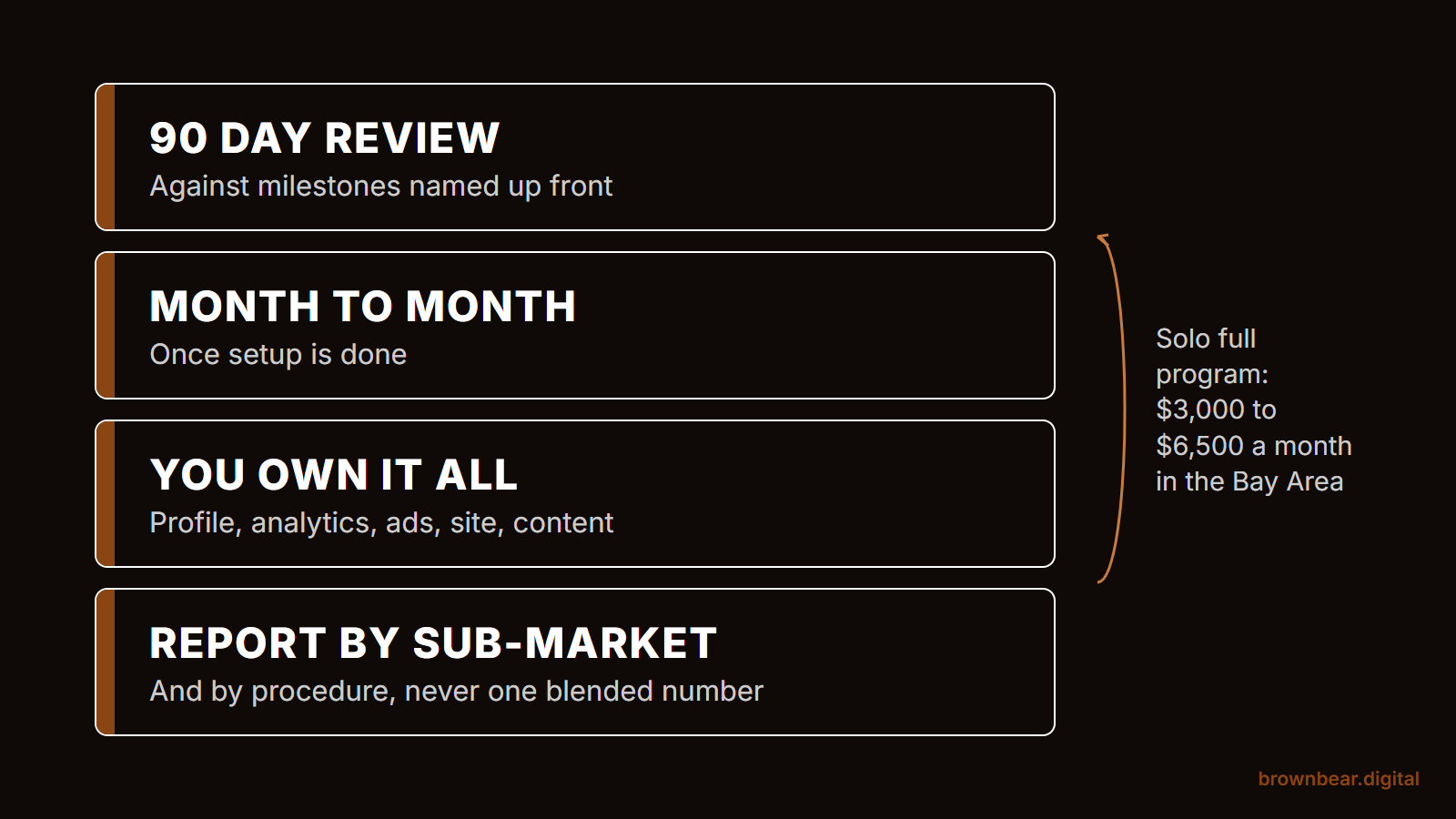
A full SEO and AI search program for a solo plastic surgeon in the Bay Area typically runs $3,000 to $6,500 a month, and the ranges climb with surgeons and locations. Anything far below these bands for a full program in this market usually means fewer hours or less senior work than the proposal implies.
| Practice type | Typical monthly range | What the fee should cover |
|---|---|---|
| Solo surgeon, full program | $3,000 to $6,500 | Profile, procedure pages, reviews, technical fixes, AI visibility work and monthly reporting |
| Multi-surgeon practice | $5,000 to $10,000 | All of the above, with reporting by surgeon and by procedure |
| Multi-location group, such as a city office plus a Peninsula office | $8,000 to $20,000 or more | Separate profiles, pages and tracking for each sub-market |
| Focused program in a smaller market | $1,500 to $3,000 | One procedure or one smaller sub-market office; rarely enough for a full city program |
Our San Francisco plastic surgery SEO cost breakdown explains why the same fee buys fewer hours here than in most metros, and the national plastic surgery SEO cost guide shows how the bands are built.
On contracts, hold every San Francisco proposal to four terms: a 90 day review against named milestones, month-to-month terms once setup is done, full ownership of your Business Profile, analytics, Search Console, ad accounts, website and content, and reporting broken out by procedure and sub-market rather than one blended number. If you are switching after a bad experience, settle ownership before anything else, because the next agency needs your history to see what went wrong.
To turn all of this into a decision:
- This week, run the three procedure searches and the five AI prompts from your office and save the screenshots.
- Send every agency the same one-page brief: your top three procedures, your sub-markets and what each patient is worth to you.
- In the first call, ask the five results questions and the compliance questions, and score the AI test.
- Sign only with the 90 day review clause and full account ownership in writing.
Done this way, you walk into each pitch meeting knowing more about your own search results than most of the agencies across the table. Over the following year, that is what keeps your visibility tied to consultations rather than to an agency's monthly slide deck.
Holding Brown Bear to the Same Standard
Brown Bear is a Bay Area agency, so read this section as a pitch and judge it by the tests above. On a first call we run the five prompts and the procedure searches for your practice and show you what we found, check how AI crawlers read your homepage, and walk through the section 651 and tracking questions for your site. We do not guarantee rankings or a place in AI answers, for the same reasons this guide tells you to distrust anyone who does. The 136-site crawler study cited above is the kind of local evidence you should ask every agency for, including us.
Work With Brown Bear on Plastic Surgery SEO in San Francisco
Choosing an agency in this market comes down to whether it can explain the results your patients already see and has a plan to change them. Brown Bear builds that plan around San Francisco's map packs, AI answers and California's advertising rules, with every claim tied to something you can check. When you are ready to see it applied to your practice, start with our approach to plastic surgery SEO and AI search in San Francisco.
Written By
Founder, Brown Bear Digital
Bryan has 15 years of experience across SEO, paid search, and AI search strategy. He founded Brown Bear to give businesses direct access to senior-level search expertise without the agency overhead.
Learn More About BryanGet Found on Google.
Get Cited by AI.
Tell us about your site. We'll send back a proposal for SEO and AI search.