Plastic Surgery SEO Cost in San Francisco: What It Takes to Compete in 2026
A San Francisco plastic surgery practice that wants to rank for its main procedures should plan on the full-program budget: $3,000 to $6,500 a month for a solo surgeon, $5,000 to $10,000 for a multi-surgeon practice at one location, and $8,000 to $20,000 or more for a group with several offices. The $1,500 to $3,000 band that works in smaller markets rarely fits here. The reason is not the city's reputation for high prices. It is what a patient sees when she searches.
On October 10, 2026, we ran six procedure and provider searches the way a San Francisco patient would and recorded who showed up. We paired that with federal wage data for the Bay Area, two of Brown Bear's own studies of practice websites, and the California rules that govern how a practice can advertise and track its visitors. This is the San Francisco companion to our plastic surgery SEO cost guide, which covers the line items and the hours math in depth.
If you are a solo surgeon weighing a quote from a downtown agency against one from a remote team, the labor section shows why the same fee can buy different amounts of work. If you run a group with offices on both sides of the Bay, the search results section shows who you are really up against. And if you manage marketing for a practice, the worked budget gives you numbers to take to the surgeon who signs the checks.
The Cost Framework in Brief
An SEO fee is hours multiplied by a rate. In Ahrefs' survey of 439 SEO providers, the most common hourly rate was $75 to $100, so $3,000 a month buys roughly 30 to 40 hours and $6,000 buys roughly 60 to 80. Those hours get split across six line items: strategy and reporting, technical work, Google Business Profile and local, medically reviewed content, links and digital PR, and AI search work. A budget works when enough of those lines get real hours.
Your market sets the floor. The cost guide sorts markets with a simple count: search your three most important procedures plus your city, then count the distinct practices in the map results and on the first page. Five or fewer serious competitors with thin pages is a smaller market. Ten or more with deep procedure pages is a major metro, where a solo surgeon needs the full program. Then judge any quote by the organic consults it needs to break even, not the rankings it promises.
The rest of this guide runs that framework on San Francisco.
What San Francisco Search Results Show
We searched plastic surgeon, breast augmentation, facelift, rhinoplasty, tummy tuck and liposuction, each followed by "San Francisco", with Google set to San Francisco. For each search we recorded the map results, the organic first page, any AI Overview and any ads.
| Search | Distinct practices on page one | Hospital or directory results | AI Overview | Ads |
|---|---|---|---|---|
| plastic surgeon san francisco | 8 | Sutter Health | No | 0 |
| breast augmentation san francisco | 6 | Yelp, UCSF | No | 0 |
| facelift san francisco | 7 | UCSF | No | 0 |
| rhinoplasty san francisco | 7 | UCSF | No | 0 |
| tummy tuck san francisco | 7 | None | No | 0 |
| liposuction san francisco | 8 | None | No | 0 |
Five findings shape what SEO costs here.
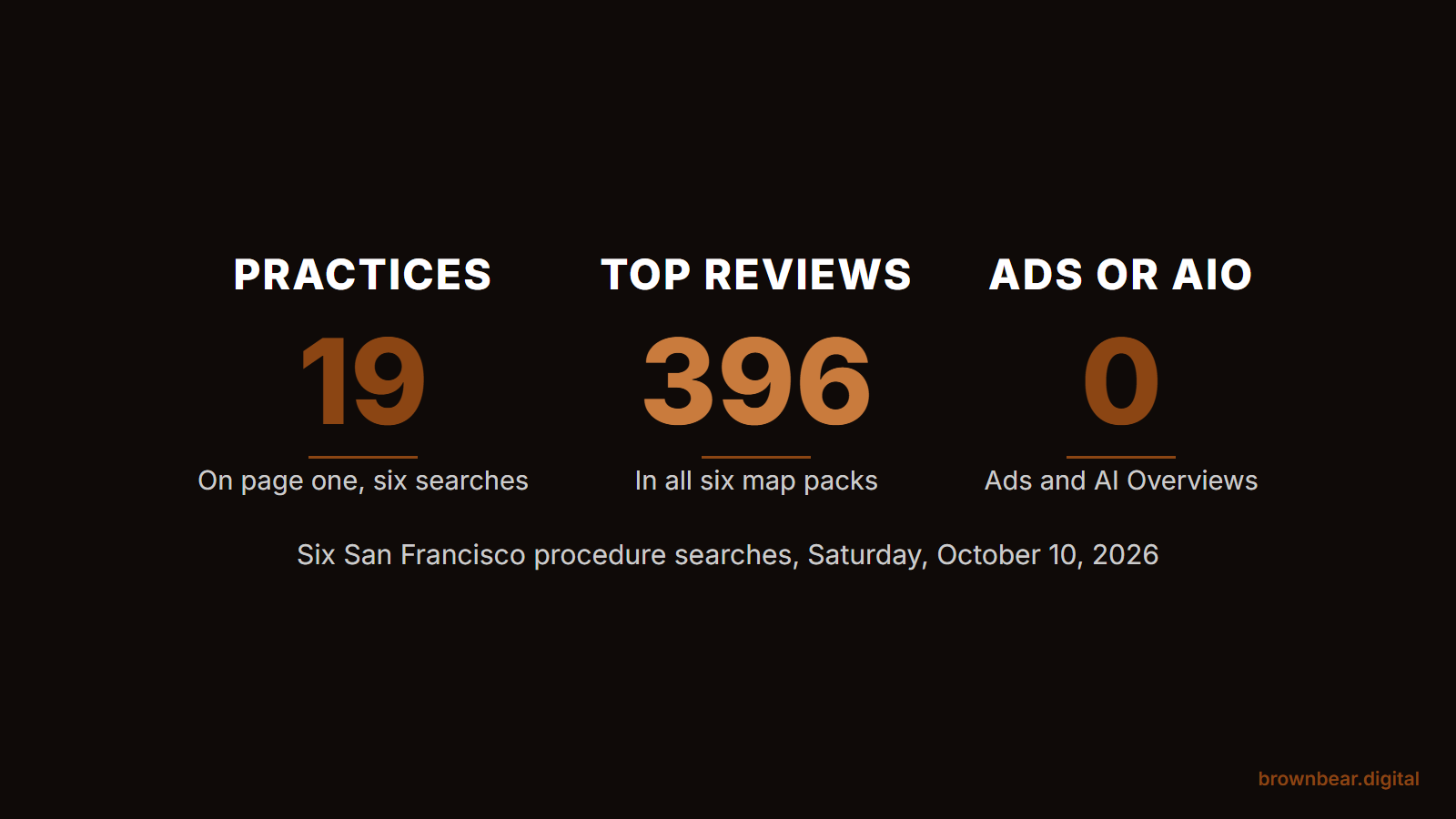
- Practices own the page. Across the six searches, 19 distinct practice websites reached the first page. Directories barely showed up: one Yelp list, on breast augmentation. Health systems held a few spots, with UCSF on three searches and Sutter Health on one.
- The competition is the whole Bay, not the city. Several first-page practices are based in Walnut Creek and Marin County and target San Francisco searches anyway. In our breast augmentation study across 101 cities, Oakland's #1 page sat inside a folder named for San Francisco. A practice in the city competes with the East Bay and Marin, and they compete with it.
- One practice sets the review bar. The same practice appeared in all six map packs, with 396 Google reviews at a 4.9 rating. The other map-pack practices we saw carried 74 to 210 reviews. Three of them list the same building, 450 Sutter Street, so distance cannot separate them; reviews, relevance and the website do.
- Face procedures draw specialists. The rhinoplasty and facelift results mix in face-focused practices and UCSF's head and neck surgery department. A general plastic surgeon who wants those terms is competing with practices that do little else.
- No ads and no AI Overviews on the procedure searches. None of the six showed a sponsored result or an AI Overview when we checked, on a Saturday, so treat the ad count as a snapshot. A cost search behaved differently: "breast augmentation cost san francisco" returned an AI Overview that put the local price at $7,000 to $15,000 and cited practice websites, not national publishers.
That last finding matters for the budget. The cost guide argues that cost and local searches still open the door to practices in AI answers, and in San Francisco the AI Overview for a local price question was built from local practice pages. A practice that publishes a clear, current cost page for its main procedures is competing for that citation.
Why San Francisco Sits in the Full-Program Band
Run the cost guide's market count against those results and San Francisco is not near the line. Nineteen practices on page one is nearly double the 10-competitor mark for a major metro, and most of them have dedicated, substantial procedure pages.
The page that ranked #1 for breast augmentation in our 101-city study in August 2026 still held the top organic spot on October 10. It is a procedure page, not a homepage, and it shows the local standard: 14 H2 sections, 17 question-style headings, a section answering what breast augmentation costs in San Francisco, 46 unique images and an embedded video. Across all 101 cities, 52% of #1 results were practice homepages. San Francisco is one of the markets where a dedicated procedure page won instead, so a budget here has to pay for pages built to that standard, one procedure at a time.
The review bar matters as much. A practice with 60 Google reviews will not close a gap to 396 in a quarter, and the gap compounds every month the leader keeps asking. A steady review program belongs in the local line of a San Francisco budget from the first month, which is one more reason a $1,500 retainer stretches too thin here.
The American Society of Plastic Surgeons' member directory points the same way. Its San Francisco results run past 10 pages of 12 office listings each, and by the tenth page they reach Napa, San Jose and Vacaville, about 40 miles out. Of the 136 Northern California practices on Brown Bear's own research list, 30 are in San Francisco.
What Bay Area Labor Costs Do to the Hours Math
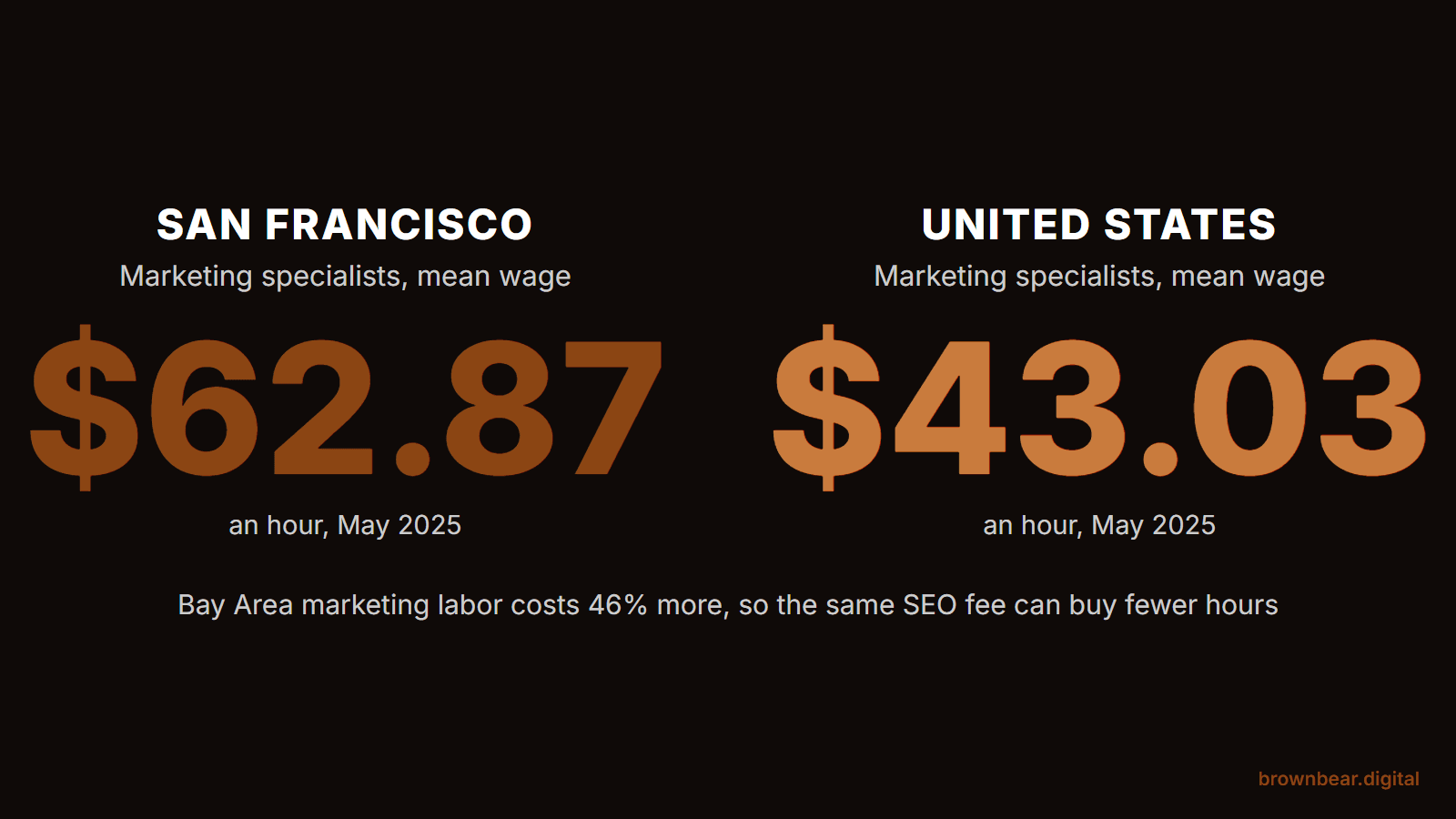
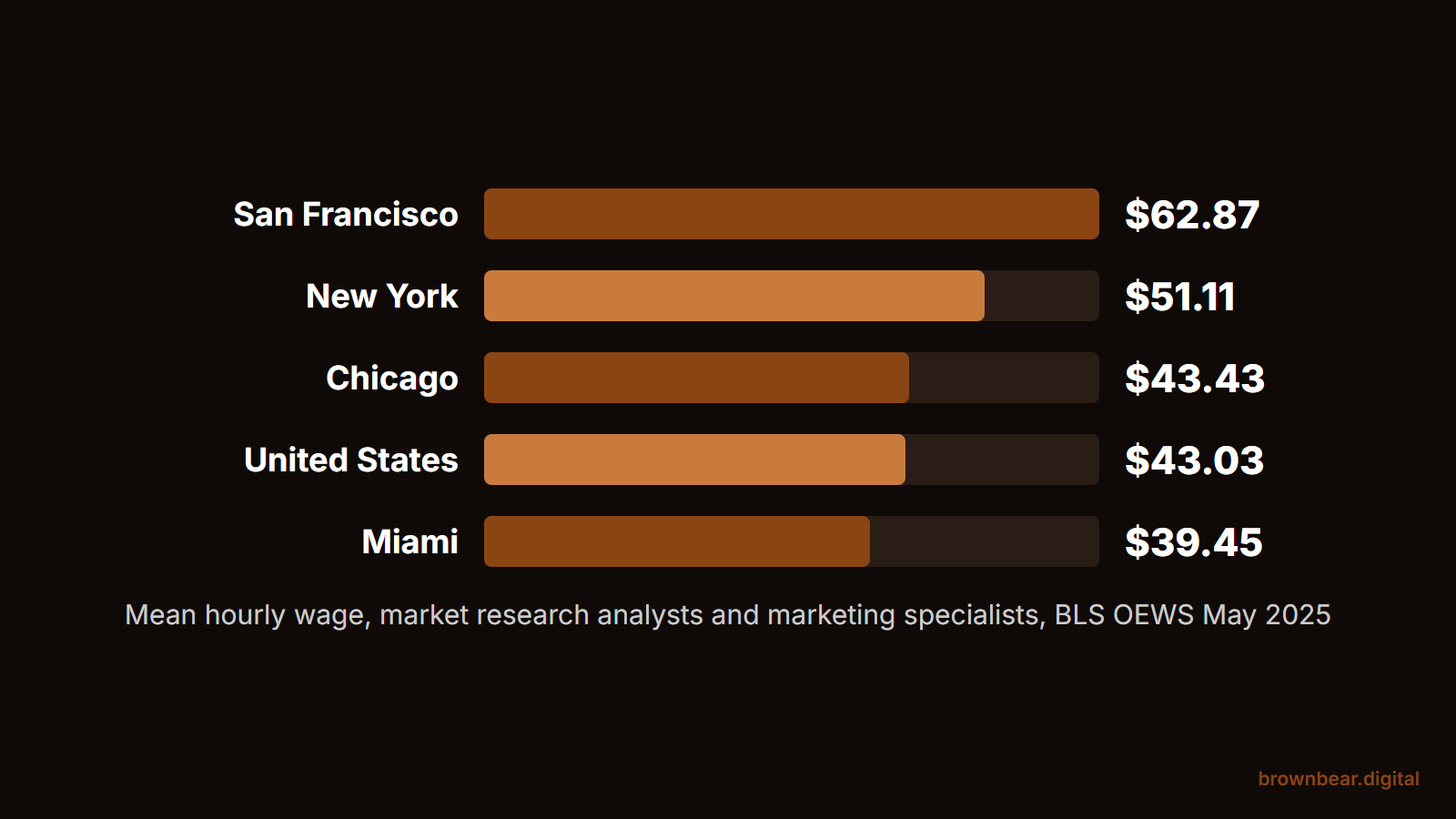
The survey rates behind the hours math are national. San Francisco labor is not. In the Bureau of Labor Statistics' May 2025 wage estimates, market research analysts and marketing specialists in the San Francisco-Oakland-Fremont metro earned a mean of $62.87 an hour, 46% above the national mean of $43.03. Web developers, who handle much of the technical line, earned a mean of $151,450 a year locally against $98,770 nationally.
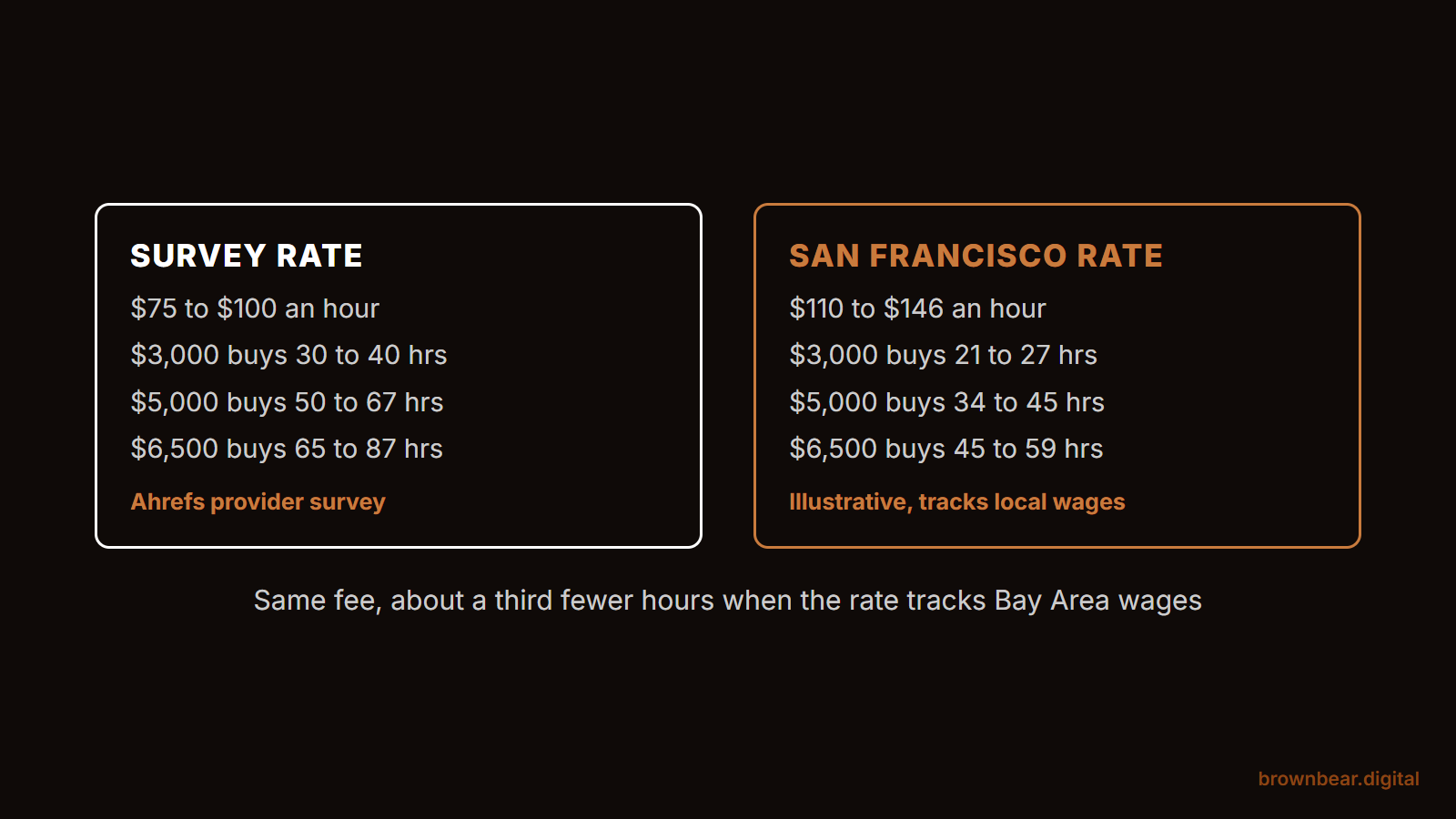
Agencies set their rates above wages, and not every agency that serves San Francisco practices pays San Francisco salaries. But if an agency's rate tracks local marketing wages, the survey's $75 to $100 an hour becomes roughly $110 to $146, and the same fee buys about a third fewer hours. We call this the San Francisco hours adjustment:
| Monthly fee | Hours at the survey's $75 to $100 | Hours at $110 to $146, illustrative San Francisco rate |
|---|---|---|
| $3,000 | 30 to 40 | 21 to 27 |
| $5,000 | 50 to 67 | 34 to 45 |
| $6,500 | 65 to 87 | 45 to 59 |
Two quotes at the same price, one from a downtown agency and one from a remote team, can therefore buy different amounts of work. Ask each for its hourly rate and its hours by line item. A higher rate can be worth paying when it buys senior strategists and medical review. What matters is whether the hours left after the rate still cover the line items this market demands. Your rankings depend on your Business Profile, reviews, citations and pages, not on your agency's zip code.
California Rules That Add Hours to the Work
Content and tracking take more review in California because the state adds its own rules on top of federal ones. Every gallery case, surgeon bio and tracking tag has to clear them, and that review time belongs in the budget.
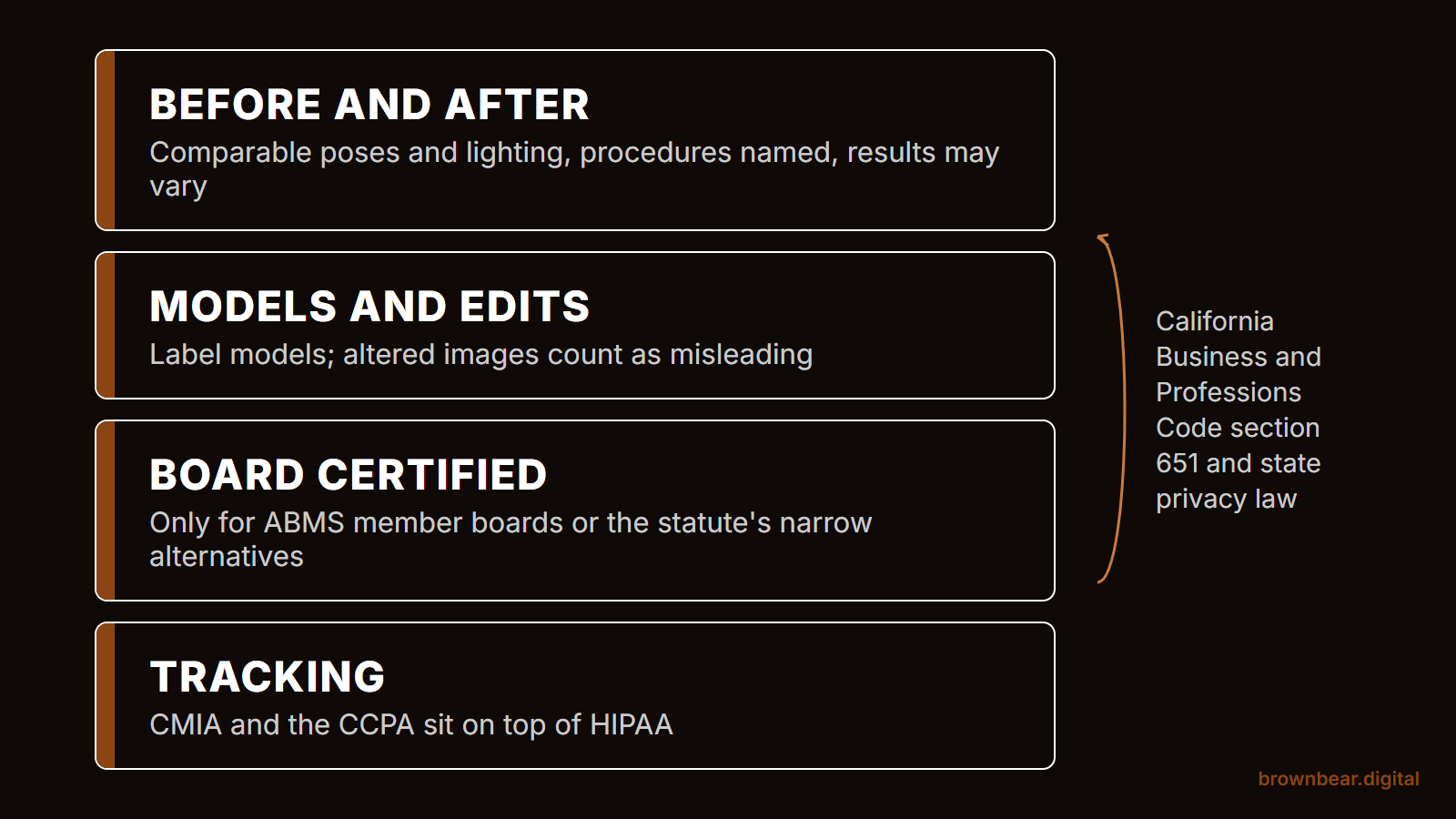
Before-and-after photos.
California Business and Professions Code section 651 prohibits false or misleading health care advertising and spells out what that means for photos. Before and after views have to be comparable in presentation, so poses and lighting do not distort the result, and they must state that the same results may not occur for all patients. A results photo has to say which procedures were performed, photos of models must be labeled as models, and images altered from the actual patient count as misleading. Building a before-and-after gallery that follows the rules takes real hours for exactly this reason.
The words "board certified".
The same section limits when a California physician can say board certified. The certifying board has to be a member of the American Board of Medical Specialties or meet one of two narrow alternatives the statute sets out. Every surgeon bio, procedure page and schema block that uses the phrase needs checking.
Tracking and privacy.
HIPAA is only one layer. California's Confidentiality of Medical Information Act separately bars providers of health care from disclosing medical information without authorization. The state's consumer privacy law, the CCPA, covers businesses with more than $26,625,000 in annual revenue as adjusted for 2025, or that buy, sell or share the personal information of 100,000 or more consumers or households, and sharing includes passing data to a third party for cross-context behavioral advertising, which is what many ad pixels do.
Whether a given practice crosses those lines is a question for its lawyer, not its agency. On the federal side, a Texas court in June 2024 vacated the part of HHS's tracking guidance that covered visits to unauthenticated public pages, but the rest of that guidance stands. Our guide to the HIPAA side of tracking covers the federal rules. None of this is legal advice; it is a list of the work an agency should be budgeting for.
A Worked Budget for a San Francisco Practice
Here is the cost guide's math applied to a typical San Francisco case. It is illustrative, not a quote.
A solo surgeon in Pacific Heights wants to rank for breast augmentation, facelift and rhinoplasty. The site has some procedure pages, but none built to the standard of the current #1. The market count puts the practice in a major metro, so the plan calls for about six pages per procedure: a core page plus supporting cost, recovery and candidacy pages, 18 pages in all. The practice chooses $5,000 a month, inside the full-program band.
At survey rates, $5,000 buys 50 to 67 hours. Using the planning shares behind the cost guide's Quote Decoder, roughly 8 hours per reviewed page with a little under half of the working hours going to content, that is about 2.4 to 3.2 reviewed pages a month, and the 18 pages take roughly 6 to 8 months. At the illustrative San Francisco rate, the same fee buys 34 to 45 hours, about 1.6 to 2.2 pages a month, and the build takes roughly 8 to 11 months.
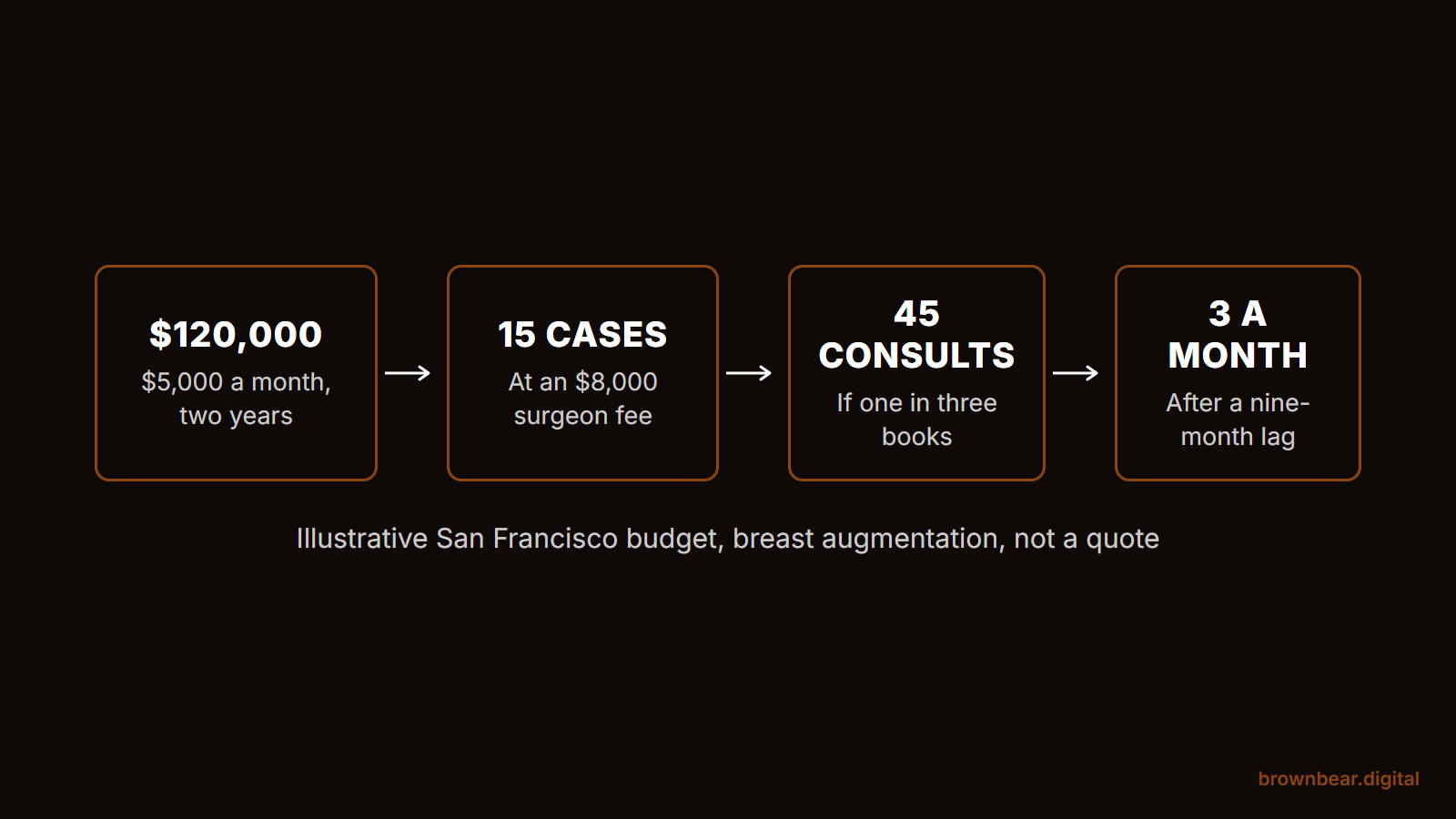
Now the break-even. Over two years the program costs $120,000. The American Society of Plastic Surgeons' 2024 statistics put the surgeon's fee for breast augmentation at $4,575 to $8,000, and San Francisco prices run high. One practice that ranks for these searches says its all-inclusive breast augmentation averages around $11,000, and a Marin County practice lists saline augmentation from $9,900, both including facility, anesthesia and implant costs. So assume a surgeon's fee at the top of the ASPS range, $8,000. The practice needs 15 organic cases to break even. If one in three consults books surgery, that is 45 organic consults over two years, about 2 a month. If the first nine months produce little, the remaining 15 months need 3 a month.
Facelift changes the picture. At the ASPS range of $12,000 to $19,000, a $15,000 surgeon's fee means 8 cases and 24 consults cover the same $120,000, about 1.6 a month after the lag. That is the case for putting the first content months into the highest-value procedure, as long as it is winnable. In San Francisco the facelift results include face-focused practices and UCSF, so check that search before you commit.
The Technical Line Runs Heavier Here
In October 2026 Brown Bear tested 136 Northern California practice homepages for an AI crawler study of practice homepages. The 25 San Francisco homepages that rendered cleanly were heavier than the group: a median of 1,449 KB of JavaScript against 1,102 KB across all 123, with 17 of the 25 over 1 MB and 7 over 2 MB. Five of the 28 San Francisco sites that answered a normal browser refused at least one AI crawler's user agent at the server.
Animated, video-heavy builds are part of how San Francisco practices sell a premium experience, and they are not fatal on their own. The median San Francisco homepage still had 94% of its visible text in the raw HTML. But a site that turns away AI crawlers or hides text behind scripts needs technical hours before new content can pay off, so many San Francisco budgets should open with an audit-and-fix month.
How San Francisco Compares With Miami, Chicago and New York
All four of these large markets sit in the full-program band for a solo surgeon. What differs is what the money buys and where it should go.
| Metro | Mean hourly wage, marketing specialists, May 2025 | #1 breast augmentation result in our 101-city study |
|---|---|---|
| San Francisco | $62.87 | Procedure page |
| New York | $51.11 | Practice homepage |
| Chicago | $43.43 | Procedure page |
| Miami | $39.45 | Practice homepage |
| United States | $43.03 | 52% of 101 cities: homepage |
San Francisco has the most expensive marketing labor of the four, about 23% above New York and about 59% above Miami, so a locally priced agency fee buys the fewest hours here. And like Chicago, its #1 breast augmentation result was a dedicated procedure page rather than a homepage carried by the practice's overall authority. That points a San Francisco budget toward deep procedure content and the reviews and links that support it. The quiet ad results we saw on procedure searches are the other local difference worth watching, with the caveat that they come from a single day.
Questions San Francisco Practices Ask About SEO Pricing
How much does plastic surgery SEO cost in San Francisco?
Plan on $3,000 to $6,500 a month for a solo surgeon's full program, $5,000 to $10,000 for a multi-surgeon practice at one location, and $8,000 to $20,000 or more for a multi-location group. A quote under $3,000 in this market usually covers one or two line items, not a program.
Should I hire a San Francisco agency or a remote one?
Either can work. A local agency may know the neighborhoods and the competitors well, but if its rates track Bay Area wages, the same fee buys fewer hours. Compare hours by line item, not addresses.
Do I need Google Ads while SEO builds?
Often, yes. In medical niches SEO typically takes 9 to 12 months to start producing patients, and paid search can cover that gap. On the day we checked, none of the six procedure searches showed an ad, so price your own terms before assuming the clicks are expensive, and check on weekdays too, since one snapshot is not a trend.
Does California law change what an SEO agency can publish for my practice?
Yes. Section 651 of the Business and Professions Code governs before-and-after photos, images of models and the words board certified, and California privacy law adds to HIPAA when it comes to tracking. A good agency builds that review into its hours. Ask who on the team does it.
Get a San Francisco Plastic Surgery SEO Budget
Brown Bear is based in the Bay Area, and San Francisco is our home market. The right budget for a practice here is the one whose hours cover the content, review and technical work these search results demand, and whose break-even consult count the practice can actually hit. See what we do for San Francisco practices, or start with the plastic surgeon SEO program behind it.
Written By
Founder, Brown Bear Digital
Bryan has 15 years of experience across SEO, paid search, and AI search strategy. He founded Brown Bear to give businesses direct access to senior-level search expertise without the agency overhead.
Learn More About BryanGet Found on Google.
Get Cited by AI.
Tell us about your site. We'll send back a proposal for SEO and AI search.