Plastic Surgery SEO Cost in New York: What a Manhattan Budget Has to Beat
A plastic surgery practice in New York is not buying SEO for one market. It is buying it for a ten-block stretch of Midtown and the Upper East Side where the map pack is decided, for outer boroughs where hospital systems and directories take most of page one, and for a Long Island market where Manhattan practices open second offices to compete. Each of those asks for different work, and the bill follows the work.
This guide prices SEO for New York practices using what we found on live New York search results on October 10, 2026, the New York laws that add hours to the job, and the same hours-based math as our line-by-line cost guide. If you want the general framework in depth, start there. This page is about what changes when the practice is in New York.
The Short Answer for New York Practices
A solo surgeon competing for Manhattan procedure searches should plan on the full-program band of $3,000 to $6,500 a month, and in our view toward the top of it. A multi-surgeon practice at one address typically needs $5,000 to $10,000. A group with a Manhattan office plus a Long Island, Westchester or New Jersey location is a multi-location program at $8,000 to $20,000 or more. The focused $1,500 to $3,000 band fits New York only for a practice that deliberately targets one borough or one suburban town and stays out of the Manhattan fight. Under $1,000 a month buys hours, not a program, anywhere.
Those bands come from the general guide, and so does the way to check any quote: convert the fee into hours. Ahrefs' survey of 439 SEO providers found the most common hourly rate was $75 to $100, so $3,000 a month buys roughly 30 to 40 hours and $6,000 buys roughly 60 to 80. A New York address on an agency's letterhead does not change that math. What New York changes is how many of those hours the market eats before you see a consult.
What New York Search Results Showed on October 10, 2026
We searched eight queries a New York patient might type and recorded who held the map pack, who held the organic results, and whether Google showed an AI Overview. The map pack was set to New York, NY. Our browser was not physically in New York, so treat ad counts as unknown: we saw no sponsored results, and ads are targeted by location.
| Query | Map pack | Organic results we recorded | AI Overview |
|---|---|---|---|
| rhinoplasty nyc | 3 practices | 7: 6 practice sites, Mount Sinai at #3 | No |
| facelift nyc | 2 practices and a skin care clinic | 8: all practice sites | No |
| breast augmentation nyc | 3 practices | 8: Mount Sinai at #1, then 7 practice sites | No |
| deep plane facelift nyc | None shown | 8: all practice sites | Yes, citing practice sites |
| plastic surgeon nyc | 3 practices | 9: 5 practices, Mount Sinai and NYU Langone, the ASPS directory and U.S. News | Yes, naming practices |
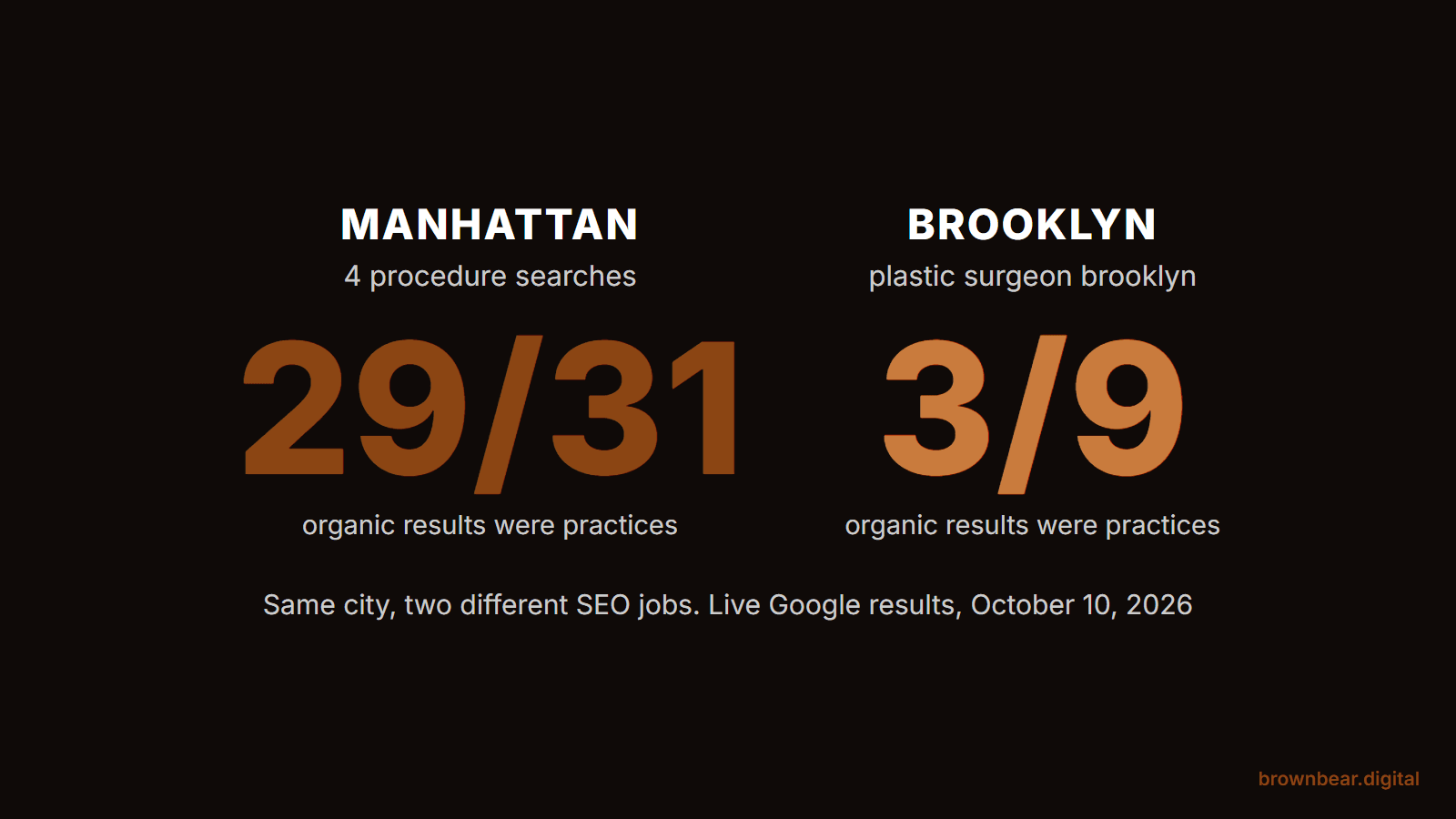
| plastic surgeon brooklyn | 2 listings for one practice and a national chain | 9: 3 practices, 4 hospital systems, Zocdoc and the ASPS directory | No |
| plastic surgeon long island | Practices in Smithtown, Jericho and Hauppauge | 9: 7 practices, 1 hospital system, Yelp | No |
| plastic surgery seo nyc | None shown | Agency service pages and agency list posts | Yes |
Five things in that table set the price of SEO here.
Procedure searches in Manhattan belong to practices.
On the four procedure queries, 29 of the 31 organic results we recorded were practice websites. The only exception was Mount Sinai, which ranked #3 for rhinoplasty and #1 for breast augmentation. That is good news and bad news. A private practice can win these searches, but the practices already there have built deep procedure pages for years, and many of their titles claim to be the best in the city. You are paying to outbuild them, page by page.
The map pack lives in about ten blocks.
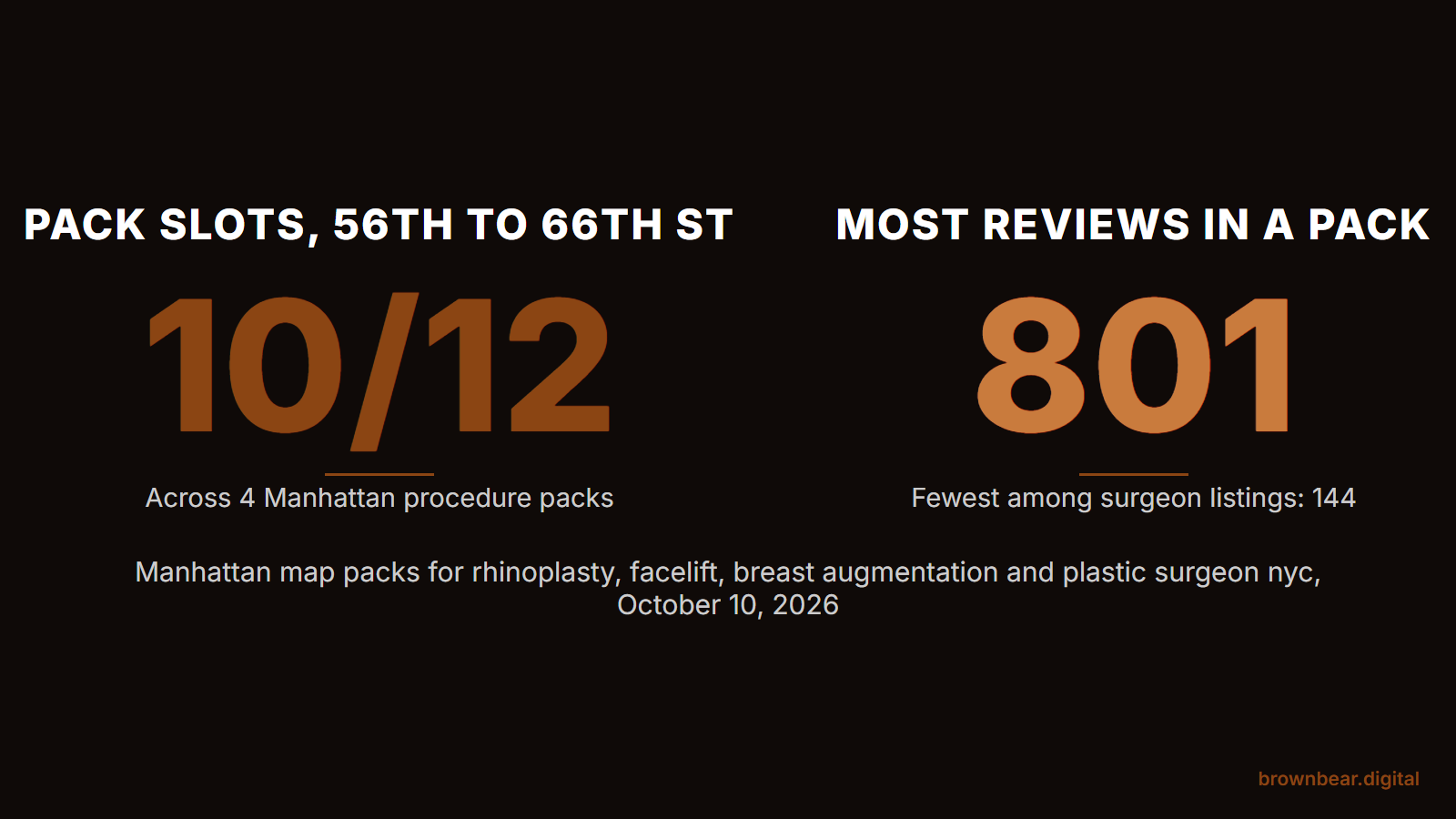
Across the four Manhattan packs we recorded, 10 of the 12 slots went to offices between 56th and 66th Streets, around Fifth, Madison and Park. One building, 60 East 56th Street, held slots for two different practices, and one surgeon appeared in three of the four packs. The plastic surgery listings in those packs carried between 144 and 801 Google reviews with ratings of 4.7 to 5.0. A new Midtown practice is not competing with the city; it is competing with its neighbors on the same blocks, and the review gap is often the first line item to fund.
Broad searches pull in institutions and directories.
"Plastic surgeon nyc" put two hospital systems, the ASPS directory and U.S. News on page one beside five practices. In Brooklyn, practices held only 3 of 9 organic results, behind NYU Langone, The Brooklyn Hospital Center, Maimonides and One Brooklyn Health, with Zocdoc at #1. Outside Manhattan, ranking a practice website is only part of the job; profiles on the directories that rank are part of the budget too.
AI Overviews appeared where questions get broad, and they cited practices.
Google showed an AI Overview for "plastic surgeon nyc" that named individual practices, and one for "deep plane facelift nyc" whose sources were practice websites, including a cost section that put Manhattan deep plane facelifts at $30,000 to $100,000 or more. The specific procedure searches showed none. In New York, the pages that feed those answers are practice pages, which means the content line of the budget also buys AI visibility.
Long Island is a separate market, and Manhattan practices know it.
The Long Island pack went to suburban practices in Smithtown, Jericho and Hauppauge, and one of them listed a Manhattan phone number. The top organic result described its practice as serving "NYC & Long Island." Competing there means a real second office with its own profile and pages, which moves a practice into the multi-location band.
Manhattan, the Outer Boroughs and the Suburbs Cost Different Amounts
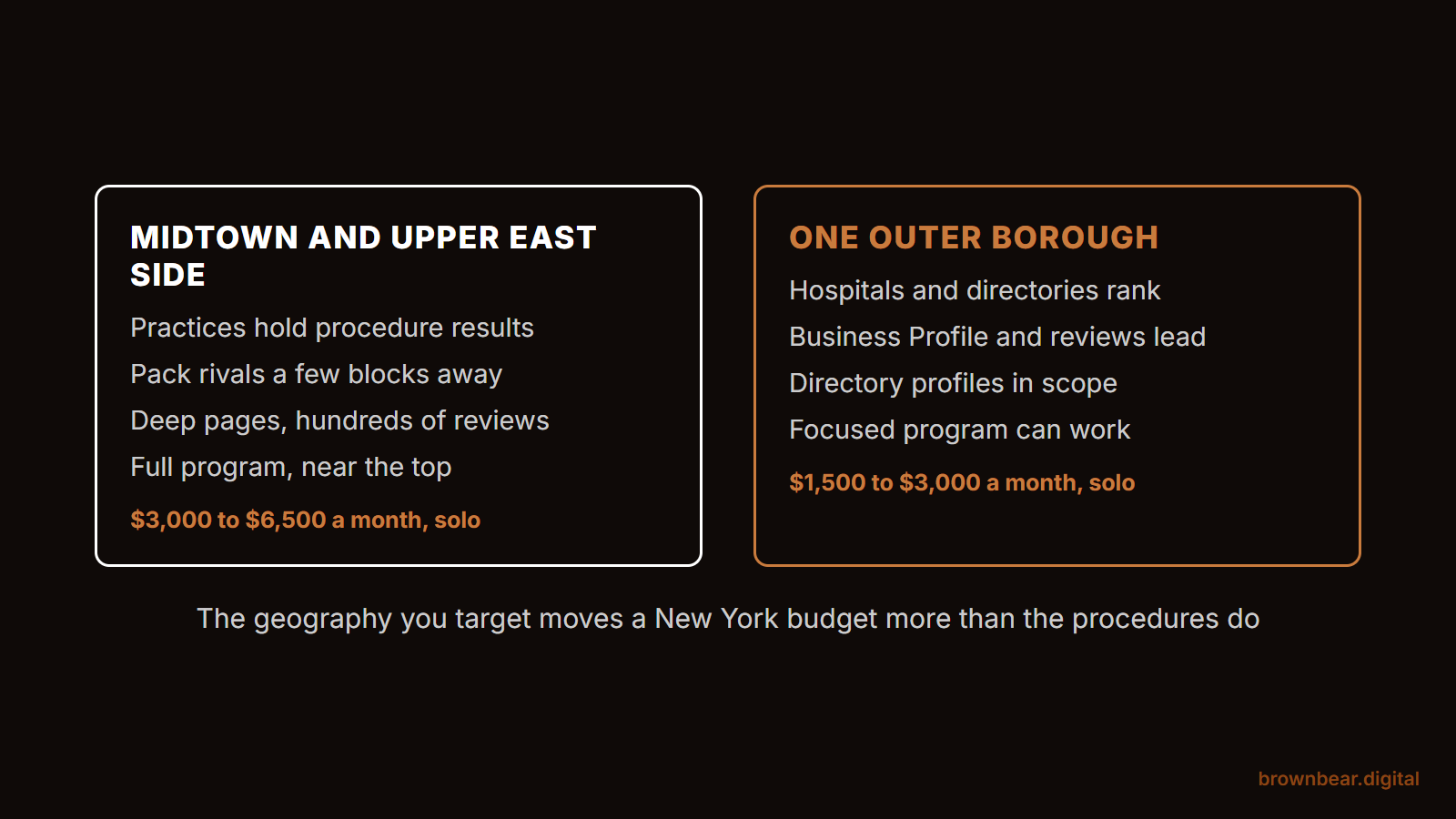
New York is not one search market, and a quote that treats it as one is pricing the wrong job. The geography you target is the biggest single lever on a New York SEO budget, more than the procedures.
If you practice in Midtown or on the Upper East Side
, you are in the hardest version of the market. Your map pack rivals are within walking distance and already carry hundreds of reviews. Your organic rivals have deep procedure pages. When we pulled the #1 breast augmentation result for New York for our 101-city ranking study, it was a practice homepage of about 2,000 words carrying 165 images, 20 H2 headings, a section built around a Newsweek ranking and a press section. That same practice ranked #2 for "breast augmentation nyc" in our October capture. That is the level a Manhattan budget is funding against, and it is why the full-program band, near the top, is the realistic plan.
If you practice in Brooklyn, Queens, Staten Island or the Bronx
, the organic fight is less about other practices and more about hospital systems and directories. That shifts money from content volume toward a strong Business Profile, a steady review program and complete directory profiles. A solo surgeon who targets one borough and neighborhood-level searches can often work in the focused $1,500 to $3,000 band, as long as the proposal says exactly which searches it is chasing. Expect national chains in the pack too: a national chain held a Brooklyn pack slot with about 1,000 reviews.
If you practice on Long Island or in Westchester
, you are competing in a suburban market that Manhattan practices also want. We recorded the Long Island results for this guide but not Westchester's, so check your own town before you set a number. For Long Island, the practices in the pack are local, well reviewed and established, and a single-office suburban program sits in the full-program band unless your town is quiet.
If you run offices in Manhattan and a suburb
, each location needs its own Business Profile, its own location pages and its own review program. Google only allows a Business Profile for each real office, so a virtual office will not get you into the Long Island pack. Planning for a second office on Long Island is a multi-location budget, $8,000 to $20,000 or more. North Jersey offices add a second state's rules, which the next sections do not cover.
How Many Surgeons a New York Practice Competes With
There is no current public census of plastic surgeons in the New York metro. The AAMC's 2021 New York physician workforce profile counted about 600 active plastic surgeons statewide, roughly one for every 32,600 residents, using 2020 data. The ASPS directory alone runs to several pages for New York City. The more useful number is the one you count yourself: search your top three procedures with your neighborhood, the way a patient would, and count the distinct practices in the map pack and on page one.
On the Manhattan procedure searches we ran, that count is high. Across the four procedure queries we found 26 distinct practices in the organic results and the packs, before counting the practices on page two. By the general guide's rule of thumb, 10 or more serious competitors is a major-metro market, and Manhattan clears that bar on every procedure we checked.
New York Rules That Add Hours to the Work
Three sets of New York rules change what an SEO program has to do, and every one of them costs hours that a template program does not budget. None of this is legal advice; it is a map of where an agency's work touches the law, so you can ask your counsel the right questions.
Physician advertising under Education Law 6530
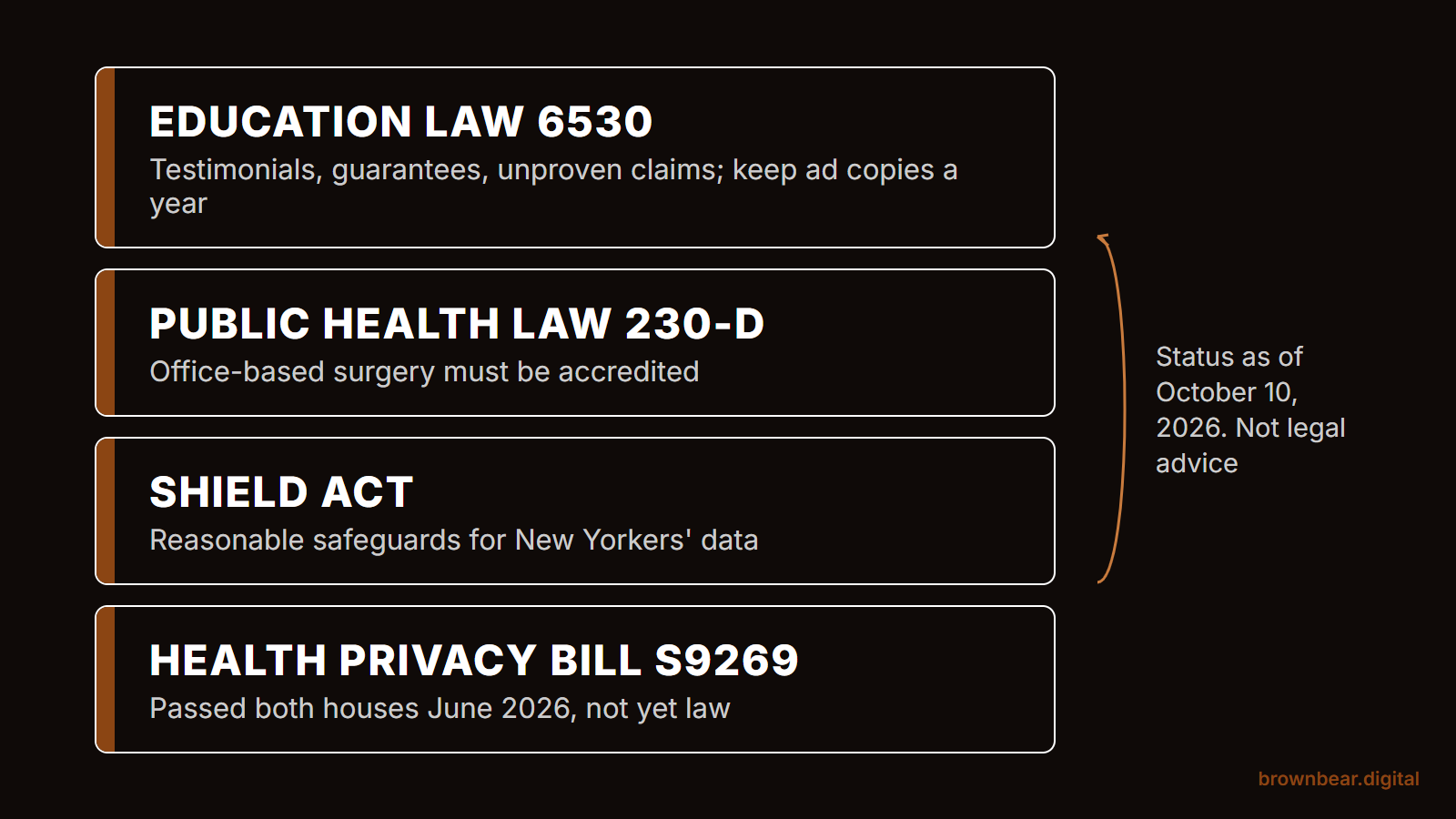
New York's definition of physician misconduct includes advertising that is not in the public interest, and the statute lists what that includes: advertising that is false or misleading, that uses testimonials, that guarantees any service, or that makes claims about services, costs or professional superiority the physician cannot substantiate. Physicians also have to keep an exact copy of each advertisement for a year after it last appears. Discipline runs through the Department of Health's Office of Professional Medical Conduct.
Read that list against a typical practice website. Patient testimonial pages, review widgets, "best rhinoplasty surgeon in NYC" title tags, before-and-after claims and published price ranges all sit close to it. Whether a given page crosses the line is a question for the practice's healthcare counsel. It is also a question your SEO agency should be raising every time it writes a title tag, and the review step costs time. Keeping dated copies of pages and ads costs time too. Budget for both; we plan on roughly 3 to 5 hours a month for compliance review and page archiving in a New York program.
The review work interacts with collecting and answering reviews. Reviews on Google are the patient's words on a third-party site; quoting them on your own pages as advertising is the part to clear with counsel first.
Office-based surgery accreditation under Public Health Law 230-d
New York requires practices that perform office-based surgery, procedures done outside a hospital under moderate or deep sedation or general anesthesia, plus any liposuction, to obtain and keep full accreditation from a nationally recognized accrediting agency, and to report adverse events within three business days. For SEO, this is a content requirement more than a cost: in-office surgical suite pages should state accreditation accurately and name the accrediting body. It is also a trust signal patients look for, and an accurate one is worth a line on every procedure page.
Tracking pixels, the SHIELD Act and a pending health privacy law
Tracking is where New York has already enforced. In December 2023 the New York Attorney General announced a $300,000 settlement with NewYork-Presbyterian over tracking pixels on its website that could share visitors' health information with third parties, and treated it as a HIPAA violation. Federally, a court vacated part of HHS's tracking guidance in June 2024, the part covering public pages, but tracking on patient portals and other logged-in pages is still covered.
Two more state laws sit around that. The SHIELD Act, General Business Law 899-bb, requires any business holding New Yorkers' private information to keep reasonable security safeguards, and treats a practice that complies with HIPAA's rules as compliant. And the New York Health Information Privacy Act came back in 2026: the governor vetoed the first version on December 19, 2025, and a revised bill passed both houses in June 2026 but, as of October 10, 2026, had not been delivered to the governor. If it becomes law, health data collected on practice websites would likely carry its own consent rules.
For the SEO budget, that means a tracking audit before any new analytics or ad pixel goes on a procedure page, consent handling that works, and conversion tracking that counts consults without sending health details to ad platforms. It is a one-time project with ongoing upkeep, and in New York it belongs in the technical line from the first month.
A Worked New York Budget, Illustrative
Here is how the bands and the hours math play out for three typical New York practices. These are illustrative examples built from the bands and published fees above, not quotes and not a promise of results.
A solo facial surgeon on the Upper East Side
targeting facelift, rhinoplasty and eyelid surgery. Every one of those searches is held by deep practice pages, and the pack is a few blocks away, so plan near the top of the full-program band, say $6,000 a month. At $75 to $100 an hour that buys roughly 60 to 80 hours. After compliance review, reporting, technical upkeep, the review program and link work, about 3 reviewed procedure pages a month is a realistic content pace at that fee.
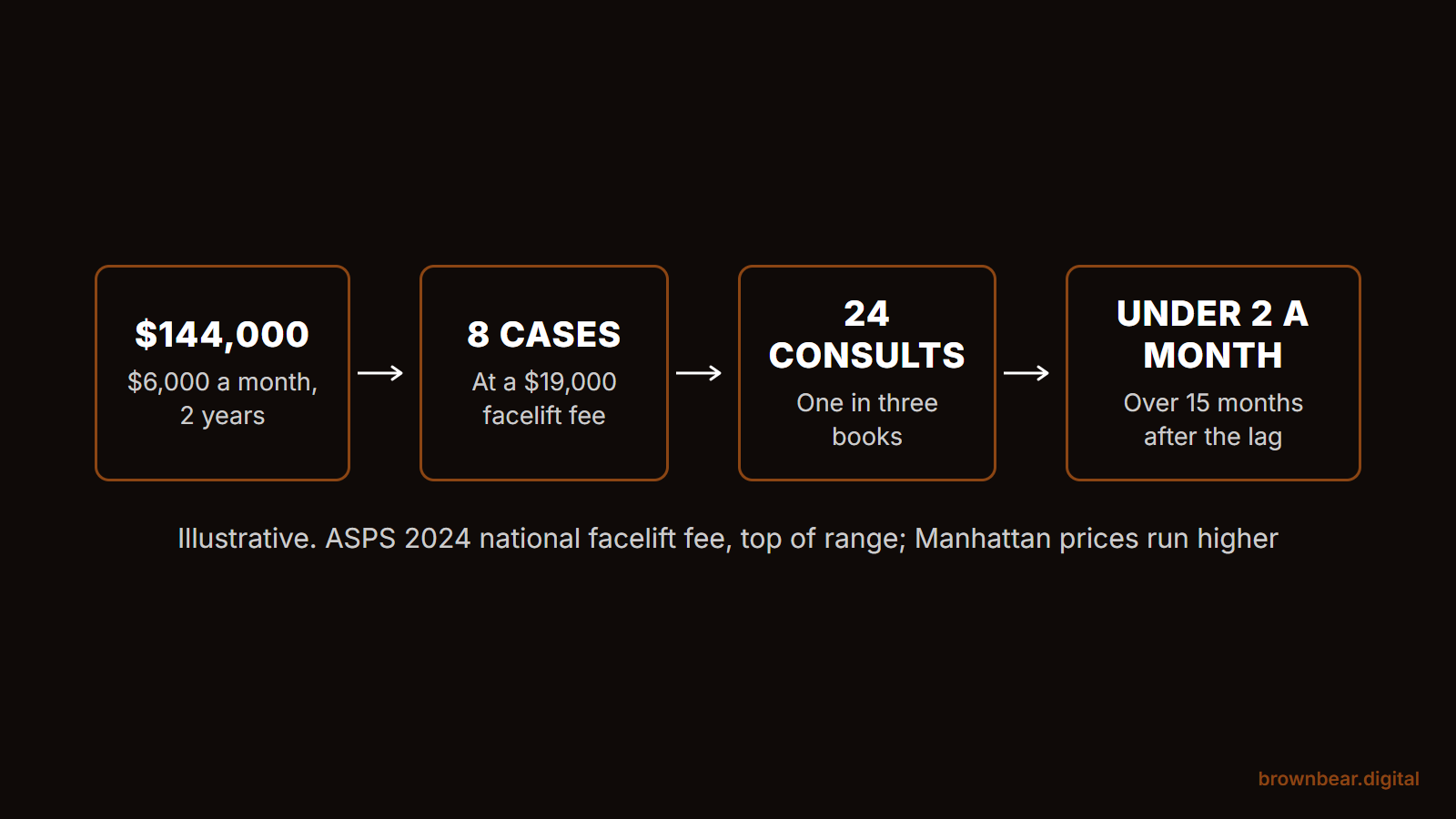
The break-even math is friendlier than the fee suggests, because facial cases are worth a lot here. Over two years the program costs $144,000. The American Society of Plastic Surgeons puts the national surgeon's fee for a facelift at $12,000 to $19,000; use $19,000, which is conservative for Manhattan, where published prices run far higher. That is 8 organic facelift cases to break even. If one consult in three books surgery, it is 24 organic consults over two years. Allow for the 9 to 12 month lag medical SEO runs on, and the remaining 15 months need fewer than 2 organic facelift consults a month.
A breast and body surgeon in Brooklyn or on Long Island
, targeting one borough or a few towns, at $3,500 a month. That buys roughly 35 to 47 hours, weighted toward the Business Profile, reviews and directory profiles. Over two years it costs $84,000. At a breast augmentation surgeon's fee of about $6,000, inside the ASPS range of $4,575 to $8,000, that is 14 cases, or 42 consults at one in three, a little under 3 organic consults a month once the lag has passed.
A multi-surgeon Park Avenue group with a Long Island satellite
is a multi-location program at $8,000 to $20,000 or more. The Manhattan office carries the procedure content and links; the satellite needs its own profile, pages and reviews. The money is usually well spent when each location reports its own consults, and wasted when the satellite gets a copied page and nothing else.
The pattern across all three: in New York, case values are high enough that the break-even consult count is modest. The risk is not that SEO cannot pay for itself here. It is that the fee buys too few hours to reach the first page against practices that have been building for a decade.
How New York Differs From San Francisco, Miami and Chicago
We are building the same guide for three other cities, and New York is the outlier on concentration. Chicago's practices split between the city and the suburbs, and Miami's demand comes partly from patients who travel in and partly from Spanish-language searches. The Bay Area spreads across San Francisco, the East Bay and the South Bay. New York has suburbs and travelers too, but its hardest competition is packed into a few dozen Manhattan blocks, its broad searches pull in some of the country's best-known hospital systems, and its physician advertising law names testimonials, guarantees and unsubstantiated superiority claims in the statute itself. That combination is why a Manhattan program spends more of its hours on depth, reviews and compliance than the same program would elsewhere.
Questions New York Practices Ask About SEO Pricing
Is plastic surgery SEO more expensive in New York than elsewhere?
For Manhattan procedure searches, yes, in the sense that a solo practice should plan near the top of the full-program band rather than the bottom. The hourly rate is not the reason; the hours are. A practice that targets one outer borough or one suburban town can spend much less.
Should a Manhattan practice also target Long Island or New Jersey?
Only with a real office there. The map pack follows physical locations, so a second market means a second location and a multi-location budget. New Jersey also brings a different state's rules.
Do we need to change our website because of New York advertising rules?
Have your counsel review testimonial pages, "best" claims in titles and headings, guarantees and published price ranges against Education Law 6530, and keep dated copies of your pages and ads. An agency working in New York should build that review into the program.
Get a New York SEO Budget Built Around Your Blocks
The right number for a New York practice depends on which blocks, boroughs or towns you need to win, how far behind your neighbors you start, and how many hours the compliance work takes. Brown Bear builds New York plans from that math and reports consults, not traffic. See how we approach SEO for New York practices.
Written By
Founder, Brown Bear Digital
Bryan has 15 years of experience across SEO, paid search, and AI search strategy. He founded Brown Bear to give businesses direct access to senior-level search expertise without the agency overhead.
Learn More About BryanGet Found on Google.
Get Cited by AI.
Tell us about your site. We'll send back a proposal for SEO and AI search.