How to Choose a Plastic Surgery SEO and AI Search Agency in New York
A plastic surgeon on the Upper East Side can take six agency pitches in a month and hear the same promises six times: page one, AI visibility, more consults. The pitch decks look alike because they are written for every city at once. New York is not every city, and the agency you hire should be able to prove it knows the difference before you sign anything.
This is Brown Bear's buyer's guide for plastic surgery and aesthetic practices choosing an SEO and AI search partner in the New York metro. It is built on the live Google results for the procedure searches New York patients actually run, on New York's own physician advertising and privacy laws, and on what we see when we audit how AI assistants describe practices. We wrote it as an agency, so read it with that in mind: Brown Bear is based in the San Francisco Bay Area and serves New York practices remotely, and the last section scores us against the same criteria we give you here.
When we say SEO and AI search, we mean both halves of how a patient finds you now: the Google map pack and organic results, and the answers ChatGPT, Perplexity and Google's AI features give when a patient asks who to see. If you own a practice on Park Avenue, you need an agency that can win a map pack that fits inside ten city blocks. If you run marketing for a group with offices on Long Island or in Westchester, you need one that treats each office as its own market. And if you have been burned by an agency before, you need questions that expose a template plan in the first meeting.
By the end you will have five interview questions drawn from what New York's search results show today, a way to check any agency's AI search claims yourself in under an hour, the New York compliance questions most agencies cannot answer, and the budget and contract terms that fit this market. So let's start with what the search results show, because that is where every good pitch should start too.
Key Takeaways
Start with the search results, not the pitch
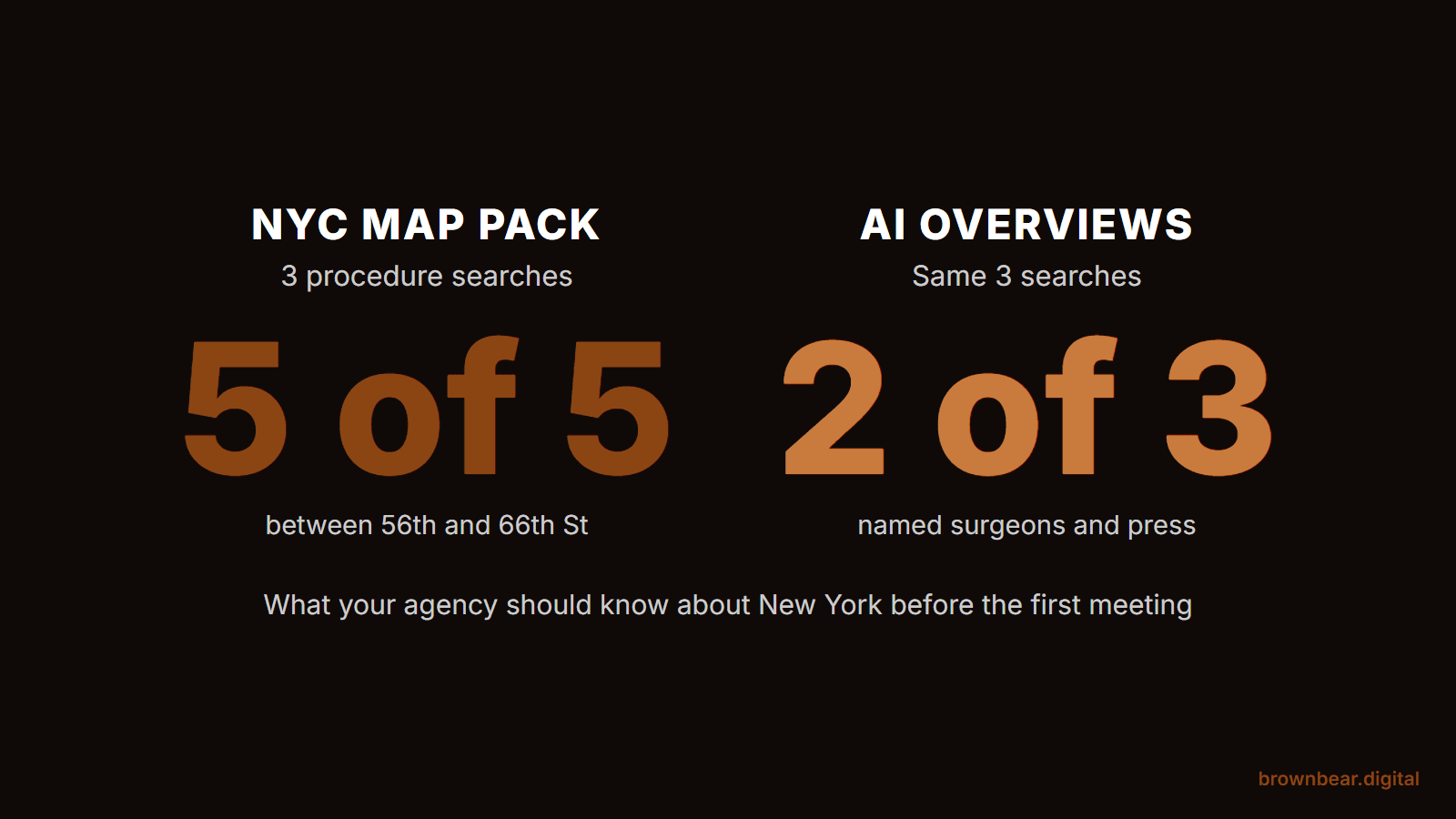
On October 10, 2026, the New York map pack for core plastic surgery searches sat between 56th and 66th Streets, and on the broadest search, hospitals and directories held four of the nine organic results. A good agency has run your searches before the first meeting.
Match the plan to your part of the metro
Manhattan competes on a few blocks, reviews and press. The outer boroughs, Long Island, Westchester and North Jersey compete on neighborhoods, towns and driving distance, and North Jersey answers to a different state board.
Test every AI search claim yourself
Run 8 to 10 patient prompts by neighborhood in ChatGPT, Perplexity and Google AI Mode, record who is named and what is cited, then score the agency on 7 yes or no checks.
Ask the New York compliance questions
Education Law 6530 covers testimonials, guarantees, unprovable superiority claims, a one-year ad archive and paying the press for publicity. Public Health Law 230-d governs office-based surgery accreditation claims.
What the National Agency Guides Already Cover
The general hiring questions are the same in every city, and we have written them up already. Our guide to evaluating a plastic surgery marketing agency covers the questions agencies dread, the live Search Console data you should ask to see, the reference calls that reveal real performance, and an interview scorecard you can use on every proposal. Our guide for medical practice owners hiring an SEO agency covers the five questions that filter a real healthcare SEO agency from a good salesperson, the test-their-own-SEO rule, and why a one-year agreement with a 90-day review is reasonable.
Read those first if you have not. This guide does not repeat them. It adds what changes when the practice is in New York: who you are actually competing with on the page, how the metro splits into separate markets, why press matters more here than almost anywhere, and which state laws your agency's work has to live inside.
What New York's Search Results Show Before You Take a Pitch
On October 10, 2026, we ran three of the searches a New York patient runs, "plastic surgeon nyc", "rhinoplasty nyc" and "best plastic surgeon nyc", and Google placed all three in New York, NY. Here is what held the page.
| Search | Map pack | Organic first page | AI Overview |
|---|---|---|---|
| plastic surgeon nyc | 3 Midtown practices, 347 to 801 reviews | 5 practices, Mount Sinai, NYU Langone, the ASPS surgeon finder, U.S. News | Yes, names 5 practices and gives vetting advice |
| rhinoplasty nyc | 3 practices on the Upper East Side and Midtown East | 6 practices, Mount Sinai | None |
| best plastic surgeon nyc | Practices from the other two packs, including one on Park Avenue | 7 practices, U.S. News | Yes, names individual surgeons and their press |
Five findings matter for choosing an agency.
1. The map pack is a few city blocks.
Across the three searches we recorded five different practices in the map pack, and all five sit between 56th and 66th Streets, within a few blocks of Fifth and Park Avenues. Their review counts ran from 347 to 801, with ratings of 4.7 to 5.0. A practice outside that cluster is unlikely to break into that map pack on the strength of its listing alone, whatever an agency promises.
2. Hospitals and directories hold seats you will not take.
On "plastic surgeon nyc", four of the nine organic results belonged to Mount Sinai, NYU Langone, the American Society of Plastic Surgeons' Find a Surgeon tool and U.S. News. Those are institutions with enormous authority. An independent practice wins around them, on narrower searches, not through them.
3. Practices still own procedure searches.
On "rhinoplasty nyc", six of the seven organic results were private practice websites. Procedure searches are where a well-built practice site can still earn a first-page position against the hospitals.
4. AI Overviews name practices and surgeons.
Two of the three searches showed an AI Overview, and both answered with named practices and surgeons. The "plastic surgeon nyc" overview listed five practices, then told patients to verify board certification and hospital privileges at an accredited New York hospital. Your credentials are part of what the AI repeats back.
5. Press shows up inside the AI answer.
The "best plastic surgeon nyc" overview described one facial plastic surgeon as recognized by Newsweek and New York Magazine. In New York, press coverage is not only reputation. It is source material the AI quotes.
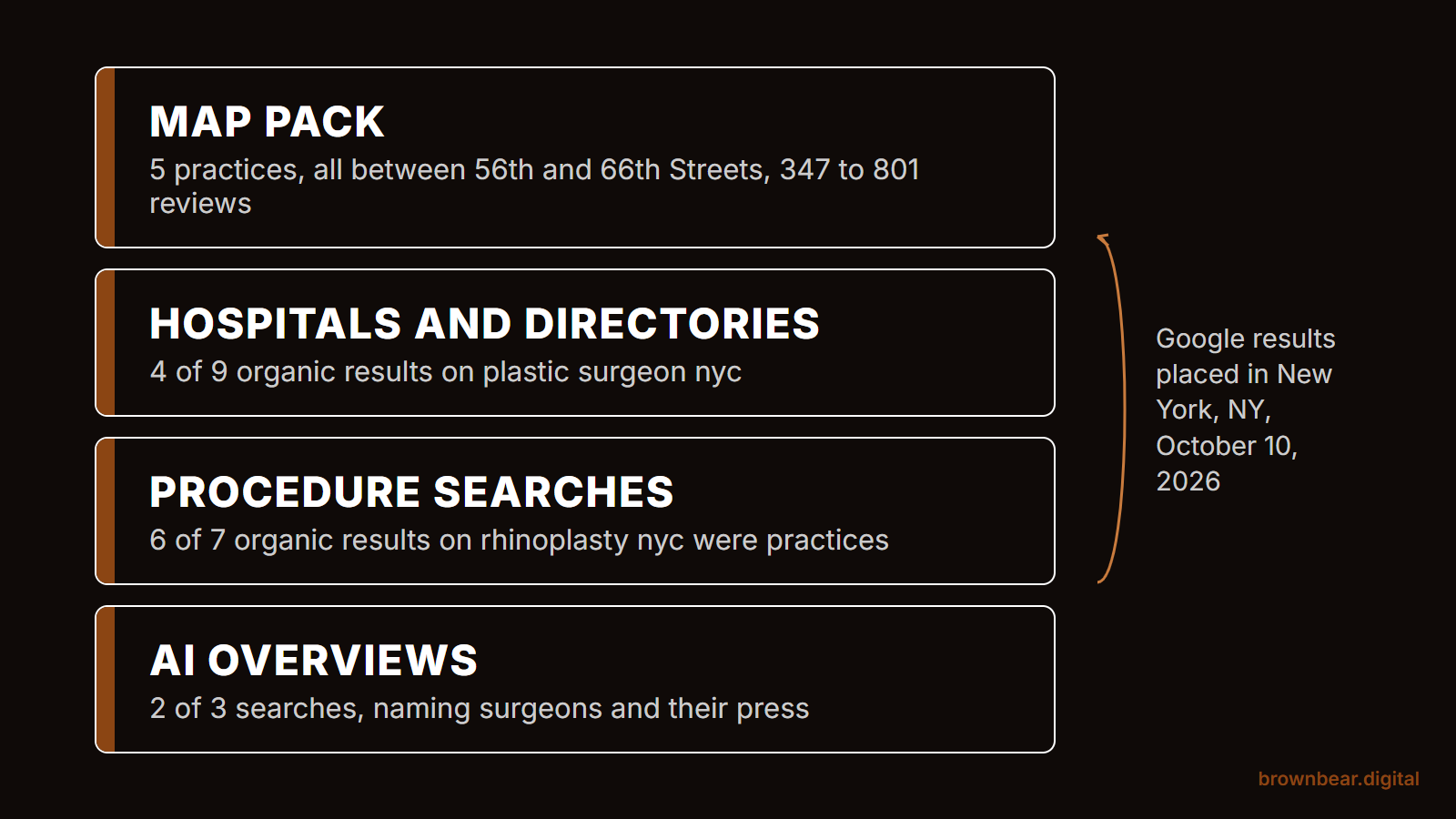
Search results shift by the day and by where the patient is standing, so treat this as a snapshot. The point is that any agency pitching you should have run these searches before the meeting and should be able to tell you what they found.
Five Interview Questions Built From Those Results
Each finding becomes a question. Ask them in the first meeting and listen for whether the answer is about your market or about every market.
1. Which map packs can we realistically enter, and how will you measure them?
A good answer starts with your address. If you are on the Upper East Side, the agency should say you are already inside the cluster and the fight is reviews, categories and profile completeness against practices with several hundred reviews each. If you are in Brooklyn, Queens or on Long Island, it should say plainly that "plastic surgeon nyc" is not your map pack, and that you will compete on searches patients run near you. A strong agency measures the map pack from several points across your patient area, not from one location, because a patient on East 70th Street and a patient in Park Slope see different results. Our guide to the Google Business Profile for plastic surgeons covers the profile work itself.
A weak answer promises the citywide map pack to a practice outside Manhattan, or reports a single ranking number for "New York".
2. Hospitals and directories hold four seats on page one. Which searches are we actually competing for?
A good answer names specific searches: a procedure plus your neighborhood, revision procedures, the techniques you are known for, and cost questions. It should come with a reason for each, such as the page on your site that could win it and the competitor that holds it today. A weak answer talks about ranking for "plastic surgeon New York" and never mentions Mount Sinai or NYU Langone.
3. When an AI Overview lists New York surgeons, how do you get us named?
A good answer talks about the sources the AI draws from: your own pages stating your board certification, hospital affiliations and procedures plainly; reviews on the platforms patients use; directory profiles that match your site; and press. In the AI visibility audits we run, owners are most surprised by how much those third-party sites, reviews, directories and press, drive what AI assistants say about them. A weak answer is schema markup and nothing else, or a promise of a guaranteed AI mention, which no one can deliver.
4. Which of our procedures still play by the classic rules?
Our "rhinoplasty nyc" search showed no AI Overview at all, while the two broader searches did. A good agency checks AI Overview presence search by search and splits its work accordingly: classic page and link work where the page has no AI answer, citation and source work where it does. A weak agency treats AI search as one switch that is either on or off for the whole practice.
5. What is your plan for press, and how do you keep it inside New York's rules?
A good answer separates earned coverage from paid placement and knows that New York treats paying the press for publicity in a news item as professional misconduct for physicians. It should describe how they pitch your expertise to reporters and producers, and how they make sure that coverage then supports your search presence. A weak answer is a package of paid "featured in" articles.
One Metro, Several Markets: Manhattan, the Boroughs, Long Island, Westchester and North Jersey
New York is not one search market, and an agency's plan should say which one you are in.
Manhattan, especially the Upper East Side and Park Avenue,
is the densest market. The map pack we saw sat inside a few blocks, so the work is about out-earning neighbors on reviews, procedure depth and reputation. Celebrity surgeons with television, social media and press profiles compete here too, and their brand searches pull patients who never search a procedure at all. An agency should not promise to out-brand them in a year. It should show you where your specialty, technique or patient focus gives you searches they do not own.
Brooklyn, Queens, the Bronx and Staten Island
behave more like neighborhoods than a borough. Patients search near where they live and work, and many prefer a consultation close to home over a trip across the river. A good plan targets the neighborhoods your patients come from rather than the borough name.
Long Island and Westchester
are suburban driving markets. Patients search by town, compare a local surgeon with a Manhattan name, and weigh parking and recovery logistics. An agency should know whether your patients are choosing between you and Manhattan or between you and the next town over, because the content for each is different.
North Jersey
is a separate state with its own Board of Medical Examiners and its own advertising rules. If your group has offices on both sides of the Hudson, ask the agency who checks your New Jersey pages and ads against New Jersey's rules, not New York's.
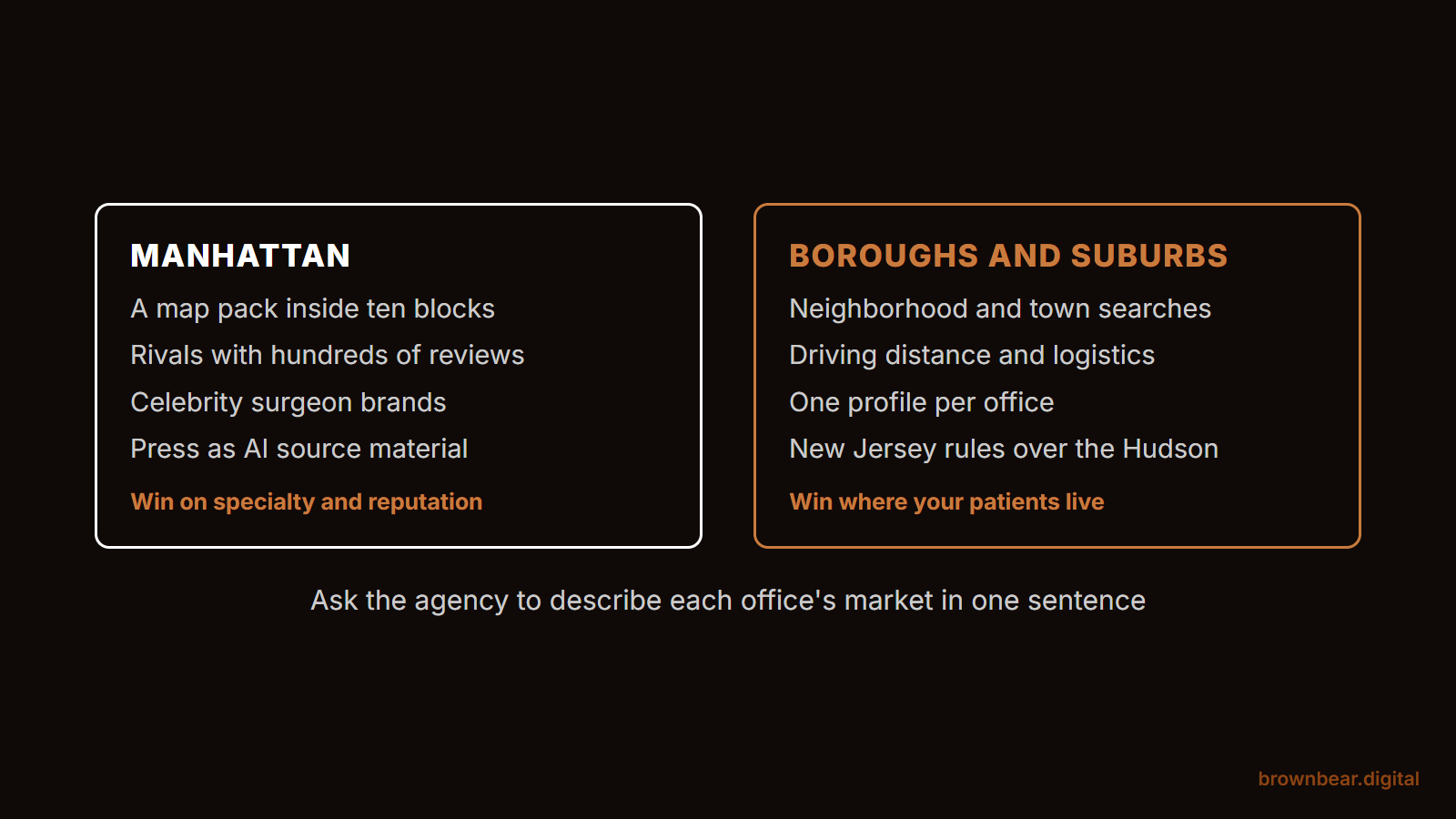
If you run offices in more than one of these markets, each one needs its own profile, its own location page and its own review program. Our guide to growing every office of a multi-location practice covers the structure. In the interview, ask the agency to describe each office's market in one sentence. If the sentences are interchangeable, so is the plan.
Press, Celebrity Brands and AI Answers in New York
New York is home to much of the national media, and that proximity changes how AI search works here. The AI Overview we saw credited one surgeon's recognition by Newsweek and New York Magazine directly. AI assistants build their picture of a practice from many sources, and our research on what AI actually reads before it recommends a practice shows how much of it sits off your website.
That makes PR a search input here, and it makes the agency's PR approach a compliance question. New York's physician misconduct law bars compensating or giving anything of value to the press in return for professional publicity in a news item. Ask any agency that bundles "media features" exactly how those features are placed. Earned interviews, expert commentary and real reporting are fine. Paid editorial dressed as news is the problem.
Ask too about ranking lists and awards. Many "top doctor" lists are legitimate, and AI answers repeat them. The agency should be able to tell you which ones carry weight, what each costs if anything, and how a listing is described on your site so it does not become an unsubstantiated superiority claim.
Local or Remote: When Being in New York Matters
Plenty of excellent search work is done remotely, and a Manhattan office address does not make an agency better at it. What you need is market knowledge you can test, not a zip code.
Being in-market helps in a few specific places:
- Photo and video production, if the agency will shoot your surgeons, office and team. A remote agency should have a New York crew it has worked with, or should plan around your own.
- Press relationships, if earned media is a large part of the plan. Ask who the relationships belong to and what they have placed for healthcare clients.
- Neighborhood knowledge, which a local team may have by default and a remote team has to earn by research. The interview questions above test it either way.
It matters less for technical SEO, content, Google Business Profile work, review programs, reporting and AI search, which are done at a desk wherever the desk is. Test an agency on what it knows about your market, and judge a local and a remote agency by the same answers.
How to Test an Agency's AI Search Claims in New York
Every agency now says it does AI search. You can check whether it means anything in under an hour, and you can ask the agency to do it with you in the meeting.
Write 8 to 10 prompts the way a New York patient would ask them. Mix procedures and places: "Who are the best rhinoplasty surgeons on the Upper East Side?", "Good tummy tuck surgeon in Brooklyn", "Facelift surgeon near Garden City, Long Island", "How much is a breast augmentation in Manhattan?" and one question that names your practice directly. Run each prompt in ChatGPT, Perplexity and Google's AI Mode, in a logged-out or private window, and record three things for each answer: who was named, in what order, and which sources were cited.
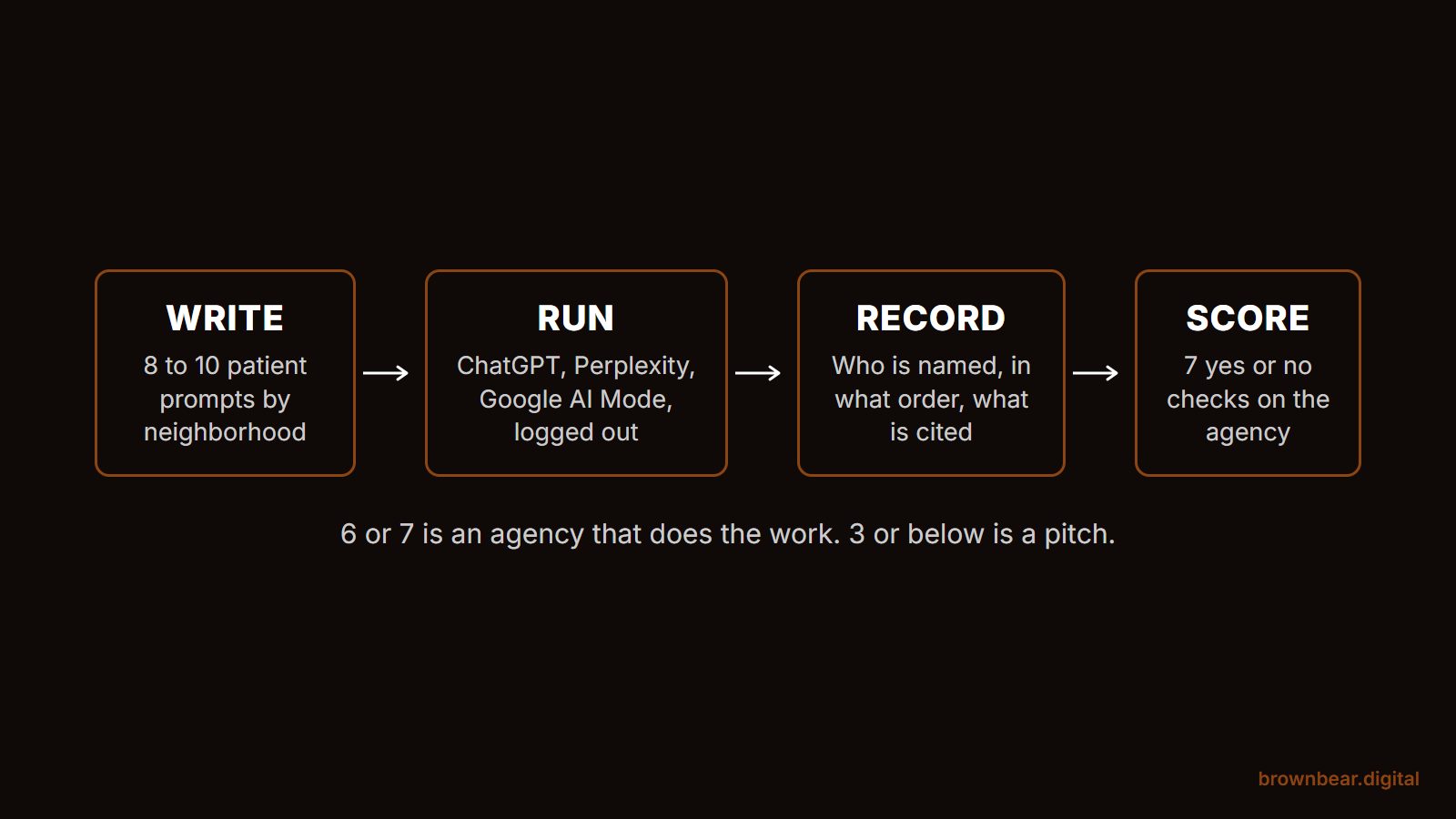
Then score the agency, not the answers. Give one point for each yes:
- They ran the prompts before the meeting, for your neighborhoods, without being asked.
- They used more than one platform and can explain why the answers differ between them.
- They looked at the sources, not just the names, and can tell you which reviews, directories, press or pages the answers lean on.
- They found something specific to fix, such as a procedure the AI does not connect to you or a directory profile that contradicts your site.
- They dated their findings and explained that answers change from day to day.
- They told you how they will measure it, with prompt tracking and AI referral traffic in your analytics, not a single screenshot.
- They made no guarantee of being named.
A score of 6 or 7 is an agency that does the work. A 3 or below is a pitch. Bryan's observation from Brown Bear's audits is that the most common factual error AI makes about a practice is an odd variation of its name, address or phone number, and that this is usually quick to fix at the local level. An agency that finds that kind of thing in your test has actually looked. Our guide to tracking brand mentions in AI search covers turning this test into a monthly system.
New York Compliance Questions to Ask Any Agency
Your agency writes ads, landing pages, review requests and before-and-after captions that go out under your license. New York has specific rules for all of it. These are the questions to ask, with the law behind each. They are not legal advice, and your healthcare attorney should confirm how they apply to your practice.
Do you know New York's physician advertising rules?
New York's Education Law section 6530 defines professional misconduct for physicians, and its subdivision 27 covers advertising that is not in the public interest. That includes advertising that is false, deceptive, misleading, sensational or flamboyant, that uses testimonials, that guarantees any service, or that makes claims about services, prices or professional superiority the physician cannot substantiate, with the burden of proof on the physician. Complaints against physicians are investigated by the Department of Health's Office of Professional Medical Conduct.
Three practical follow-ups:
- "How do you handle testimonials?" The statute lists them by name. An agency that builds ads or landing pages around patient quotes should be able to explain how it approaches that clause, and should welcome your attorney's review.
- "Where do 'best' and 'top' claims come from?" "Best rhinoplasty surgeon in New York" is a superiority claim. If the agency writes it, it should be able to say how you would substantiate it.
- "Who keeps the ad archive?" The same subdivision requires licensees to keep an exact copy of each advertisement for one year after it last appears, available to the Department of Health on demand. Ask the agency to keep that archive for you as a written deliverable.
How do you price, and does any of it depend on consults or revenue?
Section 6530 also lists, as misconduct, paying or receiving a fee for the referral of a patient and letting someone outside the practice share in the fees for professional services. Pay-per-consult and percentage-of-revenue pricing can run into both. Our national guide covers how another state's board has ruled on the same question. Ask the agency to explain its pricing model in writing, then have your attorney read it.
Do your pages describe our surgical facility correctly?
Under New York Public Health Law section 230-d, a practice that performs office-based surgery, meaning procedures requiring moderate sedation, deep sedation or general anesthesia, and any liposuction performed outside a hospital, must obtain and maintain full accreditation. Your website will mention your operating suite. Ask the agency how it confirms that every accreditation claim matches your current status, and who updates the pages if that status changes.
How do you handle tracking pixels and patient data?
New York's SHIELD Act requires any business holding New Yorkers' private information to keep reasonable security safeguards, and a practice that complies with HIPAA is deemed compliant with that requirement. The bigger risk for a marketing program is tracking code. The federal health privacy office's guidance on online tracking still covers pixels on patient portals and other logged-in pages, even after a 2024 federal court ruling vacated the part covering certain public pages. A broader New York health data privacy bill passed the legislature in 2025 and was vetoed in December 2025. Ask the agency which pixels it would place, on which pages, and whether it will sign a business associate agreement where one is needed. Our guide to how HIPAA compliance affects medical SEO covers the measurement trade-offs.
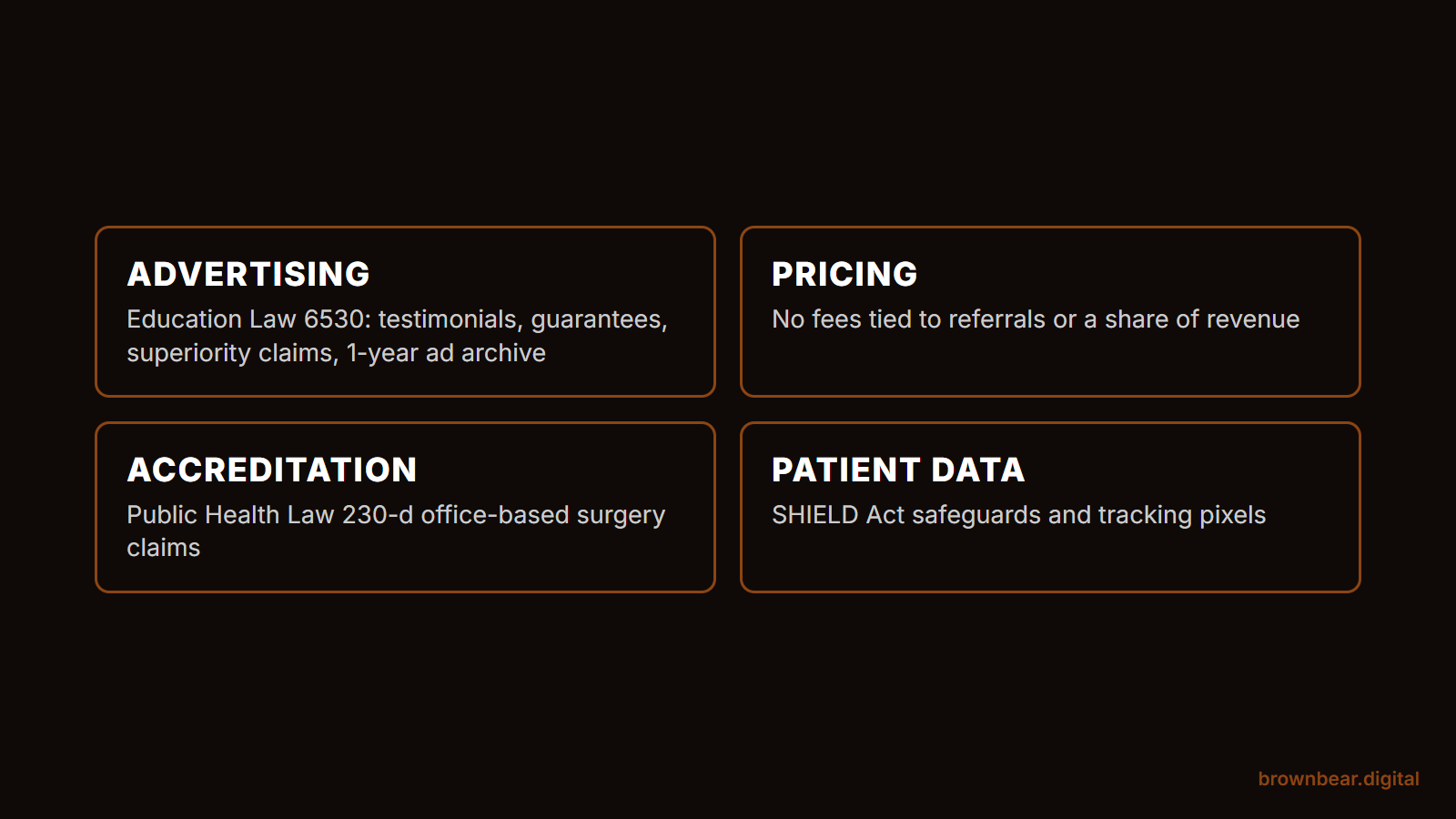
An agency that has worked with New York physicians will have heard these questions before. One that has not will usually say it is "fully compliant" and move on.
What a New York Contract and Budget Should Look Like
New York sits in the major-metro tier, so expect proposals at the full-program end. For a full program, a solo surgeon should expect roughly $3,000 to $6,500 a month, a multi-surgeon practice $5,000 to $10,000, and a group with several locations $8,000 to $20,000 or more. A focused program in a smaller market runs $1,500 to $3,000, and that band rarely fits a Manhattan practice competing for the blocks we saw. Our breakdown of what plastic surgery SEO costs in New York prices the city in detail, and the national guide to plastic surgery SEO cost shows what each budget buys in hours.
Contract terms to ask for:
- A one-year term with a 90-day review against milestones written into the contract, in line with what our national hiring guide recommends.
- Every account in the practice's name: domain, website, Google Business Profile, Search Console, analytics and ads.
- Office-by-office reporting if you have more than one location, with consults by procedure, not traffic totals.
- The ad archive described above, kept and handed over on request.
- A written pricing model your attorney has read, with no fee tied to patient referrals or a share of your revenue.
- An AI search line that names the prompts being tracked and the neighborhoods they cover.
Applying the Same Criteria to Brown Bear
We said we would score ourselves, so here it is. Brown Bear is a remote agency for New York: we are based in the Bay Area, so we do not have a Manhattan office or a New York photo crew on staff, and if in-market production is central to your plan, weigh that. We specialize in search and AI visibility for plastic surgery and medical practices, which is the subject of most of what we publish.
What we can show you: the New York searches and AI prompts for your procedures, run before the first call; Search Console data from client sites, shared with their permission; and a written plan that names the searches, the neighborhoods and the sources we would work on. We do not guarantee rankings or AI mentions, we keep accounts in your name, and we expect your attorney to read our pricing. Hold us to the same five questions and the same scorecard as anyone else.
Questions New York Practices Ask About Choosing an Agency
Do I need an agency based in New York?
No. You need an agency that knows your market, which you can test with the questions in this guide. Being local helps with production and some press relationships. It does not help with technical SEO, content or AI search, which are done at a desk.
What should an AI SEO agency in New York actually do?
It should know which of your procedure searches show AI answers, which sources those answers draw on, and how to strengthen the sources that mention you: your site, your reviews, directory profiles and press. It should measure that with tracked prompts and AI referral traffic, and it should never guarantee a mention.
How long before we see results in a market this crowded?
Expect early movement on neighborhood and procedure searches within a few months and meaningful consult growth over a year. The broad citywide searches can take longer, and some, held by hospitals and directories, may never be the right target.
Choosing a New York Agency With Brown Bear
If you want a partner that runs your New York searches and AI prompts before the first meeting, see how we approach search and AI visibility for New York practices, or get in touch with your procedures and neighborhoods, and we will bring the results to the call.
Written By
Founder, Brown Bear Digital
Bryan has 15 years of experience across SEO, paid search, and AI search strategy. He founded Brown Bear to give businesses direct access to senior-level search expertise without the agency overhead.
Learn More About BryanGet Found on Google.
Get Cited by AI.
Tell us about your site. We'll send back a proposal for SEO and AI search.