How to Choose a Plastic Surgery SEO and AI Search Agency in Miami
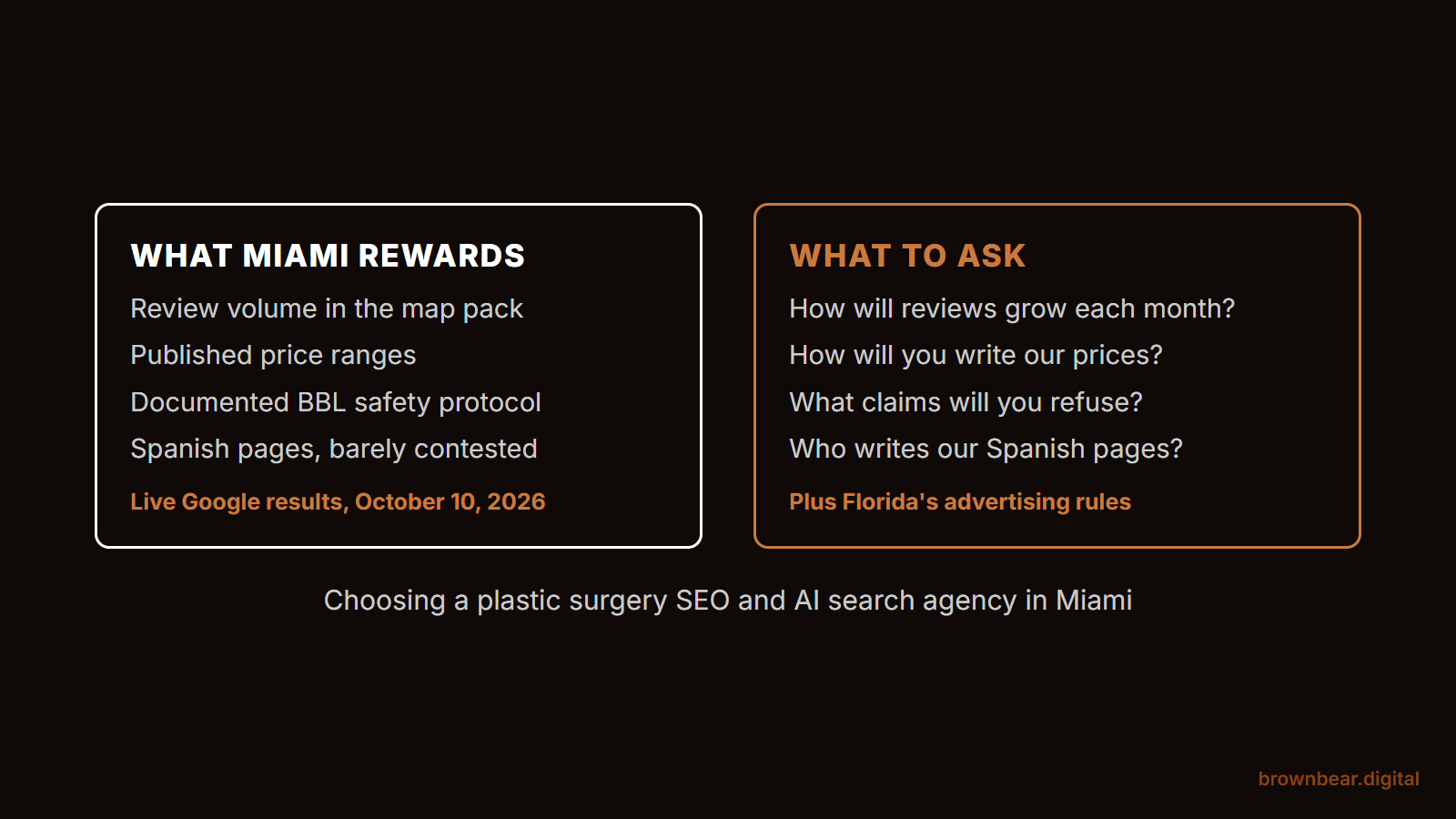
Every agency that pitches a Miami plastic surgery practice promises page one and a mention in ChatGPT. Very few can tell you why a practice with about 11,000 Google reviews and a 4.5 rating sits above surgeons rated 5.0, why Google answers a BBL search with a price list, or why a patient who searches in Spanish mostly lands on English pages. Those are the things that decide who gets consultations in this city, and they are what you should test an agency on before you sign.
This is Brown Bear's guide to hiring a search agency as a Miami plastic surgery or aesthetic practice. It is built on live Google results we captured on October 10, 2026 for seven Miami procedure searches in English and Spanish, the Florida statutes and Board of Medicine rules that govern physician advertising, and the checklist Brown Bear founder Bryan Passanisi applies to any agency, his own included.
A plain disclosure before we start: Brown Bear is an agency. We are based in the San Francisco Bay Area and work with Miami practices remotely, so we have a stake in how you choose. Every test in this guide applies to us too, and the last section runs it on Brown Bear.
When we say a search agency, we mean whoever is responsible for three things at once: your Google rankings and map pack position, how AI assistants like ChatGPT, Perplexity and Google's AI Mode describe you, and the website and review work that feeds both.
If you are a solo surgeon in Coral Gables or Brickell weighing two proposals, you need questions that separate a Miami-ready agency from a national template. If you run a multi-surgeon BBL and body contouring practice that draws patients from out of state, you need an agency that understands safety content, price-led searches and travel patients. And if you manage marketing for a practice, you need a way to check an agency's AI search claims yourself, in English and in Spanish, before the contract starts.
By the end you will have a set of interview questions tied to what Miami's search results actually show, a five-minute AI search test with a scoring checklist, the Florida compliance questions every agency should answer without hesitating, and a realistic picture of what a Miami program costs. We cover it in five parts: what Miami's results demand, bilingual and travel patients, BBL safety and Florida rules, local versus remote agencies, and pricing and contracts.
Start with what makes this market different from the generic hiring advice you have already read.
What Makes Choosing an Agency in Miami Different
Choosing a search agency in Miami means testing for four things a generic agency rarely handles: a map pack decided by review volume, Spanish-language demand that most practice sites ignore, patients who travel in from other states and countries, and BBL searches where Google leads with prices and safety credentials. An agency that cannot speak to all four is selling you a national template.
The general rules of hiring still apply, and we have covered them elsewhere. Our guide on how to evaluate a plastic surgery marketing agency walks through portfolio checks, red flags, reference calls and contract terms, and includes a scorecard for comparing pitches. Hiring an SEO agency for a medical practice covers the five filter questions and the test-their-own-SEO rule. This guide does not repeat those. It adds the Miami layer on top.
Miami-Dade is also a different audience from most US metros. In Census Bureau survey data summarized by Data USA, 69.3% of county residents are Hispanic and 54.5% were born outside the United States. Your patients search in two languages, compare prices across borders, and often arrive having read about BBL risks first. The agency you hire has to be built for that.
What Miami's Search Results Say an Agency Must Handle
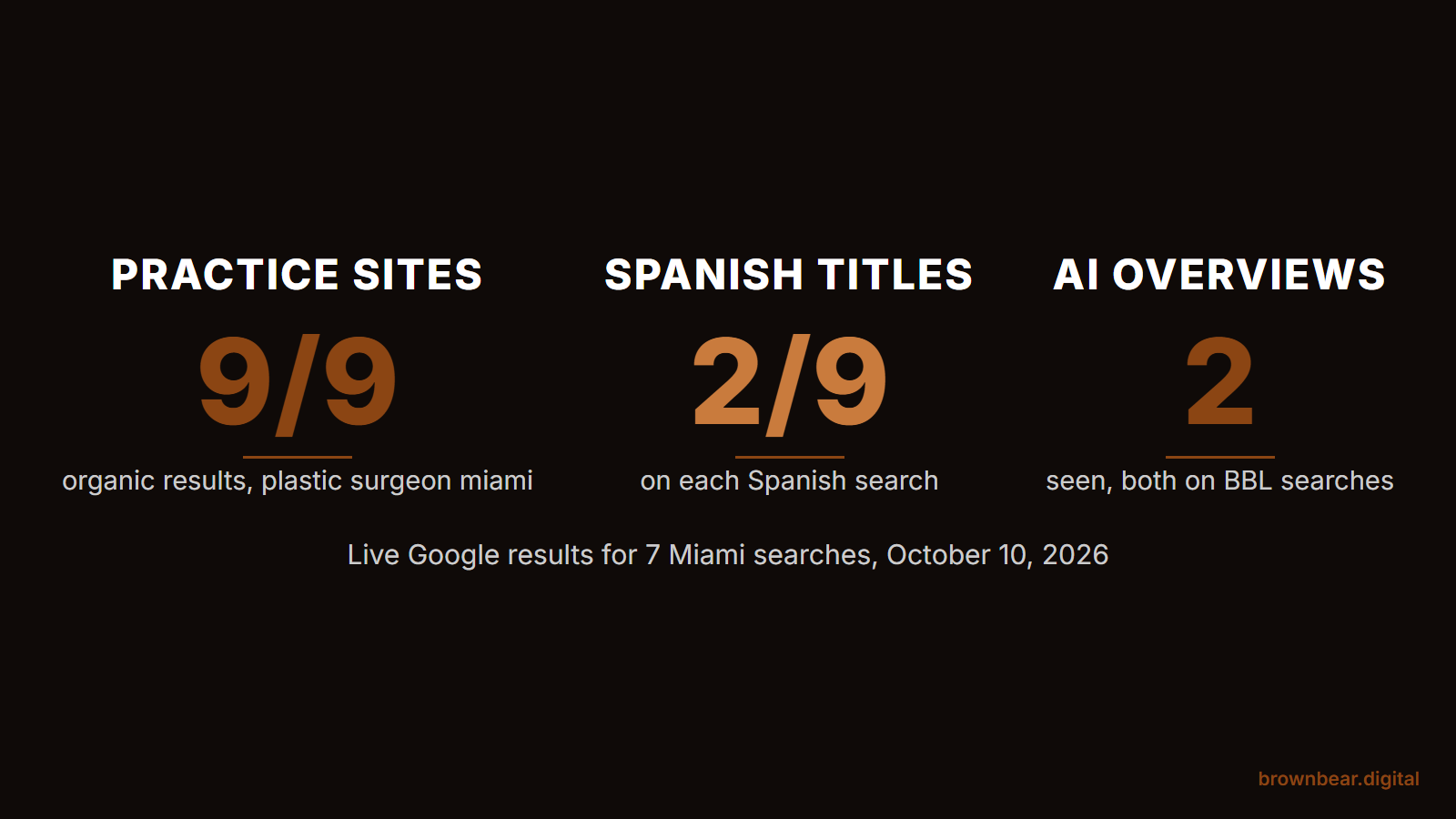
We searched seven Miami queries on Google on October 10, 2026: "plastic surgeon miami", "brazilian butt lift miami", "mommy makeover miami", "tummy tuck miami", "safest bbl surgeon miami", and two in Spanish, "cirujano plastico miami" and "bbl en miami precio". Results vary by device, location and day, so treat these as a snapshot, not a ranking report. Five patterns stood out, and each one turns into an interview question.
1. The map pack rewards review volume, not a perfect rating
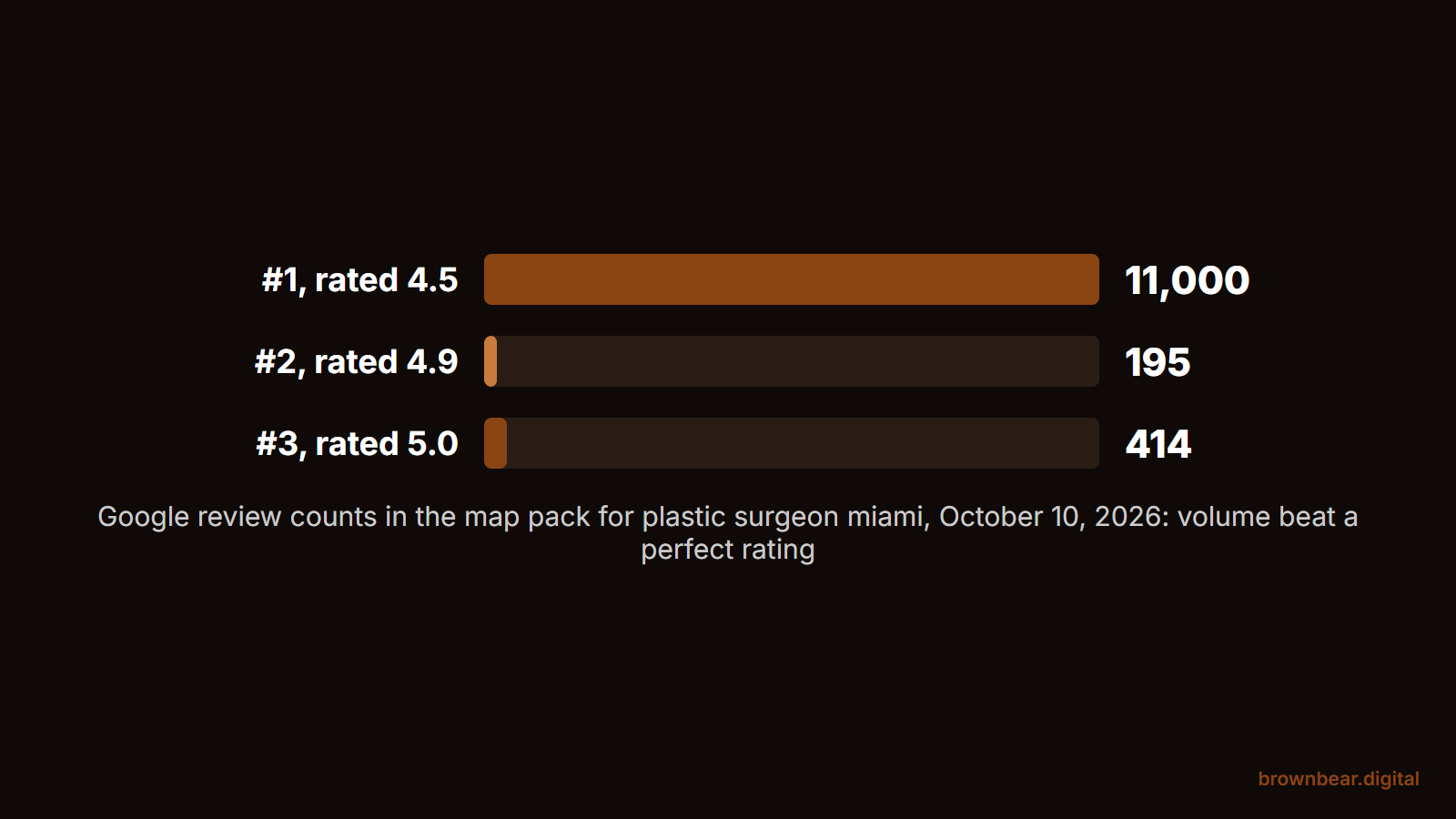
For "plastic surgeon miami", the first business in Google's map pack was a high-volume cosmetic surgery center with about 11,000 reviews and a 4.5 rating. It sat above a single-surgeon practice rated 4.9 on 195 reviews and another rated 5.0 on 414. The same center led the map pack for "mommy makeover miami" and "tummy tuck miami", and a second high-volume clinic with about 3,500 reviews joined it on the mommy makeover search.
Ask:
"How will you grow our review count every month without gating or incentivizing reviews, and how will you respond to reviews without confirming anyone is a patient?"
A good answer sounds like:
a request process built into post-op follow-ups, a response policy written with your privacy obligations in mind, and a monthly review count target, not a star rating promise. Our guide to generating and responding to plastic surgery reviews covers the mechanics. An agency that talks only about your rating has not looked at who holds the pack here.
2. Page one belongs to practice websites, so your own pages carry the weight
All nine organic results for "plastic surgeon miami" were practice websites. No directories, no hospital listings, no review sites. The pattern held on the BBL, mommy makeover and tummy tuck searches, where every organic result we recorded was a practice page. The exception was safety: for "safest bbl surgeon miami", a RealSelf directory page ranked first.
Ask:
"Which of our pages should rank for which Miami procedure searches, and which searches do you expect a directory to win instead?"
A good answer sounds like:
a page-by-page map that pairs each procedure search with one URL on your site, plus a plan for your RealSelf and directory profiles on the safety and comparison searches where those sites lead. Your RealSelf profile matters for AI search for exactly that reason.
3. Google answers BBL searches with a price list
For "brazilian butt lift miami", Google showed an AI Overview that opened with a cost range, $2,500 to $10,000, and then named four Miami practices with their package prices. Two of the nine organic titles carried a price in the title itself, and a third led with cost. Prices are what Google chose to summarize, and the practices that published them got named.
Ask:
"Should we publish pricing, and if so, how will you write it so AI answers can quote it accurately while staying inside Florida's fee advertising rule?"
A good answer sounds like:
a range tied to what is included, with the variables that change the fee spelled out, because Florida's physician advertising rule treats fee statements that leave out the variables as misleading. If the agency suggests advertising a free or discounted consultation, it should know that Florida requires a specific capitalized statement on those ads. Our plastic surgery SEO cost guide for Miami covers the agency side of the price question.
4. Safety searches get an AI answer built on credentials
For "safest bbl surgeon miami", Google's AI Overview opened by telling the searcher to prioritize board certification by the American Board of Plastic Surgery, accredited surgical facilities and ultrasound-guided fat placement. It then listed nearby surgeons with a sentence each about their safety protocols, citing practice sites and RealSelf.
Ask:
"How will you present our safety protocol so an AI answer can find it, and what claims will you refuse to write?"
A good answer sounds like:
a dedicated safety page that states documentable facts, such as the surgeon's board and how fat is placed, linked from every BBL page. And a clear no to phrases like "safest BBL in Miami", which you cannot prove and which create the kind of unjustified expectation Florida's advertising rule prohibits.
5. Spanish searches mostly return English pages
For "cirujano plastico miami", only two of the nine organic titles were in Spanish, and there was no map pack. For "bbl en miami precio", again two of nine titles were in Spanish; most of the results were English cost pages. Neither Spanish search showed an AI Overview.
Ask:
"Who writes and reviews our Spanish pages, and how will you measure Spanish search separately?"
A good answer sounds like:
a native Spanish medical writer, a surgeon or bilingual staff review before anything goes live, separate Spanish URLs rather than a translation widget, and reporting that splits Spanish page traffic out from English. That gap is the next section.
Spanish and Bilingual Search: What to Ask an Agency
Spanish-language search in Miami is under-served, which makes it one of the clearest places an agency can prove its value. Our Spanish captures returned mostly English pages, so a practice with real Spanish content faces less competition there than on the English searches. The questions below separate an agency that does bilingual work from one that runs a translation plugin.
- "Will the Spanish pages be written or translated?" Written by a native speaker with medical vocabulary is the answer you want. Machine translation of procedure and risk content is a liability on a medical site.
- "Will each Spanish page have its own URL?" Google indexes pages, not language toggles. A translation widget that swaps text in the browser often leaves no Spanish page for Google or an AI crawler to read.
- "Who reviews the Spanish copy before it goes live?" Florida's advertising rules do not carve out Spanish ads. A bilingual surgeon or coordinator should sign off on claims, risks and pricing.
- "Can our phones and forms handle a Spanish lead?" Ranking for Spanish searches is wasted if the consultation request lands with someone who cannot reply in Spanish.
- "How will you report Spanish results?" Ask for Spanish pages tracked as their own group in Search Console, with consultation requests attributed by language.
Miami's Spanish speakers come from across Latin America and the Caribbean, so the copy should read naturally to all of them rather than leaning on one country's slang. Ask to see a Spanish procedure page the agency has written for another medical client, and have a bilingual staff member read it.
Out of State and International Patients: What to Ask
Miami is a destination market for cosmetic surgery, and an agency that treats it like a neighborhood practice will miss the patients who travel. A travel patient searches differently: they compare surgeons nationally, read price and safety content first, and want to know about recovery before they book a flight.
Ask an agency four things about travel patients:
- "Which searches will bring patients from outside South Florida?" A good answer separates national procedure and safety searches, which take longer to win, from local map pack searches, and plans for both.
- "What pages will a travel patient need?" Look for a travel and recovery page, a virtual consultation path, and clear information on how long to stay in Miami after surgery, all reviewed by the surgeon.
- "How will you keep us out of a price race?" The BBL results show patients comparing package prices. A good agency builds the case for value with surgeon credentials, protocol and results, not just a lower number.
- "How will you track where consultations come from?" Ask for reporting by patient location, so you can see whether out of state demand is growing.
BBL Safety Content, Reviews and Florida's Rules
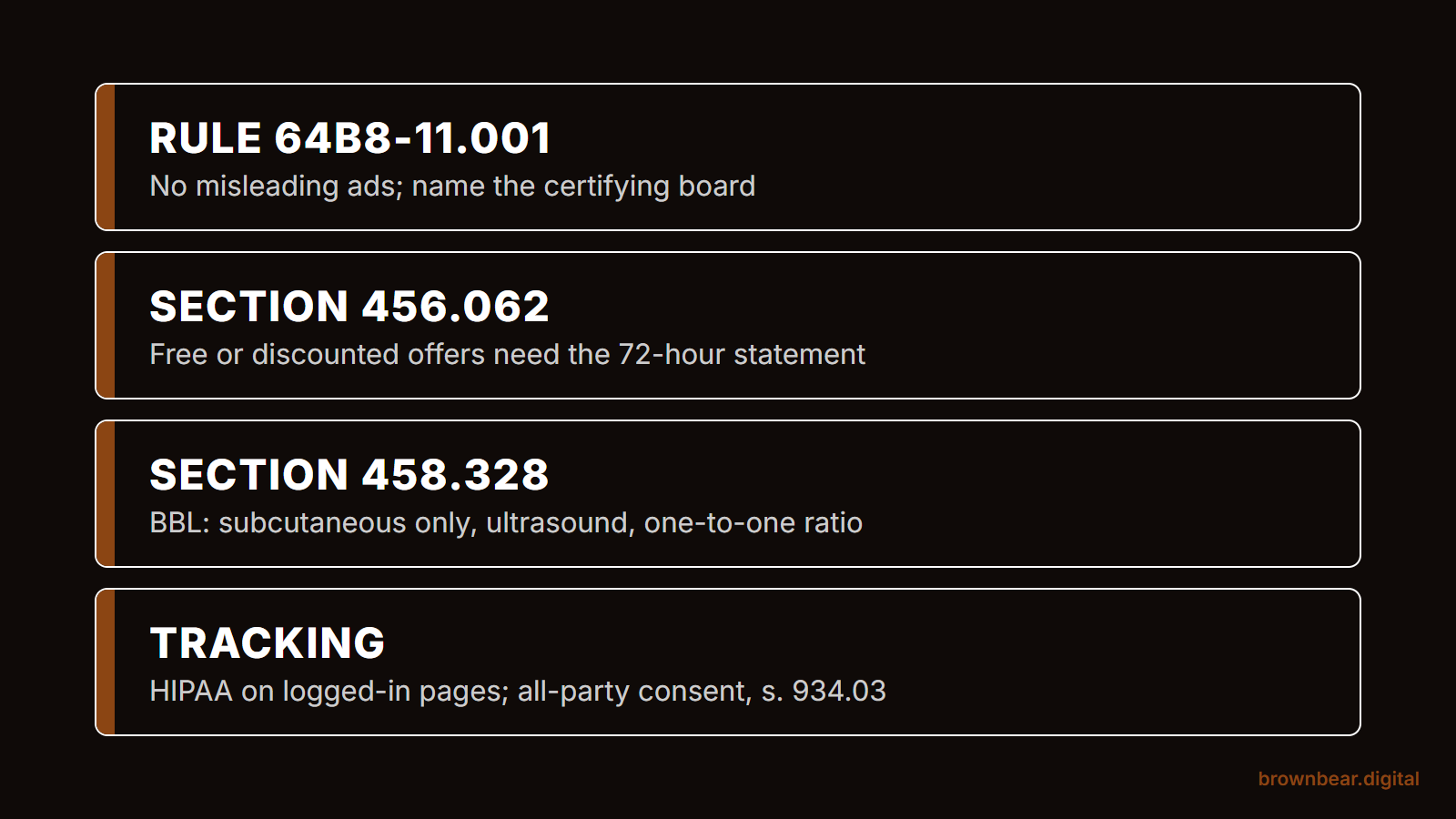
Any agency marketing body contouring in Florida must know that the state writes BBL standards into law. Florida Statutes section 458.328 sets rules for gluteal fat grafting performed in a physician's office: fat may only be injected into the subcutaneous space, the physician must use ultrasound guidance or equivalent technology approved by the Board, the office must keep one physician to one patient during all phases of the procedure, and the patient must have an in-person exam no later than the day before surgery.
That matters for marketing in two ways. First, your safety page can describe those standards accurately and explain how your practice meets them, which is exactly the kind of documentable fact the safety AI Overview rewarded. Second, the agency must not write past them. "Ultrasound-guided" is a protocol your surgeon can document. "Zero risk" or "the safest BBL in Miami" is a promise nobody can document.
Ask:
"Show me the safety page you would write for our BBL program, and tell me who on our team approves it."
Reviews need the same care. A patient who posts about a complication deserves a response, but the response cannot confirm they are a patient or discuss their care. Ask the agency to show you its response template for a negative review that mentions a complication. A good template thanks the reviewer, invites them to call the office directly, and says nothing about the procedure or the person.
Florida Compliance Questions to Ask Any Agency
A Miami agency should be able to answer every question in this table without calling a lawyer first. That does not make the agency your lawyer; have healthcare counsel review your advertising and tracking setup. But an agency that has never heard of these rules will write ads and install tags that put your license and your patients' privacy at risk.
| Topic | What the rule says | Question to ask the agency |
|---|---|---|
| Misleading advertising | Board of Medicine Rule 64B8-11.001 treats an ad as false, deceptive or misleading if it misrepresents facts, discloses only part of the relevant facts, creates false or unjustified expectations, or otherwise misleads | "Which claims on our current site would you remove, and why?" |
| Board certification | The same rule requires any specialty certification claim to name the specialty board, and requires a disclaimer when the certifying body is not recognized by the Board | "How will you word our surgeon's certification on every page and ad?" |
| Physician name | An ad that names a physician must identify them as an M.D. | "Do our ads and listings meet that today?" |
| Fees and pricing | Fee statements that do not disclose all variables affecting the fee are treated as misleading | "How will you present our price ranges?" |
| Free or discounted offers | Florida Statutes section 456.062 requires a capitalized statement on ads for free, discounted or reduced fee services, telling patients they may refuse to pay for other services performed within 72 hours | "Where would that statement appear if we promote a free consultation?" |
| Testimonials and before-and-after photos | Florida's rule does not name them directly, but its catch-all bans any misleading claim, and the FTC's Endorsement Guides also apply to testimonials. Photos need written patient authorization | "How do you choose and caption before-and-after photos, and where is the patient authorization kept?" |
| BBL claims | Section 458.328 sets subcutaneous-only injection, ultrasound guidance and a one-to-one physician ratio for office gluteal fat grafting | "How will our BBL pages describe our protocol accurately?" |
| Tracking pixels and HIPAA | A federal court vacated part of HHS's tracking technology guidance on June 20, 2024, the part covering some public, unauthenticated pages. Guidance on patient portals and other logged-in pages was not challenged | "Which tags fire on our consultation form, booking flow and patient portal, and what data do they send?" |
| Chat and session recording | Florida is an all-party consent state under section 934.03, and plaintiffs have used it against website session replay tools, with mixed results | "Do any of your tools record what visitors type or click, and how is consent handled?" |
Our guide to HIPAA compliance in medical SEO covers the tracking question in depth, including what the 2024 ruling changed and what it did not.
Local Agency or Remote Agency: When Being in Miami Matters
Being physically in Miami matters for a few specific jobs and much less for the rest. Search work itself, from page writing to technical fixes to AI search monitoring, is done at a desk anywhere. The question is which of the in-person jobs your practice needs and who will do them.
Being in-market helps when:
- You need regular photo and video at the practice. Surgeon introductions, facility tours and patient education video need someone on site. A remote agency can hire a local crew, but ask who directs them.
- Your market is a neighborhood, not the metro. Google weighs distance in the map pack, so searchers in Brickell, Coral Gables, Miami Beach, Aventura and Doral can see different results, and Fort Lauderdale and Boca Raton are separate markets again. An agency should show you your map position by neighborhood, from a grid ranking tool, not from a single search on their own laptop.
- Local press and events are part of the plan. Miami media, community events and referral relationships favor someone who can show up.
It matters much less when the job is the website, procedure pages, technical SEO, Spanish content production, review systems or AI search work. For those, ask for evidence of results in a comparable competitive market, not a Miami address.
For transparency: Brown Bear works with Miami practices remotely, and our Miami SEO agency page explains how we run those programs. Hold us to the same test: ask who would handle your on-site photo and video, and how we would show your map position from Brickell to Aventura.
How to Test an Agency's AI Search Claims in Miami
The fastest way to test an agency's AI search claims is to run the prompts your patients would type, in English and Spanish, and see who gets named. Do it before the pitch meeting, then ask the agency to explain what you found. It takes about five minutes per assistant.
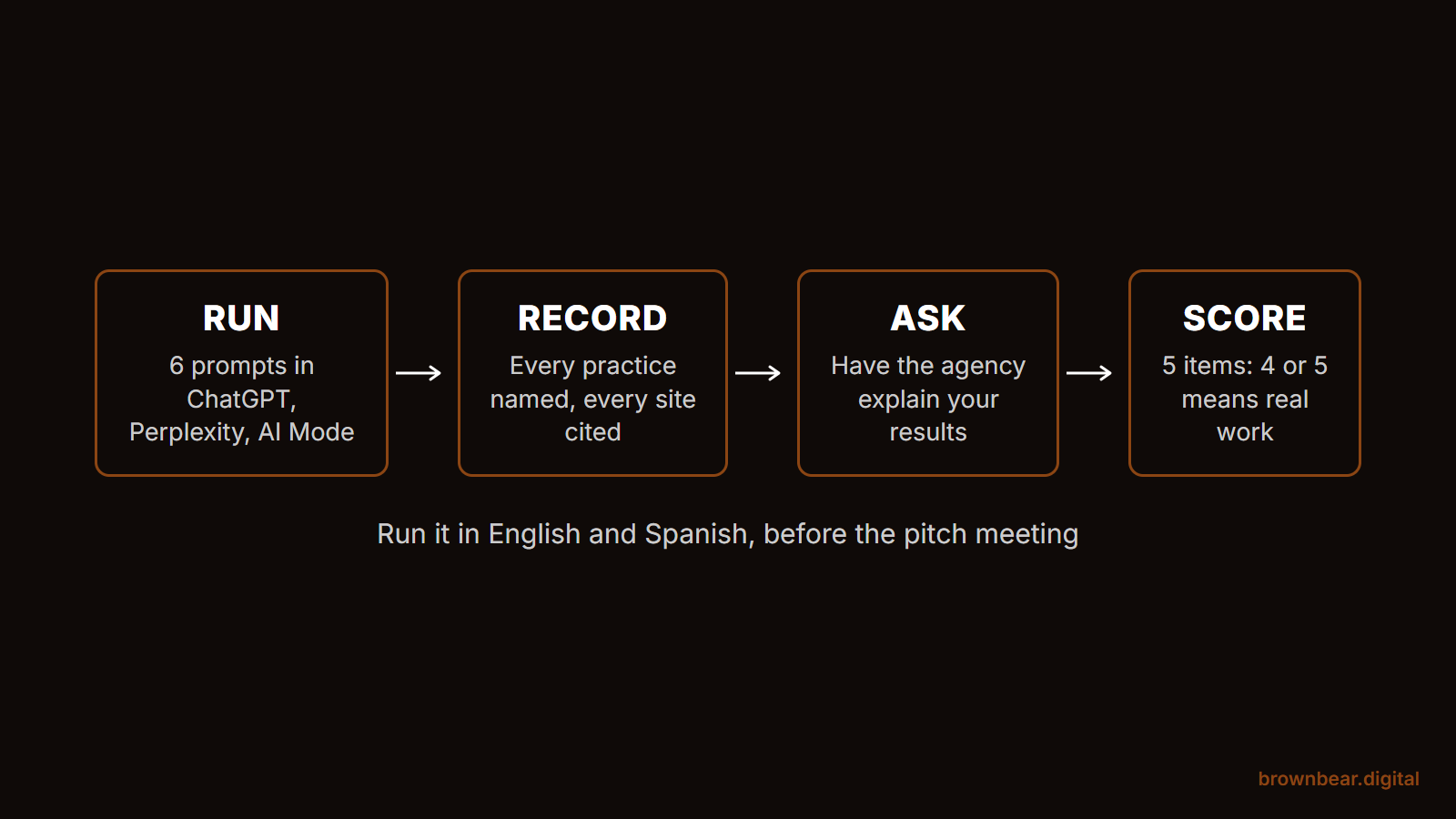
Run these prompts in ChatGPT, Perplexity and Google's AI Mode, with location sharing on if the tool allows it:
- "Who are the best plastic surgeons in Miami for a BBL?"
- "How much does a mommy makeover cost in Miami?"
- "Which Miami plastic surgeons are board certified and use ultrasound for BBL?"
- "¿Quiénes son los mejores cirujanos plásticos en Miami?"
- "¿Cuánto cuesta una lipo 360 con BBL en Miami?"
- One prompt naming your practice: "What do patients say about [your practice name]?"
Write down every practice each assistant names and every site it cites. Then score the agency's pitch against what you found.
| Checklist item | Score 1 if the agency |
|---|---|
| Diagnosis | Ran prompts like these before the meeting and showed you the results, including the Spanish ones |
| Sources | Named the sites the assistants cite for your procedures, such as RealSelf, review platforms and competitor pages, and how you would earn a place on them |
| Accuracy | Checked what the assistants say about your practice by name and flagged anything wrong or missing |
| Measurement | Proposed tracking AI referral visits and consultations separately from other channels |
| Realism | Told you which prompts are realistic to win in 6 to 12 months and which are not, instead of guaranteeing mentions |
A score of 4 or 5 is an agency that has done the work. A score of 1 or 2 is an agency selling AI search as a line item. When we tried to run these prompts for this guide, Google's AI Mode returned a bot check and Perplexity asked us to sign in, which is a useful reminder: run them yourself in your own logged-in accounts, and expect answers to change from week to week. For more on which sources these assistants draw from, see our research on AI citation sources for medical practices.
In Bryan's AI visibility audits for plastic surgery practices, owners are most surprised by how much third-party sites, such as reviews, directories and press, shape what AI assistants say about them. That is why the Sources row matters as much as anything the agency does on your own site.
Contract and Pricing Expectations for a Miami Practice
A full SEO and AI search program for a solo Miami plastic surgeon typically runs $3,000 to $6,500 a month, and $5,000 to $10,000 for a multi-surgeon practice. Multi-location groups across Miami-Dade, Broward and Palm Beach should expect $8,000 to $20,000 or more. Focused programs in a smaller market run $1,500 to $3,000, but Miami's core neighborhoods are not a smaller market.
Two Miami factors push a quote up: bilingual content, which is close to a second content program, and BBL or body contouring, where safety and price content needs more surgeon review time. If a quote includes Spanish pages, ask how many a month and who writes them. Our national plastic surgery SEO cost guide breaks every tier into hours and deliverables.
On the contract, look for three things:
- Ownership in your name. Your Google Business Profile, Search Console, analytics and ad accounts should belong to the practice, with the agency added as a user.
- A review point you can act on. A 90-day review with the right to leave after the initial setup period.
- Compliance sign-off built in. A clause that nothing publishes in either language without approval from the surgeon or a named staff member.
Applying the Same Test to Brown Bear
We said we would hold ourselves to this guide, so here is how Brown Bear answers it. We are remote: our team is in the Bay Area, and on-site photo and video for a Miami practice would be done by a local crew we brief. We specialize in medical, dental and legal practices, the categories Google holds to its highest standard. Spanish pages are written by native speakers and reviewed by the practice before anything goes live. Every pitch we make starts with the AI search prompts above, run in English and Spanish, shown to you before we talk about price. Ask us for the same proof you would ask anyone else: live Search Console data, reference calls, and a Spanish page we have written. If you want a second opinion on a proposal you already have, our plastic surgery marketing team can review it with you.
Questions Miami Practices Ask About Hiring an Agency
Do I need a Miami-based agency?
Not for most of the work. You need someone in-market for on-site photo and video and local events, and an agency that can show your map position neighborhood by neighborhood. Everything else can be done remotely.
Should a Miami practice have a Spanish website?
If your patients search in Spanish, yes, with separate Spanish pages written by a native speaker and reviewed by your team. Our Spanish captures showed mostly English results, which means less competition for a practice that does it well.
Can an agency guarantee my practice shows up in ChatGPT?
No. AI answers change by prompt, location and week. An agency can improve the signals assistants rely on and measure the change, but a guarantee is a red flag.
What should a BBL practice ask an agency first?
Ask to see the safety page they would write for you and the claims they would refuse to make. Florida writes BBL standards into statute, and your marketing should describe them accurately, not stretch them.
Get a Second Opinion on Your Miami Agency Proposals
If you are comparing agency proposals for a Miami practice, run the tests in this guide first, then bring us what you found. We will walk through your results with you, in English and Spanish, and tell you plainly what we would change. Book a strategy call.
Written By
Founder, Brown Bear Digital
Bryan has 15 years of experience across SEO, paid search, and AI search strategy. He founded Brown Bear to give businesses direct access to senior-level search expertise without the agency overhead.
Learn More About BryanGet Found on Google.
Get Cited by AI.
Tell us about your site. We'll send back a proposal for SEO and AI search.