GEO for Law Firms: What AI Actually Cites When Someone Asks for a Lawyer
Search "geo for law firms" and Google hands you an AI Overview that tells you exactly what to do. Write for prompts. Attach verified attorney credentials to every piece of content. Cite statutes and case law. Implement clean schema markup.
Every item on that list is work you do on your own website.
Then ask Google the question a client actually asks. "Best divorce lawyer in Dallas." The AI Overview names three firms, and the material it uses to describe them is not from their websites. It is their Google Business Profile: the star rating, the review count, the street address, whether they are open right now.
We ran eleven of those client queries and logged every source. The gap between what the GEO advice points at and where the citations actually come from is the subject of this piece.
Key Takeaways
No firm website was cited as a substantive source in any of the eleven queries
Firm sites appeared only as the small attribution under a descriptive sentence inside a Business Profile card. The standard GEO checklist for law firms is aimed almost entirely at the one asset our ledger never observed carrying a citation.
Four of eleven queries returned no AI Overview at all
Including best personal injury lawyer in Chicago and best estate planning attorney near me, two of the most commercially valuable strings in legal search. Checking whether the surface exists for your queries is free and takes four minutes.
On best-lawyer-in-a-city queries, Google Business Profile is the citation
Every one of those Overviews was built from profile fields: rating, review count, address, open or closed status, category. That is local SEO wearing a GEO costume, and the content programme is not the constraint.
Our own medical research found the opposite, and both are right
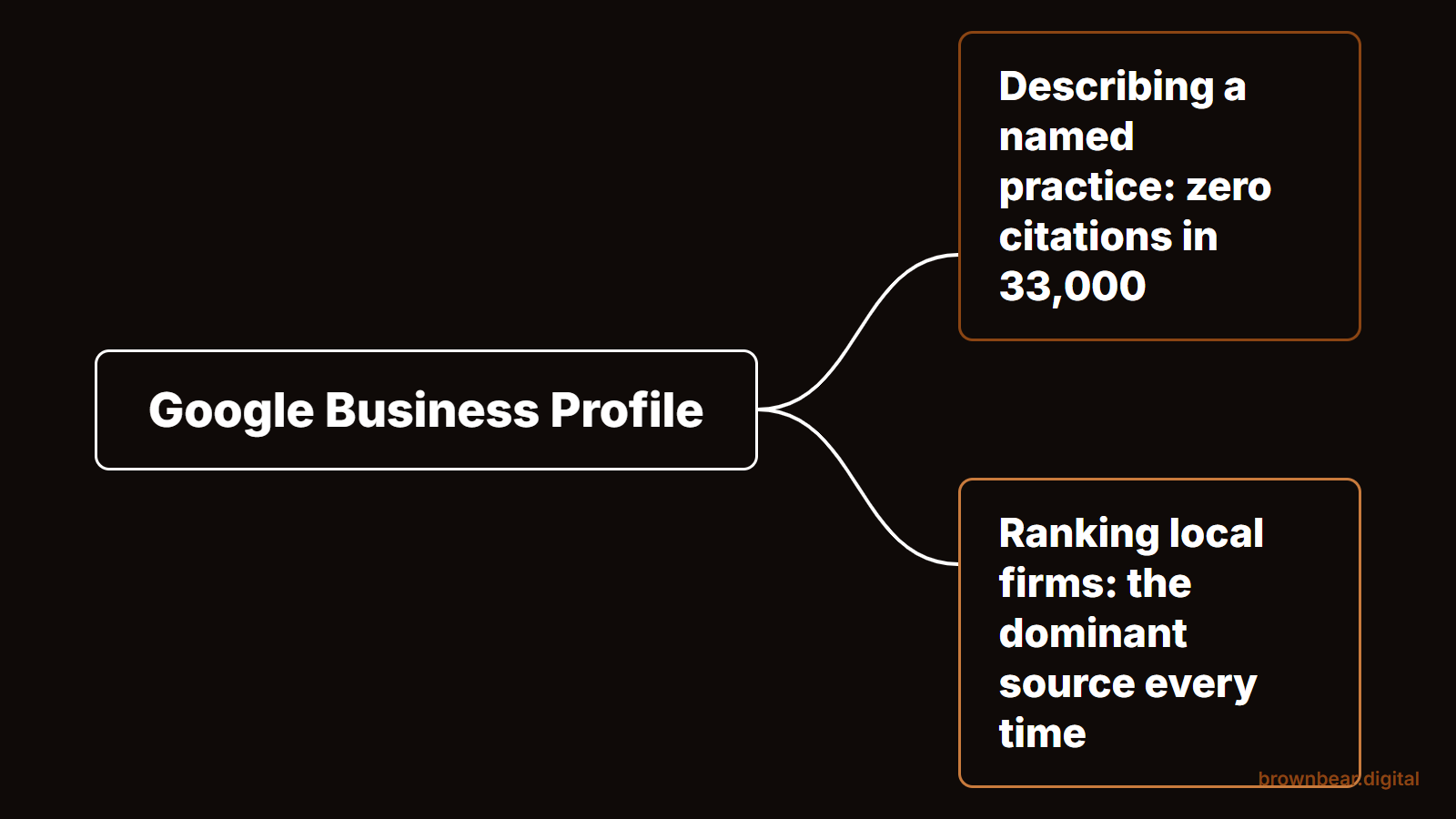
Business Profile took zero citations in a 33,000-citation ChatGPT corpus about medical practices. The engine and the question together decide which asset gets read. Ask for a description and it hunts for prose; ask for a local ranking and it reaches for structured local data.
1. The Short Answer
For law firms, the asset that gets cited depends almost entirely on which kind of question the client asks, and the three kinds behave so differently that a single GEO checklist cannot serve all of them.
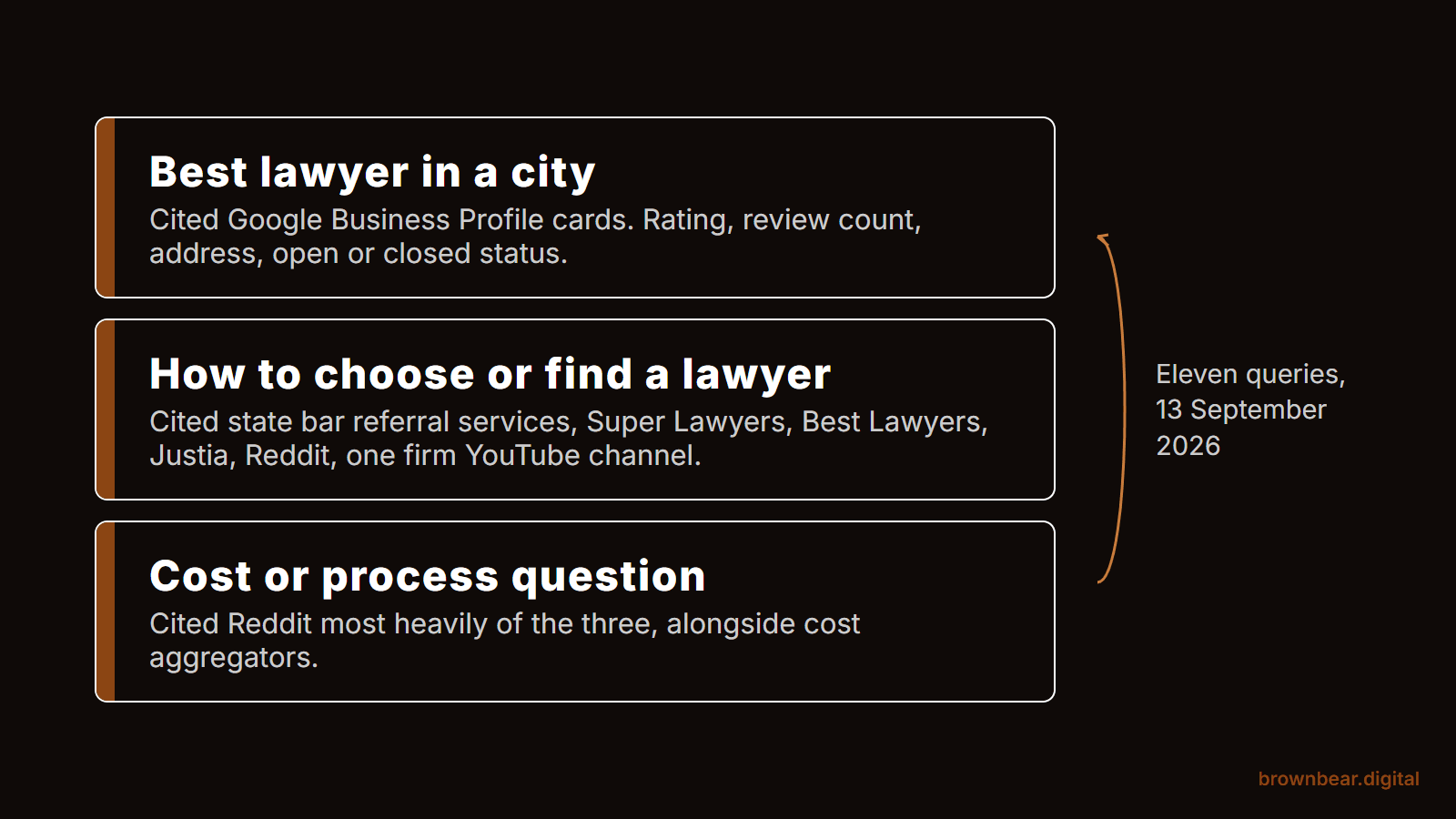
When someone asks for the best lawyer in a city, the AI Overview is built from Google Business Profile data. When someone asks how to choose or find a lawyer, it cites bar association referral services, ranking directories like Super Lawyers and Best Lawyers, Reddit threads, and occasionally a firm's YouTube channel. When someone asks what something costs, it leans on Reddit harder than on anything a firm publishes.
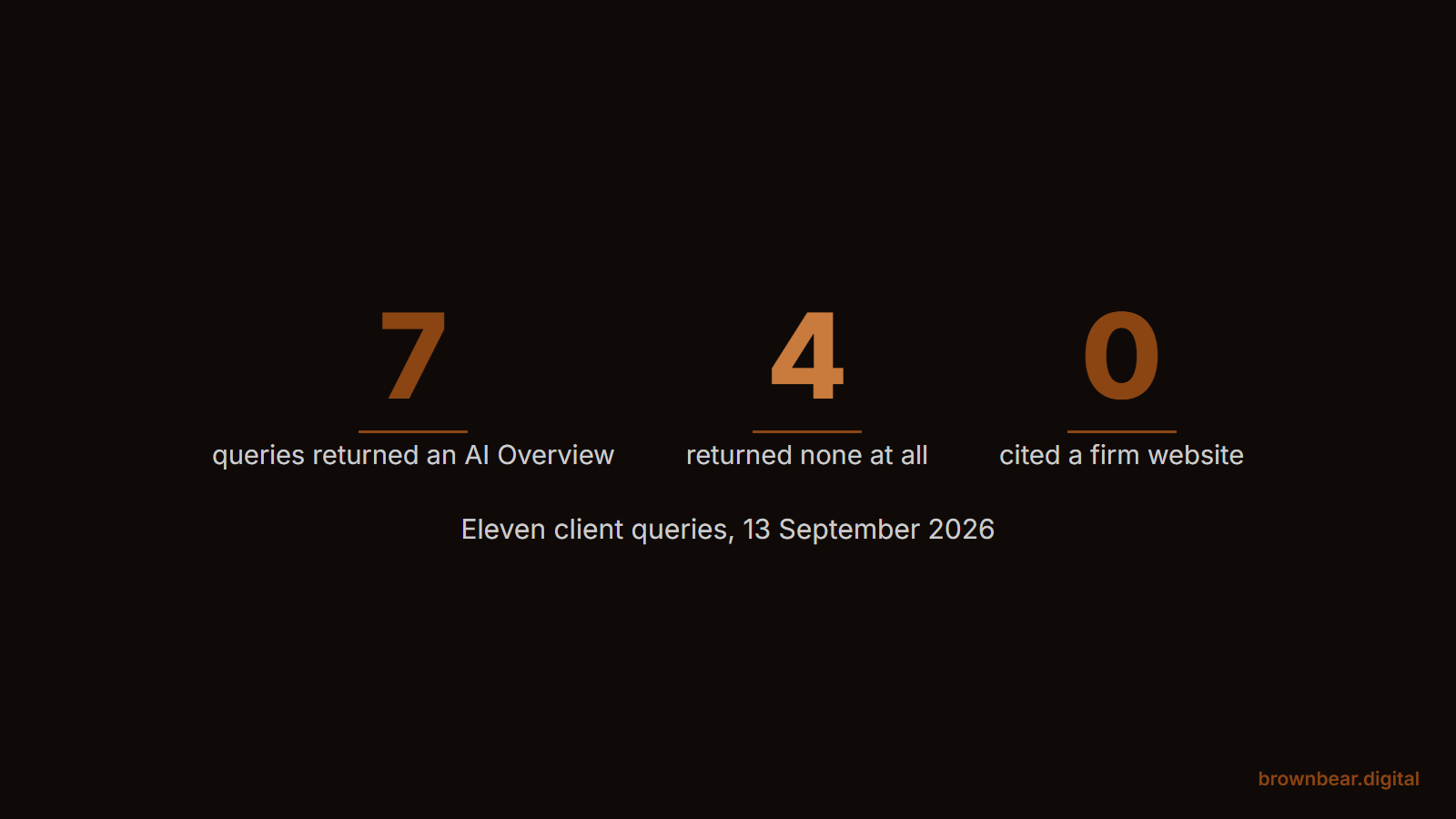
Across all eleven queries, no firm website was cited as a substantive source. Firm sites appeared only as the attribution line under a descriptive sentence inside a Business Profile card.
This does not mean your website is worthless. It means your website is not the page the engine reads to decide what to say about you, and the standard GEO advice for law firms is aimed almost entirely at your website.
2. How We Built the Ledger
The method is simple enough that you can repeat it on your own market this afternoon, which is the point. Section 10 walks through it.
We took eleven queries a prospective client would plausibly type, spread across practice areas and metros, and split into three shapes: best lawyer in a named city, how to choose or find a lawyer, and cost or process questions. We ran each one logged out, read the rendered AI Overview rather than the page source, and recorded every source the Overview attributed. Captured 13 September 2026, United States, desktop.
Reading the rendered text matters more than it sounds. Google ships fallback strings in the markup of every results page that mention AI Overviews whether or not one is served. Detecting presence from the source code produces false positives on queries that have no Overview at all, which is a mistake we have made and corrected in our own work.
Here is what came back.
| Query | AI Overview | What it cited |
|---|---|---|
| best personal injury lawyer in Chicago | None | n/a |
| best divorce lawyer in Dallas | Yes | Business Profile cards, Reddit |
| best estate planning attorney near me | None | n/a |
| best criminal defense lawyer San Francisco | Yes | Business Profile cards |
| best personal injury lawyer Houston | Yes | Business Profile cards |
| best employment lawyer New York | Yes | Business Profile cards, Best Lawyers |
| how do I find a good divorce attorney | Yes | State bar referral service, Super Lawyers, Best Lawyers, Reddit, Justia |
| how to choose a personal injury attorney | Yes | YouTube, state bar records, review platforms |
| how much does a divorce lawyer cost | Yes | Reddit, cost aggregators |
| do I need a lawyer for a car accident | None | n/a |
| what questions to ask a divorce lawyer | None | n/a |
Seven of eleven queries returned an Overview. Four returned nothing at all, which is the first finding worth sitting with.
3. Four of Eleven Queries Had No AI Overview
Before optimizing for a surface, check that the surface exists for your queries.
"Best personal injury lawyer in Chicago" produced no AI Overview. Neither did "best estate planning attorney near me", "do I need a lawyer for a car accident", or "what questions to ask a divorce lawyer". Those are not obscure long-tail phrases. Two of them are among the most commercially valuable strings in legal search.
Picture a personal injury firm in Chicago that just approved a fifteen thousand dollar GEO retainer after a pitch deck full of AI Overview screenshots. Their single most valuable query does not serve one. The money went to a surface that, for their market and their practice area, Google currently declines to render.
We cannot tell you why Google suppresses the Overview on some of these. The pattern in our sample leans toward queries where a wrong answer carries real consequence, which would be consistent with how Google has handled other high-stakes categories, but eleven queries is not enough to call that a rule. What we can tell you is that checking is free and takes four minutes, and that no vendor pitch we have seen starts there.
4. On Best Lawyer Queries, Your Business Profile Is the Citation
Every one of the four best-lawyer-in-a-city queries that returned an Overview returned the same shape: a block of firm entity cards.
For "best personal injury lawyer Houston", the Overview named Zehl and Associates with a 5.0 rating and 1.3 thousand reviews, at 2700 Post Oak Blvd, marked Open. Then The Lanier Law Firm, 4.6 with 146 reviews. Then Williams Hart and Boundas, 4.8 with 308. Dallas and San Francisco and New York produced the same structure with different names.
Look at what is doing the work in that answer. The rating. The review count. The street address. The open or closed status. The practice category. Every one of those fields lives in Google Business Profile, not on the firm's website. The firm's own site shows up in one place only: as the small attribution under the single descriptive sentence, and even then it is competing with ranking directories for that slot.
This is local SEO wearing a GEO costume. The work that moves it is the work that has always moved the local pack: category accuracy, review volume and recency, profile completeness, address consistency. If your firm is chasing AI visibility for the best-lawyer query in your city and your Business Profile has 31 reviews and a category of "Lawyer" rather than "Personal injury attorney", the content program is not your constraint.
If your highest-value queries are the best-lawyer-in-a-city shape, your Business Profile is the lever and your content program is not. Audit the profile first, specifically the primary category, the review count measured against the three firms currently named, and whether your hours and address are current.
5. Our Own Medical Research Said the Opposite, and Both Are Right
Two weeks ago we published a ledger of what AI actually reads before it recommends a medical practice. In a 33,000-citation corpus, Google Business Profile accounted for zero citations. Not a small share. None.
Now we are telling you Business Profile is the dominant source for legal queries. Both findings are accurate, and the reason they differ is the most useful thing in this piece.
The medical study measured ChatGPT describing a named practice. The question was effectively "tell me about this practice", and to answer it an engine goes looking for prose someone has written about that practice: a hospital roster bio, a specialty board profile, a directory entry. A Business Profile has no prose to lift. It has fields.
Our legal ledger measured Google's AI Overview answering who to hire in a given city. That is a different job. It is a ranked local recommendation, and Google already owns a structured, ranked, local dataset built for exactly that: Business Profile. It does not need to find prose. It needs entities with ratings.
So the rule is not that Business Profile matters, or that it does not. It is that the engine and the question together decide which asset gets read. Ask an engine to describe you and it hunts for descriptions. Ask it to rank local options and it reaches for structured local data.
Lawyers should notice one more thing in that comparison. The largest citation source for physicians was the hospital and academic roster, at 27.5 percent, a page with the doctor's name on it that the doctor does not control. Law has no exact equivalent. The nearest analogues are the state bar member directory and the ranking directories, and unlike a hospital roster, several of those you can actually edit.
6. Reddit Is in the Room and You Cannot Edit It
Reddit appeared in three of the seven Overviews we captured.
On "how much does a divorce lawyer cost", the Overview cited r/Divorce alongside five additional sources for its cost bands. On "how do I find a good divorce attorney", it pulled from r/SanJose and r/bayarea, including a caution against hiring an aggressive litigator unless the other side is hostile or hiding assets. On "best divorce lawyer in Dallas", after naming three firms, the Overview added that opinions on r/Dallas are mixed, with some users suggesting self-representation for simple uncontested cases.
Read that last one again. Google named three firms, then immediately told the searcher that people on Reddit think they might not need a lawyer at all.
Say a Dallas family law firm has spent two years building the best content library in its market. On the query that matters most, Google surfaces its Business Profile card and then hands the reader a Reddit thread arguing for filing pro se. Nothing on the firm's website participates in that exchange. There is no on-site fix for it, because the objection is not being raised on the firm's site.
What can be done is narrower than the GEO pitch implies. You can answer the objection somewhere the engine already reads, which for cost questions means your own fee transparency page needs to be specific enough to be quotable rather than an invitation to call. You can have a real attorney answer questions in public under their own name where your bar rules permit it. What you cannot do is buy your way into the thread, and firms that try tend to end up explaining themselves to a disciplinary board.
With all three shapes now on the table, you can sort your own queries. Type in a query a client of yours would search and this reports what that shape cited in our capture, and which asset carried it.
7. Where the Advertising Rules Bite
Everything above assumes you can say what the optimization implies you should say. For lawyers that assumption needs checking, and it is the reason legal GEO is not simply SEO with a different noun.
The black-letter rule is short. A lawyer shall not make a false or misleading communication about the lawyer or the lawyer's services, and a communication is false or misleading if it contains a material misrepresentation of fact or law, or omits a fact necessary to make the statement considered as a whole not materially misleading. That standard was written for brochures and billboards. It now has to cover a sentence an engine generated about you from a directory profile you filled in three years ago.
Read the omission clause again with that in mind, because it is the operative half. An AI Overview does not usually misstate a fact about a firm. It compresses. It takes a sentence from a ranking directory, strips the qualifiers, and presents the remainder as a summary. Compression is precisely how a statement ends up omitting a fact necessary to keep it from being materially misleading.
Two practical consequences follow.
The first is that the descriptors most likely to earn a citation are often the ones most constrained. Best, top-rated, leading, aggressive, and comparative superlatives generally are the vocabulary of the ranking directories that AI Overviews lean on. Comment 3 to the Model Rule treats an unsubstantiated comparison of a firm's services or fees against other firms as potentially misleading, and states that have adopted that comment restrict exactly this vocabulary on your own site. The directory can say it about you. You frequently cannot say it about yourself. That asymmetry is part of why the directories occupy the citation slot.
The second is that your GEO work is now generating claims you did not write. If your Business Profile category, your Super Lawyers listing and your practice description combine into an AI-generated sentence implying a specialization you are not certified in, that sentence exists in the world with your name on it. The rules in most states attach to communications about the lawyer's services, and nothing in them contemplates who typed the sentence.
We are not your ethics counsel and this is not legal advice. Take the specific question to your state bar, and read your own state's adopted text rather than the ABA Model Rules, which bind nobody until a state adopts them. We wrote separately about which parts of legal SEO the advertising rules actually constrain, including a copy checker for Rule 7.1 language.
8. What the Advice on This Page's Own SERP Gets Wrong
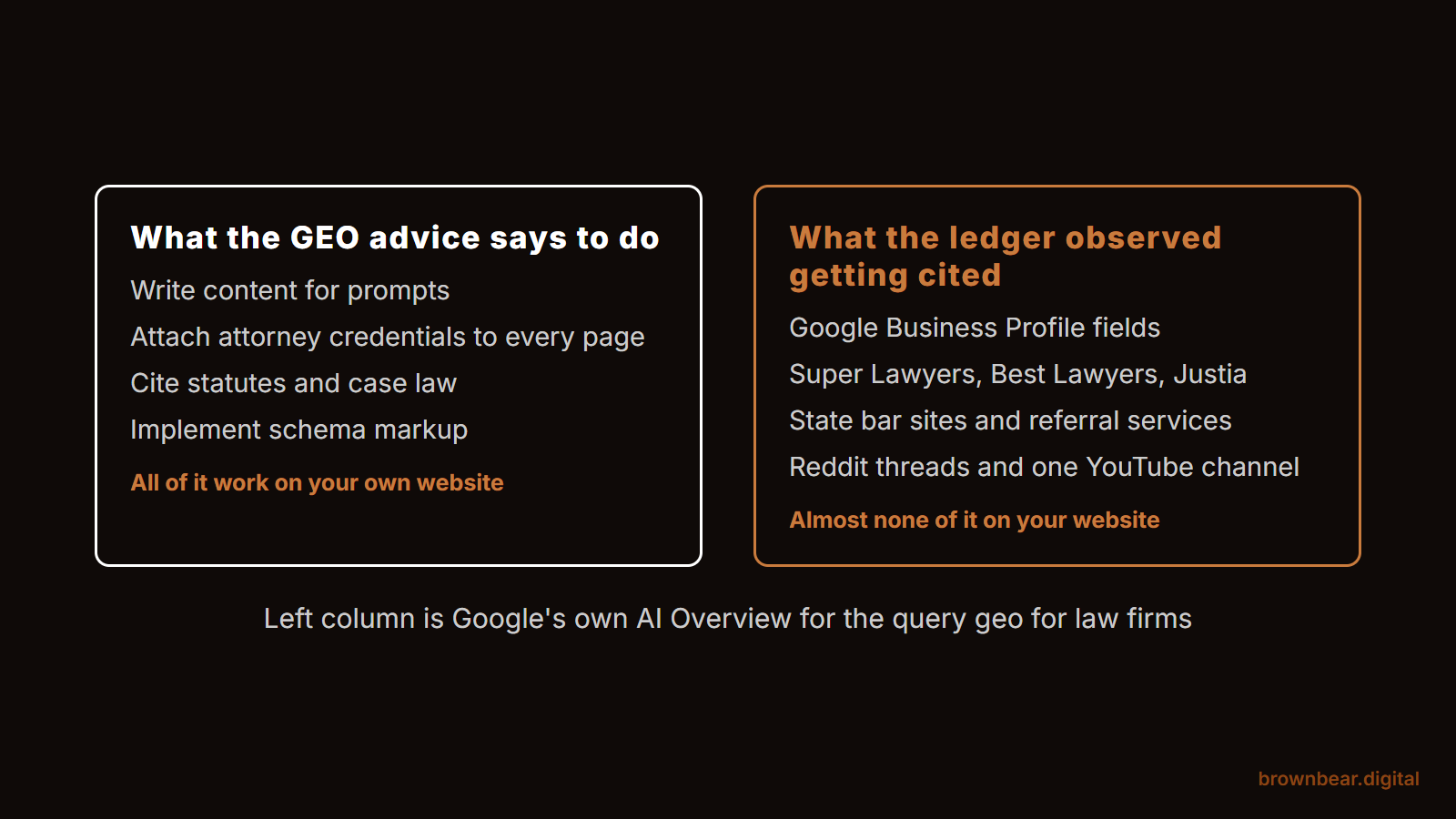
Go back to the AI Overview for "geo for law firms" that opened this piece. Its four core strategies were: write for prompts, show authorship credibility, cite external sources, use schema markup.
Set those against the ledger. Prompt-shaped content did not determine a single citation in our sample. Authorship credentials did not appear as a cited source once. Schema markup labels information already on a page the engine mostly was not reading. Citing statutes is good practice for several reasons and was not why any source in our sample got cited.
This is not a strawman built from bad blogs. It is the consensus of the pages ranking for the term. Clio's guide, the second result and the most authoritative brand in legal software, runs 2,847 words and mentions Google Business Profile, Reddit, state bar directories and the ranking directories exactly zero times each. The fourth result is a 1,709 word agency service page with the same omissions. Across the top of that SERP we found no original measurement of any kind.
None of this makes the on-site work useless. Crawlability genuinely matters, and if an engine cannot render your content it certainly cannot cite it. Clean structure helps. But we have written before that schema is the most overhyped item on the GEO list, and legal search is the clearest example we have found: the citation surface for the queries that generate cases sits almost entirely off your website.
For the record, independent observation points the same way. A legal marketing analysis published in December 2024 ran commercial litigation queries through ChatGPT and found nine of ten named firms traced back to Best Lawyers and Super Lawyers rankings rather than to firm sites. Different engine, different year, same conclusion.
9. What to Do, Sorted by Practice Area
The ledger splits cleanly by how clients search for each kind of law, and the right first move differs accordingly.
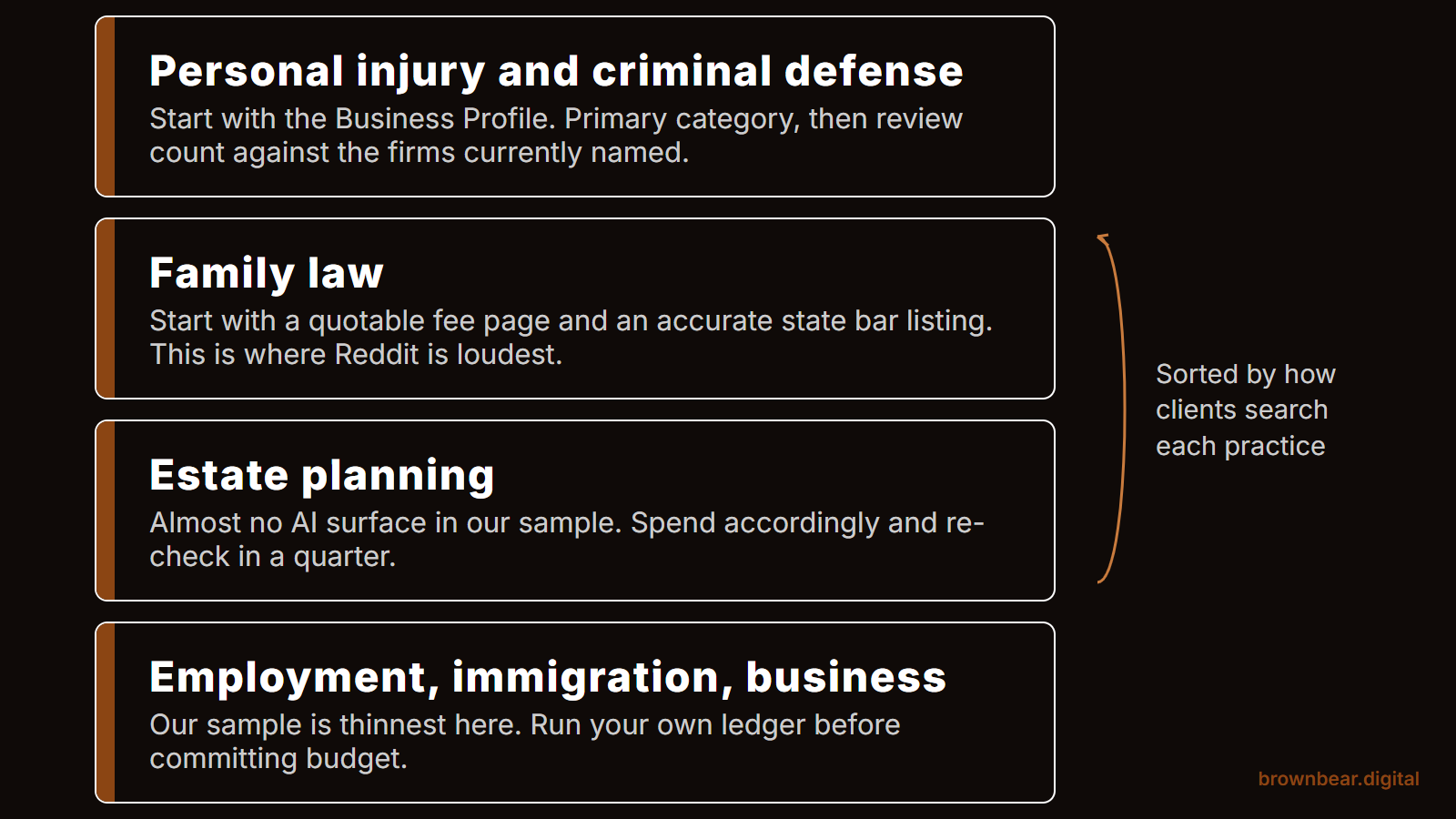
Personal injury and criminal defense. Your clients search for the best lawyer in a city and they search under time pressure. That query shape is the Business Profile regime. Start with the profile: primary category exactness, review volume measured against the firms currently named in your market's Overview, and recency. Then check whether your city even serves an Overview, because two of ours did not.
Family law. Your clients search advice and cost questions before they search for a firm, and those are the Overviews where Reddit and bar referral services dominate. A quotable fee transparency page and an accurate state bar directory entry do more here than another practice area page.
Estate planning. Both the best-attorney-near-me query and most process questions in our sample returned no Overview at all. The AI surface is thin for this practice area right now. Spend accordingly and re-check in a quarter.
Employment, immigration and business law. Our sample is thinnest here. Run the ledger on your own queries before committing budget, because the one employment query we ran behaved like the Business Profile regime and we would not generalize from a single observation.
10. Run This Ledger on Your Own Market
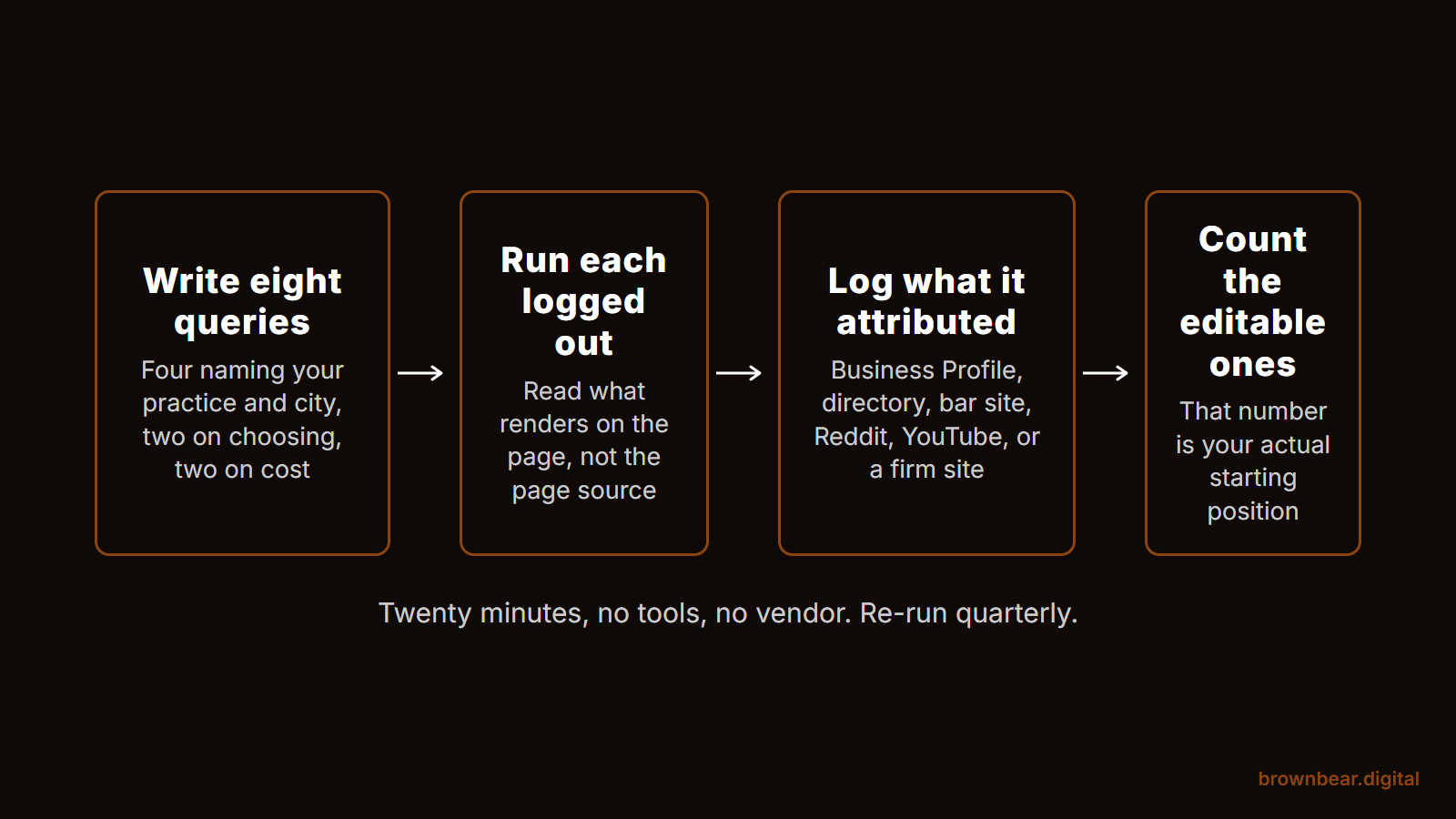
Twenty minutes, no tools, no vendor.
- Write down the eight queries your clients actually type. Four naming your practice and your city, two beginning with how to choose, two about cost or process.
- Run each one logged out, in an incognito window, and read what renders on the page rather than the page source.
- For each query, log one line: was there an AI Overview, and what did it attribute? Note whether the sources are Business Profile cards, directories, bar sites, Reddit, YouTube, or firm websites.
- Count how many of your eight queries cite something you can edit this week. That number, not a vendor's visibility score, is your actual starting position.
The worksheet below builds your eight queries from your practice area and city, then scores how much of your citation surface sits on something you can actually edit. Nothing is sent anywhere.
Picture a mid-size Houston firm running this on a Tuesday morning. Six of their eight queries return Overviews. Five of the six are Business Profile cards naming three competitors. Their profile has the wrong primary category. That is a ninety second fix that no amount of content production would have reached, and they found it without buying anything.
Re-run it quarterly. The four queries in our sample with no Overview today may well have one by the time you read this, which is itself a reason to measure rather than to trust a checklist written before the measurement.
The ledger tells you where your citations come from. If it turns out that an engine cannot read your site properly in the first place, that is a different problem with a different fix, and the twelve site checks in our GEO audit are the faster way to find it.
11. What This Ledger Cannot Tell You
Eleven queries, one country, one day, one engine, one location, logged out. That is a sample, not a study, and we would rather say so than dress it up.
AI Overviews are personalized and volatile. Yours may differ by location and by signed-in history. We measured Google's AI Overview and not ChatGPT, Perplexity or Gemini, which have different source pools and would produce a different ledger. We cannot explain why four queries returned nothing, only that they did. And a citation is not a case: we measured what gets named, not what gets signed.
What the sample is sufficient for is the narrow claim we are making, which is that the standard GEO checklist for law firms points at assets our ledger did not observe getting cited even once, and that a firm can check this for itself in twenty minutes rather than taking either our word or a vendor's.
12. Frequently Asked Questions
Does GEO for law firms mean something different from SEO?
Less than the term implies. For the highest-value legal queries in our sample, the citation source was Google Business Profile, which means the work is local SEO. Our wider argument about what GEO actually names holds here: the useful parts are mostly things SEO already covered, done with a different surface in mind.
Should my firm stop investing in website content?
No. Content earns the organic rankings that still produce most legal traffic, and Overviews did not appear on four of our eleven queries at all. The finding is narrower: content is not the asset being cited in the Overviews we captured, so it should not be sold to you as the AI visibility lever.
Why do some of my queries have no AI Overview?
We do not know, and anyone who tells you they do is guessing. Our sample lost four of eleven. Check your own queries before budgeting against a surface that may not render for them.
Can I get my firm into a Reddit thread that an AI Overview cites?
Not safely as a marketing tactic. An attorney answering questions publicly under their own name is legitimate where state rules allow it. Undisclosed promotional posting is a disciplinary problem, and in our sample the Reddit citations were consumer threads that would be obvious to astroturf.
How often should we re-run the ledger?
Quarterly. The surface moved enough between our medical study at the start of September and this legal one that the two verticals produced opposite conclusions about the same asset.
Work With Brown Bear on Your Firm's AI Visibility
Most firms we audit are not losing AI visibility because their content is weak. They are losing it because the citation surface for their practice area sits somewhere nobody told them to look, and in legal that is usually a Business Profile category, a stale directory entry, or a Reddit thread raising an objection their site never answers.
If you want to know which sources are currently describing your firm to an engine, and which of them you can change this quarter, talk to us about an AI visibility audit. We will run the ledger on your market and tell you plainly when the answer is that your practice area has no AI surface worth buying yet.
Ledger captured 13 September 2026, United States, desktop, logged out. Rule 7.1 text referenced from the ABA Model Rules linked above; your state's adopted text governs. Independent corroboration of directory citation patterns from a December 2024 legal marketing analysis published on JD Supra.
Written By
Founder, Brown Bear Digital
Bryan has 15 years of experience across SEO, paid search, and AI search strategy. He founded Brown Bear to give businesses direct access to senior-level search expertise without the agency overhead.
Learn More About BryanReady to Turn Search
Into Revenue?
No pitch decks. Just a real conversation.