Hospital SEO: What 25 Health System Websites Show About Directories, Service Lines and AI Crawlers
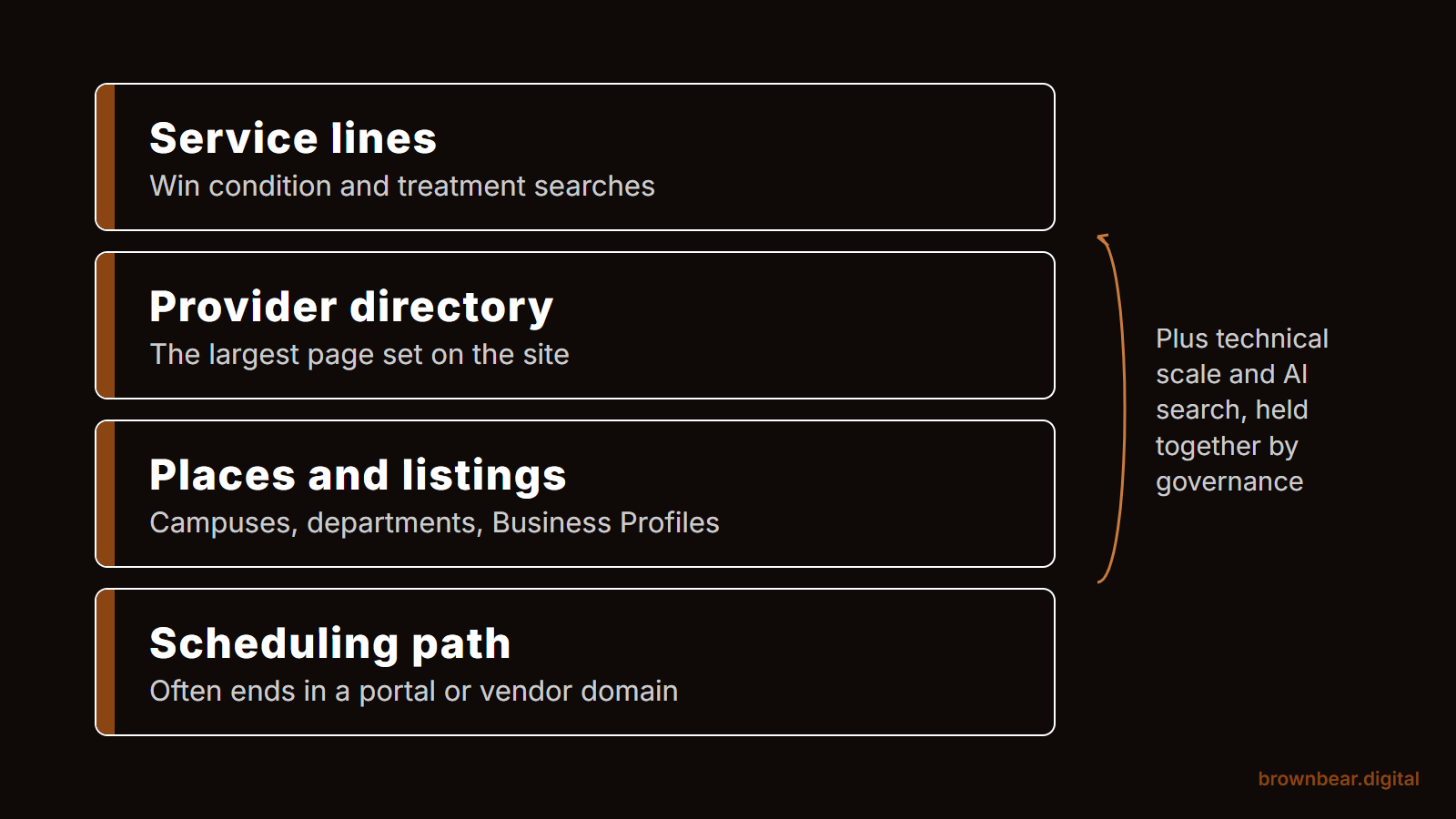
A hospital website is not one website. It is a provider directory with thousands of profiles, a set of service-line pages that carry the system's margins, a map of campuses and departments, and a scheduling path that usually ends on someone else's software. Hospital SEO is the work of making all of it findable at once, without breaking it every time a doctor leaves or two systems merge.
This guide is built on a November 2026 check of 25 large US health system websites, Google's own documentation on crawling and Business Profiles, and the federal hospital price transparency rule. It is written for hospital and health system marketing teams, digital leads and the web managers who inherit the directory.
You will get a directory scorecard, a robots.txt reader for AI crawlers and an approval model your compliance team can live with. Start with what makes a hospital site different from a practice site.
What Hospital SEO Covers That Practice SEO Does Not
Hospital SEO is the practice of getting a hospital or health system's service lines, doctors, campuses and departments found in Google Search, Google Maps and AI answers, then turning those visits into scheduled care. The tactics overlap with practice SEO. The scale, the stakeholders and the ways it breaks do not.
A private practice might run 40 pages and one Google Business Profile. A health system can run thousands of provider profiles, hundreds of location and department listings, and service lines that each behave like a separate business. Each of those page sets is fed by a different internal system: credentialing for doctors, facilities for addresses, the EHR for scheduling and compliance for anything clinical. If you have just inherited hospital SEO, that is usually the first surprise: the pages are easy to find, and the people who control them are not.
The search results split in a way practices feel from the other side. When Brown Bear sorted 1,830 local Google results across 10 specialties in October 2026, health systems held the #1 spot on 13 of 16 condition searches and were strongest in orthopedics, physical therapy and dermatology, with 29%, 25% and 19% of local results. Independent practices still held 115 of 185 #1 spots on local provider searches. For a hospital team, that is the map: condition and service-line searches are yours to defend, and provider and neighborhood searches are where practices take patients from you.
Hospital SEO has six moving parts, held together by governance:
- Service-line pages that win condition and treatment searches.
- The provider directory, usually the largest page set on the site.
- Campus, department and location pages, plus their Google Business Profiles.
- The scheduling path, which often crosses into a portal or vendor domain.
- Technical SEO at scale: crawl control, faceted directories and migrations.
- AI search, where crawler access and citable pages decide who gets named.
What We Found on 25 Health System Websites
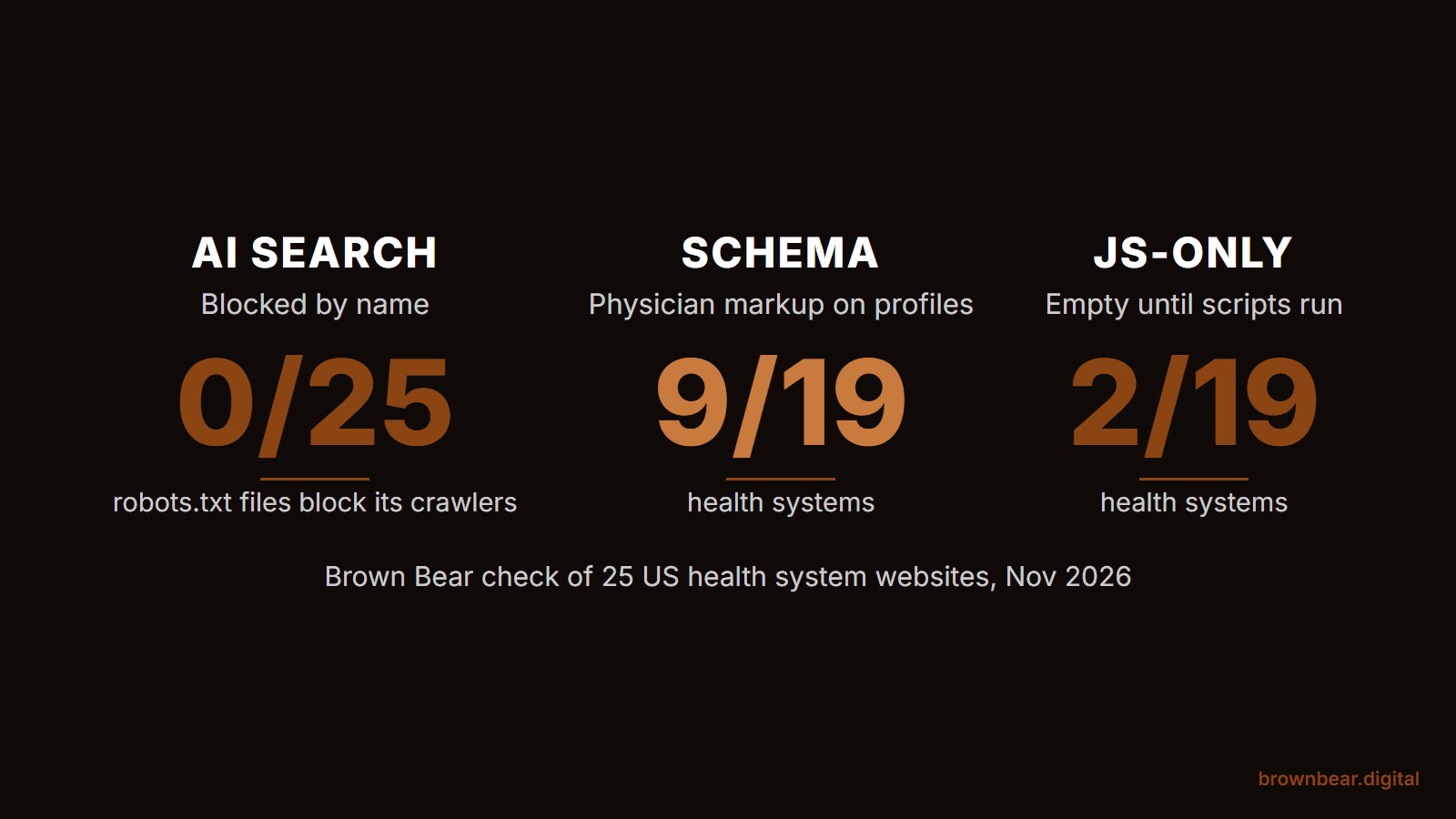
Most large health systems get the basics of a provider profile right, about half skip the structured data, and the real damage hides in how they handle departed providers and changed URLs. That is the short version of what we found when we checked 25 US health system websites on November 7, 2026.
For each system we read robots.txt, followed the XML sitemaps to provider profiles, and fetched two profiles as raw HTML, the way a crawler that does not run JavaScript sees them. We could read profiles for 19 of the 25 systems. The sample is large systems only, one day, from one location, so treat it as a field check rather than a census.
| What we checked | Result |
|---|---|
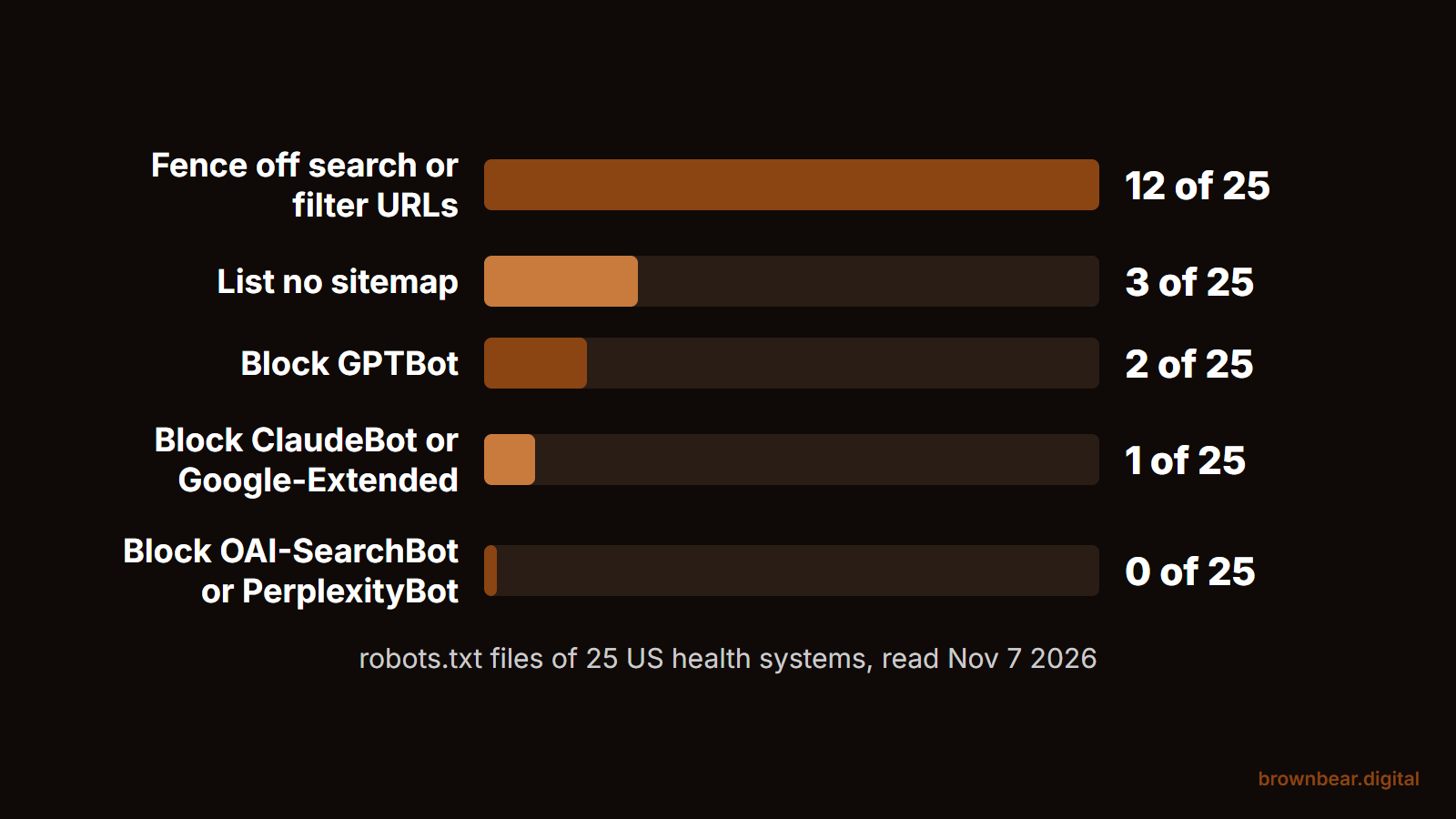
| robots.txt files that block GPTBot | 2 of 25 (Intermountain Health, Duke Health) |
| robots.txt files that block ClaudeBot or Google-Extended | 1 of 25 (Intermountain Health) |
| robots.txt files that block OAI-SearchBot, ChatGPT-User or PerplexityBot by name | 0 of 25 |
| robots.txt files that disallow internal search or filter URLs | 12 of 25 |
| robots.txt files that list no sitemap | 3 of 25 (Providence, Intermountain Health, Stanford Health Care) |
| Provider profiles with credentials in the raw HTML | 17 of 19 |
| Profiles served as a near-empty shell until JavaScript ran | 2 of 19 (Northwell Health, Cedars-Sinai) |
| Profiles with Physician-type schema in the raw HTML | 9 of 19 |
Two single findings matter as much as the counts. Houston Methodist's robots.txt lists 142 individual doctor profile URLs as Disallow lines. Cleveland Clinic's sitemap lists provider URLs that 301 to an http address on a separate providers subdomain, and the profile behind them refused our fetcher, so it sits outside the profile counts.
Read the table as three lessons. The directory basics are mostly solid. AI crawler policy is mostly "allowed by silence," since few systems name any AI crawler at all. And the expensive mistakes live in the operational edges: who removes a departed doctor, and whether the sitemap points at the real page.
Service-Line Pages Carry the Revenue, So Build Them Around What Patients Search
A service-line page is the page for a clinical program such as cardiology, orthopedics or cancer care. It should answer the patient's condition and treatment questions, show which doctors and locations offer that care, and offer a way to book. Most hospital sites build these pages from the org chart instead, so the page is named after the institute and organized by the department's internal structure.
Patients do not search for the "Heart and Vascular Institute." They search for "afib treatment," "cardiac ablation near me" or "heart surgeon" plus a town. A service line that wins those searches is built in layers:
- Hub: the service line overview, with the institute name in the body rather than as the only label.
- Condition pages: one per condition patients search, written in their words.
- Treatment pages: one per procedure the surgeons actually perform, with candidacy, recovery and cost questions answered.
- Program and location pages: where the care happens, linked to the campus pages.
- Provider profiles: linked from every treatment page that names the doctors who perform it.
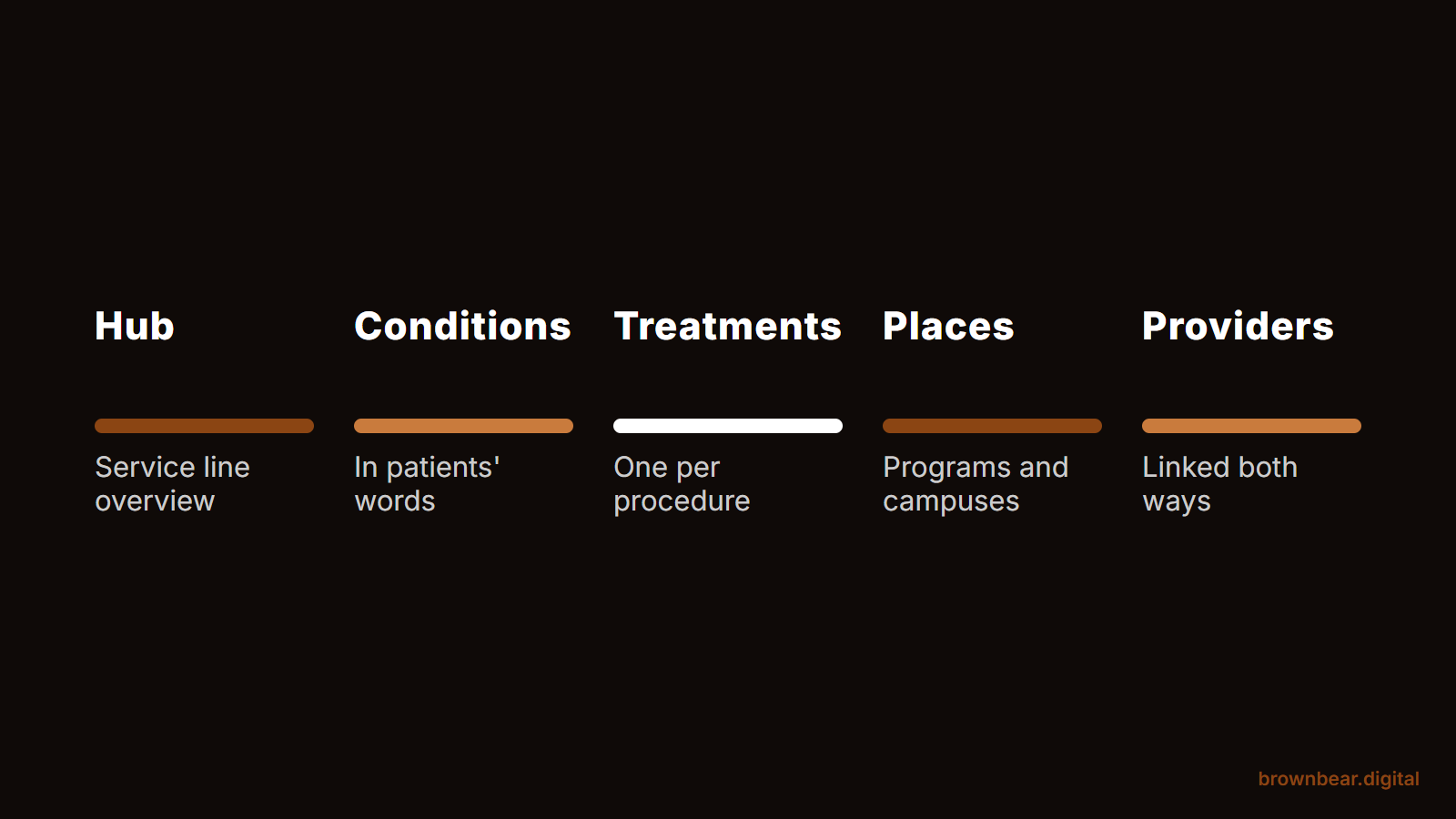
Links should run both ways: treatment pages up to the hub and across to the doctors, profiles back to the treatments they offer.
Picture a regional hospital opening a robotic surgery program. The press release calls it the Center for Advanced Robotic Surgery, and the web team builds one page under that name. Patients search "robotic hernia repair" and "robotic prostatectomy near me." The better build is a hub plus a page for each robotic procedure the surgeons perform, each naming the surgeons, the campus and how to book. The center keeps its name; it just stops being the only door.
Which service lines go first is a business decision, not an SEO one. Rank them on four inputs: margin per case, open capacity, search demand and how hard the local results are to crack. A high-margin line with a three-month wait for new patients is a poor first build, because the traffic arrives before the appointments do.
The Provider Directory Is the Biggest SEO Asset a Hospital Owns
Provider profiles are usually the largest page set on a hospital site, and they match the most specific searches: a doctor's name, or a specialty plus a town. The systems we sampled publish profiles by the thousands in their sitemaps. A profile that wins those searches carries:
- Full name, degrees and board certifications.
- Specialties, plus conditions treated and procedures in plain patient words.
- Every practice location as text, with street address and phone.
- Accepting new patients status, languages and insurance information.
- A booking or request path on the page itself.
- Physician schema filled from the same data the page shows.
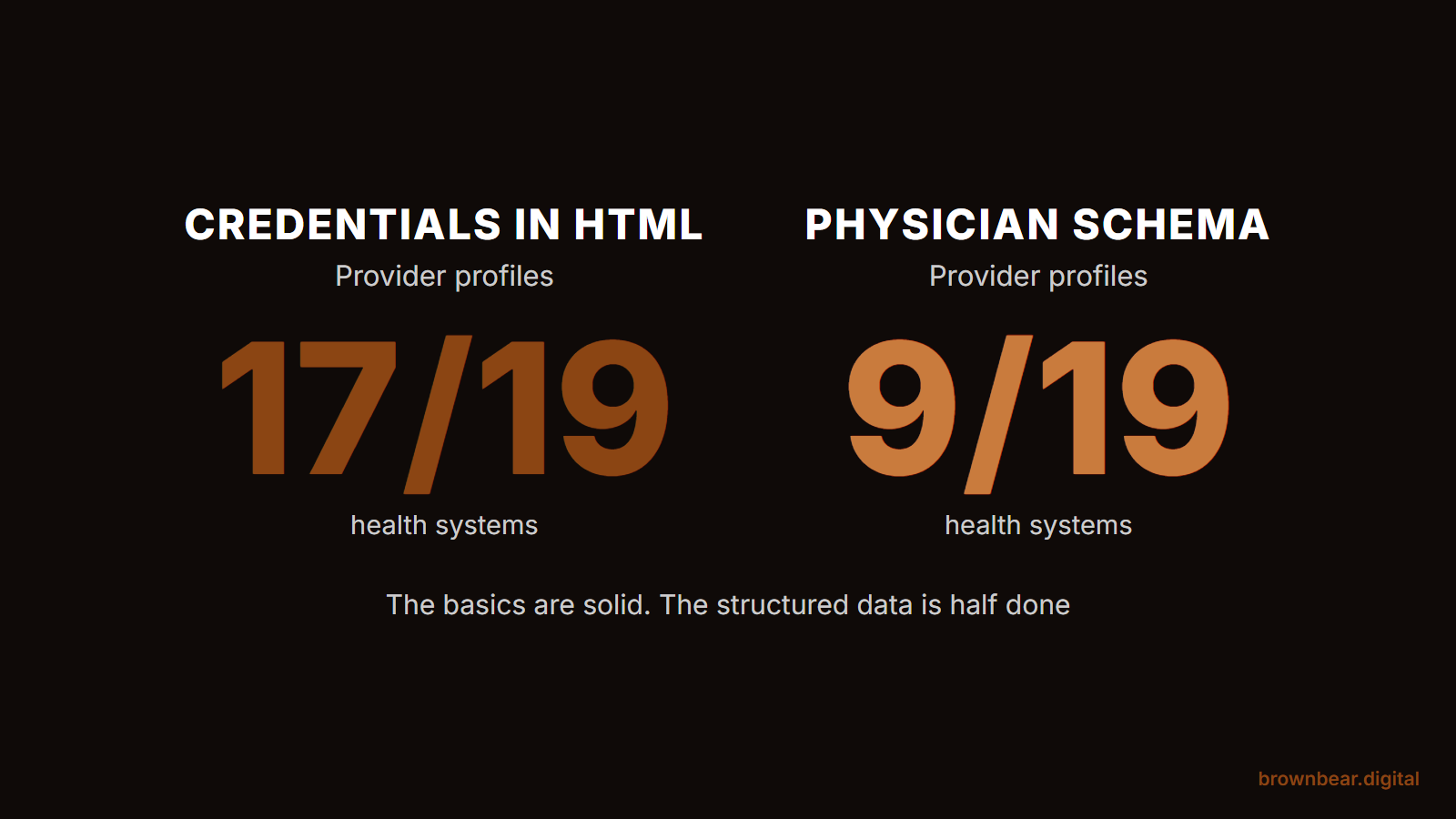
All of it has to be in the HTML the server sends. Northwell Health and Cedars-Sinai served profile pages with roughly 10 to 20 words of text until JavaScript ran; in a full browser the same pages filled with a bio and Physician schema. Google renders JavaScript, eventually. The major AI crawlers do not, so a directory that loads the profile with JavaScript is invisible to them.
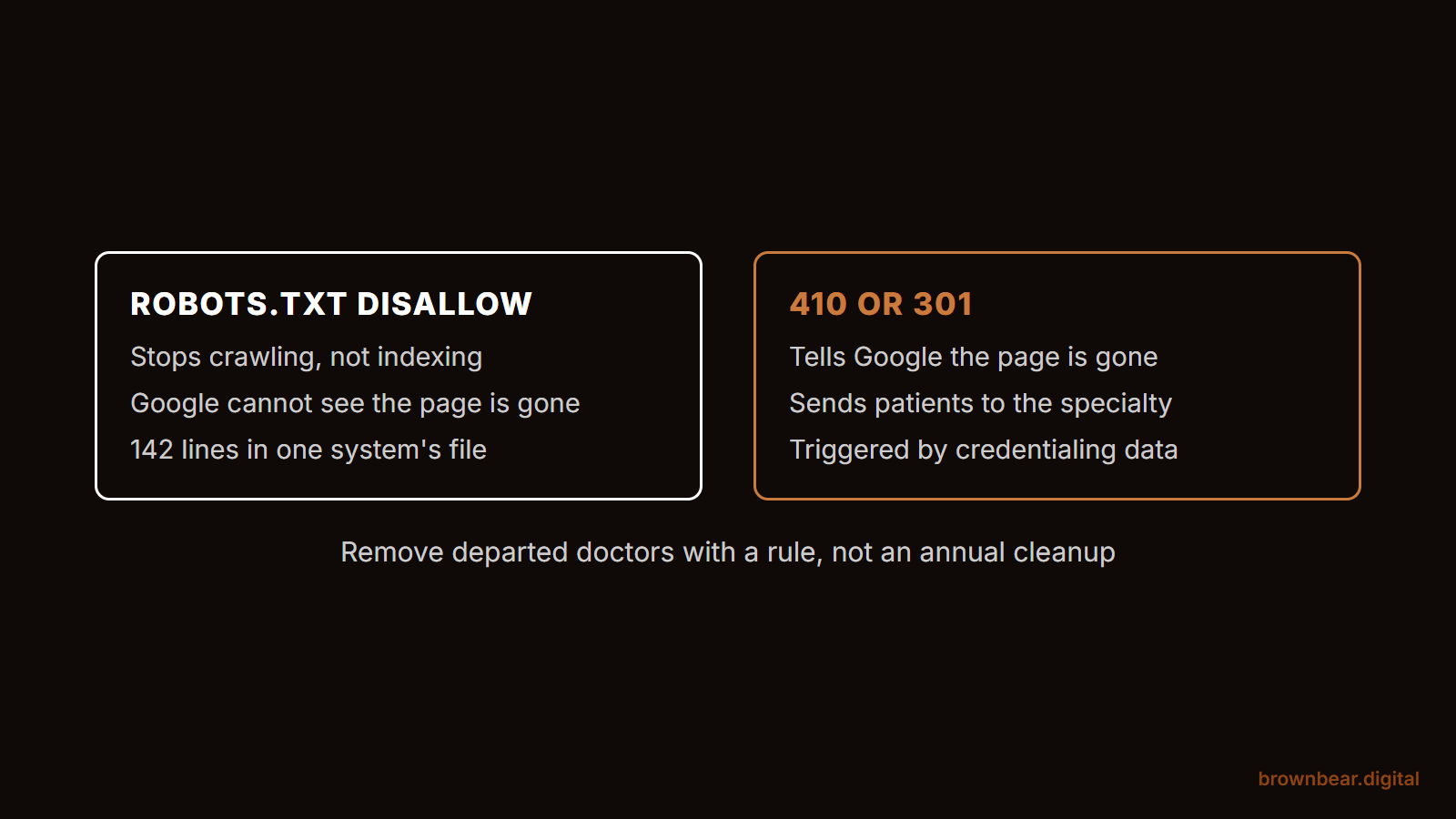
Departed providers are where directories quietly fail. Say a cardiologist leaves a six-hospital system in March. Her profile still ranks for her name, so patients land on a page offering appointments she can no longer take, and her Google Business Profile listing keeps sending calls to a desk that has to explain. The fix is a rule, not an annual cleanup: when credentialing marks a provider inactive, the profile returns a 410 or 301s to the specialty page within an agreed number of days, and someone owns her listing.
A robots.txt Disallow is not that rule. Google's documentation states that a page disallowed in robots.txt can still be indexed if other sites link to it, and Google's crawl budget guide says to return a 404 or 410 for permanently removed pages. We cannot tell from Houston Methodist's file why those 142 doctor URLs are listed, but a Disallow line stops Google from crawling a page, which also stops Google from seeing that it is gone. The same logic applies to sitemaps: every redirect listed in one, like the Cleveland Clinic URLs above, costs a crawl to find the real page. List final URLs only.
The directory also forces a scope decision that marketing and medical staff leadership often fight over: do affiliated, independent physicians get profiles? If your growth plan depends on employed physicians, keep affiliates in a clearly labeled section and put your booking paths on employed profiles. If independent affiliates fill your operating rooms and admit to your hospitals, include them in full, because patients searching their names are also choosing your facility.
Campus, Department and Location Pages: One Page for Every Door Patients Walk Through
Every place a patient can physically go deserves its own page, and if it has its own entrance, its own Google Business Profile. Google's Business Profile guidelines say departments within hospitals may have their own profiles, and that each department's name must differ from the main hospital's name and from other departments. Doctors who see patients can have practitioner profiles; when several practitioners share a location, the organization keeps a separate profile for the location.
That points to a page set most systems only half build: a page for each campus, a page for each public-facing department on it (emergency, imaging, lab, maternity, cancer center), and a page for each outpatient site and urgent care. Each page carries its own hours, phone, entrance and parking directions, and links to the services and doctors found there. The doorway-page rules from our guide for multi-location practice groups apply here at a larger scale: every page has to say something true about that place that no other page says.
Say the imaging center on your main campus uses the hospital's main number and the hospital's round-the-clock hours. A patient searching "MRI near me" at 7 p.m. sees a listing that says open, calls the operator and gets transferred twice before learning outpatient imaging closed at 6. A separate imaging listing with its own direct line, its real hours and a landing page that explains how to schedule ends that call before it starts.
Running Google Business Profiles Across Dozens of Locations
Google Business Profile at hospital scale is an operations problem more than a marketing one. Google offers bulk verification to organizations with 10 or more profiles from the same business, which covers most systems, and business groups let you hand each region or department its own managers without handing over the whole account.
What breaks is ownership. Listings get created by a clinic manager, a former agency or a vendor, then drift. A working setup has four parts:
- Inventory every listing, including unclaimed and duplicate ones, and map each to a page on your site.
- Name one owner per listing type: facilities for campuses and departments, the medical group for practitioners, marketing for categories and photos.
- Feed hours, phones and practitioner status from the same source as the website, so a change happens once.
- Write a review reply policy with compliance that never confirms someone was a patient, then let local teams reply inside it.
Scheduling, Portals and the EHR: Where Hospital SEO Turns Into Booked Visits
Many hospital booking paths end in a patient portal or a scheduling vendor on another domain. That rarely hurts rankings. It hurts measurement, because the visit that started on your service-line page finishes somewhere your analytics cannot see.
Three rules keep the path clean. Put the booking action on the pages patients land on, mainly provider profiles and treatment pages, not only on a central "make an appointment" page. Keep login, portal and appointment confirmation pages out of the index. And measure the click to schedule as an event on your own domain, rather than trying to track what happens inside the portal, where health data lives. Before any tag goes near a scheduling flow, read the HIPAA rules on tracking pixels on scheduling pages with your compliance team.
The right booking button depends on what your EHR can do. If its scheduling module supports direct-book links per provider and visit type, put those links on every profile and treatment page. If only some departments schedule online, route the rest to a department phone number or a request form, label it clearly, and track that click instead.
Crawl Budget, Faceted Directories and Migrations at Health System Scale
Google's crawl budget guide is written for sites with more than 1 million unique pages that change about weekly, or more than 10,000 pages that change daily, and Google says those are not exact thresholds. Most hospital sites sit below the first line. The trap is the directory search: filters for specialty, location, language, insurance and gender can generate more crawlable URLs than the site has real pages.
Twelve of the 25 systems we checked fence off internal search or filter URLs in robots.txt. UCHealth's file, for example, carries rules for provider filters such as specialty, area of care and city or zip. The pattern to copy:
- One indexable URL per provider, per location and per specialty landing page.
- Filter and search result URLs disallowed, or never linked in a way crawlers follow.
- Every profile reachable through plain links, such as specialty and A to Z index pages.
- Sitemaps generated from live, final URLs, with removed pages returning 404 or 410 rather than a soft 404 that keeps getting crawled.
Mergers and rebrands are the other scale problem. A system that changes its name, folds an acquired hospital's site into its own or swaps EHR vendors can change thousands of profile and location URLs in one release. Treat a website redesign of that size as a migration: map every old profile, location and service URL to its new home before launch, and run it against a full migration checklist rather than a launch-day spot check.
AI Search for Health Systems: Who Gets Cited and What Crawlers Can Read
AI answers draw on pages crawlers can read and sources the models already trust. Health systems start with an advantage there. Bryan Passanisi, Brown Bear's founder, has watched big authority sites such as Mayo Clinic take over AI answers for head-term health questions, while local and cost questions still leave room for smaller sites. For a health system, that means condition explainers can earn citations if the content is strong, and local service and provider pages decide whether you appear when a patient asks for a specialist nearby.
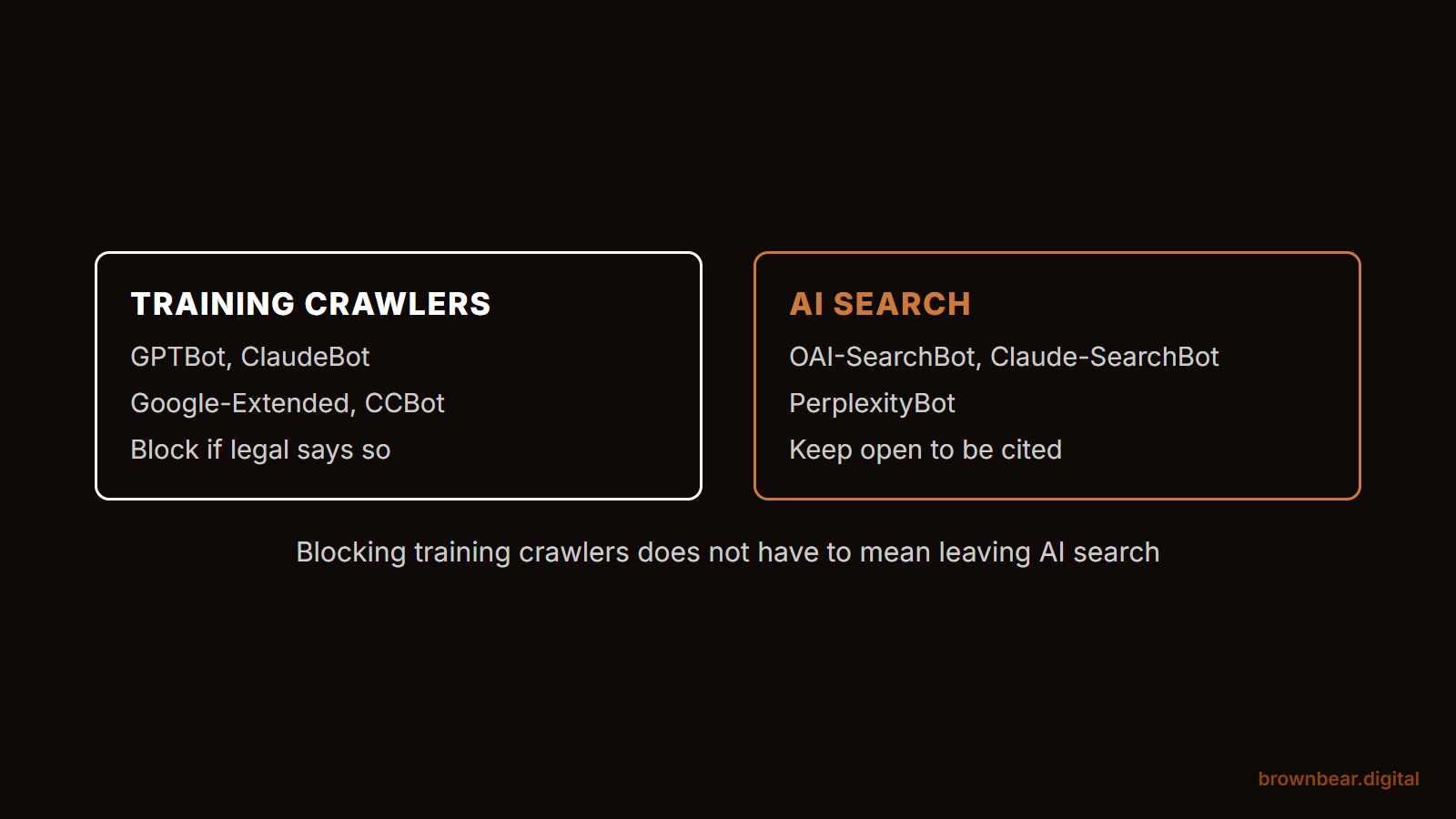
Crawler access comes first. In our check, 23 of 25 robots.txt files do not block GPTBot, and none block OAI-SearchBot, ChatGPT-User or PerplexityBot by name. If legal wants training crawlers out, block those and leave the search crawlers open: blocking GPTBot does not have to mean leaving ChatGPT search, and Google states that Google-Extended "does not impact a site's inclusion in Google Search." If your policy is to stay out of AI answers entirely, block the search and user-request crawlers too, and accept that patients asking those tools will hear about someone else.
robots.txt only shows what a site declares. A firewall or content delivery network setting can still turn crawlers away. In Brown Bear's 136-site study of plastic surgery homepages, about 1 in 7 refused at least one AI crawler at the server level while serving the same page to a browser, with nothing in robots.txt. Check your server logs, not just the file, before you assume your AI search visibility problem is a content problem.
Price Transparency Pages Are Search Pages Too
Since January 1, 2021, CMS has required hospitals to post a machine-readable file of standard charges and a consumer-friendly display of shoppable services. The display has to cover at least 300 shoppable services, or every one the hospital offers if it offers fewer, and the rule lets a hospital use an online price estimator tool to meet that part.
Most hospitals file this under compliance and bury the estimator two clicks deep. Patients search for exactly what it answers: "MRI cost," "colonoscopy cost," "how much is a knee replacement." Give the estimator an indexable landing page that explains what it covers, answer the common cost questions in text on the matching treatment pages, and link both ways. Cost is one of the local questions where Bryan still sees room for providers in AI answers, so a plain-language cost section on a treatment page earns its place twice.
Getting SEO Changes Through Compliance, Legal and Clinical Review
The fastest way to ship SEO inside a health system is to sort every change by risk and give each tier its own approval path and turnaround. One queue for everything means a title-tag fix waits behind a cancer page rewrite.
| Tier | Examples | Who approves | Target turnaround |
|---|---|---|---|
| Technical, no copy | Redirects, schema, sitemaps, robots.txt, title templates | Web team and SEO lead | Days |
| Non-clinical copy | Hours, parking, page titles, calls to action | Marketing | About a week |
| Clinical copy | Condition and treatment content | Clinical reviewer, then compliance | A published service level, such as 2 to 3 weeks |
| Claims | Outcome statistics, rankings, prices, patient stories | Legal and compliance | Case by case |
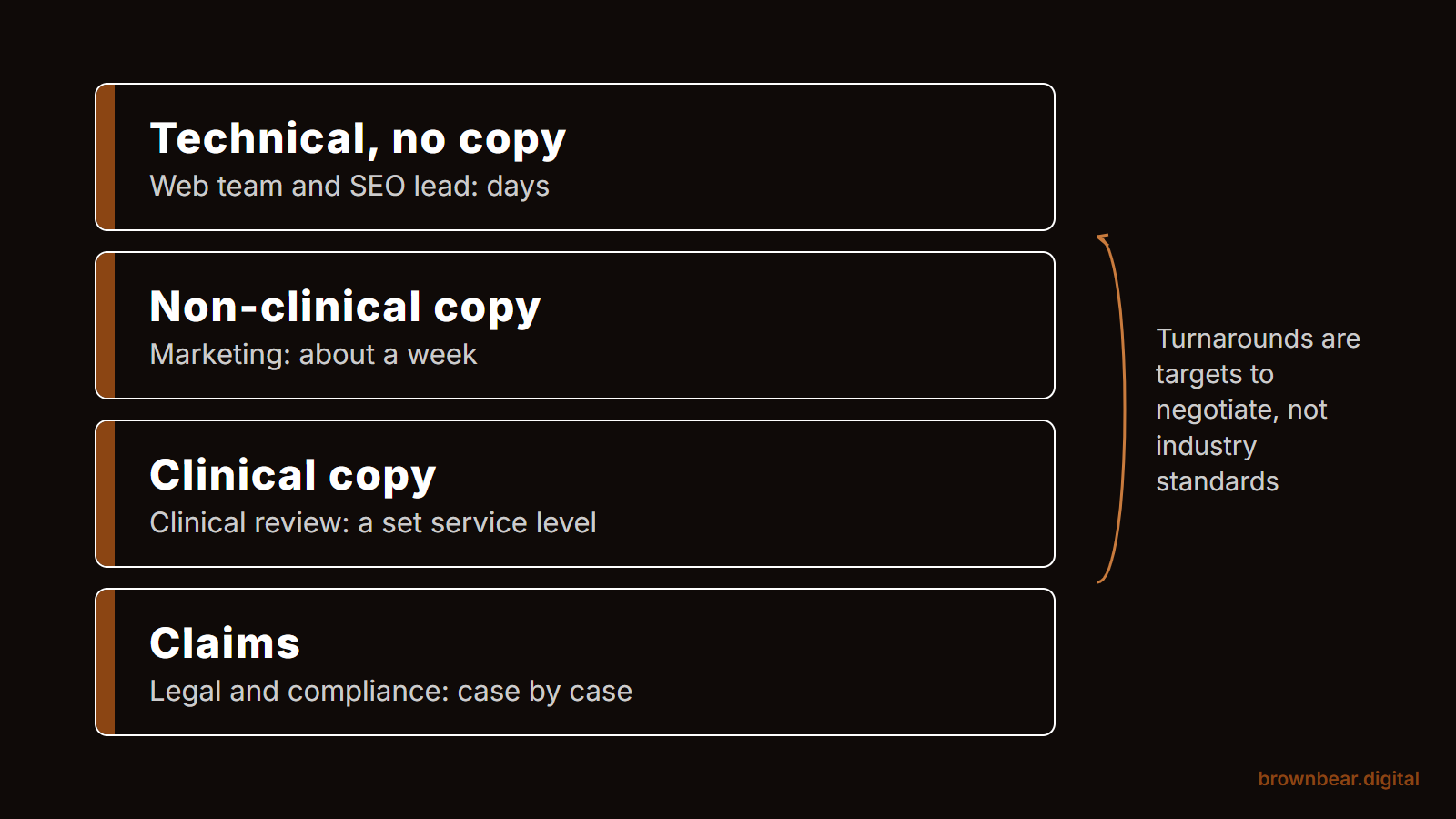
The turnarounds are starting targets to negotiate, not industry standards.
Picture a web manager with one fix: the provider title template drops the specialty, so 4,000 profiles read "Dr. Jane Smith | Health System." In a single approval queue, that change waits six weeks behind clinical review of a cancer page. Under tiers, it is a template change with no clinical copy, it ships in days, and 4,000 pages gain the specialty and city in their titles at once.
At enterprise scale the template is the unit of change, so treat template approvals as their own tier. Bryan ran SEO at that scale as Principal of SEO and AI Search at QuickBooks and as Senior SEO Content Manager at Shutterfly, where one template change reaches thousands of pages at once.
How to Measure Hospital SEO So Finance Believes It
Report hospital SEO by service line and by location, in the units the business already plans in. Rankings and total sessions are supporting evidence, not the headline.
| Metric | Why it matters |
|---|---|
| Organic entrances to each service line's pages | Ties search to the lines finance budgets for |
| Provider profile entrances and booking clicks | Shows whether the directory converts, not just ranks |
| Calls, direction requests and website clicks per Business Profile | Location-level demand, straight from Google |
| Booking and request starts from organic search | The closest privacy-safe proxy for new patients |
| Indexed profiles compared with the active provider roster | Catches departed doctors still indexed and new ones missing |
| Referral sessions from ChatGPT, Perplexity, Gemini and Copilot | AI search demand, small today and worth trending |
That last row is worth watching early. In Brown Bear's practice client work, Bryan has seen referral traffic from AI tools convert at a higher rate than other channels, because the patient often arrives after narrowing the choice inside one conversation.
Hospital SEO for Health Systems and Provider Groups
Hospital SEO serves any organization whose patients search for services, doctors and places at the same time. Before picking a path, consider how many hospitals sit under one domain and whether your clinics compete with private practices for the same searches.
For health systems running one directory across several regions
Kaiser Permanente's robots.txt disallows its Northern California physician folder, while Southern California physician profiles fill its sitemaps. Cleveland Clinic's sitemap lists provider URLs that redirect to a separate subdomain. Neither is necessarily wrong, but both show how regional and platform decisions pile up in a large directory. Audit the directory region by region and brand by brand, and give one team the authority to set the profile template, URL pattern and removal rule for all of them.
For hospital-owned provider groups competing with private practices
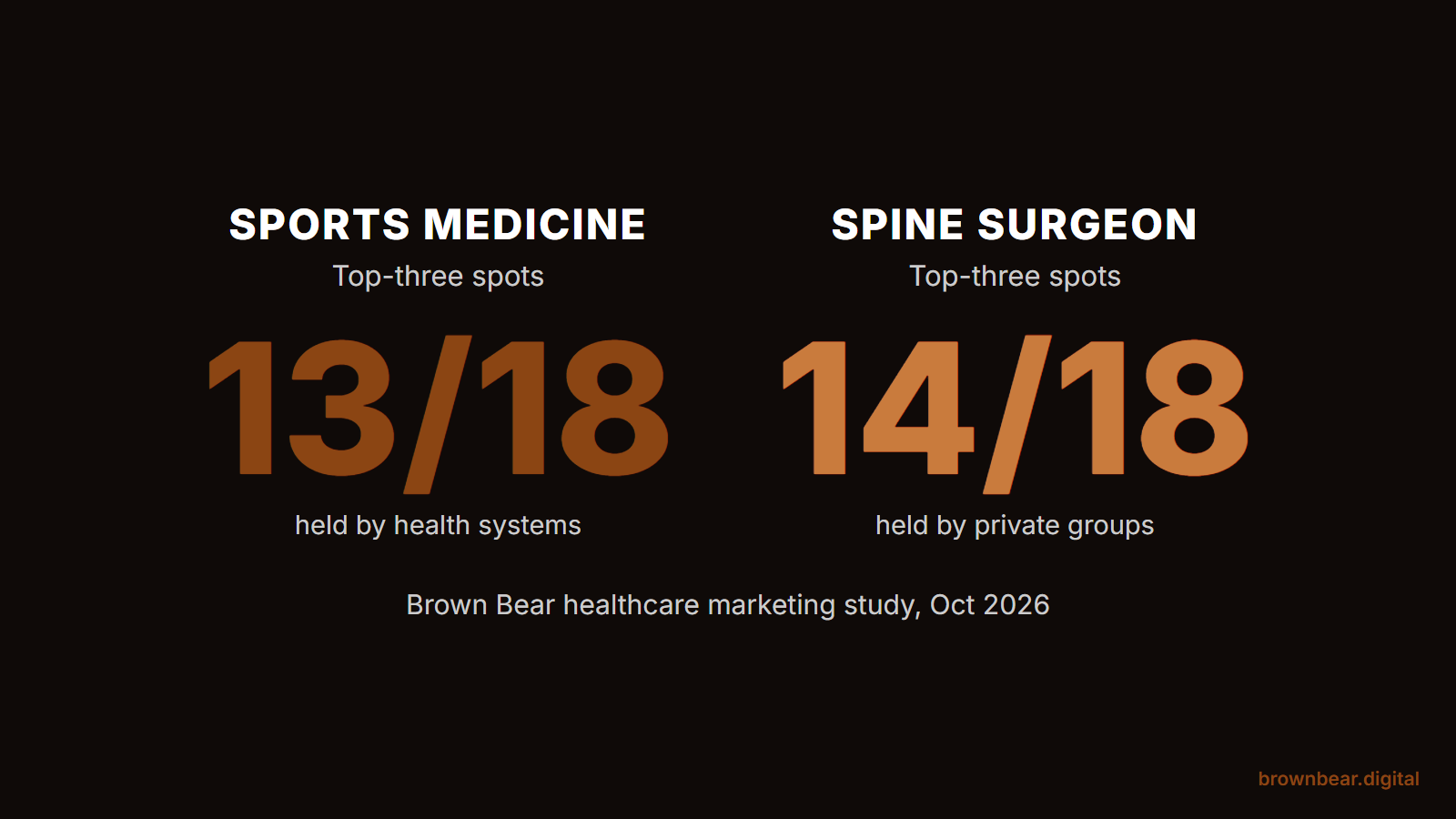
In Brown Bear's October 2026 study, health systems held 13 of 18 top-three spots on sports medicine searches, while private groups held 14 of 18 on spine surgeon searches. The same specialty split into a lane the hospitals owned and one they did not. A hospital-owned group should find that split in its own markets, then build clinic-level location pages and practitioner listings for the subspecialties private groups currently own. The system's domain strength helps, but the clinic page still has to beat a practice page on that neighborhood search.
Hiring a Hospital SEO Agency or Building the Team In-House
Semrush shows about 320 monthly US searches for "hospital seo company" and 260 for "hospital seo agency," so plenty of teams are weighing outside help. The deciding factor is who controls the CMS and the directory. If your web team owns both and ships weekly, hire for strategy and technical audits and keep execution in-house. If every change needs an IT ticket, an agency that writes the tickets, specs the templates and sits in the approval meetings is worth more than one that only sends reports.
Ask any agency these four questions:
- Show us how you would audit our provider directory, and what you would fix first.
- How do you work inside clinical and legal review without stalling?
- What do you need from IT, credentialing and the EHR team, and when?
- How will you report results by service line and location?
If you have just inherited hospital SEO on your own, start smaller: connect Search Console and analytics, crawl the site, score one provider profile with the scorecard above, and inventory every Google Business Profile. That week of work will show you where the first quarter should go.
Planning Hospital SEO? Talk to Brown Bear
Brown Bear works with medical practices on SEO and AI search, and brings enterprise SEO experience from QuickBooks and Shutterfly to sites with thousands of templated pages. If your team is weighing a directory audit, a service-line build or an AI crawler review, we can scope a hospital SEO program around the approvals you already have.
Written By
Founder, Brown Bear Digital
Bryan has 15 years of experience across SEO, paid search, and AI search strategy. He founded Brown Bear to give businesses direct access to senior-level search expertise without the agency overhead.
Learn More About BryanGet Found on Google.
Get Cited by AI.
Tell us about your site. We'll send back a proposal for SEO and AI search.