Med Spa SEO: How to Rank Injectables and Memberships When Every Spa Says the Same Thing
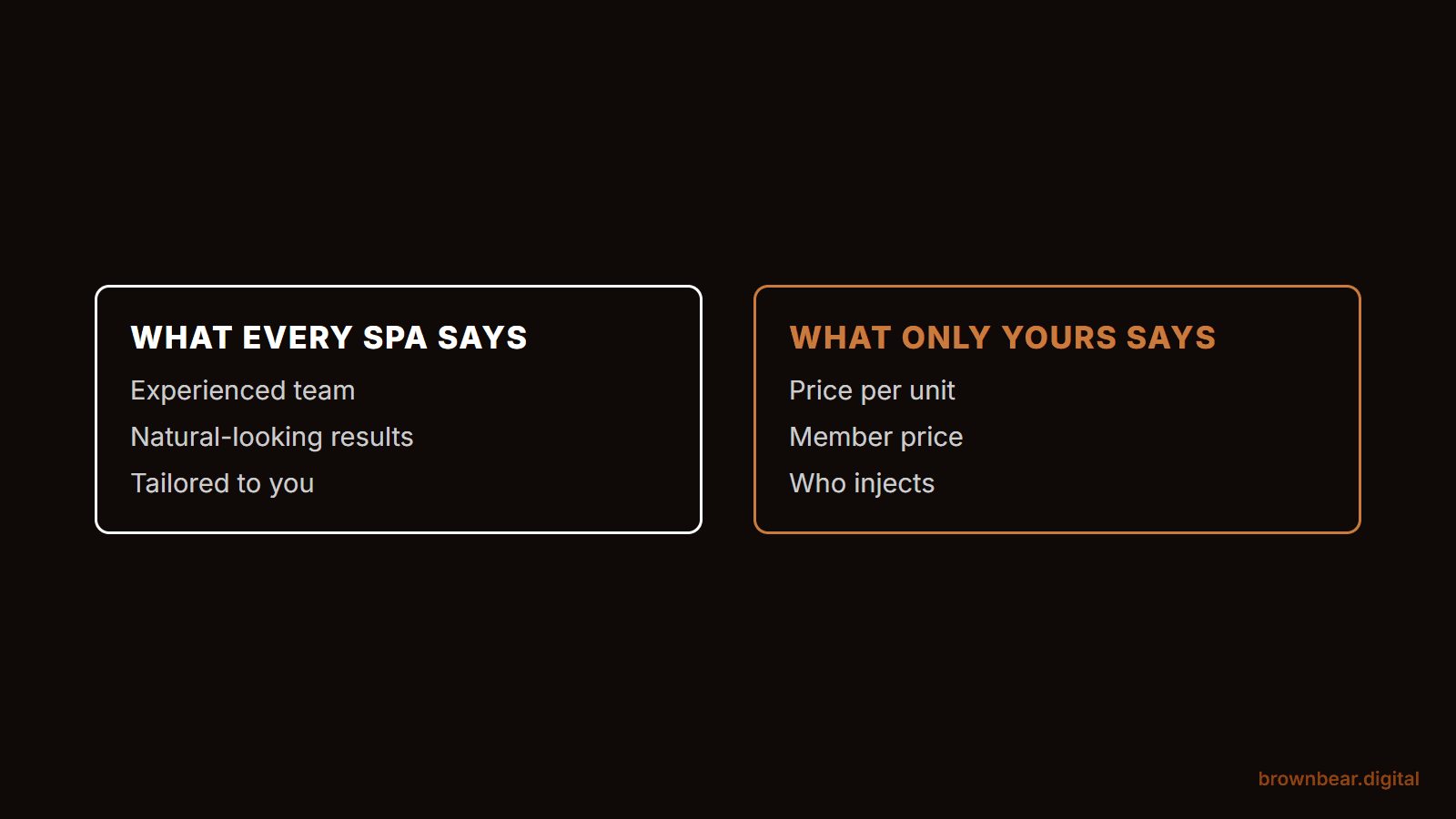
Open the Botox page of any five med spas in one city and you will read the same page five times. Experienced team, natural-looking results, a relaxing space, a treatment tailored to you. Most spas' pages say the same thing, so search engines and AI answers fall back on whatever is different: a price, a name, a credential, a review, a membership rate. This is Brown Bear's guide to med spa SEO, written for the spa that wants to be the different one.
It draws on how Bryan Passanisi, founder of Brown Bear Digital, works on search and AI visibility for plastic surgery and aesthetic practices, read against Google's own Business Profile guidelines and what live search results showed in October 2026. Where a point is our own client observation rather than published research, we say so.
Med spa SEO here covers both the independent spa and the spa that sits inside or beside a plastic surgery practice, which is where most of the confusing questions live: one website or two, one Business Profile or two, and which page should rank for "Botox" in your city.
If you own an independent med spa, you have probably paid for SEO that looked like everyone else's and want to know what actually moves bookings. If you are a surgeon whose practice runs an aesthetics arm, you need the spa to grow without muddling the surgical brand. And if you manage marketing for both, you need a setup that keeps reviews, calls and reports clean on each side.
By the end you will know how to set up your site and profiles, how to write treatment and membership pages that only your spa could have written, how to collect reviews without breaking a policy, and what to track. The longer payoff is a spa that search results and AI answers can quote with confidence, because the facts they need are on your pages.
We cover it in four parts: the setup decisions, the pages, the reviews and outside sources, and measurement. Start with what patients actually search.
What Med Spa SEO Is, and Why Treatment Searches Decide It
Med spa SEO is the work of getting a medical spa found in Google, Google Maps and AI assistants when people search for the treatments it offers. Patients rarely search for "med spa". They search for a treatment and a place: "Botox near me", "lip filler Austin", "how much is laser hair removal in Tampa". So med spa SEO is mostly local SEO, built one treatment at a time.
The field is crowded. The American Med Spa Association counted 10,488 med spas in the US in 2023, up from 8,899 a year earlier, with average revenue of $1,398,833 per spa, in its 2024 State of the Industry summary. The same summary found 73% of patients were repeat patients. That split shapes the work: search wins the first visit, and memberships and rebooking win the rest.
Where patients look is also shifting. In BrightLocal's 2026 Local Consumer Review Survey, the share of US consumers using ChatGPT or other AI tools to find local business recommendations rose from 6% to 45% in a year. The survey covers local businesses in general, not med spas specifically, but treatment questions are exactly the kind people now ask an assistant.
Bryan's read from Brown Bear's plastic surgery work is that big authority sites now take the broad treatment questions, the "what is" and "is it safe" searches, while local and cost questions stay open to practices. For a med spa, that means the winnable searches are the ones with your city or a price in them. That is where the rest of this guide points.
Same Website or Separate Site When the Spa Sits Inside a Surgery Practice
If your spa is a standalone business, skip to the next section. If it shares an owner, a building or a brand with a plastic surgery or dermatology practice, the first decision is whether it lives on the practice's website or its own. The right answer depends on how the two businesses present themselves.
- The spa is part of the practice brand. "Dr. Lee Plastic Surgery" offers Botox and fillers under the same name. Keep one website with a distinct aesthetics section, such as /med-spa/ with a page per treatment. The surgical pages and the spa pages share one domain's authority and link to each other naturally.
- The spa has its own name and identity, but the same owner. "Willow Aesthetics" runs next door to "Dr. Lee Plastic Surgery". Either structure can work. One domain with a clearly branded spa section keeps authority together; a separate domain keeps the spa brand clean but starts from zero.
- The spa may be sold, franchised or run by a separate operator. Give it its own domain. Untangling a shared site later is a migration nobody wants.
Brown Bear's default for the second case is one domain with a distinct, branded spa section, unless there is a business reason to keep the spa apart. The reason is the patient path. Today's injectable patient can be next year's surgical consult, and a site that links "Botox for forehead lines" to "brow lift" keeps that journey on your pages.
Picture a practice in Austin whose spa and surgeons both publish a page on forehead lines: the spa's Botox page and the surgeons' brow lift page. Both target "forehead lines Austin" and both stall on page 2, because Google cannot tell which one the practice wants to rank. The fix is one page per intent. The Botox page owns the injectable searches, the brow lift page owns the surgical ones, and each links to the other as the next step. Whatever structure you choose, give every treatment exactly one page that is meant to rank for it. The local SEO playbook for the surgical side covers the procedure pages in more depth.
Google Business Profile for a Med Spa: One Profile or Two
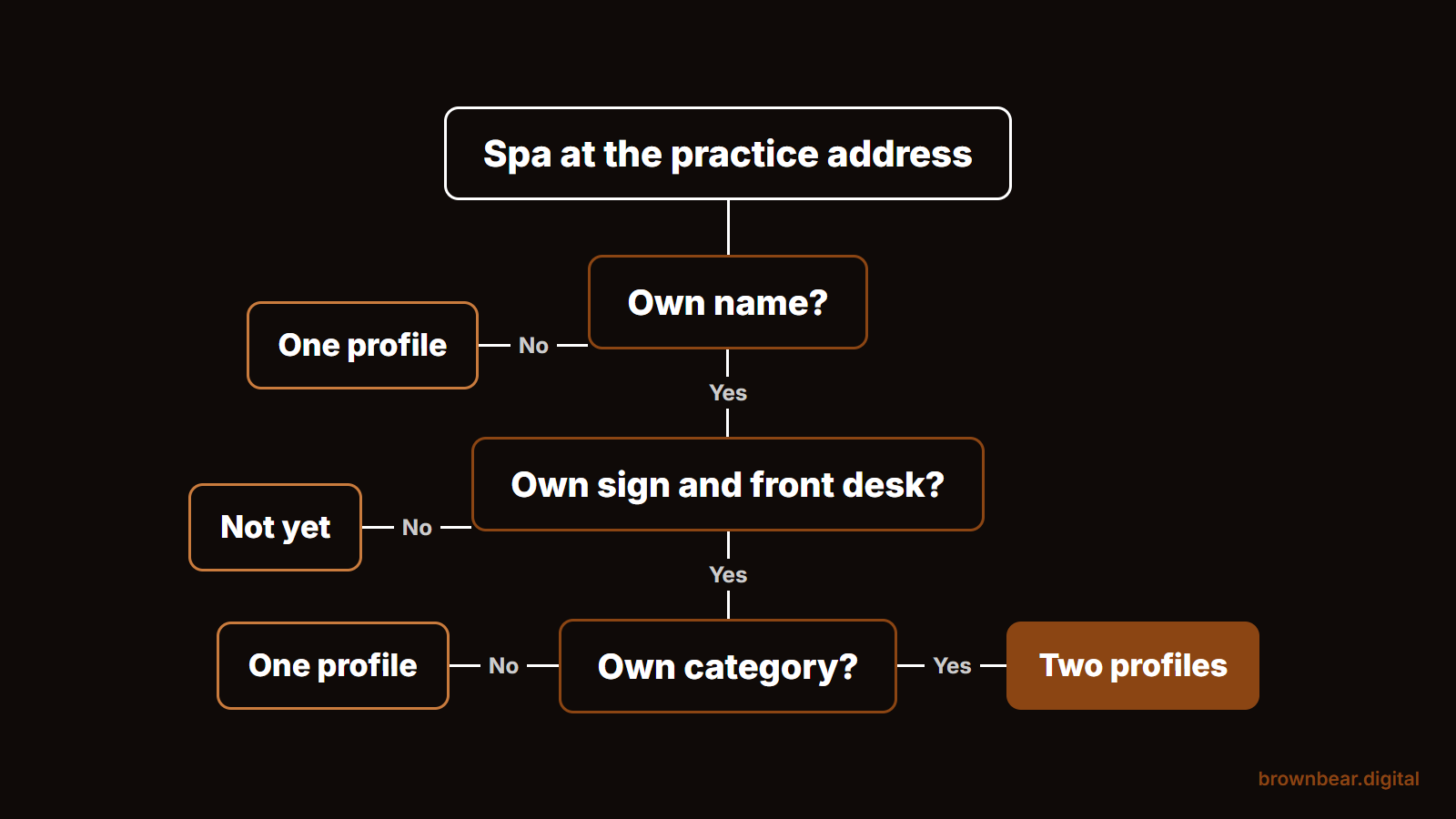
A standalone med spa needs one Business Profile, set up carefully. A spa that shares an address with a surgery practice can have its own profile only when it works as its own business. Google's Business Profile guidelines are specific about this, and most of the bad advice on the subject ignores them.
Four lines in the guidelines decide it:
- Two brands at one address. Google says not to combine brand names into one profile, and that "if the brands operate independently, you may use a separate profile for each brand at this location."
- Departments. Public-facing departments that operate as distinct entities "should have their own page", with a name different from the main business. Google adds that such departments "typically" have a separate customer entrance and "should each have distinct categories".
- Signage. Businesses showing an address "should maintain permanent fixed signage of their business name at the address."
- Categories. Do not use categories that belong to "a business physically contained within your business". The surgical profile should not borrow the spa's category, and the spa should not borrow the surgeon's.
Categories carry more weight than most owners expect. Google lets you choose one primary category and up to 9 additional ones, and asks you to pick what the business is, not what it has. The med spa category is usually listed as "Medical spa"; confirm the exact wording in the category picker, since Google does not publish its list. On the Local Search Forum, one med spa owner found their profile ranking for "dermatologist" in their city. The advice they got was to cut the categories back to the med spa category and remove dermatology language from the site, because getting Google to stop showing a profile for a specific search is very hard. Category choices are easy to make and slow to undo.
Two more rules matter to spas. Health and beauty businesses can add a booking button and a list of services with descriptions, so list every treatment there. The Products feature is different: Google excludes pharmaceuticals and medical devices from it, so do not list Botox or filler brands as products. The deeper configuration work, from attributes to photos, is in our guide to Google Business Profile setup for surgical practices.
Treatment Pages That Pass the Swap Test
A treatment page ranks and gets quoted when it says things only your spa could say. The quickest way to check yours is what we call the Swap Test: paste a competitor's name over yours on the page and read it again. If every sentence is still true, the page says what every spa says, and search engines have no reason to prefer it.
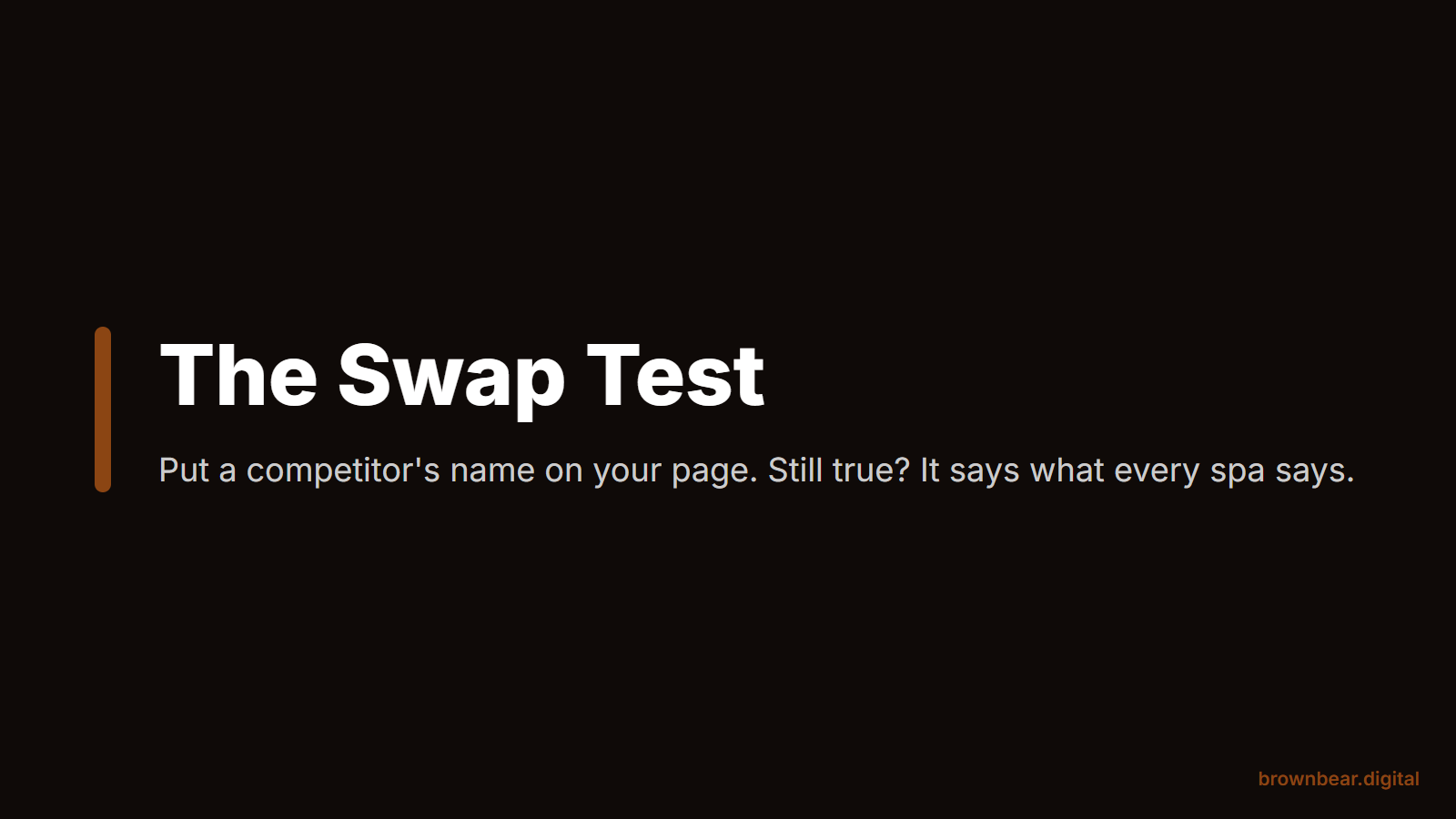
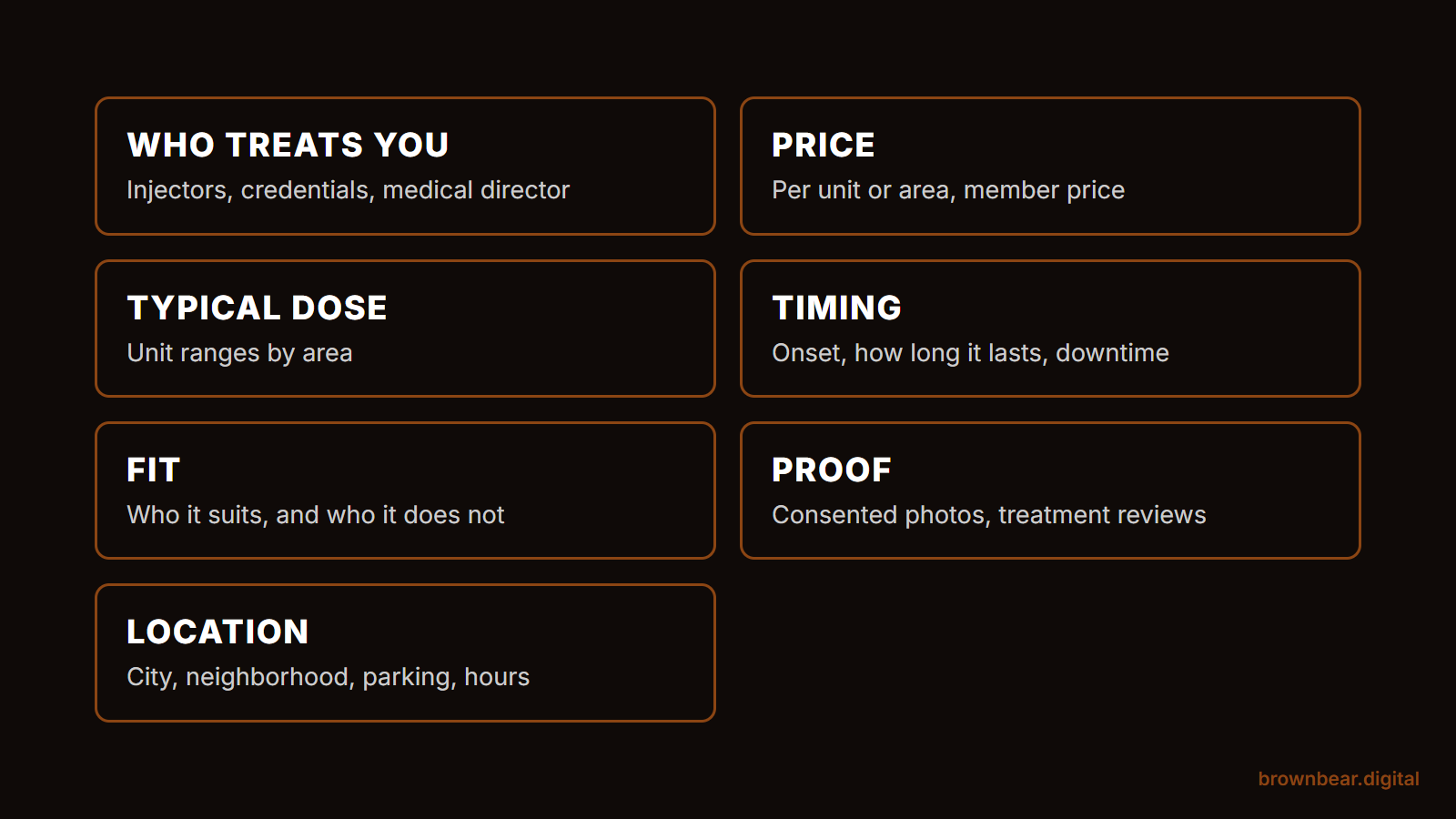
The sentences that survive the swap are facts. Prices, unit ranges, who does the injecting, how long results take, what members pay. Those are also the details patients ask AI assistants about, which is why they matter twice. Here is what a strong injectable page carries:
| Element | What to write | Why it matters |
|---|---|---|
| Who treats you | Injector names, credentials and the medical director | Treatments are medical, and credentials are the first thing a careful patient checks |
| Price | Per-unit or per-area price, member price, what is included | Cost questions are the most winnable searches and the ones AI answers quote |
| Typical dose | Unit ranges by area, as your injectors actually use them | Lets a patient estimate a total before booking |
| Timing | When results show, how long they last, downtime | Common follow-up questions in search and in AI chats |
| Fit | Who the treatment suits and who should consider something else | Answers "is it right for me" and links to the next treatment or procedure |
| Proof | Before-and-after photos with written consent, and reviews that mention the treatment | Shows the result and the experience |
| Location | Your city and neighborhood, parking, hours | Ties the page to treatment plus city searches |
One branching question comes up on every injectables site: one page for "neurotoxins" or one per brand, such as Botox, Dysport and Daxxify. If people in your area search the brand names, give each brand its own page and link them from a comparison page. If they don't, one strong page with a comparison table beats three thin ones. Your keyword data decides it, not habit.
Run your own page through the test below.
Membership Pages Are Ranking Pages
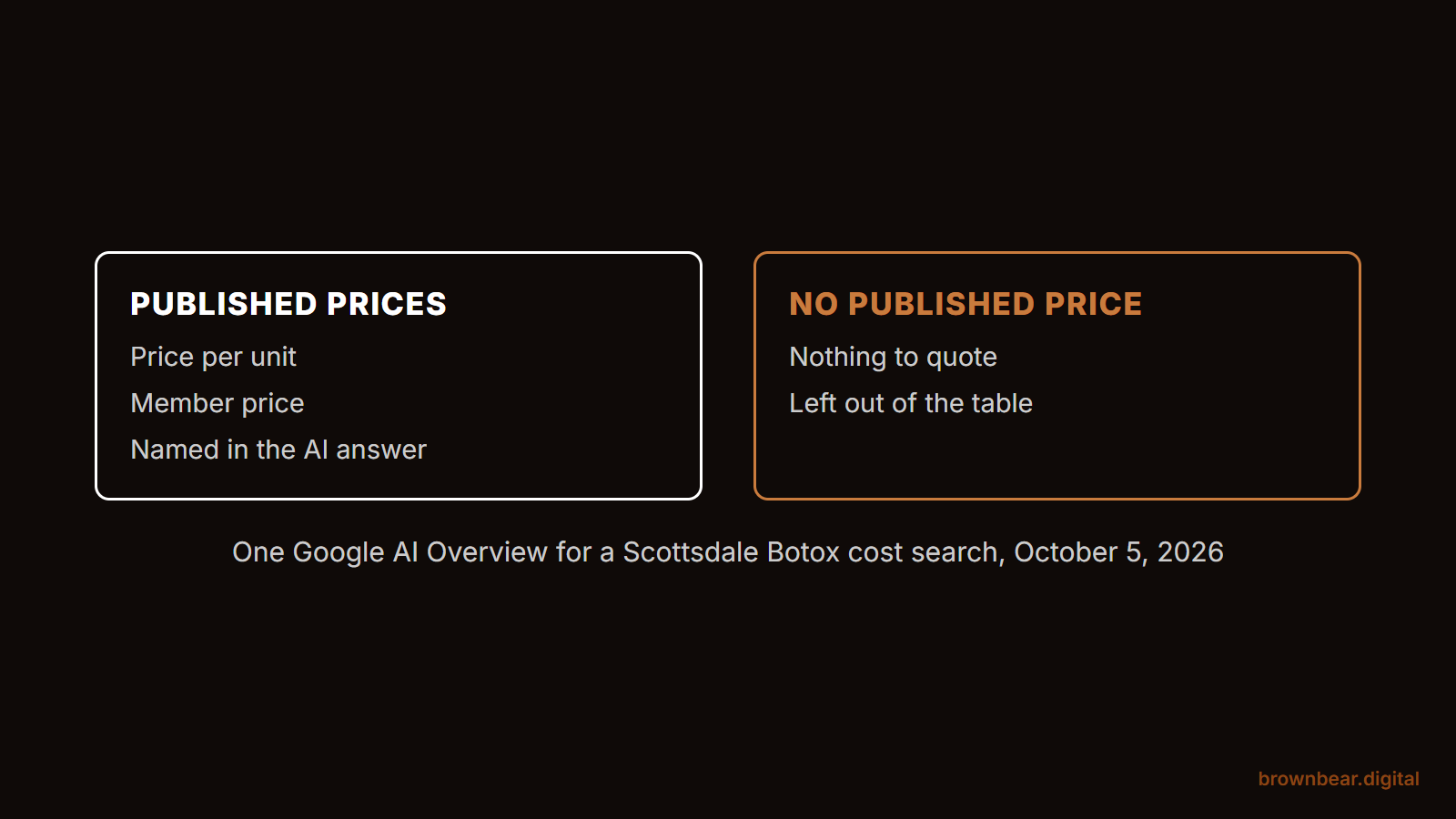
Most spas treat the membership page as a sales flyer. Search treats it as an answer. When we searched "how much does botox cost in scottsdale" on October 5, 2026, Google's AI Overview built a price table of eight local providers with a column for member pricing, drawn from the spas' own pages. That was one search on one day, and AI answers change, but the pattern is clear: the spas named in the answer were the ones that published a per-unit price and a member price. The answer then added a section on saving money through Allergan's Allē rewards program and spa memberships.
A membership page that can be quoted has:
- The monthly fee and exactly what it buys, in units, credits or treatments.
- The member price per unit next to the standard price.
- Who it suits, for example someone treating forehead and frown lines every three to four months.
- The terms: minimum commitment, rollover, cancellation.
- Links to every treatment the membership covers, and links back from each of those pages.
If you would rather not publish prices, that is a business choice, and a reasonable one in some markets. Know the trade: the answer to a cost question will be built from the spas that did.
Reviews and the Third-Party Sites AI Reads
Reviews decide both the map pack and the AI answer. In the BrightLocal 2026 survey, 97% of consumers read reviews for local businesses, 74% care most about reviews from the last three months, and 89% expect owners to respond. A steady flow of recent reviews beats a big pile of old ones.
The rules on asking are stricter than many spas realize:
- Google prohibits offering incentives such as discounts or free services for reviews, and prohibits merchants from discouraging negative reviews or "selectively solicit[ing] positive reviews from customers". Asking only happy clients breaks Google's policy.
- The FTC's rule on consumer reviews, in effect since October 21, 2024, bans fake reviews and incentives that are conditioned on a positive review. Civil penalties can reach $53,088 per violation for knowing violations.
- HIPAA applies to your replies. Health practices have paid to settle complaints over review responses that confirmed patient details: Manasa Health Center $30,000 in 2023 for replies to Google reviews, and Elite Dental Associates $10,000 in 2019 for replies on Yelp. Never confirm that a reviewer is a patient.
The safe system is simple: ask every client, by text or email, shortly after the visit, with a direct link and no reward. Our guides cover HIPAA-safe review responses and the details that make a patient review useful in depth.
Reviews on your own profile are half of it. Bryan's observation from Brown Bear's AI visibility work is that owners are most surprised by how much third-party sites, such as review platforms, directories like RealSelf and local press, drive what AI assistants say about them. The most common error those audits find is small: odd variations of the practice's name, address or phone number across those sites. For a spa that shares an address with a practice, those variations multiply fast. Keep one exact version of each business's details and use it everywhere.
Local Pages That Win Treatment Plus City Searches
Treatment plus city searches are won by your treatment pages and your profile first, and by location pages only where you really have a location. Google's spam policy calls out "having multiple domain names or pages targeted at specific regions or cities that funnel users to one page" as doorway abuse. A page per suburb with the city name swapped in is exactly that.
What works instead:
- One page per real location, with its own address, hours, injectors, photos and reviews.
- Your city and neighborhood written into each treatment page naturally, alongside the facts that make the page yours.
- Cost and comparison content for your market, such as what lip filler costs in your city and what drives the range.
Imagine a spa in Nashville that draws clients from Franklin, twenty minutes south. A thin "Botox in Franklin" page will not hold up. A page about the Franklin clients who make the drive, which treatments they come for and how scheduling works for them can, because it has something to say. If you run more than one spa, the structure for location pages for practices with several offices applies directly.
Where AI Sends Treatment Queries
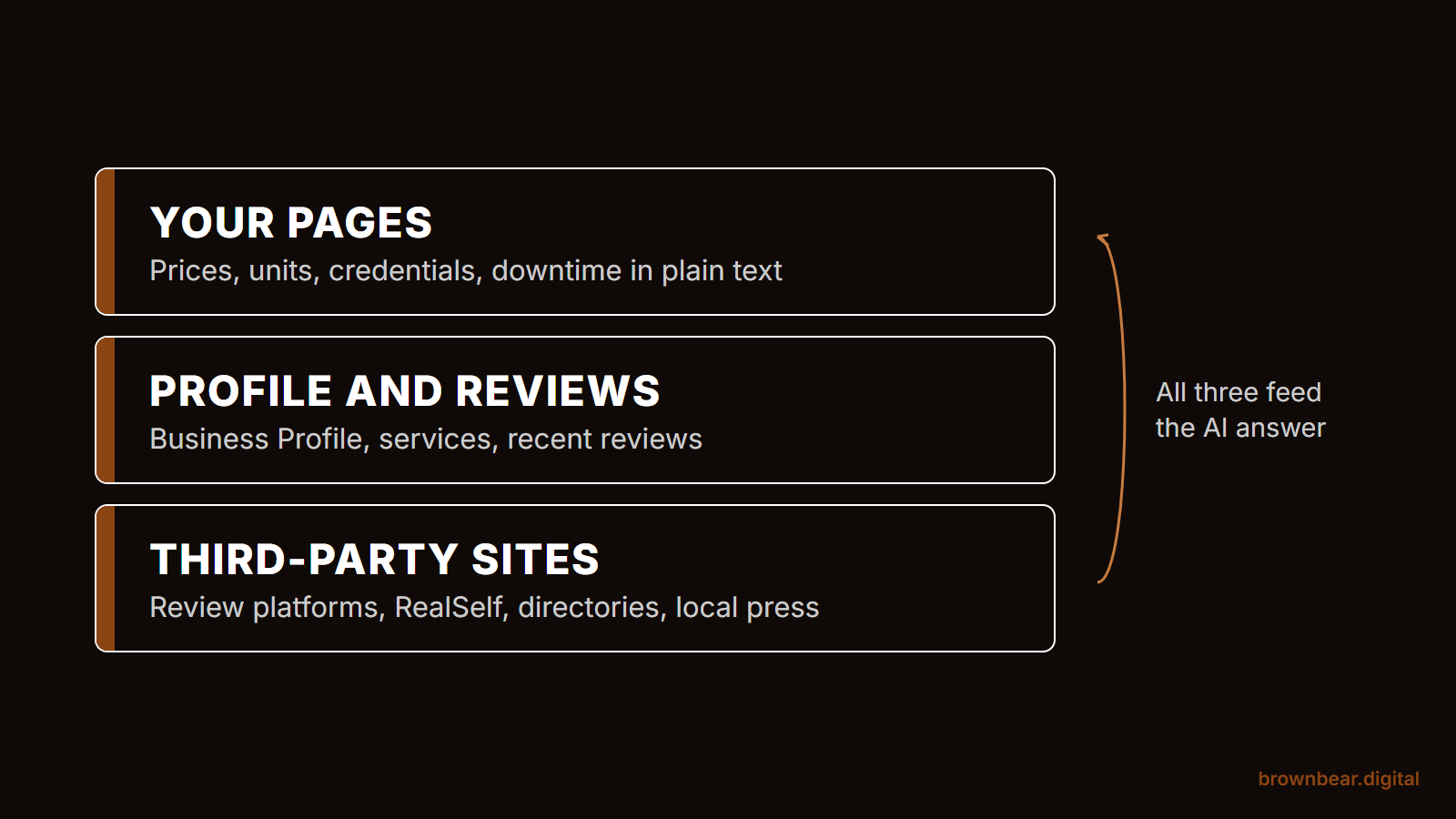
AI answers for treatments pull from three places: your own pages, your Business Profile and reviews, and third-party sites that talk about you. The Scottsdale price answer above drew on spa pricing pages and a plastic surgery practice's page. Even the AI Overview for "med spa seo" itself, checked the same day, laid out a five-part plan led by the Business Profile and treatment pages, and cited agency and software blogs plus a YouTube channel.
Three practical moves follow:
- Put the facts in plain text on your pages: prices, units, credentials, downtime. Text built by booking widgets or pricing apps may not reach every crawler.
- Keep your profile, your site and the big directories saying the same thing about each business.
- Earn mentions where patients compare spas: review platforms, RealSelf, local media.
Structured data helps machines read your pages, but expect less from it than vendors promise. Schema.org has no med spa type; Google's documentation says to use the most specific local business type available, and names DaySpa as an example. Bryan's view is that schema is worth tidying but is not a silver bullet for AI visibility; crawlable, clearly structured pages do more. For the full picture of what assistants read, see the sources AI assistants cite for medical practices, and for help building it, our AI search optimization for med spas.
What to Track Each Month
Rankings are a means, not the result. Track what turns into booked appointments, and track each business separately if you run a spa and a practice side by side.
- Profile actions per profile. Calls, booking clicks, website clicks and direction requests. If you use a custom booking link, Google does not report booking data for it, so tag the link and count bookings in your scheduler.
- Organic visits to each treatment page. Which treatments are gaining, and which pages are stuck.
- First visits by source. Ask at booking and record it. This is the number that pays for SEO.
- AI referrals. Visits from ChatGPT, Perplexity and similar assistants in your analytics. In our client work, visitors referred by AI assistants convert at a higher rate than other channels, which is why we report this number to clients.
- A monthly AI answer log. Ask the same five treatment and price questions each month and note whether your spa is named and whether the facts are right. One answer is an anecdote; a log is a trend.
Where to start this week:
- Decide one profile or two, using the guideline checklist above, and fix signage, names and categories to match.
- Run the Swap Test on your three biggest treatment pages and rewrite every swappable sentence into a fact.
- Publish or update your membership page with fees, member pricing and terms.
- Set up a review request that goes to every client after every visit, with no reward attached.
- Start the monthly AI answer log with five questions patients actually ask.
Get a Med Spa SEO Plan From Brown Bear
Most spas are told to blog more and wait. We start with the setup questions in this guide: the profile structure, a Swap Test of your top treatment pages and a check of what AI answers say about your spa today. If you want that plan for your spa or your practice's aesthetics arm, start with our SEO for med spas and aesthetic practices.
Written By
Founder, Brown Bear Digital
Bryan has 15 years of experience across SEO, paid search, and AI search strategy. He founded Brown Bear to give businesses direct access to senior-level search expertise without the agency overhead.
Learn More About BryanGet Found on Google.
Get Cited by AI.
Tell us about your site. We'll send back a proposal for SEO and AI search.