Orthodontist SEO: What 46 Top-Ranking Pages Show About Orthodontic SEO That Works
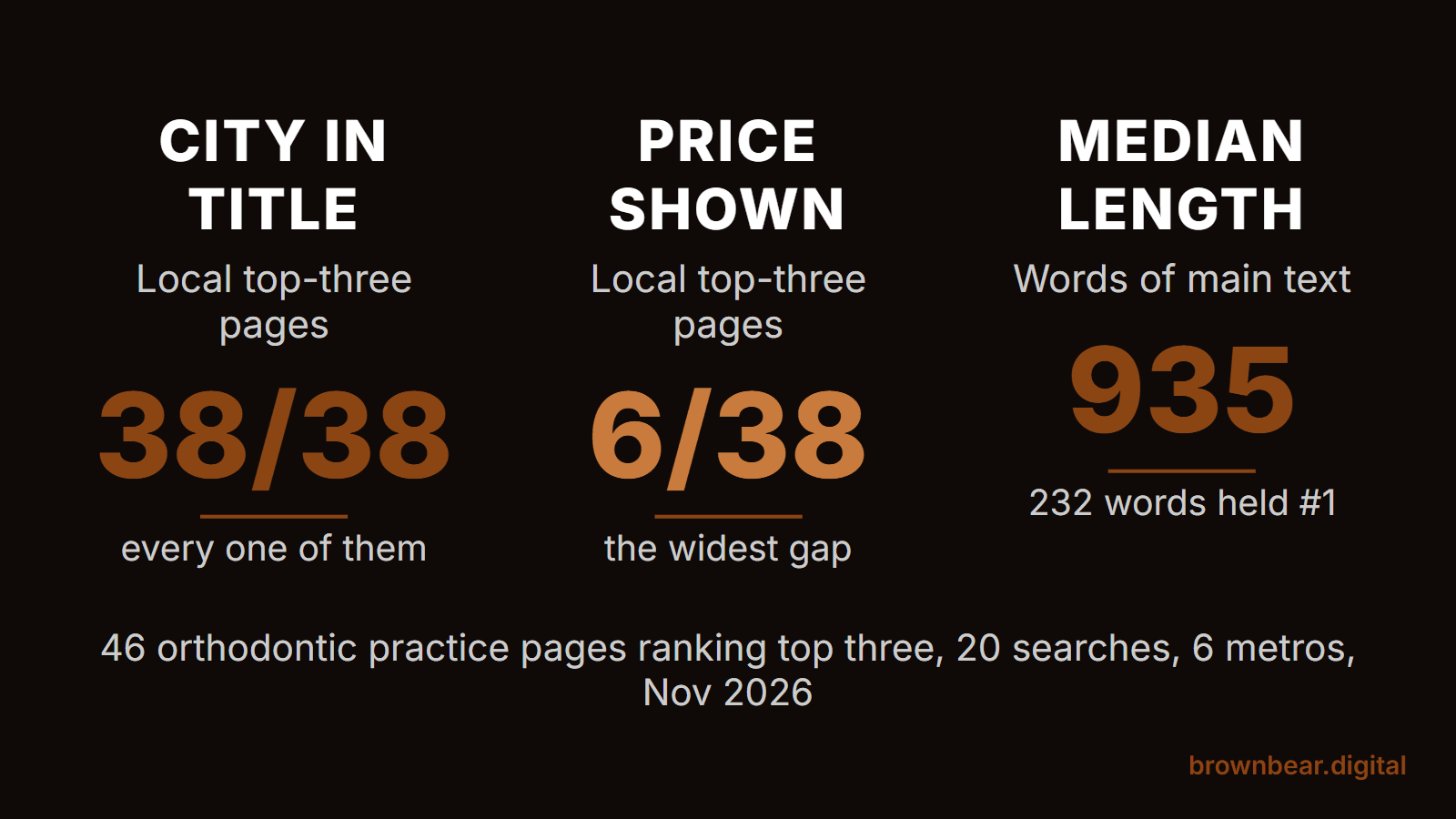
Most orthodontist SEO advice is a generic checklist that never shows what the pages already beating you look like. So we fetched every orthodontic practice page that held a top-three spot on 20 Google searches for orthodontists, Invisalign, braces and cost, and recorded what was on each one. This guide turns those 46 pages into an orthodontic SEO build plan, from keywords and page templates to schema, links and measurement.
It draws on that November 2026 page pull, the October 2026 Semrush study behind our orthodontic marketing guide, and Bryan Passanisi's SEO work for medical and aesthetic practices. It is written for orthodontists, office managers and the web teams who build their sites.
We've grouped it into four parts: what the top pages share, the keyword map and site structure, the on-page and technical build, and the plan for content, links and timing. Start with how SEO fits inside the wider marketing plan.
What Orthodontist SEO Is, and How It Fits With Orthodontic Marketing
Orthodontist SEO is the work of making an orthodontic practice's website and listings the answer Google and AI tools pick when someone searches for an orthodontist, a treatment or a price nearby. It covers the organic results, the map results that your site and profile feed, and the AI answers that quote your pages. The goal is consultation requests from searches, which become treatment starts.
Marketing is the whole plan for winning patients, and SEO is the part that compounds. Ads stop when the budget stops. A treatment page that ranks keeps working. Our orthodontic marketing guide answers who you compete with on page one, and found general dentists, not corporate groups, were the specialist's main rival on Invisalign searches. This guide answers the next question: what you should build to beat them.
The Orthodontic Page Anatomy Study: What 46 Top-Three Pages Have in Common
Every one of the 38 local practice pages that ranked top three put the city in its title. Only 6 of the 38 showed a dollar figure for treatment, and none of the 15 that ranked for "orthodontist" plus a city did. Just 21 carried structured data that described the business, and 9 had none at all. Half the top pages ran past 935 words, but a page with 232 words held #1 in Dallas.
Here is how we got those numbers. Our October 28, 2026 study read the top 10 Semrush results for 20 searches in 6 metros: "orthodontist," "invisalign" and "braces" plus Houston, Dallas, Atlanta, Phoenix, Charlotte or San Diego, and 6 national questions such as "invisalign cost" and "how much are braces." From those results we kept every practice page in the top three, 48 slots across 45 pages. Directories, an insurer, a dental school and brand sites were left out. On November 1, 2026, we fetched each page's HTML and recorded its title, main headings, word count outside the menus and footer, structured data types, and whether it showed a price, reviews, the doctor's name and credentials, a smile gallery, an FAQ, video and a booking path. Two pages failed to load, leaving 46 slots: 38 local and 8 national.
A note on limits. We read the raw HTML a crawler receives, so a page that builds its text with scripts can look empty to us. Signals like "reviews shown" were detected by matching words and widgets on the page, not by a person reading every page. And Semrush reads results without a searcher's location, so a parent in Dallas may see a slightly different page one.
We call the result the Orthodontic Page Anatomy:
| Page element | Local top-three pages with it | What to build |
|---|---|---|
| City in the page title | 38 of 38 | Non-negotiable. Every page that targets a town names it in the title. |
| State in the page title | 26 of 38 | Add it. It removes the doubt between Dallas, Texas and Dallas, Georgia. |
| "Orthodontist" or "orthodontic" in the title | 15 of 15 orthodontist results, 3 of 11 Invisalign results | Put the specialty on your treatment pages too. Most Invisalign winners left it out. |
| Booking path on the page | 35 of 38 | A booking button or form on every page, not just the contact page. |
| Doctor named on the page | 28 of 38 | Name the orthodontist on the homepage and every treatment page. |
| Reviews or testimonials shown | 27 of 38 | Show real reviews near the booking button. |
| Degree or board status shown | 23 of 38, board certification named on 13 | State the specialty training and board status in plain words. |
| Business structured data | 21 of 38, none at all on 9 | Mark up the practice as a Dentist with its address and hours. It is cheap and most skip it. |
| Smile gallery | 14 of 38 | A gallery by case type, with photo consent on file. |
| FAQ section | 11 of 38 | Answer the 4 to 6 questions patients ask on the phone. |
| A dollar figure for treatment | 6 of 38 | The widest gap on page one. Publish a price range. |
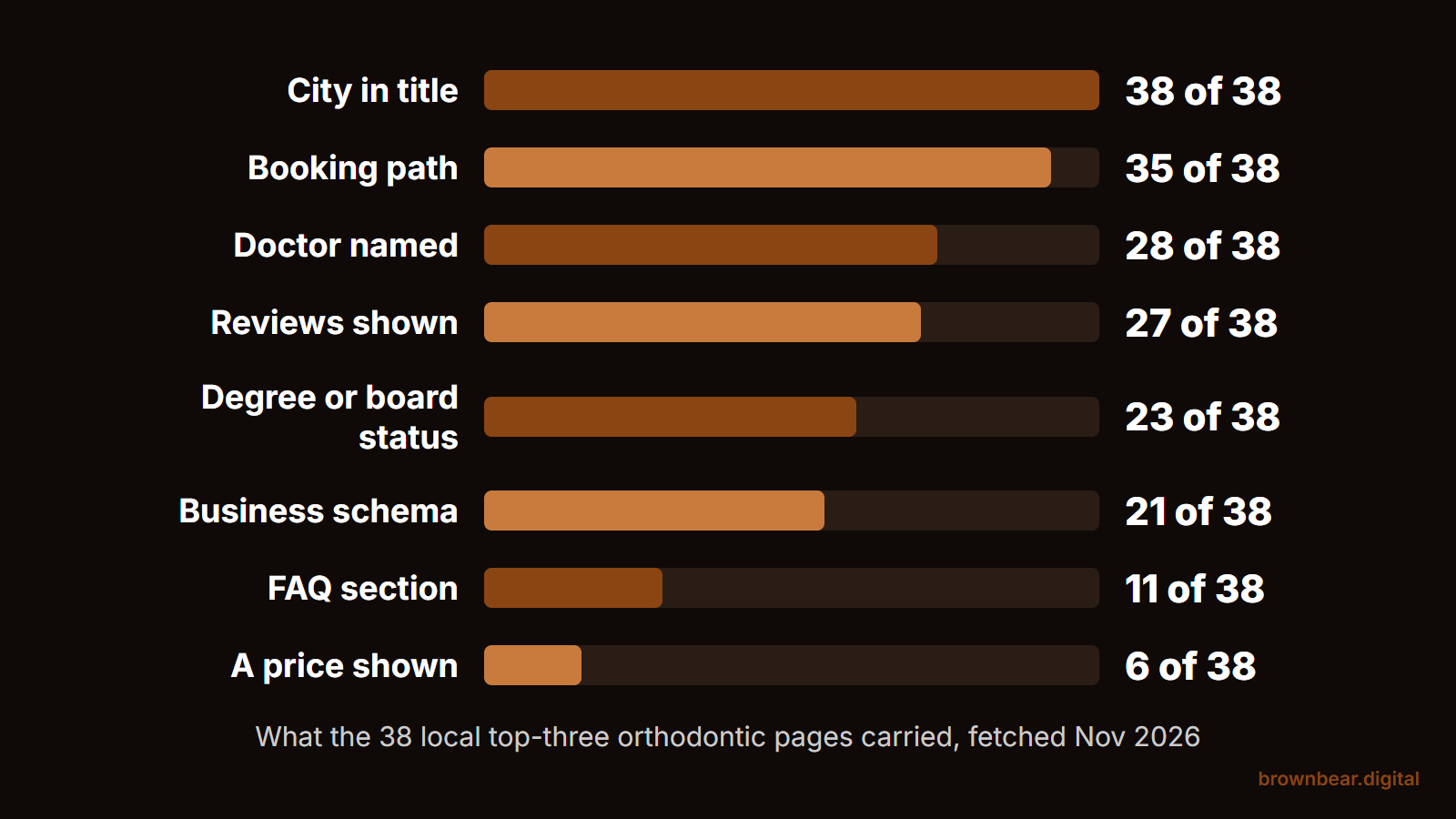
Two findings changed how we would write an orthodontic site spec. First, the basics are close to universal, so they no longer separate anyone: a city in the title, a booking path and a named doctor. You need them to be in the race. Second, the elements that would set a page apart are the ones most top pages skip: a price range, full structured data, a credentials section and an FAQ. Those are the openings.
That matches what we found reading plastic surgery pages in our procedure page ranking factors study of 101 cities. The #1 pages there shared a cheap, near-universal floor, and only 16% published real pricing. The pattern holds across specialties: clear the floor, then win on the parts competitors leave out.
The Orthodontic Keyword Universe, Sorted by the Page That Answers It
Orthodontic searches fall into five lanes, and each lane is answered by a different page on your site. Map the lane first, and the page list writes itself.
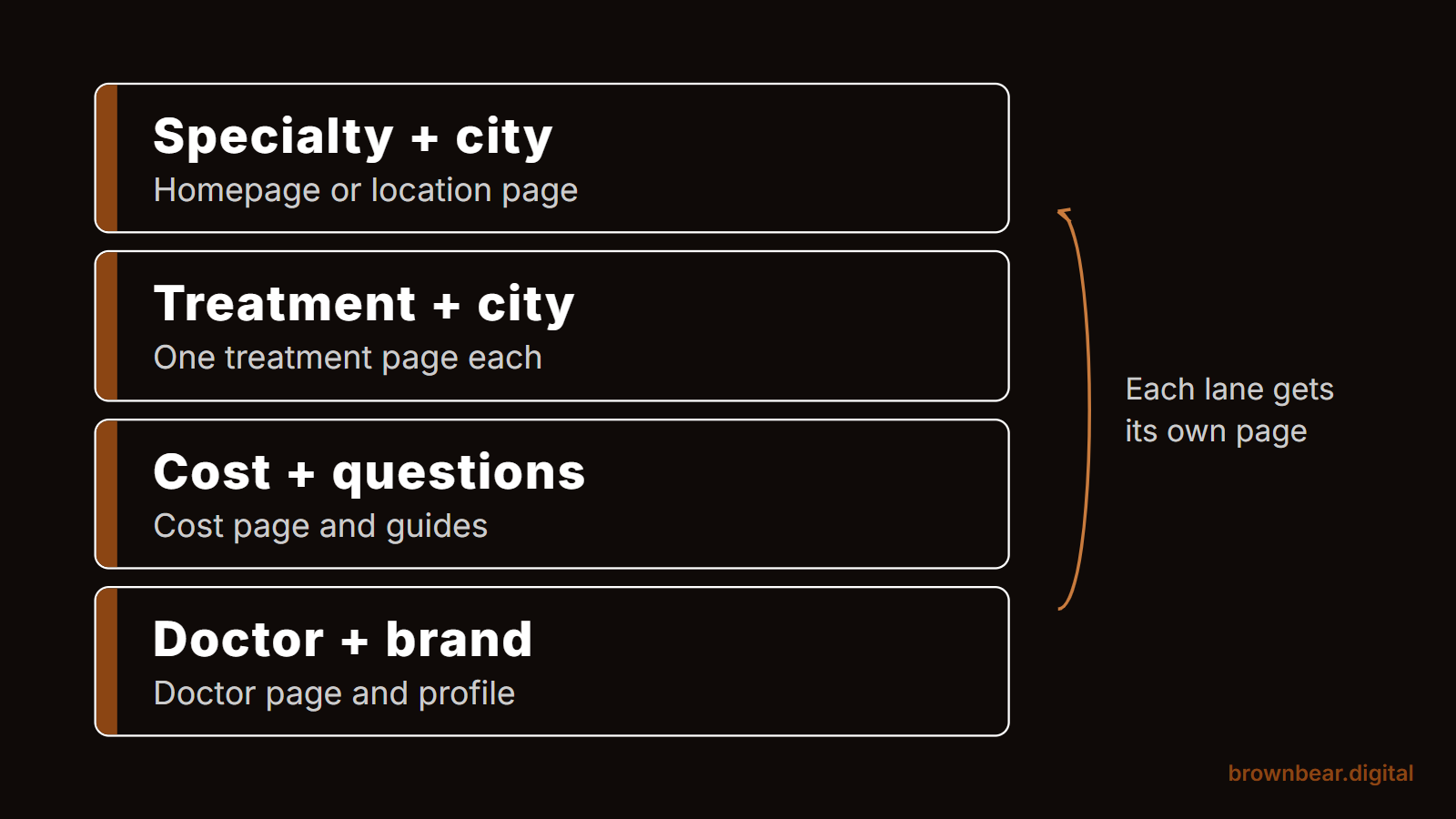
- Specialty plus place. "Orthodontist houston," "orthodontist near me," "best orthodontist in [town]." The searcher wants a practice. In our October pull, 36 of 43 independent orthodontist results for these searches were homepages, so your homepage, or each office's location page, answers this lane.
- Treatment plus place. "Invisalign atlanta," "braces dallas," "early orthodontic treatment [town]," "adult braces [town]." The searcher has picked a treatment. Treatment pages won here, and these searches are often easier: Semrush rated the Invisalign city searches at difficulty 3 to 8.
- Cost and questions. "Invisalign cost," "how much are braces," "braces for kids," "does my child need braces." This is the biggest demand in the field and it is national, so a cost page or guide answers it, ideally with your city in it.
- Doctor and brand. Your practice name, your doctor's name, "Dr. [name] reviews." Searchers here are close to booking. A doctor page and a clean Business Profile answer it.
- Referral and professional. "Orthodontist referral form [town]," searched by general dentists and their staff. Small volume, high value, and almost nobody builds for it.
Search intent decides the page, not the keyword's size. "Orthodontist dallas" and "how much are braces" may both be worth chasing, but sending both to your homepage means neither is answered well. When two searches want the same answer, they belong on one page. When they want different answers, they need two pages.
The demand inside each lane is local, so measure it by town. Pull the volume for "orthodontist," "braces" and "invisalign" plus each town you serve, and the cost questions with and without the town. Then rank the list by what a start is worth and how hard the search is, not just by volume. Our page-one ownership map shows which lanes are crowded by general dentists and directories in six metros, and the planner below turns your own towns and treatments into a page list.
Site Architecture: The Pages an Orthodontic Practice Needs
An orthodontic site that can rank across all five lanes needs six kinds of pages, linked so that each one passes weight to the others.
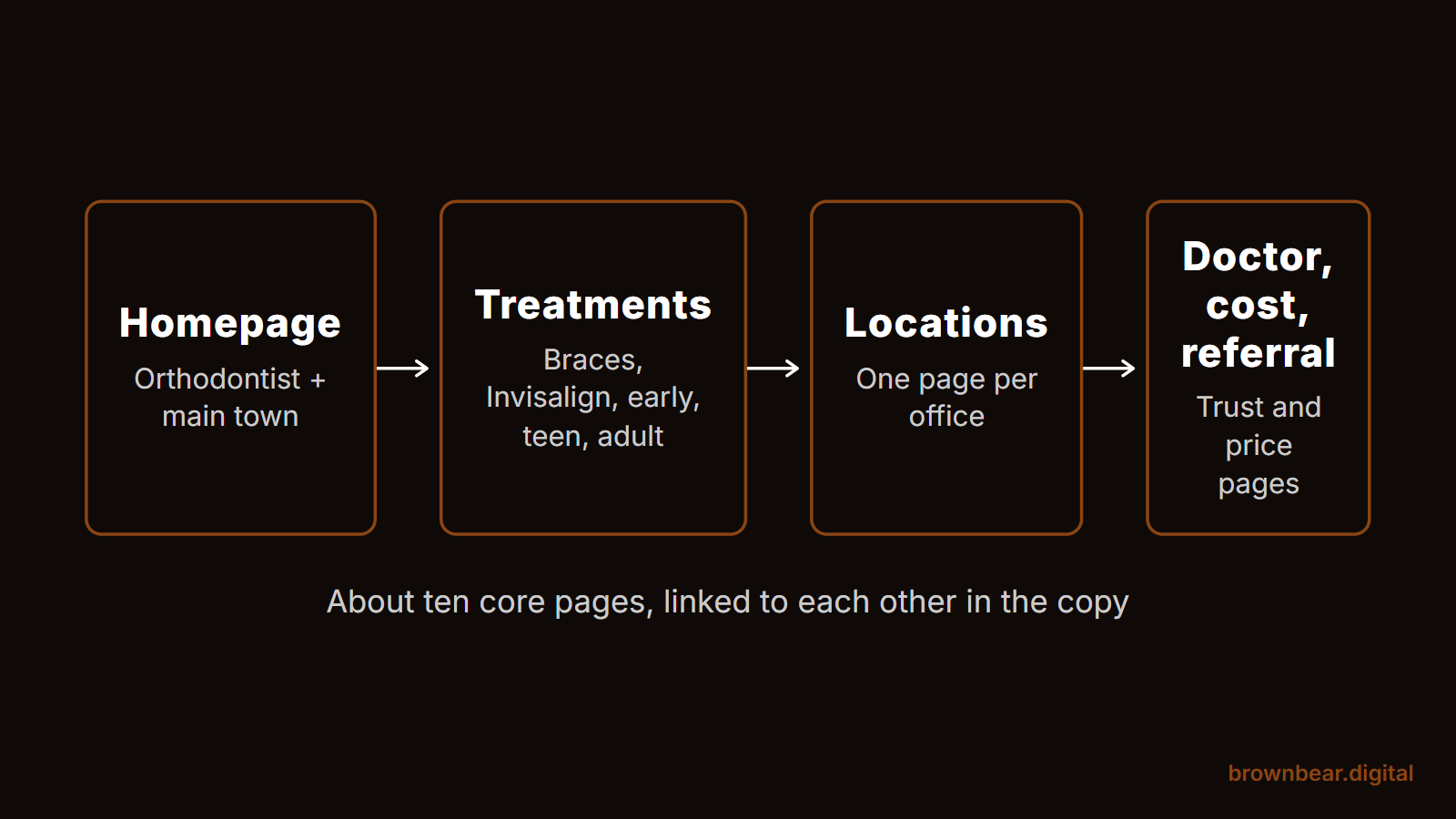
- The homepage targets "orthodontist" plus your main town. For a one-office practice, it is your most important page.
- Treatment pages, one each for braces, Invisalign or clear aligners, early treatment, teen treatment and adult treatment. Add others you do often, such as lingual braces or surgical cases.
- Location pages, one per office, each with its own address, hours, phone number, directions, doctor and map. A practice with one office does not need these.
- Doctor pages, one per orthodontist, with training, board status and the cases they treat most.
- A cost page that gives your typical ranges for braces and aligners, what moves a case up or down, insurance and payment plans.
- A referral page for general dentists: how to send a case, what you send back and how fast.
Keep the addresses short and stable: /invisalign/, /braces/, /locations/plano/, /dr-lee/, /cost/. Once a page ranks, its address should not change. If you are moving to a new site, map every old address to its new one first. Our checklist for moving a site without losing rankings walks through it.
Link the pages to each other in the copy, not only in the menu. The homepage links to every treatment page. Each treatment page links to the cost page and to the doctor who does the work. Each location page links to the treatments offered at that office. Those in-copy links tell Google which page is the authority on which subject.
Picture a two-office practice in the Dallas suburbs whose site has a homepage, an "About" page and one "Services" page listing braces, Invisalign and early treatment in three paragraphs. It ranks for its own name and little else. The fix is not more blog posts. It is five treatment pages, two location pages, a doctor page and a cost page, each built to answer one lane. That is about ten pages, and it is the core of the whole program.
Page Templates That Match What Ranks
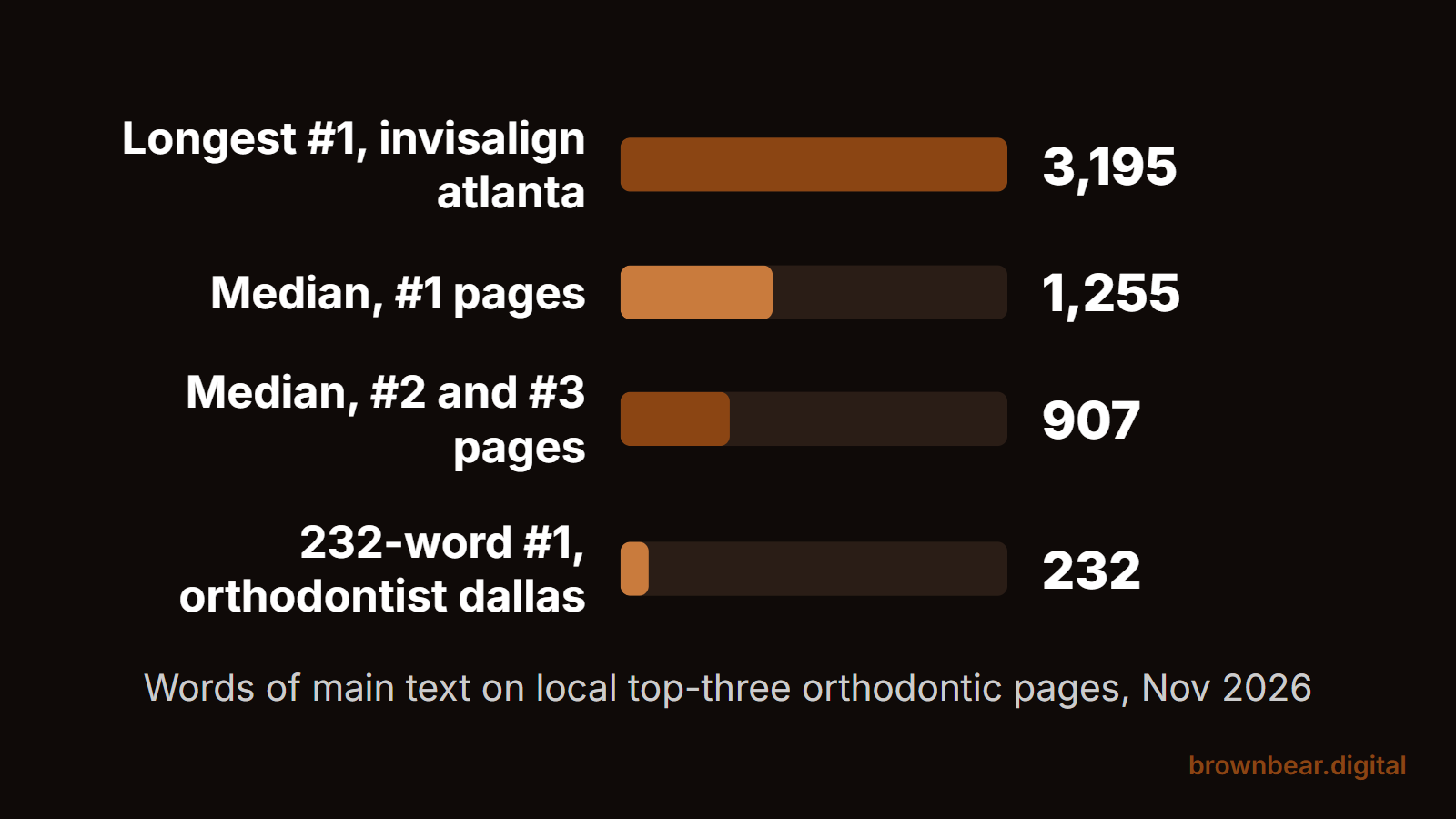
The top pages were not long for the sake of it. Local top-three pages had a median of 935 words, and 18 of 38 ran past 1,000. The #1 pages ran a median of 1,255 words against 907 for #2 and #3. But length was not a gate. A 232-word homepage held #1 for "orthodontist dallas," and an Invisalign page with 3,195 words held #1 in Atlanta. Write enough to answer the questions on the page, then stop.
Here is what each template should carry, in order from the top of the page.
Homepage, or an office's location page:
- A title and first heading that say "Orthodontist" with the city and state.
- The doctor's name, specialty training and board status in the first screen.
- The treatments offered, each linking to its own page.
- Reviews, the booking button and the phone number together.
- Insurance, payment plans and the price range one click away.
- The address, hours and a map, written as text, not only inside an image.
Treatment page:
- A title with the treatment, the city and state, and the word "orthodontist."
- Who the treatment suits, and who should consider something else.
- What a specialist adds, stated plainly. Under the ADA's code of ethics, only dentists who meet the specialty's education standards may announce themselves as specialists, so the word is yours.
- How long treatment usually takes, how often visits happen and what changes the plan.
- A price range and what moves it, with a link to the cost page.
- Cases of this type from your gallery, labeled as individual results.
- 4 to 6 questions patients ask about this treatment, then the booking button.
Doctor page:
name and degrees, residency program, board status, memberships, years in practice, the cases this doctor treats most, a photo, and reviews that name the doctor. This page carries the trust that Google looks for on health topics. Orthodontic care is health care, so Google holds it to its higher standard for health and money pages.
Only 13 of the 38 local top-three pages named board certification, and 23 showed a degree or board status at all. A specialist who has passed the American Board of Orthodontics exam and says so on every page holds a signal most competitors leave out. If you are board certified, put it in the first screen.
Titles, Headings and On-Page Copy for Orthodontists
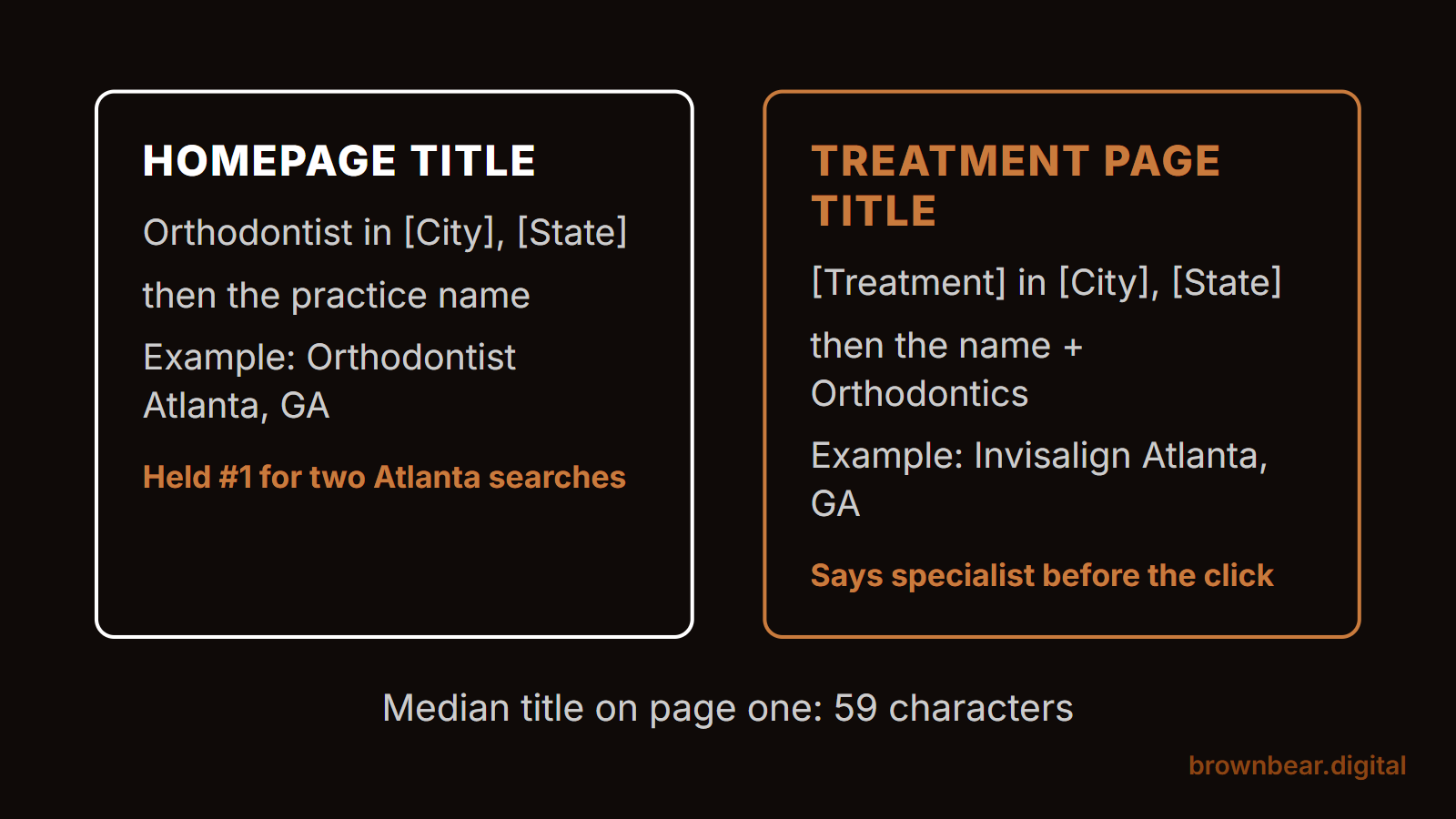
Titles were the most consistent element on page one. Every local top-three page named its city, 26 of 38 named the state, and the median title ran 59 characters, short enough to fit in most results without being cut off. The pattern that won the "orthodontist" searches put the specialty and the city first and the practice name last: "Orthodontist Atlanta, GA | Buckhead Orthodontics" held #1 for both "orthodontist atlanta" and "braces atlanta."
Use two title formulas and keep them consistent across the site:
- Homepage or location page: Orthodontist in [City], [State] | [Practice Name]
- Treatment page: [Treatment] in [City], [State] | [Practice Name] Orthodontics
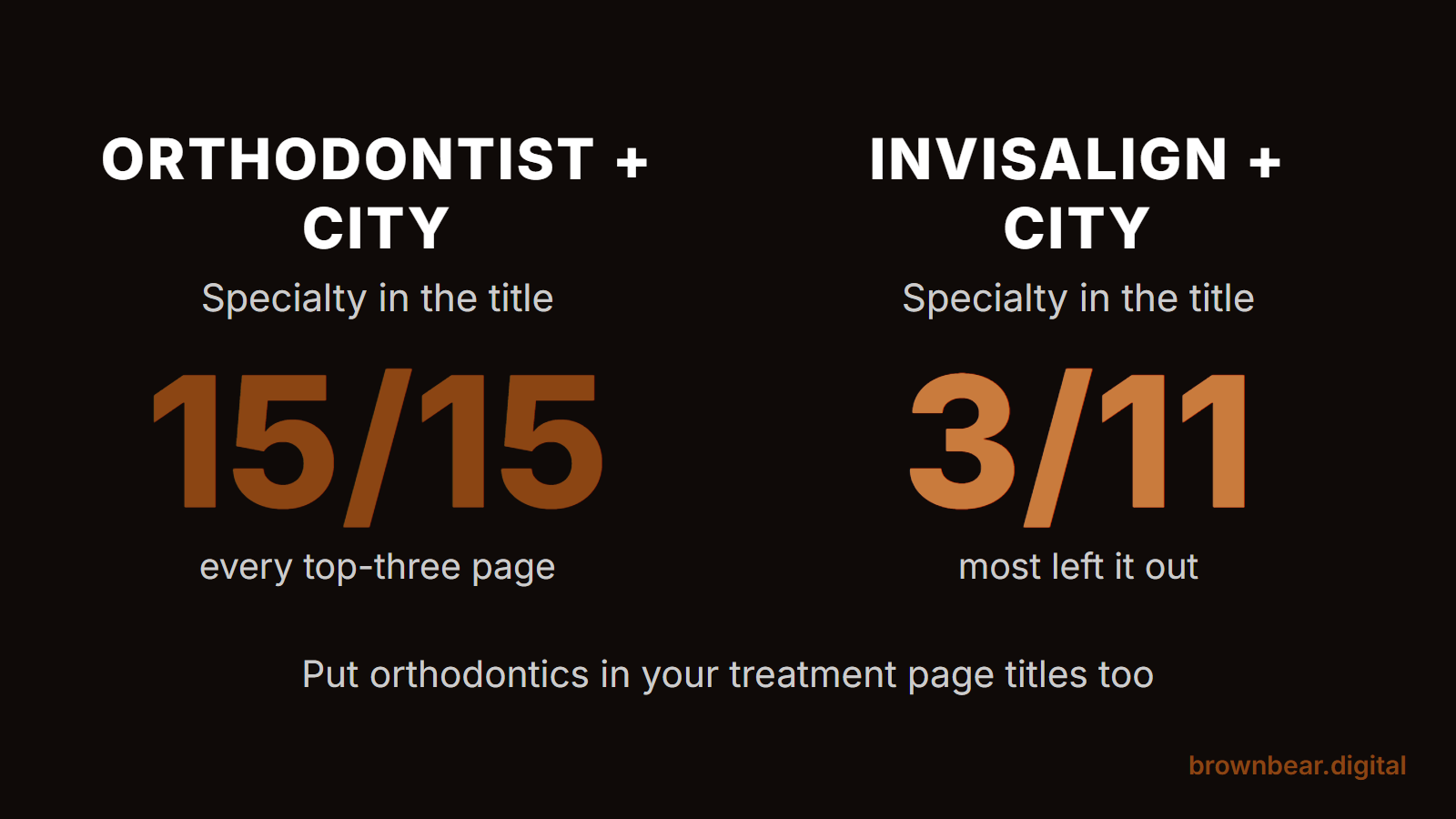
The treatment formula closes the gap we found on Invisalign searches. All 15 pages that ranked top three for "orthodontist" plus a city had the specialty in the title. On the Invisalign searches, only 3 of 11 did. That is partly because general dentists held many of those spots, but several orthodontists' Invisalign pages also left the word out. A title that says "Invisalign in Phoenix, AZ" and "Orthodontics" tells a searcher who is comparing a dentist and a specialist which one you are before they click.
The first heading on the page matters less than the title, but it is still where most top pages missed. Only 24 of 38 local top-three pages named the city in their main heading. Several used a welcome line instead, such as "Welcome to" plus the practice name. A heading like "Orthodontist in Plano, TX" or "Invisalign in Plano" does the same job as the title for the searcher who has already clicked.
For the copy itself, lead each section with the answer, then the detail. Use the words patients use: "braces for adults," "clear aligners," "overbite," "gap teeth." Mention the neighborhoods and nearby towns you serve in sentences, not in a block of keywords at the bottom of the page. And keep your claims to what your own cases show.
Schema for Orthodontic Practices
Structured data, also called schema, is code that tells search engines what a page describes: a business, a person, a set of questions. On page one it was more often missing than present. Only 21 of 38 local top-three pages marked up the practice as a business, 9 had no structured data of any kind, and 6 carried only the generic page markup a WordPress plugin adds by default.
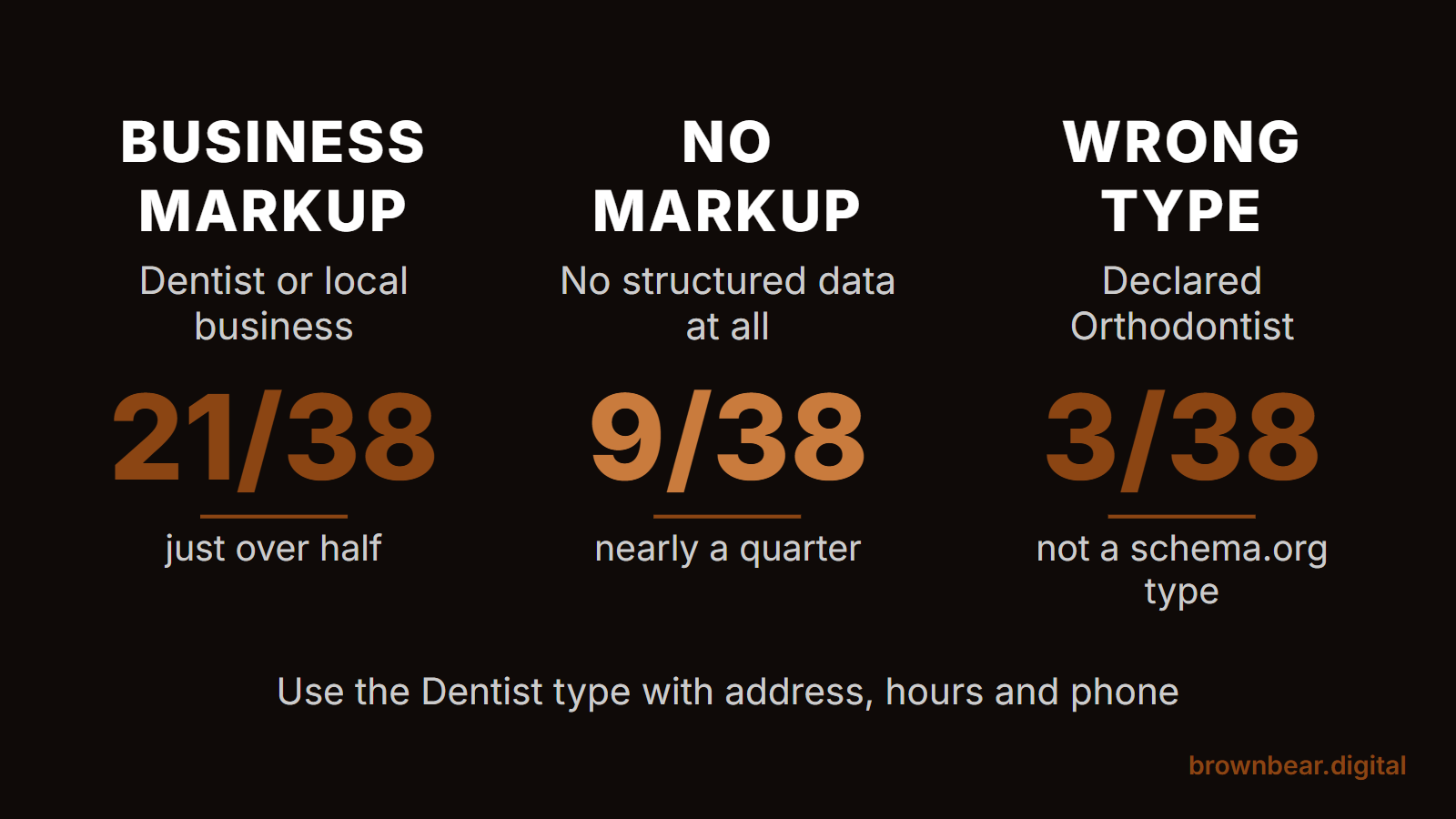
One finding is worth checking on your own site. Three of the top pages declared their business type as "Orthodontist." Schema.org, the shared vocabulary search engines read, has no Orthodontist type. Its closest fit is Dentist, which counts as a medical business and a local business at the same time. A type that does not exist is most likely ignored, so those three pages get little from their markup.
Here is the markup worth having on an orthodontic site:
- Dentist on the homepage and each location page, with the practice name, address, phone, hours, geo coordinates and a link to the Business Profile.
- Person on each doctor page, with the doctor's name, job title, degrees and the practice they work for.
- BreadcrumbList sitewide, so the page's place in the site is clear.
Two common add-ons do less than agencies suggest. Google said in August 2023 that FAQ rich results "will only be shown for well-known, authoritative government and health websites," so FAQ markup on a practice page rarely earns the dropdown in results anymore. And review stars you mark up about your own business on your own site generally do not show as stars in Google results. Keep the FAQ itself on the page for readers. It is the markup that does little.
Bryan's view, from AI search audits on medical sites, is that schema is worth keeping clean but is rarely the deciding lever. Crawlable pages that answer the question in their first lines matter more. Use the page anatomy scorer later in this guide to check where a page stands.
Technical SEO for Orthodontic Websites
A technically sound orthodontic site loads fast on a phone, shows its main text in the HTML it sends, and has one address for every page. Most of the top pages passed. One did not, and it still held #1.
The page that ranked #1 for "orthodontist houston" returned almost nothing in its raw HTML: a title, structured data and an empty container that a script fills in after the page loads. Google runs scripts before it indexes a page, so it sees the full site. Many AI crawlers do not. Vercel's December 2024 analysis of AI crawler traffic found that "none of the major AI crawlers currently render JavaScript," including the crawlers from OpenAI, Anthropic and Perplexity. To those tools, that #1 page is close to blank.
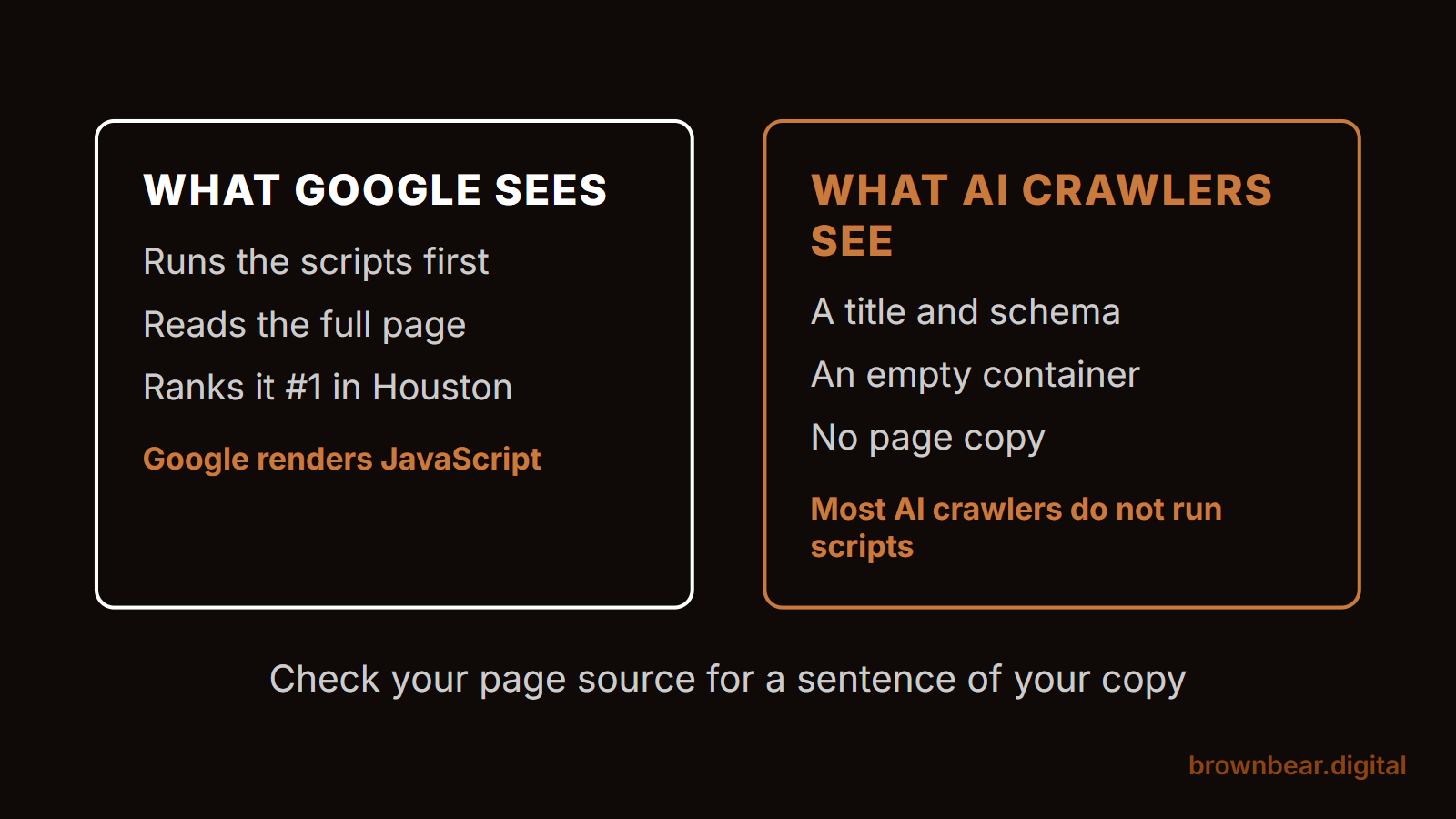
So check what your own site sends before scripts run. Open a page, view the source, and search for a sentence from your copy. If it is not there, ask your web team to render the main text on the server. Our study of JavaScript on practice homepages found the same problem across many medical sites, and our guide to rendering problems on practice websites covers the fixes.
The rest of the technical list is short:
- One address per page. Pick www or no www and redirect the other. Add a canonical tag that points each page to itself.
- Speed on a phone. Compress the before and after photos, which are usually the heaviest files on an orthodontic site, and drop sliders that load ten large images at once.
- Text, not images, for the facts. Address, hours, prices and the doctor's credentials belong in the page text, where crawlers can read them.
- The right town. Name the city and state on every location page. In our October pull, an office in Dallas, Georgia ranked #6 for "orthodontist dallas."
- Index only what should rank. Keep thank-you pages, patient forms and duplicate location pages out of the index.
An Orthodontic Content Plan for the First Year
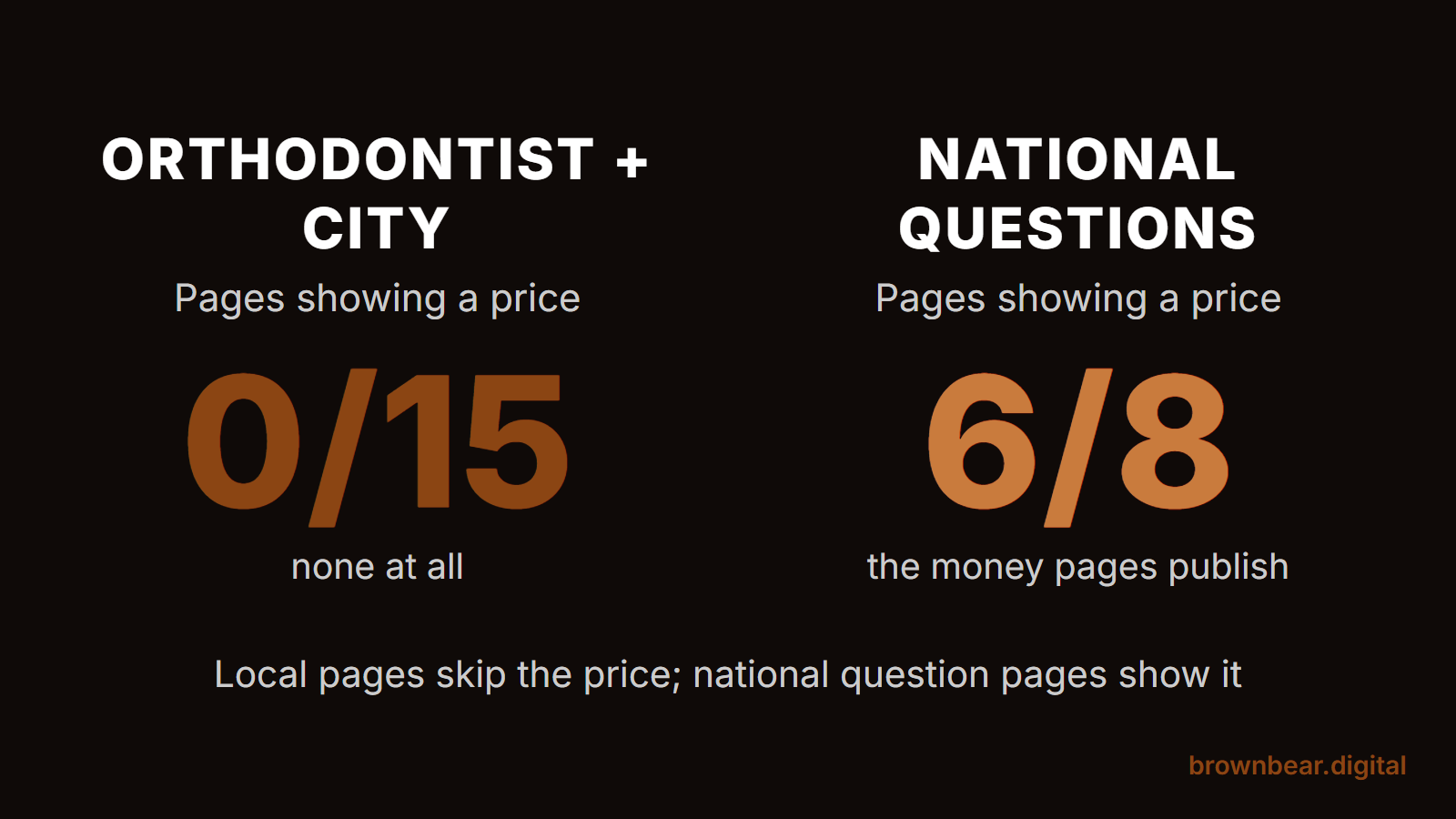
Once the core pages exist, content should fill the lanes the core pages cannot. The first gap to fill is price. Only 6 of the 38 local top-three pages showed a dollar figure, and none of the 15 that ranked for "orthodontist" plus a city did. On the six national questions, such as "invisalign cost" and "braces for adults," 6 of the 8 practice pages in the top three showed one. The pages that win the money questions publish numbers.
A content plan for the first year, in order:
- Months 1 to 3: the cost page, then one page per audience: early treatment for parents of young children, teen treatment and adult treatment. Our marketing guide explains how parents and adults search differently.
- Months 4 to 6: comparison pages patients search before they pick: braces or Invisalign, Invisalign or other aligners, what a specialist does that a general dentist may not.
- Months 7 to 12: answers to the questions your front desk hears every week, one page each: whether insurance covers braces, what age to start, what happens if a teen loses aligners, how retainers work. Each one links to the treatment page it supports.
Write from the chair, not from a keyword tool. A page in which the orthodontist explains why they told one parent "not yet" is more useful than another page that defines malocclusion. It is also harder to copy, and it gives AI tools a local, specific answer to quote. Every page should have a reason to exist that a patient would recognize.
Links, Citations and Local Signals for Orthodontists
Links tell Google that other sites vouch for yours, and listings tell it where you are. For an orthodontic practice, the best links come from places you already have a relationship with.
- Professional directories. Make sure your listing is complete in the AAO's Find an Orthodontist locator if you are a member, and in the American Board of Orthodontics locator if you are board certified.
- Referring dentists. Many general dentists keep a page of specialists they refer to. Ask to be listed, with a link to your referral page.
- Your community. School sports sponsorships, local news about a free screening day, and chamber of commerce listings all bring local links.
- Your cost page and guides. A clear local cost page is the content other sites link to when they write about braces in your area.
Keep your name, address and phone number identical everywhere: Google, Apple, Bing, Yelp, insurer directories and your site. In Bryan's AI visibility audits, small variations in those three details are the most common real error he finds, and the easiest to fix. Orthodontic practices pick them up after a move, a second office or a sale.
Your Google Business Profile carries the map results and leans on your site. Our marketing guide covers how to set up the profile and earn reviews inside the rules, and what goes into a useful review is in our anatomy of a great patient review. For SEO, the link between the two is simple: each profile should point to the matching location page, and each location page should match the profile's name, address, phone and hours.
Orthodontist SEO for One-Office and Multi-Office Practices
Orthodontic SEO works for any practice that wants patients to find its doctors first. Before you plan, decide which structure you are building, because one office and several offices need different sites.
For a one-office orthodontist
"Local seo for orthodontists" draws 480 searches a month on Semrush, and the one-office practice is who that search describes. The good news from page one: a single domain can hold a whole city. Buckhead Orthodontics held #1 for "orthodontist atlanta" and "braces atlanta" with its homepage, and #1 for "invisalign atlanta" with an Invisalign page of 3,195 words that shows a price. One strong homepage and one deep treatment page covered three lanes. For a one-office practice, that is the model: a homepage that owns the specialty search, treatment pages that own the treatment searches, and no location pages to dilute them.
For a practice with several offices
Several offices means several neighborhoods, and each one needs its own page to rank. Mia Orthodontics ranked #3 for "braces houston" with a location page titled "Orthodontist in Houston, TX," not with its homepage. In Atlanta, Braces in Georgia ranked #2 for "braces atlanta" with a homepage whose main heading names 11 offices and whose title runs 147 characters, far past the roughly 60 characters Google usually shows. One homepage cannot rank in 11 neighborhoods at once; a location page for each office can. Give each office its own page, its own Business Profile pointing to that page, and its own reviews. Our guide to structuring a site for several offices covers it in more depth.
How to Measure Orthodontist SEO
Orthodontist SEO should be judged by consultations and starts from organic search, broken down by the page that brought them in. Rankings and traffic are early signs, not the result.
Track four things each month:
- Rankings by lane and office. "Orthodontist," "braces" and "invisalign" plus each town, checked from that town. A ranking report that shows one national number hides the picture.
- Search Console clicks by page. Which treatment, location and cost pages draw clicks, and on which searches.
- Calls and forms by landing page. Tag every form and use a tracked number per channel, so you know which page started each consultation.
- Starts by source. Ask the front desk to record where each new patient came from, and match it to the consultation.
Add a monthly AI check as well. Ask ChatGPT, Gemini and Google's AI Mode for the best orthodontist in your town and the cost of braces there, note who is named, and repeat that AI mention check with the same prompts each month.
How Long Orthodontist SEO Takes
How fast you see results depends on the lane and on what already exists. Treatment searches with low difficulty scores, like the Invisalign city searches at 3 to 8, can move within a few months of a good page going live. "Orthodontist" plus a major city, which Semrush rated 42 to 58, is a longer project that leans on your homepage, profile and reviews together.
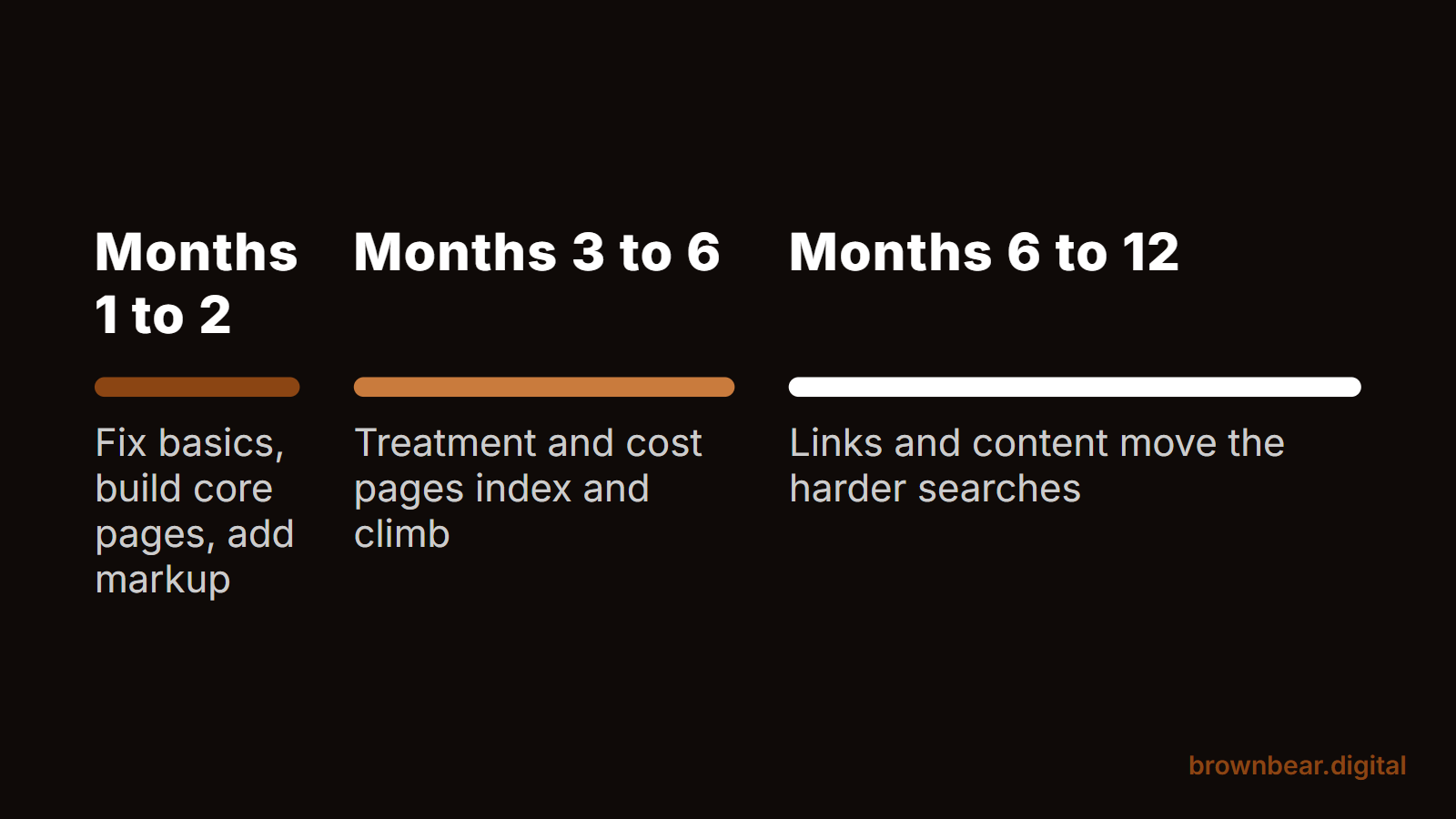
A realistic first year looks like this:
- Months 1 to 2: fix the technical basics, rewrite titles, build the homepage, treatment, doctor, location, cost and referral pages, and add the structured data.
- Months 3 to 6: the new pages are indexed and start ranking for treatment and cost searches in your towns. Publish the audience and comparison pages.
- Months 6 to 12: links from dentists, directories and local sites add up, and the harder specialty searches start to move. Add question pages and refresh the cost page with current figures.
Anyone who promises "orthodontist" plus a major city on page one in 90 days is guessing. Anyone who has not asked which treatments you want more of has not started planning.
How to Choose an Orthodontic SEO Agency
A good orthodontic SEO agency can show you what the pages that beat you have that yours do not, and which searches it will not chase. A weak one sends a keyword list and a traffic chart. What a program should cost depends on how many offices and pages you need, and our marketing guide shows how to judge a program by the starts it must produce.
Before you sign, ask for four things:
- A page-by-page review of who ranks top three for "orthodontist," "braces" and "invisalign" in your towns, and what those pages have that yours lack.
- A site plan: which pages they will build or rewrite, with the title for each.
- How they will report consultations and starts by page, not just rankings.
- What happens to your site, content and listings if you leave. They should stay yours.
Our guide to vetting an SEO agency before you sign covers the contract terms to watch.
Talk to Brown Bear About Orthodontist SEO
Orthodontist SEO works when your site has the pages your patients are searching for, built the way the pages that already rank are built, plus the price ranges, credentials and markup most of them skip. Brown Bear reads the top pages in your market first, then builds the site plan, the pages and the AI search work around it. If you want to see where your practice stands, start with our SEO for dental and orthodontic practices.
Written By
Founder, Brown Bear Digital
Bryan has 15 years of experience across SEO, paid search, and AI search strategy. He founded Brown Bear to give businesses direct access to senior-level search expertise without the agency overhead.
Learn More About BryanGet Found on Google.
Get Cited by AI.
Tell us about your site. We'll send back a proposal for SEO and AI search.