How to Choose a Plastic Surgery SEO and AI Search Agency in Seattle
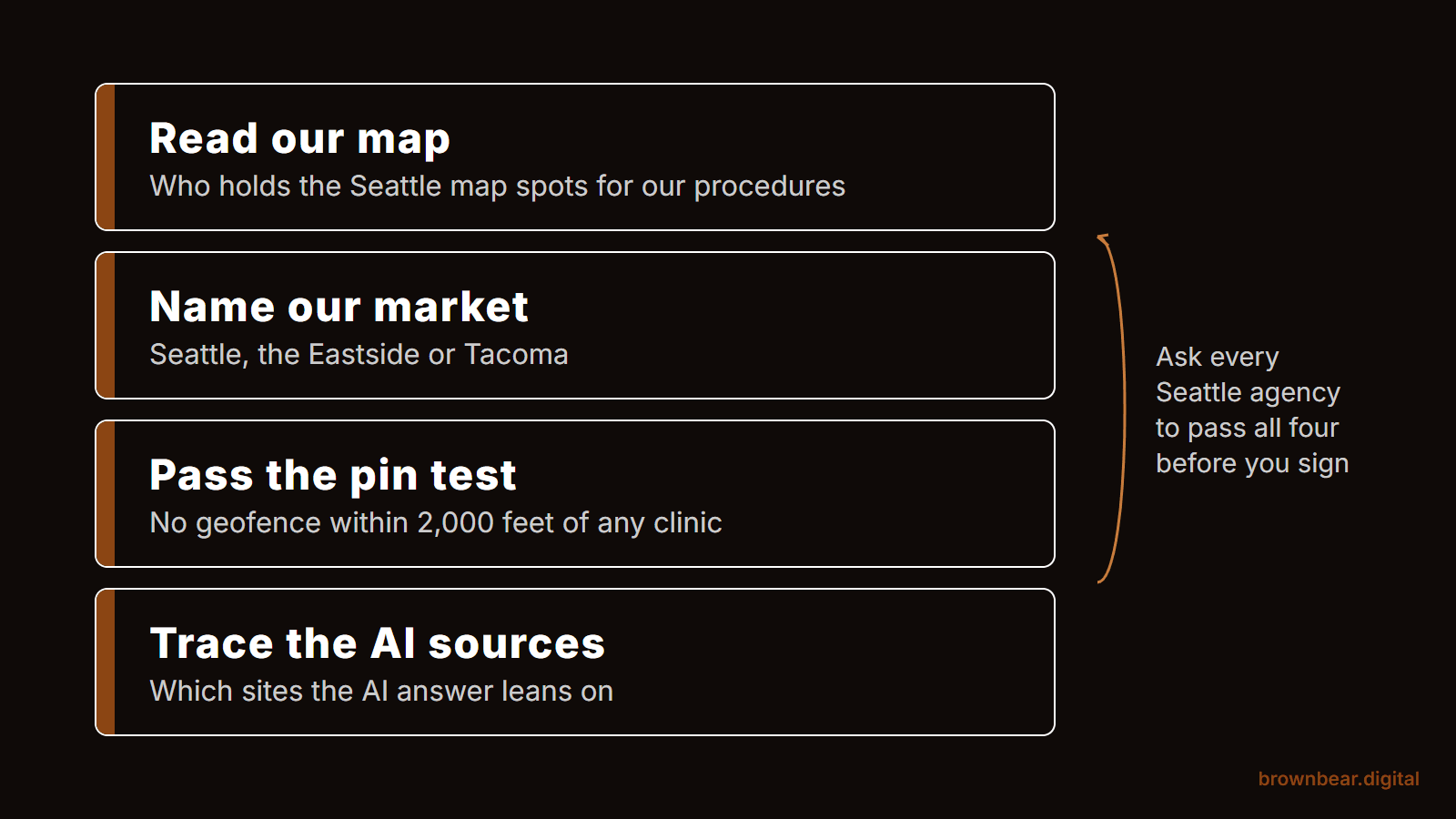
Every agency that pitches a Seattle plastic surgery practice promises the same three things: better rankings, more AI visibility and more consultations. Almost none of them mention the Washington law that governs how your marketing can use a patient's data, or the fact that the Seattle first page is shared with practices across Lake Washington. Both are easy to check before you sign, and both tell you quickly whether an agency has studied your market or is reading from a template.
This guide is built from the market itself. On October 28, 2026 we ran five live Google searches for Seattle, Bellevue and Tacoma plastic surgery terms and recorded who held the map results, the first page and the AI Overview. We also read Washington's My Health My Data Act, its biometric identifier law and the disciplinary statute the Washington Medical Commission applies to physicians, from the statute text itself. Every interview question below comes from one of those findings.
When we say an SEO and AI search agency, we mean both the firm that gets your website and Google Business Profile into the map and the regular results, and the firm responsible for whether ChatGPT, Perplexity and Google's AI answers name your practice when a patient asks who to see. Most Seattle practices now need one firm doing both.
If you run a solo practice on First Hill or Capitol Hill, you are up against the most reviewed listings in the city on every procedure. If you practice in Bellevue, Kirkland or Redmond, you are already in the Seattle race whether you planned to be or not. And if your office is in Tacoma, you are in a different market entirely, and an agency that pitches you "Seattle SEO" has not looked.
One disclosure up front. Brown Bear is an SEO and AI search agency based in the San Francisco Bay Area, so we are one of the firms you might interview, and we would serve a Seattle practice remotely. We run ourselves through the same tests near the end. If you have never hired an agency, the general rules for choosing an SEO agency anywhere and our national checklist for vetting any plastic surgery agency cover the basics. This guide covers what changes in Seattle.
By the end you will have five interview questions drawn from the live Seattle results, a way to tell which Puget Sound market you are really in, the Washington privacy questions every proposal should survive, a 15 minute test of any agency's AI claims, and the contract terms worth insisting on. We cover it in four parts: the search results, the markets, Washington law, and how to test and contract with an agency.
The search results come first, because they make every later question concrete.
What Seattle Patients See When They Search for a Plastic Surgeon
In Seattle, two listings at one Broadway address held the top two map spots on every Seattle search we ran, Eastside practices took a share of the Seattle first page, and the only AI Overview we saw drew on a Seattle Reddit community. An agency that wins here has to understand all three.
We searched five terms on October 28, 2026: "plastic surgeon seattle", "breast augmentation seattle", "facelift seattle", "plastic surgeon bellevue" and "plastic surgeon tacoma". The searches ran from outside Washington with the city in the query, so a patient standing on Broadway may see a slightly different map. Treat this as one day's snapshot, not a ranking report.
| Search | Map results | First page | AI Overview |
|---|---|---|---|
| plastic surgeon seattle | 2 listings at the same Broadway suite, each with its own name and phone number, plus a Bellevue practice | 7 practice sites, the ASPS Find a Surgeon directory and an out of state health system's provider directory | None |
| breast augmentation seattle | The same 3 listings | 8 practice procedure pages, 3 of them titled for Seattle and Bellevue or Everett | None |
| facelift seattle | The same 2 Broadway listings, plus a facelift center with no Google reviews | 8 practice sites and RealSelf; 4 titles name Seattle with Bellevue or Everett | Yes: a $10,000 to $30,000 price range, a list of practices, and a summary of Reddit opinion |
| plastic surgeon bellevue | 3 Bellevue practices, one of them also in two Seattle maps | 4 of 9 results also appear on the Seattle first page | None |
| plastic surgeon tacoma | 3 listings at one address: a practice and 2 of its surgeons, one phone number | 8 of 9 results never appear on the Seattle first page | None |
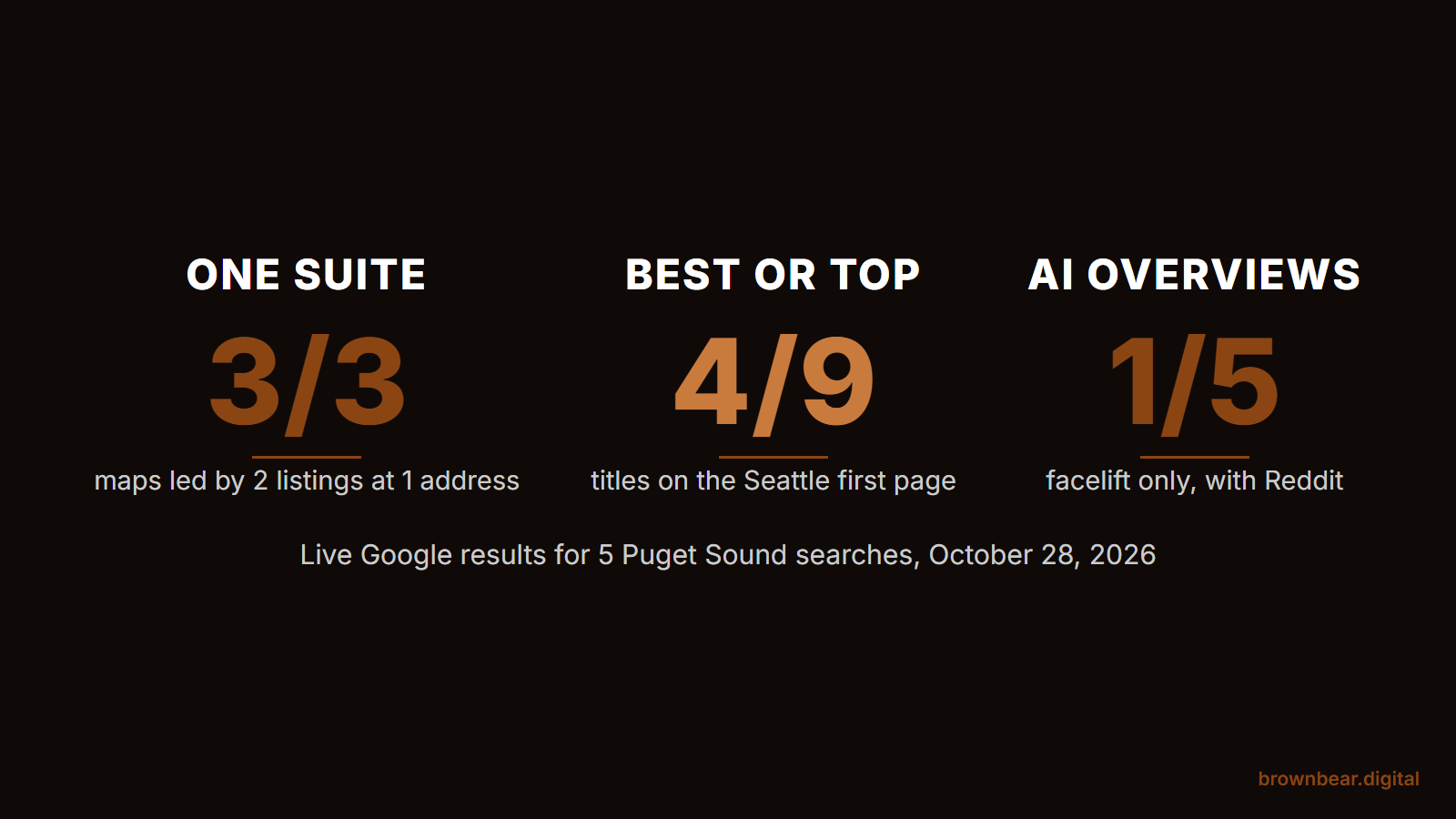
Five findings come out of that table, and each one is a question for the agencies on your list.
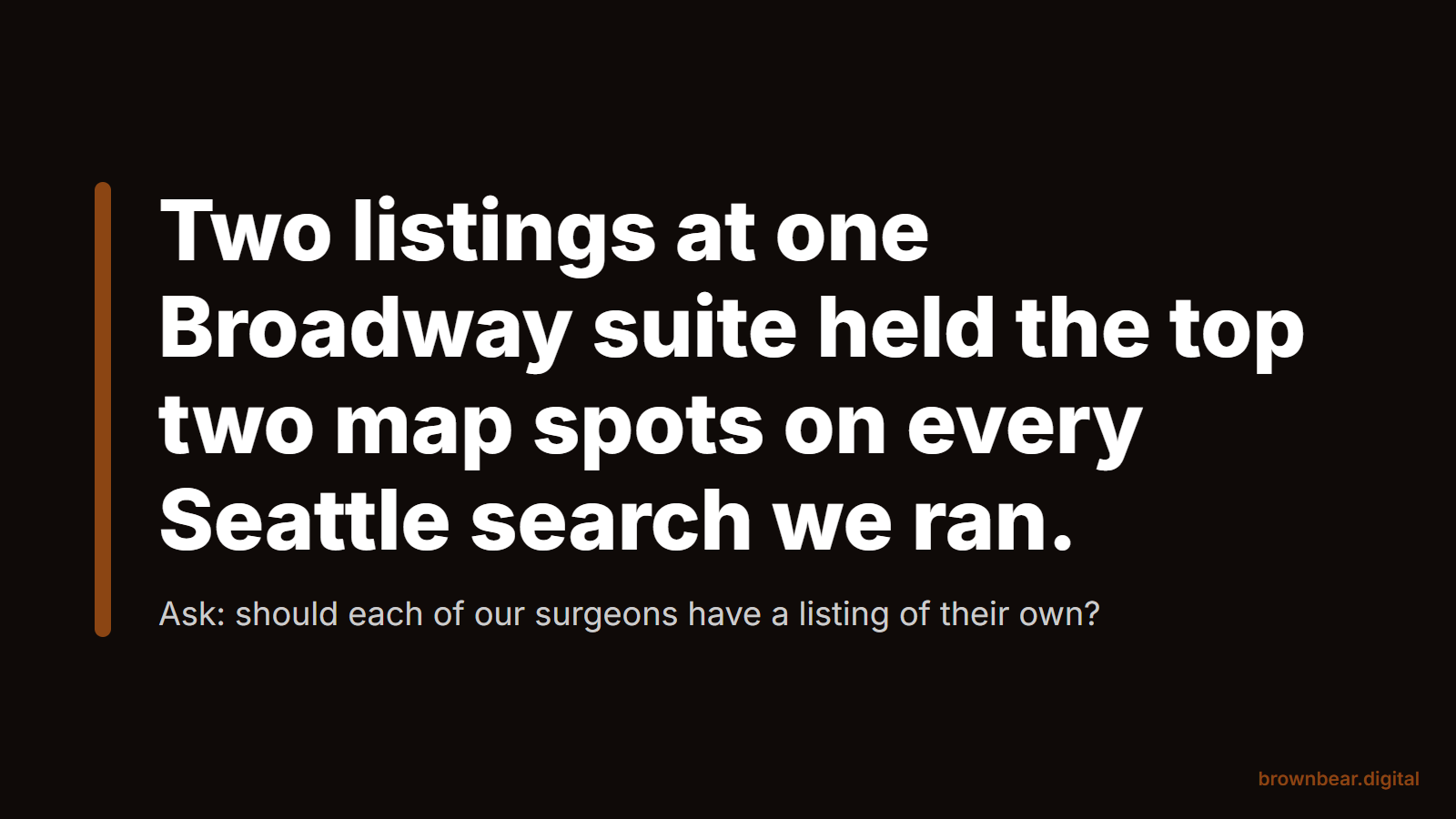
1. Two listings at one address own the top of the Seattle map
Two separate Google listings, each with its own practice name and phone number but the same Broadway suite, held the first two map spots on all three Seattle searches. One showed about 1,100 reviews and the other about 290. In Seattle, the top of the map is not one practice per spot, and the review gap between first and second place is wide.
Ask:
"Who holds our map spots for our three main procedures, and should each of our surgeons have a listing of their own?"
A good answer sounds like:
the agency names the listings that repeat, explains Google's own guidelines on practice listings versus individual practitioner listings, and tells you what a second listing would do to your reviews and your phone tracking before recommending one. Our guide to practitioner listings and categories covers the setup. In our AI visibility audits, the most common factual error is not a wrong claim about the surgeon. It is an odd variation of the practice name, address or phone number across the web, and multiple listings make that easier to get wrong.
2. The Eastside is part of the Seattle race
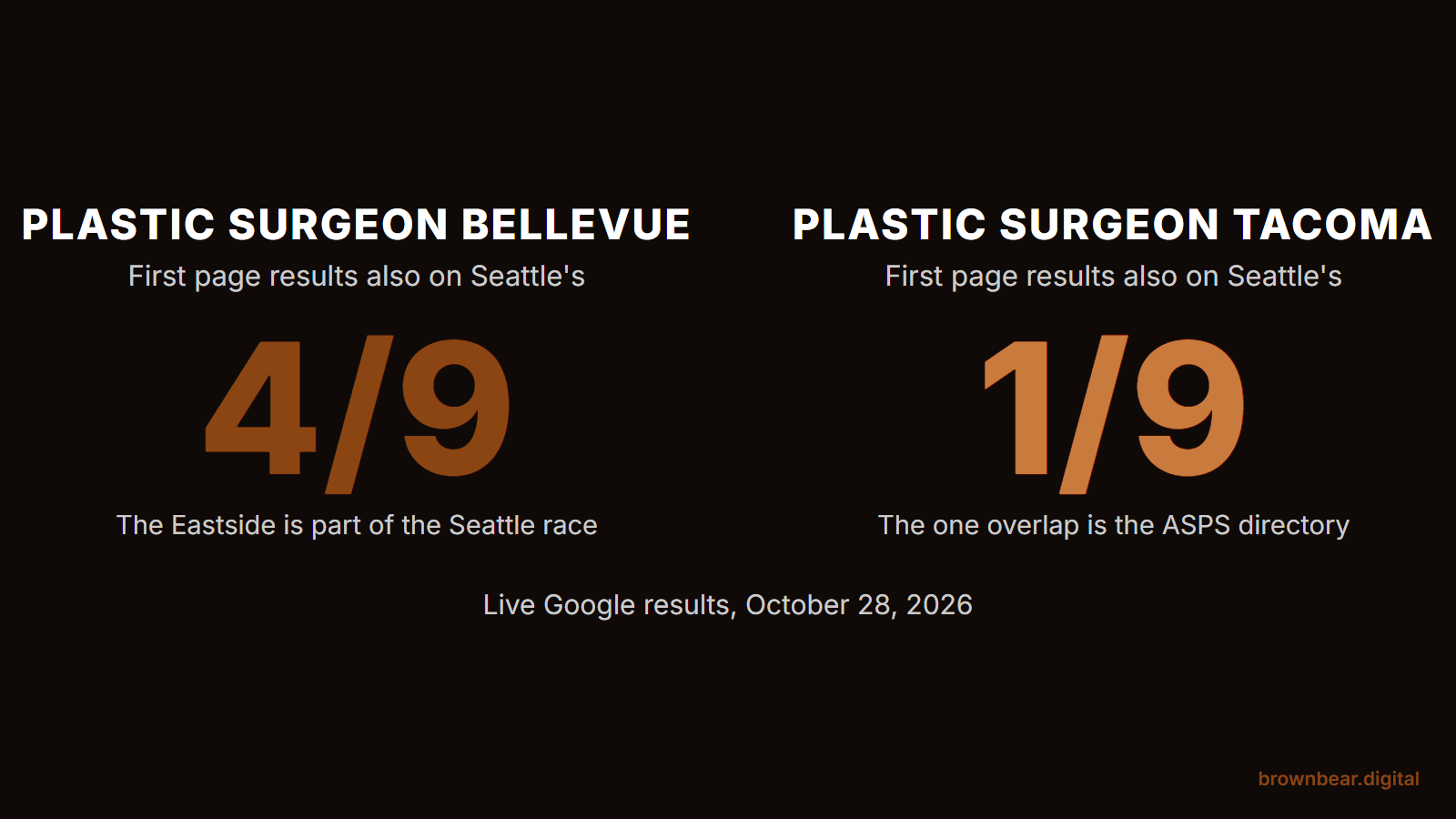
A Bellevue practice held the third map spot on two of the three Seattle searches. On the facelift first page, 4 of the 9 titles named Seattle alongside Bellevue or Everett, and on breast augmentation 3 of 8 did. Run the search the other way and the overlap holds: 4 of the 9 first page results for "plastic surgeon bellevue" also ranked on the Seattle first page.
Ask:
"Which Seattle searches can our Eastside office realistically win, and which Eastside searches are we losing right now?"
A good answer sounds like:
the agency already ran both cities before the meeting, shows you which practices appear on both sides of the lake, and explains that an Eastside office can compete for Seattle procedure searches through its pages and reputation even when the Seattle map favors closer listings.
3. Tacoma is its own market
The Tacoma map showed one practice three times: the practice listing and listings for two of its surgeons, at one address with one phone number. Eight of the nine Tacoma first page results never appeared on the Seattle first page. The one overlap was the ASPS surgeon directory, and a MultiCare health system page took a seat of its own.
Ask:
"Are you pitching us Seattle searches, or the searches our South Sound patients actually run?"
A good answer sounds like:
the agency treats Tacoma as its own competitor set, plans for the health system page you will not outrank on its own name, and only talks about Seattle searches if your consultation records show patients driving up I-5 for you.
4. The facelift AI Overview listed a center with no reviews first and summarized Reddit
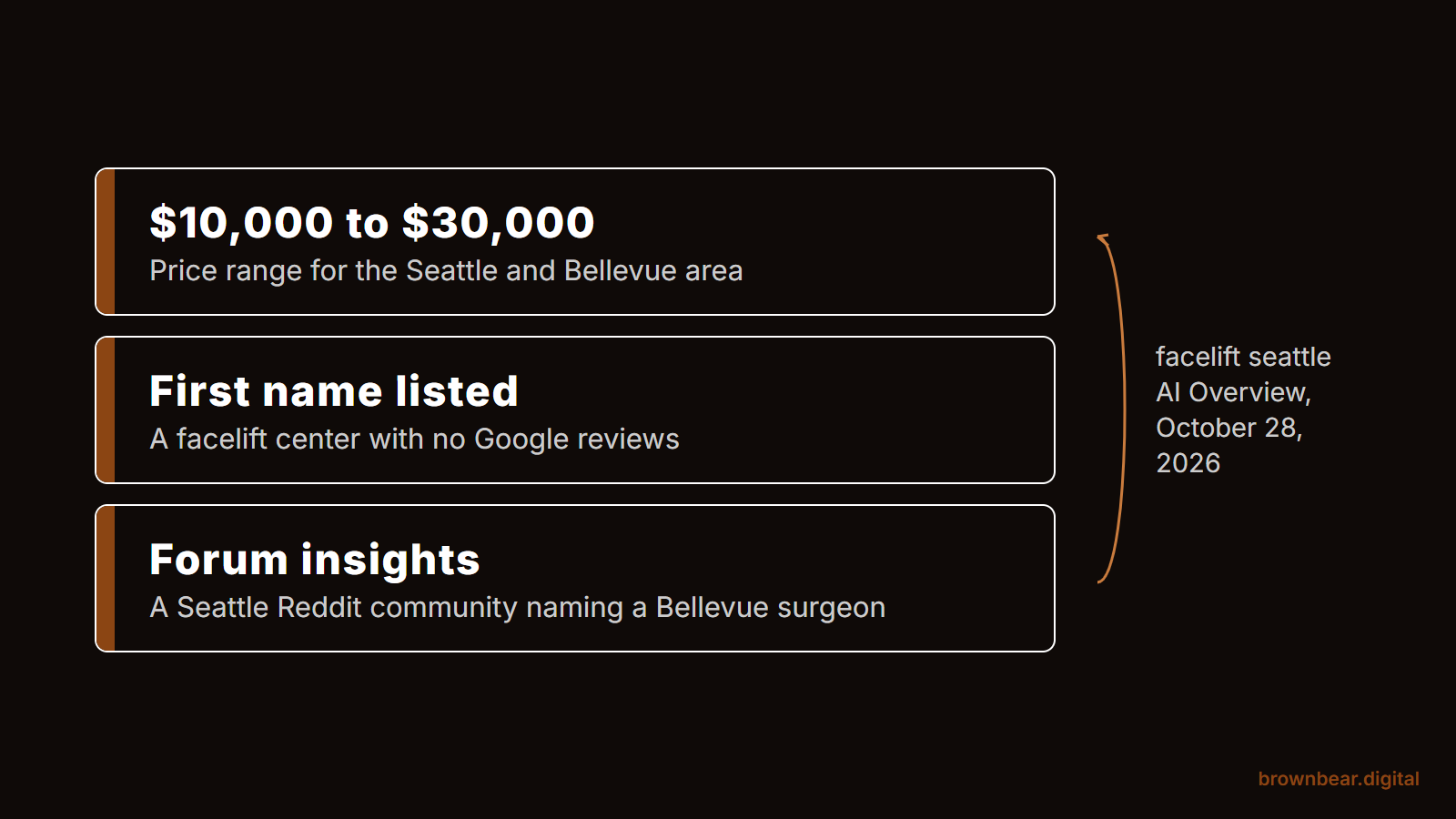
Only "facelift seattle" showed an AI Overview. It opened with a price range of $10,000 to $30,000 for the Seattle and Bellevue area, then listed practices, starting with a facelift center whose Google listing showed no reviews at all. It closed with a section titled "General Patient Consensus & Forum Insights" that summarized a Seattle Reddit community recommending a Bellevue surgeon. A thread none of the practices wrote shaped the answer, and the most reviewed listing in the map was not the first name in it.
Ask:
"What do AI answers say about us for our signature procedure, and which sources are they reading?"
A good answer sounds like:
the agency shows you the answers it already ran, traces each named practice to the sources behind it, and treats forums as something to monitor and earn through real patients, never something to seed. An agency that offers to post on Reddit for you is offering to create the kind of problem the next section describes.
5. Seattle's first page runs on Top Doctor lists
Four of the nine titles on "plastic surgeon seattle" used "best" or "top". One title cited a Seattle Met top doctors list, a snippet cited a KING 5 "Top Plastic Surgeons" segment, and the People Also Ask box asked who the best plastic surgeons in Seattle are according to Seattle Magazine. These lists matter beyond the title tag. In a study of roughly 33,000 ChatGPT citations that we break down on our site, regional magazine Top Doctors pages produced repeated citations in Seattle, while New York and Los Angeles produced almost none.
Ask:
"How do you treat Top Doctor lists and local awards, and what will you never do to get on one?"
A good answer sounds like:
the agency explains how nominations and local press actually work for your surgeons, keeps award language in your titles accurate and current, and says plainly that it will never ask staff or contractors to vote. That last point is not hypothetical in Seattle, as the compliance section shows.
Seattle, the Eastside or Tacoma: Which Search Market Your Practice Is In
The Puget Sound behaves like at least three search markets. Seattle and the Eastside overlap heavily, while Tacoma barely overlaps with either. Which one you are in decides what you should ask an agency to prove.
If your office is in Seattle
Your competition is the Broadway listings and the practice sites that repeat across procedures. Ask the agency which procedure searches you can realistically take within a year, whether your neighborhood, First Hill, Capitol Hill or South Lake Union, changes the map you see, and how it plans to close the review gap without shortcuts.
If you are in Bellevue, Kirkland or Redmond
You can compete for Seattle searches, and the results show Eastside practices already do. The decision is how much of your budget goes to Seattle terms versus your own city's map, and that should come from your consultation records, not the agency's preference. Our guide for practices with offices on both sides of the lake, and other multi-office setups, covers how to keep two offices from competing with each other.
Picture a two-surgeon practice in Kirkland whose consult forms show that a third of its facelift patients live in Seattle. One proposal leads with "plastic surgeon kirkland" and stops there. Another runs the Seattle facelift results, notes that four Eastside or Everett practices already title their pages for Seattle, and builds a facelift page and review plan aimed at both cities. Only the second proposal matches where the practice's patients come from.
If you are in Tacoma or the South Sound
You probably do not need Seattle searches at all. Your map and first page are a different set of practices, plus a health system and directories. Ask the agency to scope a program around Tacoma and the towns your patients drive from, and be wary of any proposal that opens with Seattle rankings.
Say a Tacoma practice gets a proposal promising page one for "plastic surgeon seattle" within six months. The practice's patients search for Tacoma, and the Seattle first page shares nothing with theirs except a directory. The agency has picked a goal that would look impressive in a report and send almost no one through the door. The same test applies in Everett and Olympia, which we did not search: run your own city before you trust anyone's plan for it.
The tool below builds the exact search list for your offices and procedures, with the questions to ask in each market.
Puget Sound Search Plan
Get the exact searches and AI prompts to run before each pitch
Pick where your offices are and the procedures you want more of. You get a search list for each market, what our October 28, 2026 capture showed there, and the questions to put to every agency.
Where are your offices?
Which procedures matter most?
For informational purposes only. Search results and AI answers change with location and from session to session, so treat the capture notes as one dated snapshot, not a ranking report, and nothing here guarantees a result. Your choices stay in this browser tab; nothing is stored or sent anywhere.
The Washington Health Data Question to Ask Before Anything Else
Ask every agency how it handles Washington's My Health My Data Act before you ask about rankings. The law reaches the pixels, retargeting audiences and location targeting that agencies routinely propose, and an agency that has not heard of it can create liability for your practice on its first day. None of this is legal advice, and your healthcare attorney has the final word. What you are testing is whether the agency knows the rules exist and asks before it acts.
Washington's My Health My Data Act, chapter 19.373 of the Revised Code of Washington, protects "consumer health data": personal information linked to a person that identifies their past, present or future health status. The statute's list includes health-related surgeries or procedures, biometric data, precise location that could indicate someone is seeking care, and data that identifies a consumer seeking health care services. It protects Washington residents and anyone whose data is collected in Washington.
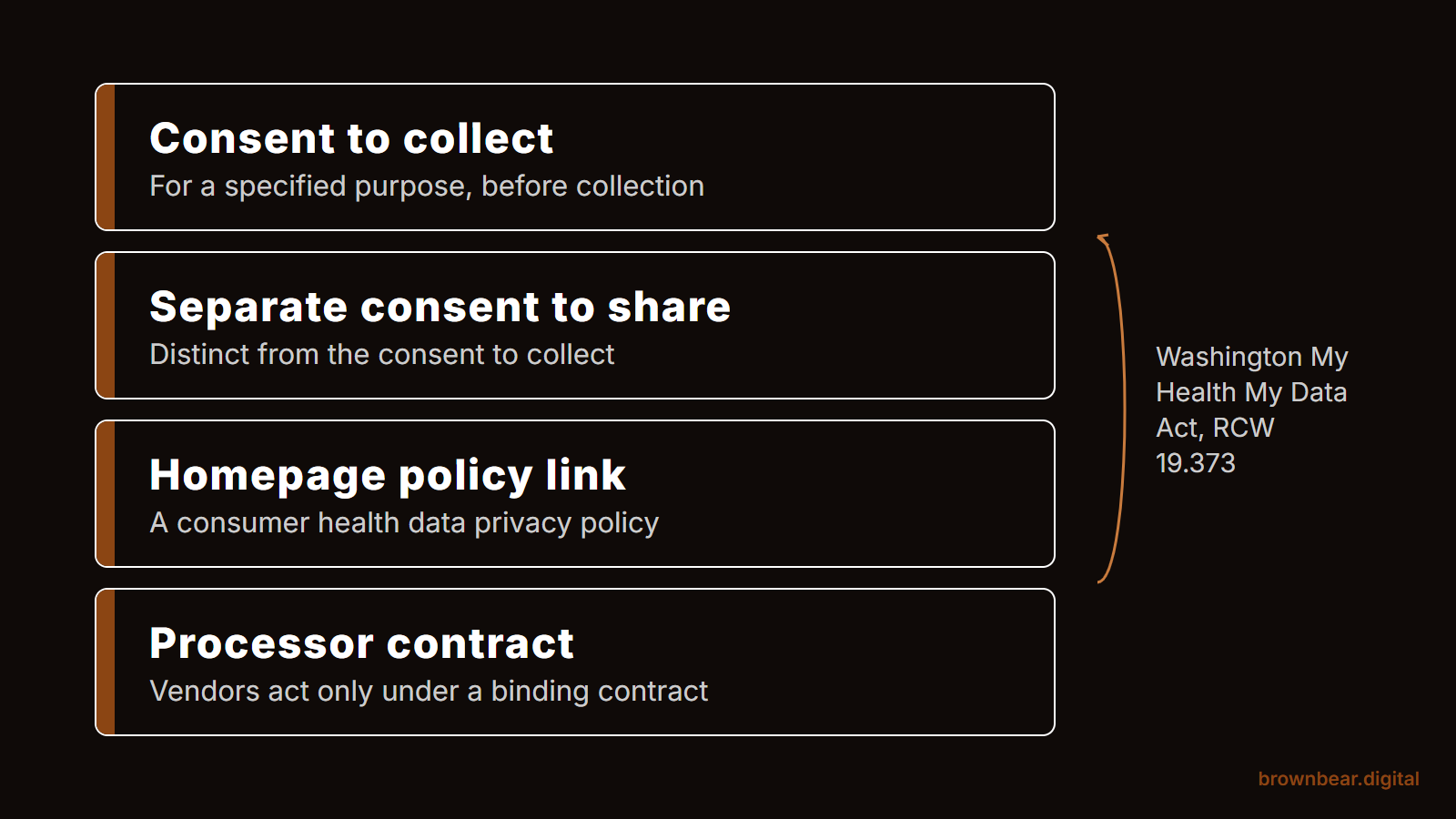
The obligations are specific. A practice needs consent for a specified purpose before collecting this data, and a separate consent before sharing it. It must publish a consumer health data privacy policy and link to it prominently from the homepage. Selling the data requires a signed authorization that expires after one year and must be kept for six. Any vendor that handles the data on your behalf may do so only under a binding contract. A violation counts as an unfair or deceptive act under the state Consumer Protection Act, which lets the Attorney General act and lets injured people sue.
The Act exempts protected health information under HIPAA. The open question for a marketing website is the visitor who reads your breast augmentation page, never books, and never becomes a patient. Whether that visit is HIPAA data, consumer health data or both is a question for your attorney, and it is exactly the data an ad pixel collects. Our guide on where HIPAA stops on a practice website is the other half of this picture.
Pixels, consultation forms and retargeting
Ask:
"Which tags fire on our procedure pages and consultation form, what does each one share, and where is the separate consent?"
A good answer sounds like:
the agency inventories every tag and vendor before adding anything, keeps procedure details and form contents out of ad platforms unless consent was captured first, offers a consented or server side setup, and puts its processor obligations in the contract.
Say a Bellevue practice's new agency adds an ad pixel to the breast augmentation page and builds a retargeting audience of everyone who visited. The ads work, but the audience itself is a list of people who looked into a surgical procedure, shared with an ad platform. Under the Act, the question is whether those visitors gave separate consent to that sharing. A default pixel install asks no one.
Geofencing and the Pin Test
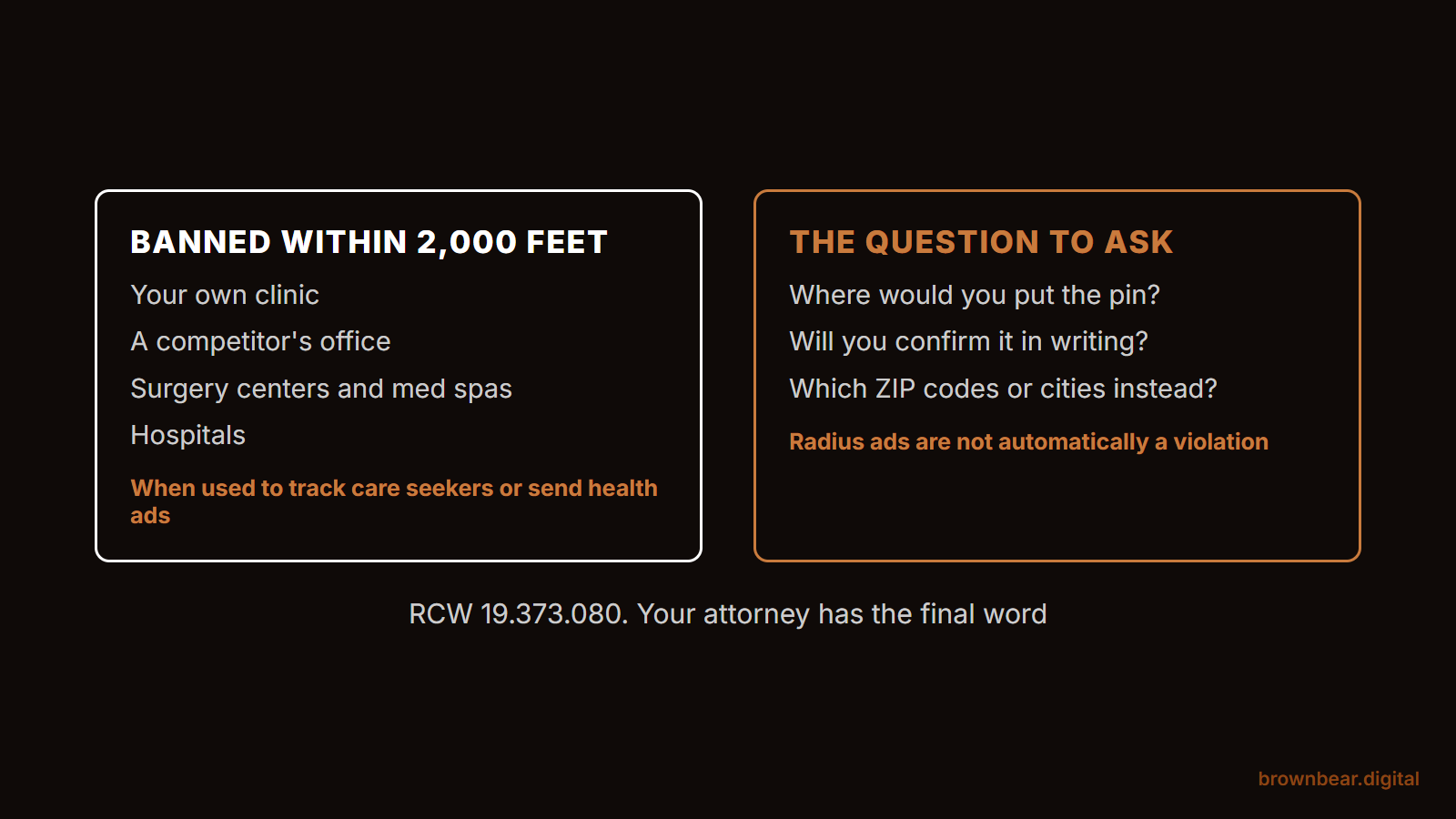
The Act makes it unlawful to place a geofence around any entity that provides in-person health care services when it is used to identify or track people seeking care, collect their health data, or send them ads related to health care services. A geofence, in the statute, is a virtual boundary 2,000 feet or less from the location. That covers a competitor's clinic as much as your own, which rules out the "conquest" tactic of targeting phones near another practice's office.
Location targeting is still sold to Seattle practices. One Seattle-targeted agency page we read offers ads built on "a pin-and-radius boundary around where you want patients". Radius targeting is not automatically a violation. It depends on where the pin goes, which is why this is the single most useful question in this guide.
Ask:
"Where would you put the pin?"
A good answer sounds like:
nowhere within 2,000 feet of any clinic, surgery center, med spa or hospital, including yours, confirmed in writing. An agency that answers with a competitor's address has told you everything you need to know.
Face mapping tools and Washington's biometric law
Washington's biometric identifier law, chapter 19.375, covers data generated by automatic measurements of a person's biological characteristics, and it excludes physical or digital photographs and video. A business may not enroll a biometric identifier for a commercial purpose without notice and consent, or a way to prevent commercial use, and the Attorney General enforces it. Biometric data is also consumer health data under the My Health My Data Act, with its own consent rules. Ordinary before and after photos are not biometric identifiers under chapter 19.375. An AI face simulation that measures a visitor's facial geometry may be.
Ask:
"Will any tool you install measure a visitor's face, and who provides the notice and consent?"
A good answer sounds like:
the agency knows which vendors measure faces, will not install one without your attorney's sign off, and puts the consent flow in place before launch.
Reviews, awards and the Washington Medical Commission
Washington's disciplinary statute for health professions, RCW 18.130.180, lists all false, fraudulent or misleading advertising, and misrepresentation or fraud in the conduct of the profession, as unprofessional conduct. The Washington Medical Commission applies it to physicians, and in May 2025 it opened a review of its physician rules in chapter 246-919 of the Washington Administrative Code, so ask your attorney which version governs when you sign.
Seattle has a recent example of what that exposure looks like. In July 2024 a Seattle plastic surgery practice and its surgeon agreed to pay $5 million to resolve a case brought by the Washington Attorney General. According to the Attorney General, patients signed agreements threatening damages for negative reviews, employees posted fake positive reviews, staff and contractors voted for the surgeon in local media "best doctor" contests, and before and after photos were edited to look better. A federal court had already ruled that the agreements violated the Consumer Review Fairness Act. The decree requires the practice to remove misleading photos and audit its public reviews.
Ask:
"How do you get us reviews and award nominations, and what will you never do?"
A good answer sounds like:
the agency describes a review program that holds up: asking every patient at the same point, never filtering by expected rating, never writing reviews, never gating feedback behind an agreement. It treats photo editing for your gallery the same way and can show you the gallery rules we follow or its own equivalent.
Use the check below on any proposal you receive. It sorts what the proposal includes into items for your attorney, questions for the agency and safeguards the proposal leaves out.
Washington Health Data Proposal Check
Check an agency proposal against Washington's health data laws
Tick everything the proposal includes, and everything it puts in writing. You get the items to stop and take to counsel, the questions to ask the agency, and what the proposal is missing.
The proposal includes
The proposal puts in writing
For informational purposes only; this is not legal advice and it does not tell you whether you comply. The My Health My Data Act exempts protected health information under HIPAA, and whether a given visitor's data falls on one side or the other is a question for your healthcare attorney. Your selections stay in this browser tab; nothing is stored or sent anywhere.
Local or Remote: What a Seattle Office Actually Buys You
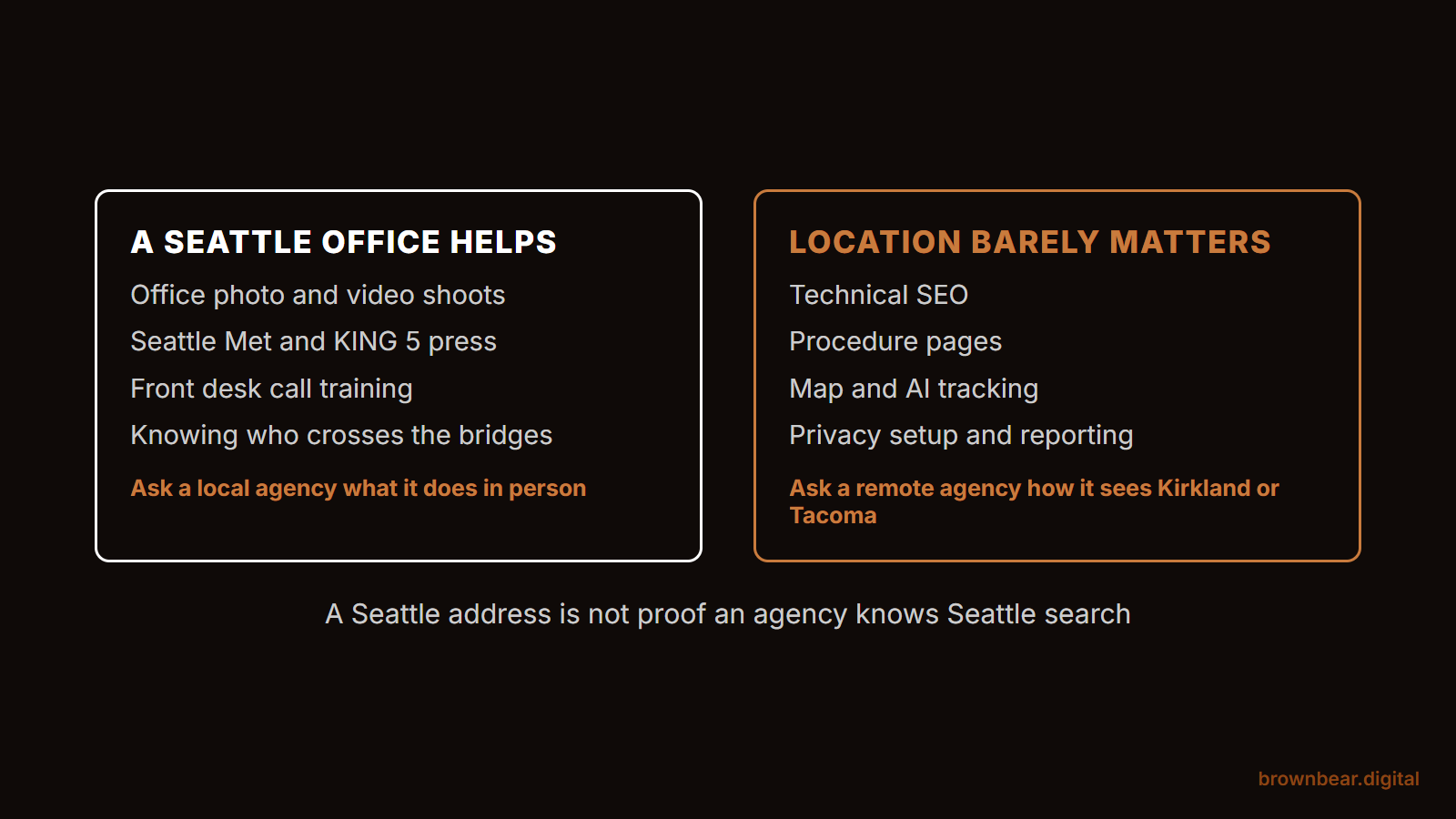
A Seattle office is not proof that an agency knows Seattle search, and a remote agency is not automatically blind to it. What matters is which parts of the work need someone in the room.
| Being in Seattle helps | Being in Seattle does not matter much |
|---|---|
| Photo and video shoots at your office for procedure pages and your Google Business Profile | Technical SEO, site speed and how AI crawlers read your site |
| Relationships with Seattle Met, Seattle Magazine, KING 5 and other local outlets that run Top Doctor features and health stories | Procedure page writing, galleries and on-page work |
| Training front desk staff on how calls from search are answered | Map and AI answer tracking, which can be set to Capitol Hill, Bellevue or Tacoma from anywhere |
| Knowing which Eastside and South Sound patients will cross the bridges or drive I-5 for you | Reporting, Search Console, analytics and the privacy work above |
Ask a local agency:
"What do you do in person that a remote agency cannot?" A good answer names shoots, staff training and specific press relationships, not just "we know the area".
Ask a remote agency:
"How do you see what a patient in Kirkland or Tacoma sees?" A good answer describes location set tracking for each city you care about and a plan for on-site work, such as hiring a Seattle photographer.
How to Test an Agency's AI Search Claims in Seattle
Run the prompts your patients would type in ChatGPT, Perplexity and Google AI Mode, write down every practice named and the source behind it, then ask the agency which of those sources it can move for you. It takes about 15 minutes and works before you sign anything.
Start with prompts like these, with your procedure filled in:
- "Who is the best plastic surgeon in Seattle for a deep plane facelift?"
- "I live in Kirkland. Who should I see for a breast augmentation consultation?"
- "Which Bellevue plastic surgeons do people on Reddit recommend for a tummy tuck?"
- "Best plastic surgeon in Tacoma for a mommy makeover"
- "Is [your practice] a good choice for rhinoplasty in Seattle?"
Then build what we call a Source Trace. For each practice an assistant names, mark which kind of source the answer leans on:
| Source type | What it looks like in Seattle | What a good agency does about it |
|---|---|---|
| Your own site | Procedure pages with prices, technique and surgeon credentials | Builds and rewrites the pages the answer should be quoting |
| Google listing and reviews | The Broadway listings with hundreds of reviews | Runs a steady review request program and keeps your listing details identical everywhere |
| Directories | RealSelf, the ASPS directory, health system profiles | Audits and completes the profiles you control |
| Forums | The Seattle Reddit thread inside the facelift answer | Monitors it and earns mentions through real patients, never seeds posts |
| Top Doctor lists and press | Seattle Met, Seattle Magazine and KING 5 features | Pursues real nominations and coverage |
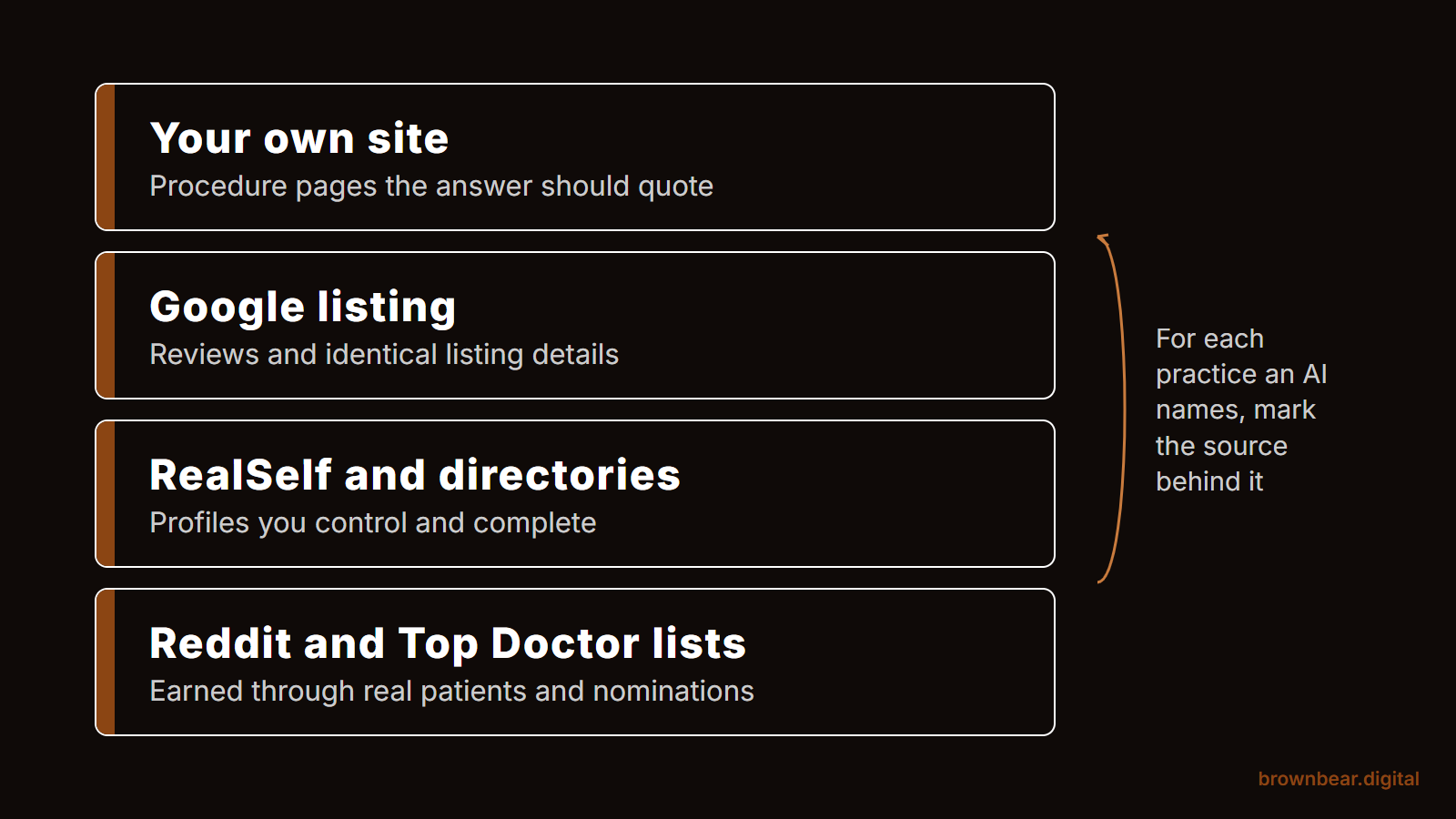
Picture a practice manager on Capitol Hill who runs the five prompts on a Monday. ChatGPT names three competitors, two of them from Bellevue, and the Source Trace shows the answers lean on a Top Doctors page and a Reddit thread, not on anyone's website. The agency that wants to rewrite her homepage has misread the problem. The one that asks about her surgeons' nomination history and her review volume has read it correctly. In our experience, owners are most surprised by how much third party sites like reviews, directories, forums and press drive these answers, which is why the fix is usually on and off your site at once.
Two warnings. AI answers change from session to session, so run each prompt on two different days and judge the pattern, not one result. And be wary of any agency that guarantees a mention in ChatGPT; nobody controls those answers. After you hire, rerun the same prompts every month so you can see whether anything moved.
What a Seattle Contract and Budget Should Spell Out
Prices for plastic surgery SEO follow the same bands in Seattle as elsewhere for the work involved. What changes here is which band you land in, because many practices run offices on both sides of the lake, and what the contract has to say about Washington privacy law.
| Seattle-area practice | Typical monthly range |
|---|---|
| One Tacoma or South Sound office with a focused program | $1,500 to $3,000 |
| Solo surgeon, full program, often in Seattle | $3,000 to $6,500 |
| Multi-surgeon practice, one office | $5,000 to $10,000 |
| Seattle plus Eastside offices, or several offices across the Sound | $8,000 to $20,000 or more |
Our national guide shows how a plastic surgery SEO quote breaks down into the hours and pages each band buys.
If you have one office, the contract questions are the standard ones: who owns the accounts, what gets reported, and when you can leave. If you have offices in more than one market, add per office pricing, separate tracking for each map and a plan for keeping the offices from competing. Either way, four terms matter more in Washington than elsewhere:
- Privacy roles in writing. The contract names who writes and maintains your consumer health data privacy policy, and the agency signs a processor agreement for any data it handles.
- A tag and vendor inventory. The agency lists every tag and vendor before anything new goes live, and updates the list when it changes.
- No geofencing near care. The agency agrees not to build location targeting within 2,000 feet of any in-person health care provider.
- A 90 day review. A 12 month agreement is reasonable for SEO, which typically takes 9 to 12 months to produce patients, as long as you can review progress on the specific procedure and city searches you agreed on.
Measure the agency on consultations booked from search, not on rankings alone. Google itself says no one can guarantee a top ranking, so a guarantee in a proposal is a reason to stop reading.
Holding Brown Bear to These Tests
We said we would apply the same tests to ourselves, so here is how we answer them.
- Local or remote. We are based in the Bay Area with no Seattle office. On-site work like photo shoots or staff training would mean hiring a Seattle photographer or a travel day, and you should weigh that.
- Track record here. Seattle is not a market where we can point you to past results, so judge us on the research in this guide and on how we would run your own searches.
- Seeing each market. We would track maps and AI answers separately for Seattle, the Eastside and Tacoma, and for each office a practice has, not just for "seattle".
- Washington privacy. We are not attorneys, and we route these questions to your counsel. We do not build geofenced campaigns around clinics, and we do not put ad pixels on procedure or form pages before consent is in place.
- Pricing. Our quotes fall inside the bands above, and we scope each office separately.
If we cannot answer one of the questions in this guide to your satisfaction, hire someone who can. You can read more about our search programs for plastic surgeons in general.
Questions Seattle Practice Owners Ask About Hiring an Agency
Does the My Health My Data Act apply to my practice's website?
It can, and your attorney should decide exactly how. The Act covers data that identifies someone seeking health care services, including interest in surgeries or procedures, and it exempts protected health information under HIPAA. A marketing site with pixels, forms and retargeting usually touches both, which is why the tag inventory comes first.
Can an agency still run location targeted ads in Washington?
Yes, with care. The Act bans geofences within 2,000 feet of any entity that provides in-person health care services when they are used to track care seekers, collect their health data or send them ads about health care services. Targeting a city or a ZIP code is a different question from drawing a circle around a clinic, but run the plan past your attorney either way.
Do I need an agency based in Seattle?
No, but you need one that can show you what patients see in Seattle, on the Eastside and in Tacoma. Being local helps with shoots, staff training and local press. It does not help with technical work, content, privacy setup or AI search on its own.
Should a Bellevue practice target Seattle searches?
Often yes for procedure searches, because the results we checked already show Eastside practices on the Seattle first page. Let your consultation records decide how much of the budget goes there, and keep your own city's map as the base.
How long before a new agency shows results?
Expect 9 to 12 months for SEO to produce patients, with early signs like map visibility in your own city and new procedure pages ranking sooner. The Seattle head terms held by the most reviewed listings take longest.
Get a Seattle Search Review From Brown Bear
Before you sign with anyone, run the five searches and the AI prompts in this guide for your own procedures and offices, and bring the results and every proposal to each pitch. If you want a second set of eyes, we will walk through your Seattle, Eastside or Tacoma results, your AI answers and any proposal on your desk in a first meeting, starting from our Seattle search work.
Written By
Founder, Brown Bear Digital
Bryan has 15 years of experience across SEO, paid search, and AI search strategy. He founded Brown Bear to give businesses direct access to senior-level search expertise without the agency overhead.
Learn More About BryanGet Found on Google.
Get Cited by AI.
Tell us about your site. We'll send back a proposal for SEO and AI search.